Getting the transcript
Reading the captions from YouTube. A video nobody has opened here before takes 10 to 30 seconds; this page fills in on its own.
Getting the transcript
Reading the captions from YouTube. A video nobody has opened here before takes 10 to 30 seconds; this page fills in on its own.
Rare Cars · @rarecars3336
Words
2,452
Runtime
14:05
Speaking pace
174wpm
Reading time
10min
174 words per minute, between the 160 25th percentile and the 181 median of 349 measured videos. That distribution comes from the 349-video hook study.
Opening (first 30 seconds)
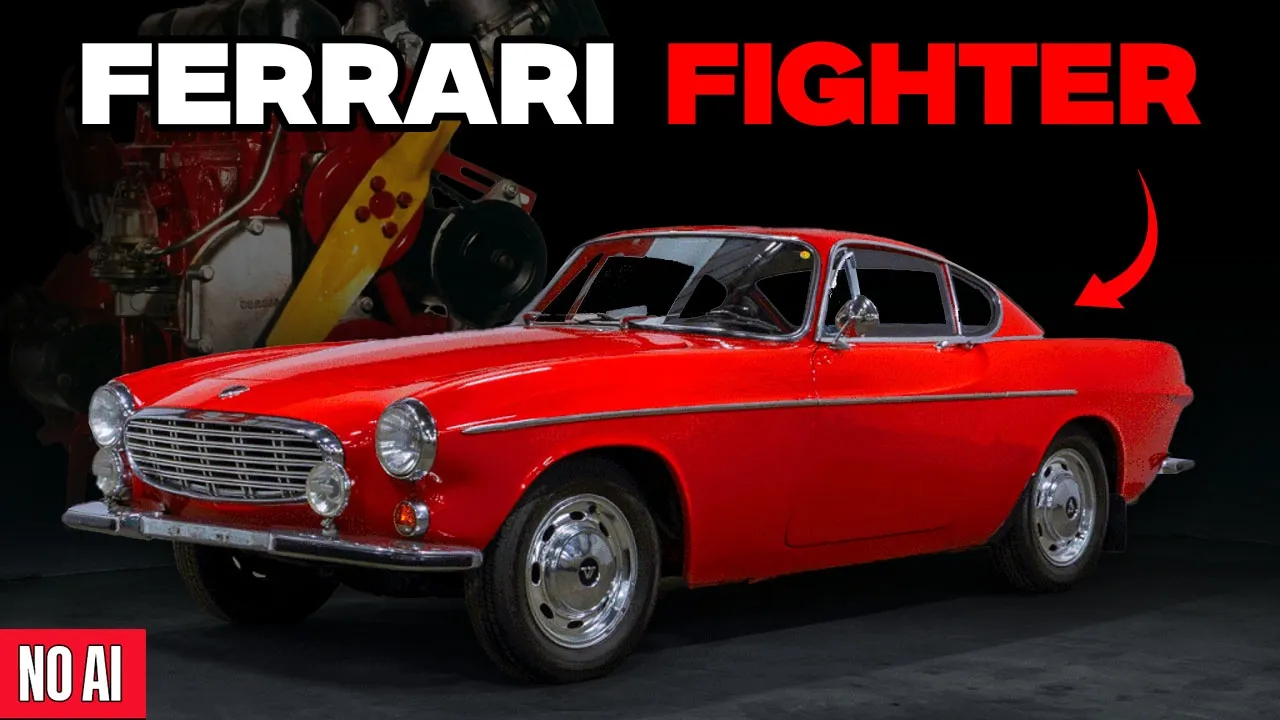
When you think of Volvo, you think dependable, safe, yet boring cars, many of which looked a lot like bricks. But, what if I told you that back in the '60s, they built one of the greatest, yet most underrated GT cars of all time? One that looked like it was sculpted in Italy, rather than Sweden, because it was. The Volvo P1800 had the looks, but it also had something that its more expensive European counterparts did not, reliability. So, why did Volvo even build this
87 words, the words spoken in the first 30 seconds at 174 words per minute.
Free, no signup. See how the first 30 seconds hold attention, with rewrites.
Sentence shape
| Measure | This transcript |
|---|---|
| Sentences | 120 |
| Average words per sentence | 20.4 |
| Longest sentence | 44 words |
| Questions asked | 5 |
| Sentences containing a number | 53 |
Most used terms
Filler phrases
15 in total: like 9 · actually 3 · basically 1 · literally 1 · sort of 1.
A literal whole-word count of the same phrase list the Prepublish browser extension uses, so a phrase inside another word is not counted and a phrase used in its ordinary sense still is. It is a count and not a judgement.
What this transcript is
Every word below is the caption track YouTube publishes for this video, pulled from the video itself and reproduced unchanged. It is not Prepublish's writing, not a summary, and not a re-transcription: it is the video's own published captions. English captions, generated automatically by YouTube, in the video’s original language. Source: the video on YouTube. A channel that would rather this page did not exist can ask for its removal through the contact page, and it is removed.
No Script X-ray for this video: YouTube shows a Most replayed graph only once a video has enough views.
When you think of Volvo, you think dependable, safe, yet boring cars, many of which looked a lot like bricks. But, what if I told you that back in the '60s, they built one of the greatest, yet most underrated GT cars of all time? One that looked like it was sculpted in Italy, rather than Sweden, because it was. The Volvo P1800 had the looks, but it also had something that its more expensive European counterparts did not, reliability.
So, why did Volvo even build this thing in the first place? Well, Volvo first had a try at a sports car with the Volvo Sport in 1956, but it just didn't take off like they hoped it would, and they ended up making less than 70 of these cars. A few years after that failure, they tried again, and this time they actually got pretty close to the hit they were looking for. They wanted a halo car, something between the boring family car and the sports car that would propel the image of Volvo to new heights.
The Volvo 1800 series started in the mind of Pelle Peterson, a Swedish man who would later, funny enough, become an Olympic sailor. He came up with the proposal for a well-styled sports car that would have the styling, while also maintaining the safety and dependability that Volvo was already known for. Now, it would be a little bit pricier than Volvo's other offerings, but it would still be much cheaper than the other better-known cars in a similar class.
Think your Jaguars and vehicles of that nature. Now, this was a gamble, but it was to try and breathe some fire into Volvo's sluggish markets in America and in the UK, at least they hoped. Now, at first, Volvo tried to get Karmann, the famous German manufacturer, to do the work and give this new Volvo project a bit of cosmopolitan flair. However, Karmann's older client, Volkswagen, nixed the deal, threatening Karmann with major consequences if they worked with this new, relatively young, Swedish car company.
So, with their first choice out of bounds, Volvo headed to Italy. And it was here where they really hit the jackpot. They hired Pietro Frua, famous for his work on spiders as the head of the Ghia design studio just a few years ago. Now, his design for this new Volvo was a unique shape. It was very Italian-looking, but it had a strange, timeless flair to it that people love even to this day. Up at the front of the 1800, it was very Italian-looking with gentle, continuous curves with a wide, yet stylish, front grille paired between the two traditional circle headlights.
However, as you got further back, the car started to pull in some styling cues of a bit of like '50s American luxury car, almost. They had a chrome side line of molding, and that was the only real thing that broke up the clean side of the car. This line curved up to meet the top back corner of the door. It was a striking and unique styling choice that really did become a hallmark of these cars. The windshield was slanted back aggressively, giving you a low, sporty roofline.
And by the time you got all the way to the back of the car, you found a gently curved trunk lid and curiously American-looking tailfins, almost, with pop-eyed taillights. Inside the car, the seats were roomy and comfortable, if a bit low to the ground, partly to deal with the low roofline. Now, the dashboard is actually one of my favorite features of the P1800. See, the dash was really simple, with just the five round gauges carefully placed for the driver to see.
But, I really like the dashboard of the P1800. I think it's super simple, yet it's elegant, especially with the slight three-dimensional pop of the gauges. I think it's an awesome-looking interior, and it's very akin to a lot of the Porsche 911s. Now, the Volvo 1800 debuted to wide acclaim at the 1960 Brussels Motor Show, and Volvo, with export sales in mind, immediately went to the UK for the bodies and assembly. Pressed Steel in Scotland was the company who would make the bodies, and Jensen Motors was the one to assemble the cars.
The first iteration of the 1800 to be sold worldwide was the P1800, and many of the later 1800 series cars are still referred to as the P1800s today. In 1961, Volvo sent all of the manufactured P1800s direct to America, where the car was seen as a relatively sporty vehicle for Volvo. It was also extremely dependable and safe. Advertisements for the car were tongue-in-cheek about its Italian styling paired with its mediocre performance, but its value prop was there.
It's sort of a souped-down Ferrari, one ad even claimed. Today, Volvo calls the P1800 their legendary sports car, but in terms of actual raw performance numbers, the P1800 was never that impressive. It was just one of the few sports cars that looked this good that could literally run forever if you maintained it right, which there is certainly something to be said about. And a lot of that has to do with the engine. The first P1800s had a 1.8 L B18 engine from Volvo, which had a 10:1 compression ratio, dual carburetors, and made 100 horsepower and 103 ft-lb of torque.
Now, it was a relatively lightweight car. Considering how roomy and comfortable the interior was, it was just shy of 2500 lb. Now, this was a lot heavier than some of the British roadsters that had similar power outputs, but this was never trying to beat them in a straight-up performance arms race. The P1800 was the ultimate cruising sports car. It It comfortably cruise pretty much anywhere. It could do over 100 miles an hour, and with the four-speed manual with the electric overdrive, you had the ability to row your own gears.
And while you could do over 100 in your Volvo, it did take you a bit of time to get there with only 100 horsepower on tap. Zero to 60 happened in about 12 seconds, which was nothing special, but as you'll see later on the video, there are some ways you can make the P1800 really fast, but it's a lot of work and a lot of money. But again, you weren't buying a P1800 for performance. You were buying it to have a sports car that was livable and dependable.
Especially here in the States when there were not many Ferrari mechanics or Italian sports car mechanics back in the day, something that seemed hassle-free like the P1800 that gave you similar styling was a very compelling offer. One of the only common issues with the P1800 was the failure of the electric overdrive, which could usually be avoided just by keeping the transmission fluid full. The engine itself, outside of regular services and oil changes, worked very well and didn't need much.
The B18 was so over-engineered it could almost run for forever if you kept up with it. In fact, the world record for the most miles on a single owner car is held by Irv Gordon, whose 1966 Volvo 1800 has over 3 million miles on it. A million miles on a car is insane, but 3 million on a vintage sports car, that is something out of this world that could have only been possible with a platform as reliable as the 1800. In addition to that bulletproof engine, the cars had Girling front disc brakes, rear drum brakes, and a decent suspension with double wishbones and a live axle with coil springs in the rear.
They handled pretty well, but at speed drivers reported to be a little bit heavy, probably due to the lack of power steering. It made it a little less tossable. Drivers also said the gas pedal felt somewhat heavy, but the brakes were good and the clutch feel was apparently good as well. By the spring of 1962, Jensen had finally sent enough P1800s to America that Volvo started to allow them to sell the P1800s in the UK as well.
It was surprisingly popular and now it being in the TV show The Saint with Roger Moore, the future James Bond driving it certainly didn't hurt either. Now, allegedly Roger Moore wanted the character to drive a Jaguar E-Type, but Jaguar was not interested, so they got the Volvo P1800 instead. Unfortunately though, Volvo soon discovered that there were a lot of issues with build quality from the Jensen cars. Jensen Motors would later redeem themselves with their own car, the Interceptor, but at the time they just weren't cutting the mustard in terms of the quality that Volvo was known for.
Volvo and them had a deal to make 10,000 cars, but Volvo actually cut them off at the end of 1962 after about only 6,000 of the vehicles were made. They were that unhappy with how Jensen was doing. Volvo then moved assembly back to their plant in Gothenburg, Sweden and renamed the P1800 the 1800S, with the S standing for Sweden, not sport as most people would assume. Now, the 1800S underwent a variety of small changes over the years like some minor dash upgrades and a few performance boosts, but nothing major.
In 1966, the B18 engine was bumped from 100 horsepower to 113 and torque was up to about 112. In 1967, the car got a new straight side trim piece and an optional engine tuning kit for American buyers only. In 1969, the venerable B18 engine stepped aside for a new punchier bored out version called the B20, which was a 2-liter motor. Sadly, the B20 didn't get much in performance because Volvo decided to drop the compression a bit, possibly due to the emissions requirements on the horizon.
The new B20s made 118 horsepower, just 5 horsepower more than the B18. The next year though, the B20 made 130 horsepower by replacing the dual carburetors with a new fuel injection system courtesy of Bosch. Volvos with the fuel injection were named the 1800E. And alongside that fuel injection system, they also got four-wheel disc brakes as a very nice upgrade. The 1800s soldiered on, but by 1971, the design was a full decade old and it was starting to get a bit outdated.
Volvo had to try and attract a different audience. And that year, they offered a three-speed automatic, but that didn't really have any effect on sales. So instead, what they did is they went back to the drawing board and took some inspiration from the British car company, Reliant Motor Company, and their popular Scimitar GTE with its peculiar shooting brake styling. Volvo released their own take on this called the 1800ES, which was a shooting brake that was heavier than the 1800E, but offered a lot more practicality and interior storage.
With the big glass rear hatch, people did like it and they started selling it in '72 with promising results at first. And by the end of the year, they stopped making the coupe altogether and went to devote all their efforts to the 1800ES. Unfortunately for them though, the shooting brake styled ESs didn't really do well after that. With the oil crisis and all the scrambling to meet new emissions and crash regulations, the 1800ES was built on a base that was too old and too different from what buyers in the American and UK markets were looking for.
And by the end of 1973, Volvo ended production of the 1800ES, closing out the last model in the lineup. Over the 13 years of production, Volvo built just under 50,000 1800 series cars. And while those engines and transmissions might have kept running for decades, the all-steel construction of the body is not as nearly long-lived because of the climate here in the US in many of our eastern states and states as you get further north.
Rust has eaten away quite a few 1800s and accidents have definitely consumed some, too, because there just aren't a ton of disposable parts available for them. But you can still see them floating around for sale. They pop up pretty often and you can get them on Bring a Trailer marketplace. They are a regularly traded car. And a very nice 1800S or 1800E, and I'm talking really nice, can be in the $25 to $40,000 range, which isn't bad considering how good this car looks.
You stack this up against a Jaguar E-Type for a car that, while granted, does have a better driving experience, is probably less reliable and less livable. Before we finish on the Volvo 1800, though, we need to talk about the crazy 1800s resto mods built by Cyan Racing. These have a crazy turbocharged 400-plus horsepower 2-liter motor underneath the hood. It is basically a Volvo version of a Singer or a Gunther Works car.
There are a lot of YouTube videos on these P1800s that they have resto modded there. There's not a lot of them out there and it is a very small market for these types of cars, but these are awesome builds. I definitely recommend if you like this video to go ahead and check out some content on those resto mods because those are sick. There was even a Volvo P1800 that Lee Johnstone from England turned into a drag-tuned gasser.
He made it into a 10-second car, which is pretty interesting considering that I don't think anybody at Volvo ever expected one of these cars to be turned into a drag car. The 1800 is unique. It is not the greatest sports car ever made. It is not the prettiest sports car ever made, but it is one of the most dependable sports cars ever made. It's a pleasurable driving experience. It's not super fast, but it's analog, it looks great, and for the price that these cost, this is a driving experience that you'd be hard-pressed to get elsewhere for even double that amount of money.
Let me know in the comments down below though what you think of the Volvo P1800s. Do you have any stories about these cars? Do you remember them driving around when they were new? Did you own one? Let me know in the comments down below. I would love to hear it. Otherwise though, I want to thank you all again so much for watching another rare cars video. Please take care, have a great day, and I will see you all in the next one.
The words are the caption track's own and nothing is reworded or re-transcribed. Paragraph breaks are placed between sentences so the text reads as prose.
Free tools for your own script. No signup, no login.
Paste your draft and see where viewers are likely to drop off, with a rewrite for each weak line.
Paste the first 30 seconds of your own draft for a hook score and rewrites.
Check your draft against YouTube's advertiser-friendly guidelines before you record it.
Read this channel's public videos and transcripts, and download a writing brief for it.