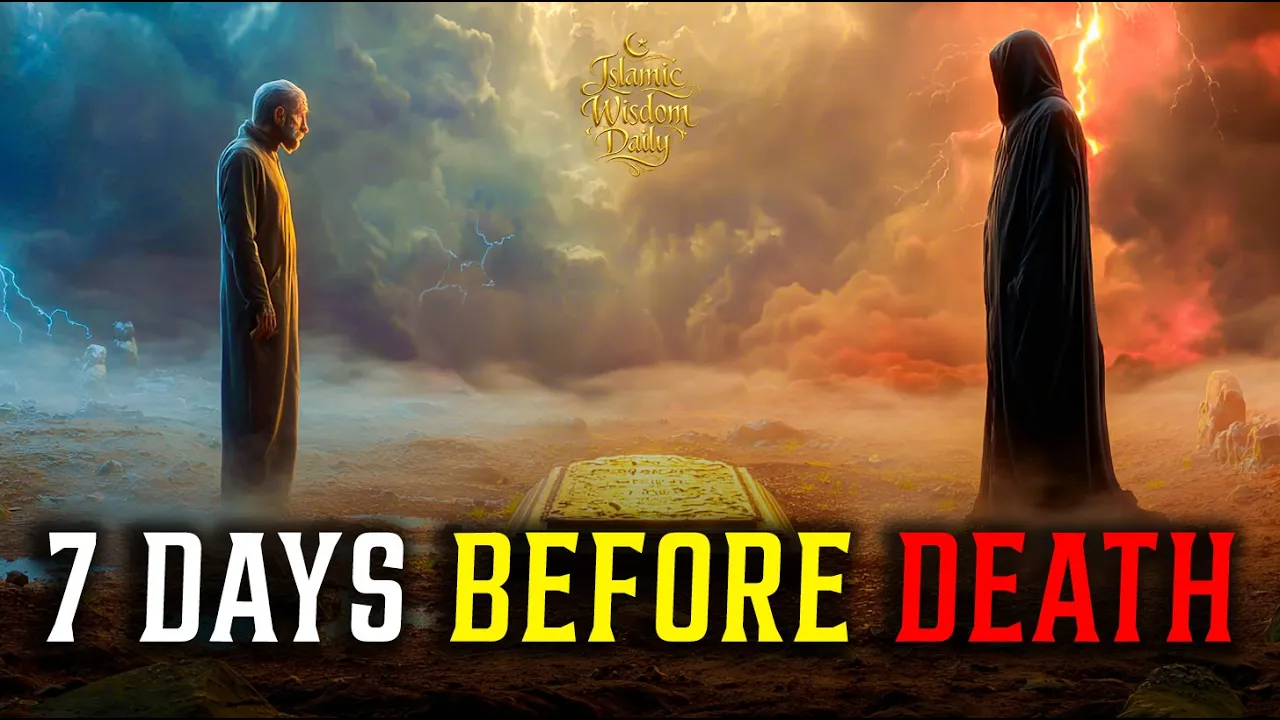
The SHOCKING Truth About Your Last 7 Days transcript
Islamic Wisdom Daily · @IslamicWisdomDaily-1xp
Words
7,380
Runtime
46:16
Speaking pace
160wpm
Reading time
31min
160 words per minute, between the 160 25th percentile and the 181 median of 349 measured videos. That distribution comes from the 349-video hook study.
Opening (first 30 seconds)
In the final 7 days before your soul departs from this world, a veil begins to lift that has separated you from realities you could never perceive before. What unfolds in those last 168 hours will shake everything you thought you understood about existence. The signs begin subtly, so quietly that most people dismiss them as coincidence or imagination. But those who know what to look for recognize them immediately as the unmistakable warnings that death has been decreed and
80 words, the words spoken in the first 30 seconds at 160 words per minute.
Sentence shape
| Measure | This transcript |
|---|---|
| Sentences | 423 |
| Average words per sentence | 17.4 |
| Longest sentence | 50 words |
| Questions asked | 33 |
| Sentences containing a number | 9 |
Most used terms
- allah72
- death56
- final45
- days44
- soul39
- people32
- day31
- angels28
- seven28
- seven days27
- life25
- peace25
Filler phrases
14 in total: like 10 · you know 2 · kind of 1 · literally 1.
A literal whole-word count of the same phrase list the Prepublish browser extension uses, so a phrase inside another word is not counted and a phrase used in its ordinary sense still is. It is a count and not a judgement.
What this transcript is
Every word below is the caption track YouTube publishes for this video, pulled from the video itself and reproduced unchanged. It is not Prepublish's writing, not a summary, and not a re-transcription: it is the video's own published captions. English captions, generated automatically by YouTube, in the video’s original language. Source: the video on YouTube. A channel that would rather this page did not exist can ask for its removal through the contact page, and it is removed.
Transcript
In the final 7 days before your soul departs from this world, a veil begins to lift that has separated you from realities you could never perceive before. What unfolds in those last 168 hours will shake everything you thought you understood about existence. The signs begin subtly, so quietly that most people dismiss them as coincidence or imagination. But those who know what to look for recognize them immediately as the unmistakable warnings that death has been decreed and the angel of death is preparing to arrive.
You might notice animals behaving strangely around you. Dogs refusing to enter your room or birds suddenly going silent when you walk outside. You might feel an inexplicable coldness in your bones that no blanket can warm or catch glimpses of shadows moving just beyond your peripheral vision. These are not random occurrences. These are the first tremors before the earthquake that will separate your soul from your body forever.
Before we continue, I want to ask you something very important. Where in the world are you watching this video from right now? Drop your country or city in the comments below so we can see how far this message is reaching. And if you haven't already, please subscribe to this channel because we're bringing you knowledge that could transform your entire relationship with death and the afterlife. Hit that subscribe button right now because what we're about to reveal in the next few minutes will change how you see every single day of your life.
Allah subhanahu wa ta'ala tells us in the Quran that every soul will taste death and that you will only be given your full compensation on the day of resurrection. But what most people don't realize is that death doesn't just happen in an instant. It's a process that begins before your final breath and the signs appear exactly 7 days before your appointed time arrives. The scholars of Islam drawing from authentic hadith and the experiences of the righteous predecessors have documented patterns that repeat over and over again in those final seven days.
Patterns so consistent that they cannot [clears throat] be dismissed as mere coincidence. The prophet Muhammad, peace and blessings be upon him, taught us that death is not the end, but rather a doorway. And the experience of passing through that doorway begins well before the moment your heart stops beating. On the seventh day before your death, something shifts in the spiritual realm that surrounds you. The angels who have been recording your deeds your entire life begin to prepare their final reports.
The angel on your right shoulder who has written every good action you've performed and the angel on your left who has documented every sin. They know that their mission with you is coming to an end. According to the teachings preserved by the early Muslims, these recording angels begin to increase their presence around you. Their attention becomes more focused because they understand that these final days will determine so much about how your book of deeds is sealed.
A good deed performed in the last week of life carries immense weight. And a sin committed at the very end can cast a dark shadow over everything that came before. This is why you might feel during this time an unusual spiritual sensitivity. A sudden urge to pray when you haven't felt that urge in years or an overwhelming desire to seek forgiveness for sins you had long forgotten. This isn't random. It's a mercy from Allah, giving you one final opportunity to tip the scales in your favor before you meet him.
But there's something else that happens on the seventh day that most people never talk about. Your connection to the material world begins to weaken while your connection to the unseen world begins to strengthen. Food starts to taste different, almost flavorless, as if your body already knows it has no more use for earthly nourishment. Colors might seem less vibrant or paradoxically more intensely beautiful than you've ever noticed before.
Sleep becomes difficult because your soul is already beginning the process of loosening its attachment to your physical form. The scholars explain that this is Allah's way of preparing you, of gradually shifting your consciousness from this temporary world to the eternal reality that awaits. It's a mercy even though it feels unsettling because a sudden complete severance would be too shocking for the human soul to endure.
As you move from the seventh day to the sixth day before your death, the signs become more pronounced and harder to ignore. This is when many people experience what can only be described as a life review, but not in the way you see in movies. It's not a linear playback of your entire life, but rather sudden, vivid memories that surface without warning, moments from your past that carry emotional or spiritual significance.
You might suddenly remember a time when you helped someone in need and forgot about it for decades, and the memory brings you unexpected peace. Or you might be haunted by the memory of someone you hurt, someone you never apologize to, and the regret becomes almost unbearable. The prophet, peace be upon him, taught us that the believer will be shown mercies and blessings in those final days as a source of comfort, while the one who lived in heedlessness will see their sins paraded before them as a final warning.
This is not cruelty from Allah. This is justice mixed with mercy, giving you every possible chance to turn to him with sincere repentance before it's too late. On the sixth day, many people also begin to sense presences around them that others cannot perceive. Family members might notice you staring at empty corners of the room or carrying on conversations with people who aren't visible. They might think you're confused or suffering from medical complications, but the reality is far more profound.
The barrier between the seen and unseen worlds is thinning for you, and you're beginning to perceive angels or even deceased loved ones who have come to ease your transition or in some cases to warn you. The righteous will see beautiful faces that bring them comfort. Angels with expressions of gentleness and love who whisper reassurances about what's coming next. But those who spent their lives in sin and rejection of Allah's guidance might see terrifying figures, angels of punishment, whose mere presence fills the room with dread.
The prophet Muhammad, peace and blessings be upon him, described how the angels of mercy descend with faces like the sun for the believers, while the angels of punishment come with faces that strike fear into the hearts of the rebellious. By the fifth day before death, your body begins to exhibit changes that medical science can document but cannot fully explain. Your eyes might develop a certain distant quality as if you're seeing through this world to something beyond it.
Traditional Islamic knowledge passed down through generations tells us that the eyes of the dying begin to perceive the realm of the bazak, the barrier world between earthly life and the day of resurrection. You might see landscapes that don't exist in physical reality, gardens of indescribable beauty if you're among the righteous, or dark, constricted spaces if your life was filled with wrongdoing. These visions aren't hallucinations caused by a failing brain.
They're glimpses of your actual destination shown to you in advance so that you understand what awaits and can spend your remaining time in this world preparing your heart. On this fifth day, something else remarkable happens with your relationship to the Quran and to the name of Allah. If you've lived a life close to Allah, you'll find that verses you memorized decades ago suddenly come flooding back to you with crystal clarity.
Your tongue might move involuntarily reciting Quran even when you're barely conscious. Your family might hear you whispering laaha illah over and over. The declaration of faith becoming your constant companion. This is the soul recognizing its imminent return to its creator and desperately trying to leave this world with the best possible words on its lips. The prophet peace be upon him told us that whoever's last words are laaha illah will enter paradise and in these final days the believing soul fights to ensure that this beautiful testimony is the last sound it makes in this world.
But for those who lived heededless of Allah these days might be filled with panic with the tongue unable to form words of remembrance no matter how hard they try. the heart sealed from turning to its Lord, even at the very end. The fourth day before death is when the struggle between the angels of mercy and the angels of punishment becomes most intense around the dying person. Islamic scholarship teaches us that both groups of angels are present and they're essentially fighting over your soul, not with weapons, but with the record of your deeds.
The angels of mercy present every good thing you ever did, every prayer you offered, every act of charity, every kind word, every moment of patience in hardship. They're building a case for why you deserve to be treated with gentleness when your soul is extracted from your body. Meanwhile, if there are sins in your record, other angels present these, not to be cruel, but because justice demands that everything be weighed.
This spiritual court case is happening in dimensions you can't see. But on the fourth day before death, you might feel its effects as emotional waves that crash over you without obvious cause. One moment you feel inexplicable peace and contentment. The next moment you're gripped by anxiety or fear. These aren't just neurological symptoms of a dying brain. They're your soul responding to what's happening in the unseen realm. to which side is gaining the upper hand in the argument over your fate.
On this fourth day, many people experience what's known as the final test of faith. Satan, who has been your enemy since before you were born, makes his final, most desperate attempt to lead you astray. He knows his time with you is running out and he pulls out every weapon in his arsenal to try to make you doubt to make you despair of Allah's mercy or to make you die with arrogance thinking your good deeds have earned you paradise without needing Allah's grace.
The prophet peace and blessings be upon him warned us about this final temptation and taught us to seek Allah's protection against it. He used to regularly make supplication asking Allah to protect him at the time of death and to grant him a good ending. This is why on the fourth day you might find yourself bombarded with doubts you've never had before. Questions about whether a lie is real, whether your faith was ever genuine, whether your sins are too great to be forgiven.
The scholars teach that these whispers are Satan's death throws. His last chance to claim victory over you. And the way to defeat him is to hold on to the rope of Allah with everything you have left. To keep your tongue moist with remembrance of Allah even when your mind is clouded. To trust in Allah's infinite mercy even when your own sins seem to tower over you like mountains. By the third day before your appointed time, your soul has begun the actual process of separation from your body.
Though you won't take your final breath for another 72 hours. This is when the phenomenon described in authentic Islamic sources as the tightening begins. Your chest might feel constricted, not necessarily from physical disease, but because your soul is literally being compressed, prepared to exit through a passage far narrower than anything in the physical world. For the believer, the angels expand this passage and make it as smooth as possible.
The scholars compare it to a drop of water sliding out of a vessel. But for the one who rejected faith or lived in persistent sin, the extraction begins to feel like thorns being dragged through wet wool, tearing and painful, resisted by a soul that knows it's heading toward punishment. The prophet Muhammad, peace and blessings be upon him, would seek refuge in Allah from the difficulties of death. And he taught his companions to make the same supplication.
Because even the prophets recognize that this transition requires divine assistance to endure. On the third day, time begins to behave strangely for the dying person. Minutes might feel like hours, or hours might pass in what seems like seconds. This isn't merely a subjective experience. Islamic teachings suggest that the dying person is beginning to exist simultaneously in two different states of time. The linear time of this world and the very different temporal experience of the bazak.
In the bazak, time doesn't flow the way it does here. And as your soul straddles these two realities, your perception of duration becomes unreliable. Family members might notice you confusing today with decades ago, mixing up the present with memories from childhood. And they might think this is just confusion from illness. But the reality is more profound than that. You're experiencing time collapse where your entire life's timeline seems to exist simultaneously where you can feel yourself as both a child and an elderly person in the same moment.
The scholars explain that this is preparation for the day of judgment where you'll be confronted with every moment of your life at once where nothing will be hidden and everything will be present before you simultaneously. The second day before death is when the angel of death, Azrael, makes his presence known more directly. Up until now, other angels have been doing preparatory work. But on this day, the angel specifically appointed to take souls arrives and begins his final assessment.
According to authentic Islamic tradition, the angel of death doesn't appear the same way to everyone. To the believer, he may appear in a form that brings comfort. Some reports suggest a beautiful luminous presence that radiates peace. To the disbeliever or the sinful, his appearance might be terrifying beyond description. A presence so overwhelming that the dying person would do anything to escape. But escape is impossible.
You might feel on this second day an [clears throat] overwhelming awareness that someone or something is watching you, evaluating you, waiting. You might sense a presence at the foot of your bed or in the corner of your room. And no matter how your family tries to reassure you that you're alone, you know with absolute certainty that you are not. This presence isn't there to torment you before your time. The angel of death is simply fulfilling his duty, observing, measuring, preparing to execute the decree that was written for you before you were even born.
On this second day, many righteous people experience what Islamic sources describe as a visitation from paradise or hellfire. This doesn't mean their soul travels to these places yet, but rather that a window is opened. A vision is granted. The believer might suddenly smell fragrances that have no earthly source. Scents more beautiful than any perfume ever created. The smell of paradise being brought to them as a taste of what's coming.
They might feel a coolness and peace wash over them that makes all worldly comfort seem like nothing in comparison. their face might begin to glow with a light that others can perceive. A radiance that comes not from this world, but from the realm they're about to enter. But the one who lived in rejection of truth, might smell terrible odor with no physical source, might feel an unbearable heat that no medicine can cool, might see their own face in a mirror, and recoil at the darkness they see there.
These experiences are not hallucinations. They're the reality of the afterlife beginning to impose itself on the dying person's consciousness, preparing them for what lies ahead. Then comes the final day, the last 24 hours before your soul departs forever. This is the day of ultimate truth. When everything hidden becomes manifest, when every secret you thought was buried comes to the surface. The prophet peace and blessings be upon him taught us that a person might live their entire life performing the actions of the people of paradise but then at the very end their true state is revealed and they die in a state that leads to hellfire.
Conversely, someone might live a life of apparent sin but in their final hours they achieve sincere repentance and die as believers destined for paradise. This final day is the ultimate test of what's truly in the heart. Because at this point, there's no more room for pretense or deception. Your tongue will speak what your heart truly contains. Your body will move toward what your soul truly loves. And there's no social pressure or fear of others to make you act differently than how you really feel.
In these final 24 hours, the accounts tell us that the dying person begins to narrate what they're seeing to anyone who will listen. A believer might describe gardens and rivers, angels with wings of light, deceased loved ones who have come to welcome them home. They might reach out their hands toward empty space, trying to grasp something beautiful that only they can see. Their last words might be declarations of Allah's greatness, professions of faith, or joyful announcements that they can see what awaits them, and it's more wonderful than anything they imagined.
But others might describe horrors, might beg for more time, might confess sins they hid their entire lives, might call out in fear for protection from things approaching them that others cannot see. The scholars warn us that how you spend your final hours is largely determined by how you spent the hours, days, and years that came before. You cannot suddenly become someone different in your last moments. Your death will reveal who you truly were all along.
As the final hours tick down, your body begins shutting down in a specific sequence that reflects Islamic understanding of the soul's departure. First, the extremities start to cool. The soul is withdrawing from the farthest points of the body, concentrating itself in the core. Your feet and hands might become cold even though you're covered in blankets because the soul no longer needs to animate these parts. Then the soul withdraws further rising up toward the chest where the heart resides because Islamic teaching tells us that the heart is the true center of a human being the throne of faith or disbelief.
Finally, in the last moments, the soul gathers at the throat. And this is the moment the Quran describes when it says when it reaches the throat in reference to death. This is why you might see a dying person struggling, their breath becoming irregular, their eyes widening, because at that moment, the angel of death is extracting the soul through the narrowest of passages. And depending on who you were, this extraction is either the gentlest or most agonizing experience imaginable.
In the very last moments, witnesses throughout Islamic history have reported the same phenomenon over and over again. The dying person's eyes will fix on something in the room, usually in an upper corner or at the ceiling, and they'll either smile or express terror. What they're seeing is the angels who have come to take their soul along with a glimpse of their destination. The righteous see angels of mercy with garments and fragrances from paradise holding shrouds made of light.
They see a door opening to gardens and beauty beyond description, and they're eager to go through it. Their last words are often, "I see it. I see paradise." Or, "They've come for me." With expressions of joy and peace. But those who lived in rejection might see angels with faces of fury, holding shrouds of fire, and behind them a door opening to darkness and torment. Their last words might be screams or pleas for more time, bargaining for just one more chance to return and do things differently.
But the door to this world has closed and the door to the eternal realm has opened and there is no going back. The companions of the prophet may Allah be pleased with them used to pray intensely for a good ending for Allah to grant them a peaceful death with faith intact. They understood something that modern people have forgotten that death is not a medical event. It's a spiritual transition of cosmic significance. How you die is more important than how you lived in some ways because your final state determines your eternal destination.
This is why the prophet peace and blessings be upon him taught us specific supplications to say regularly asking Allah to take our souls while we are in a state of Islam while we are his obedient servants. He taught us to say Allah which means oh Allah I ask you for a good ending. This isn't a supplication to be made only when you're old or sick. This is something every Muslim should say daily because death doesn't wait for old age.
It comes at its appointed time whether you're 16 or 60. The seven days before death are essentially a merciful warning system built into the fabric of creation by Allah. They give you time to settle accounts, to seek forgiveness, to make peace with people you've wronged, to reconnect with Allah if you've been distant. But here's the terrifying reality that most people ignore. You never know which seven days are going to be your last seven days.
This could be your final week right now and you don't even know it. The person reading this could see the sign starting tomorrow or they might have already begun and you've been dismissing them as stress or imagination. This is why the prophet peace and blessings be upon him told us to remember death frequently to keep it in our consciousness not to be morbid but to be prepared. He said that death is enough as an admonisher.
Meaning that simply remembering you're going to die should be sufficient to make you change how you're living right now. [clears throat] Think about how you're living your life at this very moment. If these were your last seven days, would you be satisfied with how you've spent them? Have you prayed every obligatory prayer? Or have you been skipping them, thinking you'll make them up later? Have you been kind to your parents, or have you been harsh with them, forgetting that their pleasure is connected to paradise?
Are there people you need to apologize to? Debts you need to repay? Rights you need to restore to others? The angels recording your deeds are writing everything down. And in your final seven days, they'll compile that record into your final book. Do you want that book to close while you're in the middle of a sin? Or do you want it to close while you're in prostration before Allah? The scholars of Islam have always emphasized that one of the greatest blessings Allah can give a person is awareness of their own mortality coupled with time to prepare.
Some people die suddenly with no warning, no time to repent, no chance to change their final state. But if you're reading this, you have time right now. You have this moment to turn to Allah to say with sincerity to commit to changing your ways before it's too late. Don't wait for the signs of those final seven days to appear before you take your relationship with Allah seriously. By the time those signs come, repentance becomes exponentially more difficult because Satan attacks most viciously at the end and your soul is already in the process of detaching from the body that would perform good deeds.
There's a powerful hadith where the prophet peace and blessings be upon him described how some people will live their entire lives doing righteous deeds. But then at the end the reality of what was in their hearts becomes apparent and they die in a bad state. This terrified the companions and they asked how such a thing could happen. The prophet explained that these people were doing outwardly good actions but their hearts were never truly submitted to Allah.
They were going through the motions following rituals out of culture or habit or to please others but there was no real love for Allah. No real faith deep in the heart. So when death approached and the truth had to be revealed, their tongues couldn't form the words of faith. Their hearts couldn't feel connection to Allah and they departed this world in the state their hearts had been in all along. Even though their external actions had fooled everyone around them.
This is why Allah tells us in the Quran that he looks not at our outward forms or our deeds but at our hearts. Your heart's true state will be exposed in those final seven days and especially in those final moments. You cannot fake it at that point. The veils are lifted. The pretense is stripped away and whatever is truly in your heart will manifest. This should motivate every single person to work on their hearts right now today not just on their outward actions.
Are you praying because you love Allah and want to connect with him? Or are you praying because it's what people expect is less than # zero five hash is greater than. Are you avoiding sin because you fear Allah's punishment and desire, his pleasure, or are you just afraid of what society will think? These questions matter more than you can imagine because the answers will determine everything about your experience in those final seven days.
Let's talk about what happens to your relationships in those final days. Because this is something people often don't anticipate. As death approaches, you'll suddenly see every relationship in your life with crystal clarity. The people who truly loved you for the sake of Allah will feel different to you than the people who only associated with you for worldly gain. You might feel an overwhelming desire to be around certain people.
Feeling their presence brings you peace. While other people's presence, even family members, might make you uncomfortable in ways you can't quite explain. This happens because your soul is becoming more sensitive to spiritual realities, and it can sense who has light in their heart and who has darkness. The prophet, peace and blessings be upon him. Taught that a person will be with those they love in the hereafter. And in those final days, your soul gravitates toward those whose companionship you'll share in eternity.
Many dying people experience an urgent need to give advice to their loved ones, especially about maintaining prayer and fearing Allah. Even people who weren't particularly religious, their whole lives might suddenly become insistent that their children pray, that their spouse remembers Allah, that their family stays away from major sins. This isn't random. It's the soul recognizing the weight and reality of what's about to happen and desperately wanting to save loved ones from experiencing the hard version of death and what comes after.
If a dying person tells you to pray, to read Quran, to fear Allah, don't dismiss it as delirium. That person is seeing things you can't see yet. Understanding realities you don't yet grasp and trying to warn you while they still have the ability to speak. The greatest gift a dying person can leave their family is not wealth or property, but guidance toward Allah. And in those final days, many people try desperately to give that gift before it's too late.
There's also the phenomenon of unfinished business that weighs heavily. In those final days, your soul knows it's about to cross over. But if there are major sins you committed that you never repented from, or rights you took from others that you never returned, these become like chains holding you back. Islamic teachings emphasize that there are three things that follow you to your grave. your family who will leave you there, your wealth which will be distributed to others, and your deeds which will accompany you into eternity.
In those final days, you become acutely aware of your deeds, both good and bad. And if there are serious sins in your past, the weight of them can become almost physically unbearable. This is why you might see dying people suddenly confessing things they hid for decades, desperately seeking forgiveness from people they wronged, trying to give away wealth to settle debts or make restitution. They're not being dramatic or overly emotional.
They're responding to a reality that's becoming impossible to ignore. That they're about to stand before Allah with their full record. And anything left unresolved will weigh against them. The seven days before death also reveals something crucial about the nature of regret. The Quran describes how on the day of judgment, people will beg to be sent back to the world for just a little more time so they can do good deeds and fix their mistakes.
But in those final seven days before death, you get a preview of that regret. Every wasted hour suddenly seems precious beyond measure. Every missed prayer becomes a source of anguish. Every hurtful word you spoke echoes in your mind. You'd give anything for just one more chance to prostrate before Allah with presence of heart. One more opportunity to give charity. One more moment to recite Quran with reflection. But time has run out.
Your deeds have been sealed and all you can do is face the consequences of how you chose to live. The believer who lived righteously feels this regret too, wishing they had done even more, but it's mixed with hope in Allah's mercy and confidence in his promise. The one who wasted their life feels pure anguish, knowing they had every opportunity and squandered them all. Let's address something important about the scientific versus spiritual understanding of these final days.
Modern medicine can describe the biological process of dying, the shutdown of organ systems, the changes in brain chemistry, the physical signs that death is approaching. But medicine cannot measure or detect the spiritual realities that are unfolding simultaneously. Doctors might say a patient is hallucinating when they describe seeing angels, but Islamic knowledge tells us they're not hallucinating. They're perceiving realities that medical instruments cannot detect.
Nurses might notice that dying patients often seem to rally briefly before death, becoming suddenly lucid and peaceful or suddenly agitated and fearful. Science calls this terminal lucidity and doesn't fully understand it. But Islamic teaching explains it clearly. It's the moment when the soul has gathered its strength for the final transition and the person becomes acutely aware of what's happening to them spiritually.
The question every single person needs to ask themselves right now is this. If you discovered today that you only have seven more days to live, what would you do differently? Would you suddenly start praying every prayer on time? Would you rush to seek forgiveness from people you've wronged? Would you spend every spare moment reading Quran and making dick? Would you give away your wealth in charity? Would you beg Allah for mercy and forgiveness?
Now, here's the follow-up question. If those are the things you would do in your final seven days, why aren't you doing them right now? The prophet, peace and blessings be upon him, told us to worship Allah as if we see him. And if we cannot achieve that level, then to worship him knowing that he sees us. This state of consciousness, this awareness that death could come at any moment and that Allah is always watching should transform how we live every single day.
Think about the people in your life who died suddenly with no warning. They didn't get seven days of signs. They didn't get time to prepare. One moment they were alive and the next moment they were standing before Allah. How would their eternal outcome have been different if they had known seven days in advance? Would they have died in a better state if they'd had a week to repent and prepare? Maybe or maybe not. Because true preparation for death happens over a lifetime, not in one frantic week.
The person who has been living consciously, who has been praying, fasting, giving charity, treating people well, remembering death regularly, that person is already prepared whether death comes suddenly or with warning. But the person who has been living heededlessly, chasing worldly pleasures, neglecting their obligations to Allah, even if they get 7 days warning, they might find it almost impossible to change their state at the end because their heart has become hardened over time.
One of the most profound teachings about death in Islam is that you will die in the state you lived. The prophet peace and blessings be upon him said that whoever lives a certain way will die that way and will be resurrected that way. If you live with your heart attached to this world, you'll die with your heart attached to this world, desperately clinging to life, terrified of letting go. If you live with your heart attached to Allah and the hereafter, you'll die with eagerness to meet him, viewing death as a release from this prison of the material world and entry into eternal bliss.
Those seven days before death, don't create your spiritual state. They reveal it. They expose what was always there, hidden beneath the surface, and bring it into the light where it can no longer be denied. Let's be very practical about what you should be doing right now today, regardless of whether you have 7 days left or 70 years left. First, establish your five daily prayers if you haven't already. Because prayer is the first thing you'll be asked about on the day of judgment.
If your prayers are in order, the rest of your deeds will be judged favorably. But if your prayers are deficient, everything else will be called into question. Second, settle your affairs with people. Apologize to anyone you've wronged. Forgive anyone who has wronged you. Repay any debts you owe, whether financial or otherwise. Third, make sincere toba. Repentance to Allah for all your sins, major and minor, remembered and forgotten.
Regret them. Commit to never returning to them. And ask Allah's forgiveness with certainty that he is the most merciful. Fourth, increase your remembrance of Allah. Fill your tongue with thicker. Let subhan Allah, alhamdulillah, Allahu Akbar become as natural as breathing. Fifth, give charity regularly because charity has the power to avert calamity and ease your passing from this world. There's a beautiful hadith where the prophet peace and blessings be upon him taught us that when a believer is about to leave this world, angels descend with white silk from paradise and they say to the soul, "Come out to the mercy of Allah and his pleasure." The soul then exits easily like a drop from a water skin.
And the angels take it up wrapped in that silk and no angel passes by without saying, "What a pure soul this is." They carry it up through the heavens and at each level the angels rejoice at its passing and doors are opened until it reaches Allah himself. Allah says, "Write my servant's name in Ilen, the highest level, and the soul is returned to await the resurrection in a state of peace and honor. This is what awaits the believer in those seven days and at the moment of death, ease, honor, fragrance, light, and the embrace of divine mercy.
But the hadith continues with the opposite scenario and it's terrifying to contemplate. When a disbeliever or rebellious sinner is about to leave this world, angels descend with coarse black cloth from hellfire and they say to the soul, "Come out to the wrath of Allah and his displeasure." The soul tries to hide in the body, spreading through it like mercury. And the angel of death has to extract it by force, ripping it out like thorns being pulled through wet wool, breaking veins and nerves.
[clears throat] When it finally comes out, the angels wrap it in that foul cloth. And it smells worse than any corpse. And every angel that passes says, "What a foul soul this is." They try to ascend with it, but at each level of heaven, the doors are slammed shut. And finally, it's flung back down to the earth and into a state of torment in the grave. This is what those seven days lead up to for the one who rejected Allah's guidance, anguish, terror, pain, and the beginning of eternal punishment.
The difference between these two experiences isn't based on how much wealth you had, what your social status was, or whether you were famous or unknown. It's based entirely on what was in your heart and how you lived your life in relationship to Allah. A poor person who lived with faith and righteousness will have an easy death and entry into paradise. While a billionaire who lived in heedlessness and sin will have an agonizing death and entry into hellfire.
This is the justice and mercy of Allah that the playing field is leveled that what matters is not what you had but who you were and how you behaved. As we approach the conclusion of this discussion, I want you to imagine something very carefully. Imagine that tonight, as you go to sleep, the angel assigned to you begins to sense the approach of your death date. Imagine that tomorrow morning, one week before your appointed time, the signs begin to appear.
Would you be ready? Have you lived a life that would make those seven days peaceful rather than terrifying? Have you built a relationship with Allah strong enough to carry you through the transition from this world to the next? Or have you been procrastinating, telling yourself you'll get serious about faith later when you're older after you've achieved your worldly goals? The reality is that death doesn't care about your plans or your excuses.
It comes at its appointed time, precise to the second, unavoidable and unstoppable. The prophet peace and blessings be upon him told us that death is the destroyer of pleasures. The thing that cuts through every worldly attachment and exposes the truth of our existence. We are not permanent residents of this world. We are travelers passing through and death is simply the journey from the temporary abode to the permanent one.
How we travel, whether in comfort or agony, whether welcomed by angels of mercy or seized by angels of punishment, depends on choices we make right now, today, in this very moment. The seven days before death are in a sense a microcosm of your entire life. Just as those seven days reveal your true state and prepare you for eternity, your entire life is meant to be a preparation for that final journey. Every prayer you pray or skip, every act of kindness or cruelty, every moment of remembering Allah or being heedless of him, it's all building toward your final state, the state you'll be in when those seven days arrive.
The person who has lived consciously, who has made every day a preparation for death, will find those final seven days to be the culmination of a life well-lived, a transition they've been preparing for all along. But the person who has lived heedlessly, ignoring every reminder and warning, will find those seven days to be a nightmare of regret and terror. So here's what I want you to do right now. Immediately after finishing this video, make woodoo if you're not already in a state of purity and pray two units of prayer, not out of obligation, but out of recognition that you've just been reminded of your mortality.
In that prayer, ask Allah to grant you a good ending, to take your soul while you're in a state of faith, to make your death easy and your entrance into the hereafter smooth. Then sit for a few moments and think honestly about your life. Identify one major thing you need to change, one sin you need to quit, one obligation you need to start fulfilling, and make a firm commitment to Allah that you're going to change it starting today.
Don't wait. Don't procrastinate. Don't tell yourself you'll start tomorrow or next week because you don't know if you have tomorrow or next week. Remember that the angels are recording everything, every word, every action, every intention. They're building the book that will be presented to you in those final seven days and then again on the day of judgment. What do you want that book to contain? Do you want it filled with prayers and charity and kindness and remembrance of Allah?
Or do you want it filled with missed prayers and wasted time and cruelty and heedlessness? The choice is yours. But the time to choose is now, not later, not when you're old. Not when the signs of death start appearing. Now, right now, this moment is the time to turn to Allah with sincerity and commit to living the kind of life that will make those final seven days a blessing rather than a curse. The prophet Muhammad, peace and blessings be upon him, the most beloved of Allah's creation, the one guaranteed paradise, used to pray and weep and beg Allah for a good ending.
He used to seek refuge in Allah from a bad ending, from being tested beyond his capacity at the time of death, from dying in a state that would displease Allah. If the prophet who was guaranteed paradise, was this concerned about his ending? How much more should we be concerned about ours is less than hash zero? Five hash is greater than we who have sinned countless times. We who have wasted so many opportunities. We who have been heedless more often than we've been conscious, we need to pray even more desperately than the prophet did for Allah's mercy and protection at the time of death.
There will come a day, perhaps soon, perhaps many years from now, when you wake up and it's the beginning of your final seven days. Though you don't know it yet, the signs will start to appear. Subtle at first, but growing more obvious as the days progress. Your soul will begin to detach from your body. Your perception will shift. The barriers between worlds will thin. And you'll start to see and sense things others can't.
In those moments when the reality of death becomes undeniable, when you know with certainty that your time in this world is ending, what will you feel? Will it be peace knowing you're about to meet a Lord you loved and obeyed? or will it be terror knowing you're about to face the consequences of a life spent in rebellion and heedlessness? The answer to that question is being written right now in how you choose to live this day, this hour, this very moment.
Every choice you make is a brick in the structure of your ending. Build wisely. Build with consciousness of Allah. Build with the knowledge that what you're constructing now will be your dwelling in those final seven days. and beyond into eternity. May Allah grant us all a good ending. May he take our souls while we're in a state of faith and submission. May he make our deaths easy and our entrance into the hereafter joyful.
And may he protect us from a bad ending and from dying in a state that would displease him. A mean.
The words are the caption track's own and nothing is reworded or re-transcribed. Paragraph breaks are placed between sentences so the text reads as prose.
Use this transcript
Three free tools that work on the material around a video like this one. No signup, no login.
Hook Analyzer
Paste the first 30 seconds of your own draft for a hook score and rewrites.
Policy Pre-Flight
Check your draft against YouTube's advertiser-friendly guidelines before you record it.
Channel Skill Generator
Read this channel's public videos and transcripts, and download a writing brief for it.