Getting the transcript
Reading the captions from YouTube. A video nobody has opened here before takes 10 to 30 seconds; this page fills in on its own.
Getting the transcript
Reading the captions from YouTube. A video nobody has opened here before takes 10 to 30 seconds; this page fills in on its own.
CBS News · @CBSNews
Words
1,688
Runtime
10:06
Speaking pace
167wpm
Reading time
7min
167 words per minute, between the 160 25th percentile and the 181 median of 349 measured videos. That distribution comes from the 349-video hook study.
Opening (first 30 seconds)
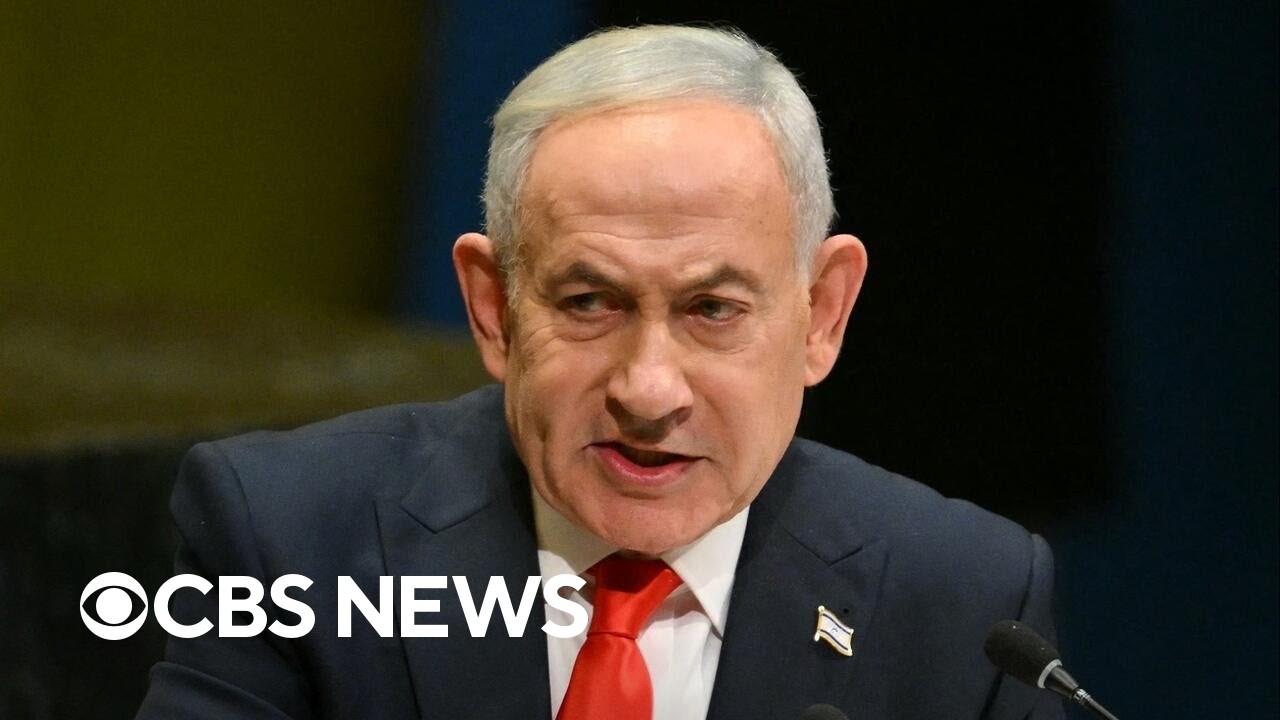
Hi, I'm Lindsay Riser. Israel's Prime Minister Benjamin Netanyahu just spoke at the United Nations General Assembly. Many diplomats walked out as he took the podium. Netanyahu said that by defending Israel and taking out Iran's nukes. Israel has also defended many of the countries whose delegates left the hall. This is part of what he said after. For the past three years, our heroic soldiers have fought day in and day out in a sevenfront war. Do you know any other country the
84 words, the words spoken in the first 30 seconds at 167 words per minute.
Free, no signup. See how the first 30 seconds hold attention, with rewrites.
Sentence shape
| Measure | This transcript |
|---|---|
| Sentences | 116 |
| Average words per sentence | 14.6 |
| Longest sentence | 56 words |
| Questions asked | 10 |
| Sentences containing a number | 8 |
Most used terms
Filler phrases
37 in total: uh 18 · um 11 · you know 3 · kind of 2 · like 2 · actually 1.
A literal whole-word count of the same phrase list the Prepublish browser extension uses, so a phrase inside another word is not counted and a phrase used in its ordinary sense still is. It is a count and not a judgement.
What this transcript is
Every word below is the caption track YouTube publishes for this video, pulled from the video itself and reproduced unchanged. It is not Prepublish's writing, not a summary, and not a re-transcription: it is the video's own published captions. English captions, generated automatically by YouTube, in the video’s original language. Source: the video on YouTube. A channel that would rather this page did not exist can ask for its removal through the contact page, and it is removed.
No Script X-ray for this video: YouTube shows a Most replayed graph only once a video has enough views.
Hi, I'm Lindsay Riser. Israel's Prime Minister Benjamin Netanyahu just spoke at the United Nations General Assembly. Many diplomats walked out as he took the podium. Netanyahu said that by defending Israel and taking out Iran's nukes. Israel has also defended many of the countries whose delegates left the hall. This is part of what he said after. For the past three years, our heroic soldiers have fought day in and day out in a sevenfront war.
Do you know any other country the size of New Jersey capable of fighting a sevenfront war and for three years? Seven fronts. Hamas, the Houthis, Iran, militias in Iraq, militias in Syria, Palestinian terrorists in Judea Samaria. They all ganged up on us to wipe us off the face of the earth. They failed because instead of collapsing, we delivered crippling blows to all of them. with our great American friends. We crushed Iran's army, navy, air force, and nuclear facilities.
[applause] Israel hammered Hamas. We pummeled Hisbala. You remember the beepers? Remember these things? Remember them? Yeah. Well, I can tell you this. Kazbala certainly remembers them. >> CBS News intelligence national security reporter Olivia Goss joins me now. So, what else stood out to you from these remarks? >> Sure, Lindsay. Well, I think as you as you mentioned, there was it was a striking exodus of delegates right as Netanyahu took the podium, which he addressed headon, calling those who walked out moral cowards right off the top.
And I think that really set the tone for the rest of the address. He was as combative as he has historically been uh at the podium. He used much of the speech to really push back against the international criticism he said Israel has gotten from other leaders including what he said were accusations of colonialism from countries like Britain and France which he snapped back had quote vetted the term. Uh he of course recounted the horrific events of October 7th and compared the scale of that attack in Israel to the equivalent of 16 911s in the United States.
And he said, "We're going to win. We have no other choice." Which kind of became a refrain for his remarks. And the broader argument, as you heard in that clip that you played, was that Israel is not fighting one war, but is in a sevenfront regional conflicts. And so Israel's various military campaigns are part of that one wider fight. Um he he defended uh Israeli actions in Gaza. He said that it had been facilitating aid and it was the opposite of the genocide.
He also singled out New York Mayor Zoran Mambadani with whom we know he's in a feud. Uh and said that many Jews in New York no longer feel safe as a result of his uh of his tenure there. He also offered thanks to President Trump for his bold leadership. uh although as we have been speaking about earlier the two leaders are uh not meeting during Netanyahu's visit this year which is pretty ex exceptional. >> Okay so we talked about the people who left there have also been protests outside the UN.
Can you tell us about some of the speakers pushing back on Israel and their remarks? >> Sure. There has been regular push back against Israel, most notably today from [snorts] Palestinian President Mahmud Abbas, who addressed the assembly virtually uh by video after the US denied him and his delegation a visa for the second year in a row. In that address, Abbas condemned uh Israel's actions in Gaza uh and in the West Bank.
He urged world leaders to do more to protect Palestinians and he made the case, as he has done in the past, too, uh for the Palestinian Authority to govern both Gaza and the West Bank. But it's worth noting he's 90 years old. Uh he's been in power there for two decades. There have been no elections or broader reform. So it's really hard uh to to take that pitch with the gravity that it should be because of that complicated past.
Um as we mentioned, Britain and France and other European and Middle Eastern governments also spoke this week uh to criticize uh Israel over Gaza and over settler violence in the West Bank and to push for a two-state solution. All things that as you heard Netanyahu defended himself against in his address this afternoon. >> Olivia Gazes, thank you so much. >> Thank you. >> Let's bring in CBS News Middle East contributor Courtney Keely.
Courtney, what are your takeaways? Now, obviously this isn't happening in a vacuum. This is happening when there are crucial elections in Israel next month. >> Right. And he's neck and neck with Gotti Esenote, who's really known as a military man, lost a son in Gaza since October 7th, and a nephew. So he's new and he's appealing to people. According to channel 10, 40 uh% approve of Ezen code over 38% of uh of Netanyahu.
Channel 10 12 also says correction channel 12 that Gaddyote um his Yashar party has 23 Knesset votes to about 20 which Netanyahu has right now. So that is a real problem for Netanyahu. He is the he has long served throughout many things. We've seen him at the UN many times. Um but he is not only putting facts out that aren't necessarily all facts. He's using words and he's skewing things that you have to listen closely to, but he's in this election and it's coming up fast.
And so he has to speak to a domestic audience. He has to appear strong. He started with Israeli soldiers. They need to be honored. He said there wasn't collateral damage only that Hamas put the civilians up to that because it's one of the most was one of the most densely populated places was Gaza. Now everyone's living in tents. Kids are going back to school and some of the malnutrition and the scarcity of food has been has been made better but not the conditions.
So when he talks about Judea Samaria he's talking about the West Bank when he so and the West Bank is in crisis right now. when he's talking about Christians thriving in Israel, he's actually saying things that I'm not hearing from Christians in Israel. Um, in Jerusalem, which is still a disputed capital, despite the US moving their embassy there, it's not recognized by international law. He claims it as such in this speech, but I've also seen viral videos of nuns being targeted by by violent youth kicked in the stomach once one video came out over the summer.
So the Christians in the Holy Land are in crisis. That's not something he he kind of said it is of a part of, you know, glorious um Israel. It's a big problem right now. So he sugarcoated over some of the bigger crisises saying they're okay. Um when you say Judea Samaria, he's not mentioning all the Israeli settlements that have been built up over the years. He's also not mentioning that his cabinet is pro the settler movement that they they're very right-wing.
So there's a lot to be said for Netanyahu taking the stage as always does. He is a or a raider um very unparalleled most often. you don't see it from the Palestinian camp, but you almost have to go line by line checking him and factchecking him because it's so important and then you don't catch like the the ancient civilization references. But when he said the Egyptians, the Babylonians, and the Persians have faded away, the Egyptians and the Persians who are Iranians that recognize as Persian would have something else to say about that.
His comments do did come on the heels of the Palestinian Authority President Mahmud Abbas in his speech uh pre-recorded video um that was played due to his um entry visa ban. During his remarks, he called on the international community to make sure there is a viable two-state solution. Is that going to happen at any point? And where are we with peace talks? Right. So Mafabas is the president and has been holding on for a long time as president and we haven't seen any real leadership since Hamas took over in around 2007.
Took over Gaza completely. Hamas was known for their suicide bombings and bus bombings. I was living there and coming back and forth from Beirut to Jerusalem and those buses were exploding with civilians down the street. That's what I was covering. You cannot say that that did not happen. I bore witness to that. But I also bore witness to Gaza. And when I saw the West Bank back then with my own eyes, the settlements were not dotting the landscape.
You didn't take a turn away from out of Bethlehem and all of a sudden see a a city that's gone up that I had, you know, because I hadn't been in in several years. So the amount of building, the amount of what they've put in is almost facts on the ground. How do you undo that to make a Palestinian state where they have enough land? And right now the Hilltop youth, which has been a movement that's existed for 20 over 25 years.
Um, so some of them are no longer youth. They're in their 40s perhaps. They're they're encircling small villages in Palestinian land. And the Palestinians are under military control and military law, but the Israelis aren't. The Hilltop youth are not being pulled away. Even our the US ambassador criticized this about the West Bank. So when you have a very tired and very old Palestine leader that does not represent the people and does not represent change to say I want a two-state solution, I've got to say after covering this for so long, it found it's not only tiresome, it's almost enraging because we're not seeing any new ideas.
Okay, Courtney Keely, thank you for your analysis.
The words are the caption track's own and nothing is reworded or re-transcribed. Paragraph breaks are placed between sentences so the text reads as prose.
Free tools for your own script. No signup, no login.
Paste your draft and see where viewers are likely to drop off, with a rewrite for each weak line.
Paste the first 30 seconds of your own draft for a hook score and rewrites.
Check your draft against YouTube's advertiser-friendly guidelines before you record it.
Read this channel's public videos and transcripts, and download a writing brief for it.