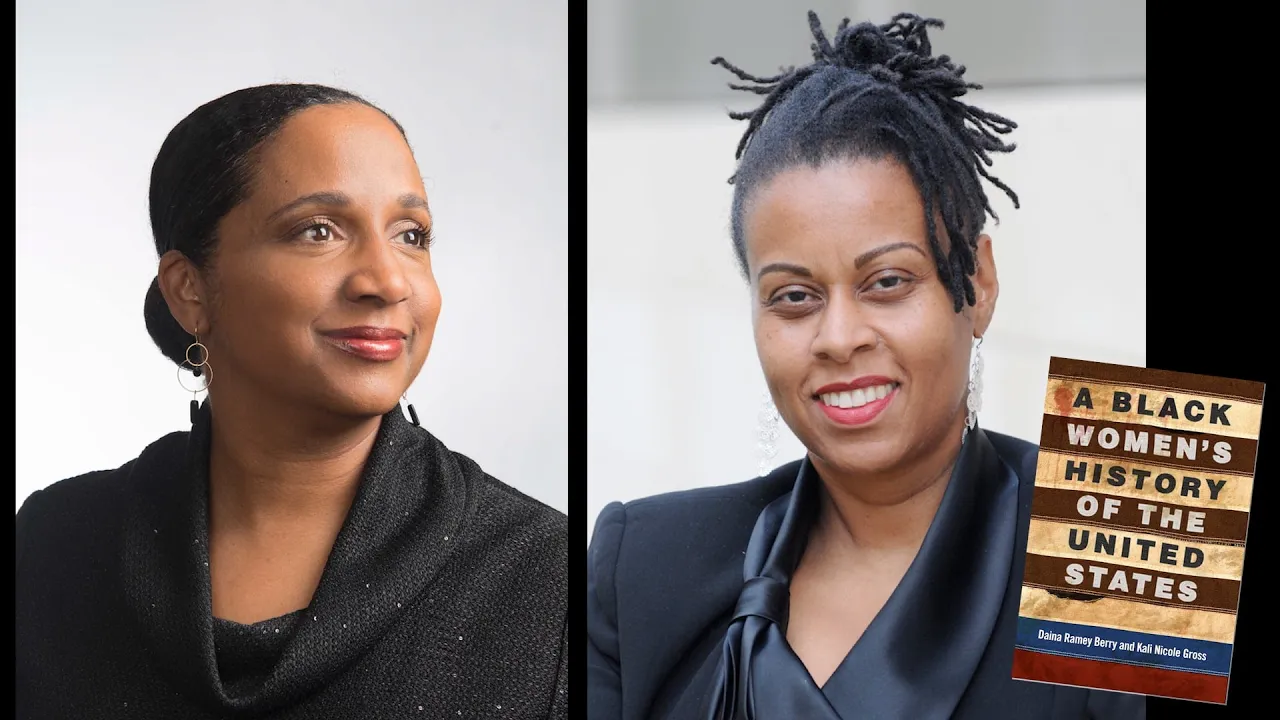
BOOK BREAKS: "A Black Women's History of the United States" transcript
The Gilder Lehrman Institute of American History · @gilderlehrman
Words
10,095
Runtime
1:00:19
Speaking pace
167wpm
Reading time
42min
167 words per minute, between the 160 25th percentile and the 181 median of 349 measured videos. That distribution comes from the 349-video hook study.
Opening (first 30 seconds)
Today's guest are the esteemed women who wrote this amazing book. They are Daina Ramey Berry, who is the Oliver Radkey Regents Professor and chair of the history department at UT Austin. She's a scholar of slavery and black women's history and an award-winning author, editor of six books. Welcome. Daina, thank you for joining us. Thank you for having us. And her co-author, Kali Nicole Gross, is a National Endowment for the Humanities Professor of African American Studies at Emory. She's also the
84 words, the words spoken in the first 30 seconds at 167 words per minute.
Sentence shape
| Measure | This transcript |
|---|---|
| Sentences | 464 |
| Average words per sentence | 21.8 |
| Longest sentence | 128 words |
| Questions asked | 49 |
| Sentences containing a number | 25 |
Most used terms
- um174
- women121
- black92
- black women75
- history69
- book46
- sort45
- people39
- american25
- uh25
- question24
- mean20
Filler phrases
515 in total: um 174 · you know 139 · like 54 · sort of 45 · uh 25 · kind of 24 · I mean 19 · right? 15 · actually 11 · literally 7 · basically 2.
A literal whole-word count of the same phrase list the Prepublish browser extension uses, so a phrase inside another word is not counted and a phrase used in its ordinary sense still is. It is a count and not a judgement.
What this transcript is
Every word below is the caption track YouTube publishes for this video, pulled from the video itself and reproduced unchanged. It is not Prepublish's writing, not a summary, and not a re-transcription: it is the video's own published captions. English captions, generated automatically by YouTube, in the video’s original language. Source: the video on YouTube. A channel that would rather this page did not exist can ask for its removal through the contact page, and it is removed.
Transcript
Today's guest are the esteemed women who wrote this amazing book. They are Daina Ramey Berry, who is the Oliver Radkey Regents Professor and chair of the history department at UT Austin. She's a scholar of slavery and black women's history and an award-winning author, editor of six books. Welcome. Daina, thank you for joining us. Thank you for having us. And her co-author, Kali Nicole Gross, is a National Endowment for the Humanities Professor of African American Studies at Emory.
She's also the creative productions director for the Association of Black Women Historians and a distinguished lecturer a lecturer for the Organization of American Historians. She's also an award-winning author of three books and we are not surprised because if you got a chance to read this book, uh you know that these ladies uh come with uh award-winning caliber material. So, welcome Kali. Thank you all both for being in conversation with me today.
Thank you. Very kind. It's a pleasure to be here. Yeah, I'm so honored to get a chance to talk to both of you about this amazing book, A Black Women's History of the United States. I'm wondering if one of you could start by just giving us a brief history a a brief synopsis of the book. And that's going to be hard cuz cuz it is so much there. So, I guess I can start. The book covers African American women of African descent who came to what became the United States from the earliest women we could we could document to uh until today, really.
Um and we look at women in multiple areas, in in sports, in politics, athletics, uh entertainment. Um and women that you've never heard of, women that may not normally be in history books because of things that they did, and women that did courageous things. And so we were our goal was to prevent present a book that anybody could see themselves in, that there would be a space for themselves um in this in this work. Um people that were differently abled, people that are underrepresented minorities, people that were wealthy, people that were poor, you know, the whole gamut, I think.
Um and have I have I missed anything, Kelly? I was just going to say we also made sure to include folks from the LGBTQ community, um women from every conceivable area of life. We tried to we tried to incorporate it um so that folks, as Daina said, could see themselves, and also that people could learn a lot about black women's history, and the centrality of it in um the overarching narrative of American history. I was so impressed that it was so late and with so many women from so many different walks of life and time spans.
Uh that was something that I that I walked away with. Uh can I just ask what inspired you to write this book and and more importantly your collaboration for writing this book? You know, it was it it was sort of serendipity in certain ways. We were approached um by an editor from Beacon about the possibility of writing the book at the same time that we were literally having conversations about the need for um a newer survey of African-American women's history because there are tremendous books on black women's history that have certainly come before ours, and and they were instrumental in in guiding our work.
Um but many of them were almost 20 years old. And so it was definitely kind of time for a newer survey that looked at different kinds of issues that could meet the challenges of today's readers and answer those questions. So um that was kind of how it came together. And then also in some ways Dana and I are the co-authors, but I feel like this book was a almost a community effort in certain ways. I mean, we relied on the wisdom and scholarship of so many sister scholars, literally and figuratively, in terms of works that we cited and used, but also, you know, and Dana and I we talk about this is like this is when the book came together when we had a manuscript workshop.
And we just had this constellation of scholars from across the field who were generous enough to read it and really give us this feedback. And I'll I'll pass it over to you, Dana, cuz I don't want to take up all of the the oxygen in the room. Oh, no. And you know, I think you're right. The the workshop that you hosted at Rutgers um was instrumental in shaping the book and instrumental in helping us as co-authors work through questions that we were having and trying to resolve.
So a lot of people ask us how we came together to write this book and what the collaborative process was like. We were both at the same institution when we started it. Um and then changed institutions, but still, you know, worked with one another via um Skype, via Zoom. We met up at conferences. We met with the editor at conferences. We would work on different sections of the manuscript and share it back and forth and edit back and forth.
But that workshop at Rutgers was instrumental because we had other scholars read what was a very rough draft of the manuscript. Some sections were outlines um of chapters, sort of skeletal outlines. Others were detailed outlines, and others were fully fully fully drafted rough drafts of chapters. And we shared our vulnerability and put it on the table for these scholars to review, and they were kind, and they really were instrumental in helping us get the structure.
Because we were sort of following a timeline structure for a while and trying to create our own timeline for African-American women and thinking about what markers of time shape black women's history in the United States, and those aren't necessarily the same as the typical. Some of them match up with timelines from US history courses, but there are other things that happen in black women's lives that were instrumental.
And so we were sort of trying to do that, but we didn't have enough, and we kept going back to that traditional timeline. Do you remember that? I do. And and I mean, it really was this generous group of of scholars who really kind of pushed us, chided, encouraged, all of the above. It was like this 8-hour period, I think, of like, you know, laughter, you know, darn near tears at points. I mean, it was really it was an incredible experience, but it um we it enriched the work in ways that I can hardly even even describe, but it definitely helped us center black women's history throughout the narrative in terms of driving the chapters, the names of the chapters, trying to really pull out their voices in every way possible.
The timeline, it really was fundamental. You you That's amazing that was such a collaborative process. You talk you you talk in the intro about this book being a survey. Um was the community involved in making that decision to make it a survey of black women's history, and was that a difficult thing to do as historians yourselves to to turn it into more of a survey into I think part of that was driven by the series that the book is published in and that those the series of revisioning American history there's like a disability history of the US you know a Latinx and African-American history of the US.
There's a number of there's like six or seven books in the series probably more now than since it's been published and so those are sort of overview studies of larger parts of American history. So that was part of what drove that for us and you know one of the things that we we also got out of that workshop was how to start the chapters and make sure we were focusing on women and girls and that this was not about just adult black women's history.
This was also about black women and girlhood and that was really important. So a lot of the chapters a number of the chapters start off with very young women young girls. And I would just add that I'm I did find it somewhat daunting. On one hand it was the exciting to be a part of of writing the book but I was also terrified because I felt this I mean I think we both did we felt this intense responsibility. Really wanted to get it right.
And to produce a book that would that would sort of do black women's history justice that would also be accessible to as many readers as possible. And and to I think have a have a positive impact just in general. So I felt personally I know we both did but I was just thinking for us so I I felt this intense kind of responsibility on that front. And I was actually terrified about how people would receive it. That that actually feeds into how we not only after the workshop we also sent out like chapters and sections of chapters to scholars that were doing work in the area.
We didn't want to step on anyone's toes. We also wanted to be respectful to scholars that were producing work that was forthcoming not stealing anything that they were going to be publishing particularly those that were more junior to us. So we reached out to a lot of other historians and asked them, you know, not not just for permission but for their feedback. And did we get this right? You know, did we represent you in the scholar that you've written about before?
Because it was people that other generation generational wide generation of scholars senior to us and junior to us that have been doing work in this field for generations. And we really wanted to make sure that we we got the story right and we were very very concerned about that. I could imagine that would be daunting and can I just say as a reader it from a reader's perspective you got it right. So so thank you for that.
You you talk about in the introduction that black women occupy a complex paradoxical relationship to America. Can you speak a bit more about the statement? Sure, it's you know, African American women's history is is is you know is deep and is complicated on one hand, you know, black women's bodies and their wombs and and offspring have literally contributed to the wealth and dominance and development of the country. But that relationship has also been almost wholly extractive.
You know, black women have also been among sort of the most sort of marginalized and excluded systematically throughout much of that history even though our presence has been foundational to the nation's development and also to that black women have resisted and sort of fought back and pushed that and I think seized on to the uh principles of democracy even when they didn't fully apply. Have really worked to demand and clarify and not just for themselves, but for the nation.
Mhm. And I think we illustrated that in the cover. Um it seems kind of trivial to say that, but even working through early drafts of what the cover The cover was a very shiny, clean American flag. And we felt like it was it didn't represent black women's experience with this country. And that it needed to have tears and sweat and blood and tears. And so the publisher was amazing in working with us to to make the flag look realistic to the experiences.
And I think that's another visual way that we represented this history. That's I did even for realize that. I've got to go back and look at the cover. Uh you start the story of black women with women like Isabel and Maria, whose arrival in America predates European settlement. And you state that um that represent representation is a shift in the story of black women in America. Why was it important for you to start the history of black women in America with this with stories like Isabel and Maria.
And what was the shift that you were hoping to achieve? Well, one I think we wanted to show black people with Isabel's story, black people that were free. Um that free before they were enslaved. Because a lot of a number of of of women of African descent that came here were came as captives on slave ships. So we wanted to look at women that were free. We also wanted to to look at the non-British story. You know, this is a story that comes from Spanish America, that comes from She came from Mexico and moved and and moved Isabel came from Mexico and then moved into what was New Spain or New Mexico.
And as an explorer traveling with explorers, that's a really different narrative about black women's presence here. Most of the first stories that we hear about are those 20, quote-unquote, odd Negroes that landed, um, you know, near Jamestown, Virginia in um, 1619, right? And so, we were looking at the non-English story and looking at the land. And when people arrived on this physical space before it was called the United States, before it was occupied by the British.
Um, and so that was one of the reasons why we started with that. Then, chapters 2 and 3 look at women arriving on enslave ships because a lot of a number of African women came that way. And so, we had um, conversations with the editor about why we were bringing them off of ships even two chapters in or three chapters in. And when you look at the historical timeline, black women were still arriving, you know, in colonial America on slave ships.
So, we were just trying to to show that that this is the true aspect of the experience. And so, you have some black women here that arrived as free free free, not freed, but free individuals and some that arrived as captive and then were enslaved. And then we had some that were fighting for their freedom, um, the moment they arrived by submitting petitions for and filing freedom suits. And so, that really shows the complex nature of the ways in which black women have interacted with our nation.
I would I would just I I mean, I agree with everything, obviously. And I would just sort of echo again that starting with Isabel was so powerful and important because, you know, she came already kind of making this demand for justice. Right? You know, affirming her sort of right to travel freely and unmolested, right? She wasn't tethered by enslavement or marriage, right? And to make that demand for justice, um, I think it's something that is is like a clarion call throughout the book and throughout black women's history in the United States.
Yeah, I the first few chapters ebb and flow between this idea of free black women as free and black women as captive and there's this common and ever-present violence, especially sexual violence that permeates um the book. How did you navigate foregrounding the violence that black women encounter throughout the history without making it a primary feature of their lives? You know, that's a great question. I'm sorry, do you want to go now and then I'll wait? ahead.
I'll I'll follow you. I'll just go super fast because I I definitely want you to talk more about this part, but it was a great question that you asked and it it was a struggle throughout the the work. Um you know, I joke and this is the I think the the beauty of of writing with a co-author is because you can sort of balance each other out. You know, I I I kind of go toward the the doom and the the darkest places and so it was important and I think Deirdre had to kind of pull me back from the ledge about how much violence to include and how to start a chapter.
Neither one of us wanted to put forward a sanitized work by any means, but it also needed to be a book that really also tapped into the verve that black women you know, have and embody in spite of these things that we needed a text that would be about lifting people up, not sort of beating them down. And I think to add to that, we knew we couldn't avoid it because it was such a common aspect of black women's experience, but we didn't want it to overpower the victimization um that often sort of underlines uh black history in general.
And so we really were trying to find ways not to insert narratives that weren't there, but we tried to have a strike a balance, you know, um so that we weren't reinscribing violence, um but we were also being honest about violence that the black women experience. We also really were attuned to as what people are calling, you know, black joy uh and showing moments of celebratory moments throughout all all aspects of this history.
Um showing um black mothers caring for their children, um black black women that are um fighting for their children in court, literally and figuratively, um and just trying to find the whole scope of their experience. And sexual violence was absolutely one of those aspects of their experience. Yeah, I I appreciated that you also included in their experience resistance and agency. Um they were primary things as well. And in various ways, black women, like you said, demanded justice for themselves and their families and others through legal action.
And you showed that through the story of Belinda and Mom Bett, whether they were running away to maroon communities or um seeking justice during the British um revolution or committing um uh infanticide um or through the uh picster festivals, which were fascinating to me because I'd never heard. Can you talk about these choices and the power they held for black women? Sorry. Um I was muted. So, I think part of those were thinking about aspects when we get on the ground and try to understand the experience.
Like as a historian, you know, we're always trying to tell the story from the perspective of a particular moment. We're trying to look at the documents, understand the culture, the the pulse of that time period. And some of these events um rose to the top as very very big aspects of people's lives, things that people did. They celebrated um different kinds of moments. They participated in parades. They marched. They They celebrated the birth of children.
They, you know, protested lynching. You know, there's so many aspects of of black women's experience. And it wasn't that hard to make those decisions because they were a part If we were describing life during a flashpoint moment in time, what were women what were black women and girls doing at that time? And so we would look at the primary document to decide like what how do we which which themes we want to focus on here and then present those stories or those experiences and those events.
So that wasn't one of the more difficult choices I would say. I don't think we had we struggled with that. I think some of the struggles were one of the struggles we had was we started off in our first draft at that workshop was we wanted to present a book that had stories that of women that nobody heard of. And so we were like we're going to pull all these women unnamed, named women that are from various historical moments that no one's heard of and we're going to present this history to the world, right?
And when we got to the workshop, our colleagues said you have to anchor it with people that the reader will be familiar with. So give us the contemporaries of Sojourner Truth, Harriet Tubman, Shirley Chisholm, you know, give us the contemporaries of some of of of some of the political figures you're writing about so that we can anchor them and understand who they were, who who their colleagues were, who their peer who their peer group was as opposed to giving us all these names and stories and having no frame of reference of which to have a foundation to understand them.
I remember that being this sort of shocking moment for both of us. A moment of real struggle right around who to feature at that point. And that and that that question ran throughout even in terms of you know, each chapter opens with the vignettes, right? Of different figures that we think sort of speak to the overarching themes of that particular period that's being focused on and even that was a lot of vigorous kind of you know I don't want to say debate because it wasn't a debate but just real intense kind of discussion around who we wanted to highlight, the range that we wanted to sort of feature, um and also again that the anchor questions, how and and realizing too that there are certain folks who I think we also assumed everyone already knew about.
Um that were big names also and it turned out that it was still kind of news for many folks. So, the you know, that guidance ended up being really important. And you I I I was really drawn to a quote in chapter five and I loved Mary's story about the apron when she when she hides her enslaver's goods in an apron and and you say that historians just like Union soldiers have overlooked her and many other enslaved women because they neglected to glance at them second or fourth time.
In that seeing and telling the stories of um of black women, how has America lost its own history? And does the absence of black women's stories throughout American history lead to kind of a mythodization of history itself? You know, I think um the one of the reasons why we told that story and even um a lot of the chap- chapter opening stories but was that the when we talk about the Civil War, how might that Civil War story be different if we know that Mary was there and that Mary helped out her enslaver's family.
Um how how different will we interpret the Civil War to understand the presence of black women like Susie King Taylor um who has a journal that she wrote, you know, that she talked about life in the in the Union Army camps, you know, um and and teaching African-American soldiers how to read and write, you know, like that's a level of activism that has been that has not been as common in general US history books. It's it's it's changing and I'm happy about that change.
Um but we have scholars in black women's history that have been writing about this for years like the historian Deborah Gray White at Duke University um, and a number of others. Um, and so I think what it does is it it allows us to look at the experiences of all people that contributed to American history and not just the people that contributed to what a grand narrative that has overlooked marginalized groups of people.
And so I think there's if you if we write American history from the perspective of all the players that might have contributed and from multiple angles, then I think that the history is richer and it's fuller and it's a much more complete story than we've been told so far. Whose uh, where whose story did you find yourself in or were you really excited to tell or unearth for the reader? That's a great question. You know, you get asked different things but I've never been asked that.
Who did you find yourself in? Interesting. Hmm. So I don't know if I found myself it in in her per se but there there are sort of two. I mean there's, you know, my my main one I think is Frances Thompson's story um, in chapter six. Frances Thompson was um, a woman who was was, you know, considered herself of double sex and had been persecuted after she testified during the Memphis riots about being sexually assaulted um, and was just basically harassed thereafter and and arrested and subjected to these invasive examinations where they then determined that she was biologically male and you know, thus had been, you know, dressing as a woman and was imprisoned um, and subjected to all sorts of, you know, brutality and treatment on passersby, um, you know, working on a line, and still didn't lose her fight, you know, and when folks asked her rude questions, mocking her, you know, are you a man or a woman, you know, she would answer, "None of your damn business." And, you know, she stayed, um, true to herself.
And this is not in, you know, 1978, you know, this is 1876 that I'm talking about. Um, you know, and she managed to survive her prison sentence, but she took ill shortly after her release, and she died that year. But, she's this impow- powerful figure for me because of the role she plays in Reconstruction, both during those hearings to testify that, you know, she and other black women did not consent, which was huge in the aftermath of enslavement for them to sort of take control of their own bodies.
But, then again, also as this sad kind of, um, almost, you know, almost like an epigraph for Reconstruction in 1876, because after she's arrested, they use her biological sex to say that she was lying about having been assaulted earlier. Um, and that also is this way to kind of continue to propel sort of the the collapse of Reconstruction. So, she is this remarkable figure for me for an early example of a black woman living her truth, right, in this way, um, and also about her in this broader kind of conversation around Reconstruction as well.
Mine, I have I would say Alice Coachman, um, the first black woman to receive a gold medal. Um, I ran track, so that sort of resonated with me. I ran track in college, and and to think about her being on a world stage as a black woman, um, competing and representing her country at a time, you know, in the peak of segregation and discrimination against African-Americans. Um it it took a lot of guts and so I I really her story resonated with me and also just the physicality of of the high jump at that time um and the way they went over the bar just just that's more technical, but um that her story resonated with me and also her saying that, you know, she had to do her best and she needed to compete.
It didn't matter how she you know, she wasn't worried about how she would perform, but she wanted to make a space for women that came after her. And I think that that's something that um Kali and I have thought about in writing this book is making a space for the generation of scholars that come after us. Um we're hoping that they will there'll be another version of a book like this in the future um to incorporate all the history that's happening today and and moving forward and then also new records that we come across um or new new ways of understanding history that might come across from when this book was published to when another version of this book is published.
So, that that theme that Alice Coachman talks about thinking about the people that are coming behind her was something that that really sort of guides our our um that that really guided our writing. And thinking of black women's history in the making, this week is a historical week for black women in history with uh the President Biden's Supreme Court nomination of Ketanji Brown Jackson. What are your thoughts about this uh event of black history black women's history in the making?
So, you know, for me it's it's it's beautiful, but it's also bittersweet. Um so, here here I'll go to a dark place and hopefully Dinah you can have something uplifting to say. Make you So, on one hand, I mean, I was I was really pleased, of course, to see the nomination. Um Lord knows she certainly earned it. Um but what was so sort of typical and disappointing were the immediate sort of racist and you know, misogynistic attacks that came almost instantly, right?
People completely discredited all all of her accomplishments, her career, you know, she built a lifetime, you know, going to top-tier institutions to earn her degree, to it's just, you know, diversified experience, even having been a public defender at one point. Um and to have people just sort of knee-jerk and belittle her achievements and act as if the only reason that she somehow got this was because she was a black woman was so typical and and retrograde that it it reminded me of the other sort of scary thing about working on this book is that there were many points where we would come across things that happened in the 19th century and it could have been yesterday.
Um and those reactions that, you know, were unleashed on her um reminded me again of the same thing. It could have been right out of a paper from 1855. Um I would fully agree with everything that um Kelly just said and was not surprised um uh disappointed but not surprised at the the attack um that's been sort of leased about her credibility. Because if you look at her on paper, she is extra qualified, overqualified, and that's often the times that's often the case.
Um I'm also wish we I look forward to the day when we're not the first of whatever, the first black woman to do X. Like that shouldn't that's not why she does what she does. That's not why we do what we do. Um you know, so I I look forward to the day when that is not something we have to celebrate, but that we are in all spaces and we are at multiple tables, and in multiple decision-making positions if that's where we want to be.
Um but that it's not an anomaly to see a black woman there. Absolutely. Well said. How do you What do you hope that readers take away from this book? Well, I think I'm hoping that they'll see black women. They'll see them historically, they'll see them um in a contemporary space as well. And that they understand the history that black women stand on. Um and it's a and it's a fraught history. And I think just to recognize that is a beginning for conversations um that I think is an important place to start.
And we also have a um a young adult version coming out for K through 12. Oh, actually probably middle school and high school, yes. Uh Tanya Bolden is going to be the adapter for that, and we don't have a publication date, but that is coming out. So, we're really excited about that. Oh my goodness, educators, cheer. Um that cuz that was my next question. What advice do you have for educators who would pick this book up and bring it into their classrooms?
So, I actually wanted to backtrack to also think about when you posed your other question about what we hope folks would take from the book. I mean, I'll echo everything that Daina said. I think the the only thing I would just add is that I'm hoping that this book and the history in it really demonstrates how bias and bigotry have harmed sort of, you know, certainly, you know, black women and and black communities, but also the country, too.
That these biases hold us all back. Right? That not knowing this history diminishes us in ways great and small. And so, I think that's the other takeaway from me that I would like folks to realize that we need to know these things because it makes us stronger and better and moves us more toward, you know, so sort of cliche, right? But that more perfect union. We can't run away from this history. We can't pretend that these things haven't happened.
Um So, that that was the other sort of takeaway for me. And I think with respect to teachers, you know, right now, I mean, we're educators as well, but I I have to sort of salute every teacher from, you know, this K through 12. Like, you know, you have my my hats off because this this Yeah, seriously, this this period is so deeply fraught. Like, the classroom now, literally, you're in the trenches. Um and it's a hard space to be in because we do have to teach this history.
I think what I was thinking about from these reactions is that there ways that we can demonstrate it teach this history. They have to know the realities, but also realize, too, that in a lot of these instances, when black women are resisting and black people are resisting, there are a handful of white people who are also opposed to these things. That, you know, for the for the masses of of, you know, white people who are feel aggrieved by this history is interesting to think about who they're identifying with in these stories.
Um and to maybe think about how to stand on some of those questions as a way to tease out some conversations with young people. And I think you're bringing up a great point about allyship just in general because there's that we found evidence of that throughout the whole book, right? Throughout the whole experience. So, I think um one of the takeaways could be is to to use this book as a way to understand and to be an ally.
To be that person that speaks up or that stands up. I always I say this as the number two. I have a really good friend who always says I want to be your number two. You know, I'm going to be there when you speak out. You know, I'm going to be right there behind you to say to to add to that and add my, you know, support to that. Sometimes in some cases throughout this book, particularly some of the political figures, um they were the some of these black women that we write about, Fannie Lou Hamer, one is one example, are speaking out, you know, and they black women need support.
And they're going to still speak out. And we're going to still speak speak truth to power, but it's great to see people standing and supporting that as opposed to tearing us down. Absolutely. Well, thank you for just the marvelous book, but also the conversation and the stories of women named and unnamed because there are some women that don't even have names, but their stories hit you right in the heart and right in the mind.
So, thank you for unearthing those stories and sharing those with us as the fabric of the American story. Um now, we get a chance to field questions from our audience. Yes. So, as with every week, our first question is our student of the week winner. Students and teachers get those questions in. If you win, you get a $50 gift certificate to the Gilder Lehrman shop not only for your student, but also for the teacher. So, this week the student winner is Ashlyn, who is a 12th grader from Bartow High School in Florida.
And Ashlyn asks, "Why do you think that Sojourner Truth is not given more credit in the suffragist movement in US history classrooms? What sources would you recommend to understand her contributions?" That's a great question. So, I I can't answer the why question. I just can't because from from someone like both Dr. Gross and myself, you know, we we know the presence of a number of black women in multiple periods of history as I mentioned.
Um there are reasons why maybe people deliberately chose because they didn't look at us a second and third time as Mary reminds us in chapter five. Um but I think one of the sources for Sojourner Truth would be her narrative. Um I I think that needs to be read. It was published in 1850. Um you can hear the story firsthand about her experiences. Also, there are two really good biographies by African-American historians, one by Nell Painter and one by Margaret Washington.
Um and those biographies are the the quintessential studies um big studies of Sojourner Truth. And I say between the narrative, Sojourner Truth's narrative, and those two biographies, that would be a great starting point. The next question comes from Kit. And Kit asks, "Who are a few of the women that you mentioned that you assumed people already knew about but on writing the book and sharing it, you found out that people just didn't?" Go ahead.
I was surprised that that there were folks who actually did not know about Shirley Chisholm. Um this was, you know, I we had gone kind of back and forth about whether or not to open up chapter 10 with Shirley Chisholm, um who in addition to serving in Congress also ran for the presidency. Um and so I I thought that everyone kind of knew that. Um and this is in like the '70s, not, you know, like but I was surprised that there were many folks who did not.
Um and that became actually apparent during the the in part because of the past um election and with the you know the election of a vice president Kamala Harris right when we're talking about sort of this longer history of black women in politics it was then that you know people were invoking Shirley Chisholm more and more that's when I realized that many folks did actually did not know about her and I I assumed that people did.
And I would just add Maria Stewart you know one of the first American women to speak publicly in front of a public a mixed a mixed audience. Um her speeches we have we have copies of her speeches. She's someone that is not a household name and probably should be someone that's studied along with Sojourner Truth and a number of other women from the the 19th and 18th century. Next question comes from Michaela who asks what new information about more well-known black women throughout history like for example Harriet Tubman or Sojourner Truth that you found in your research was the most interesting or intriguing for the both of you?
I think when we were going back I think we could have this is I'll I'll answer two questions one is not quite asked what did we not include that we should have included more of right? Um we didn't do a whole lot on the suffragette you know suffragist movement we did not do a whole lot they're there but not a whole lot I think um looking at women's activism in that space um you know I think now because of the anniversary of the 19th Amendment people understand that Ida B Wells was told to go to the back of the line in the parade you know that there was a segregation among the suffrage suffrage movement um but I don't know that that was commonly known before um before the anniversary and a number of other scholars like Martha Jones um who've written about this just recently um but I think outside of the anniversary, people didn't know Ida B.
Wells' role. I think they just thought of her as someone that was connected to anti-lynching, and they didn't realize her role was a She was a big um, part of the suffrage movement. And so, and I I hope I'm answering the question properly. I apologize if I if I don't. Um, I think for me it was actually Emmett Till's mother, Mamie Till Bradley. You know, on one hand everyone knows about the case of the you know, the the brutal murder of Emmett Till um, in in Money, Mississippi.
Um, but I don't know that folks had a full fuller sort of understanding of the amount of activism that his mother undertook even grieving to kind of try to fight for justice, just to reclaim his his corpse even. Um, you know, all these things that she had to kind of go through and try and you know, get the attention of the president to try to shine you know, shine a light on um, the injustice and and the murder of her child.
It was you know, I knew about him. I certainly knew about her, but even in doing the research, there was just so much more. And so, trying to figure out how to honor her and feature some of her words. Um, but also realizing you only have so much space too. I mean, there were challenges, you know, could have gone on and on about her. Um, but that that was just one of those I think knew about her, but somehow didn't. Deborah asks, "I know traumatic experiences stay with us, but I have not read a lot of the evidence of this.
What evidence crops up in this history? How did black women featured in your book navigate life and go on from things like the experience of being enslaved or the removal of children and family members. Uh if I understand the question correctly, I think there the some of the stories that we share in there are evidence of black women continuing on. I mean, I'll go back to Sojourner Truth, you know, having her children her son taken away from her and then going back to court to fight for him, and going to a grand jury, you know, literally walking going fundraising to get the support to go to court to then try to get him back after 2 years.
I mean, that that is an to me evidence of moving on. Another example is that when she walked into freedom, she had her 18-month-old daughter in her arms and had to leave the other children behind. So, that is an example to me of having to make very very difficult decisions and continue to live, but it doesn't mean she forgot her other children. She then tried to reconnect with them. And so, I think that's one example um of dealing with trauma.
I think um when you look at infanticide, I'm talking mostly about slavery because that's my area of emphasis, but um when you look at women that made the choice to take their children's lives, they looked at that as a higher form of love, and they looked at that as a survival mechanism. Um so, that's how they cope. That's how some women coped with that trauma. Some women um you know, took their children's lives by not having giving birth to children.
They prevented themselves from becoming pregnant. That was their way of resisting. Uh and then living on. And then last thing I'll say is that even in the aftermath of either being separated from their children um or being sold away, um they were we have evidence in the last scene ads of black women trying to find uh their daughters, mothers, sisters trying to find relatives and placing advertisements in the newspapers all the way through the 19th century and early 20th century.
So, that to me is like trauma and then trying to live on and continue to move forward or filing a freedom suit 70 years after experiencing slavery. I think those are good evidence from my perspective. Also, I think all those are excellent examples. I I would echo all of it. I also think black women's writing um their music, their art also to me I think evidences that trauma at the same time that it's about trying to heal or move past it.
Um so I think that that's some of the other ways that we can think about it. If you think about early writing from you know Ann Ann Petry or even a a you know, Alice Walker, uh a Toni Morrison, um of course like Zora Neale Hurston, like these stories that that we have engage all of these issues around racial trauma that black women are dealing with in ways that that folks try to cope and and they usually have examples of ways that folks, you know, didn't always kind of come through it unscathed.
And that's something else too that as one I sort of say in in the outset too or that I didn't say the outset. Um we also include the stories of folks who who didn't get justice and who didn't get fair outcomes um in part because those experiences also sort of contribute to the totality of who we are. Um you know, there are many many instances of people who fought the good fight, you know, fight, did everything, you know, the way that you know, by the book and you think they're going to get justice and they completely did not.
Um and so those examples are also a a part of that history too um that that we wanted to weave into the story. The next question Sorry. The next question comes from Bill who asks how could you if you could provide a couple of examples of how this book challenges common narratives related to broader US history but also black women's history in the United States? I think broader is that black women were present for the all the periods of American history.
Um, and if you were to tell one way to teach this even regardless of what the state standards are in your state, one way to teach and incorporate black women's experiences is that the examples that you give maybe from the Civil War, the American Revolution, or or some time period, you know, weave in stories um of black women and other other other marginalized groups of people. Um, so for instance, you know, we worked hard on trying to find black women during the American Revolution.
What were black women doing then? You know, how did they cope? What what did they do? Where where were they? Um, and so, you know, even when you're if you're teaching about the American Revolution to add those stories in and we were hoping that this book would provide examples um for scholars and uh of American history to see black women in all periods of this history. I think well, so I mean I would just echo certainly the the example I spoke about earlier.
I think Francis Thompson in Reconstruction is one, but also even if we think about commonly held narratives around sort of civil rights and and figures like Rosa Parks. I mean, certainly we build on the scholarship of um like Jeanne Theoharis who talks about Rosa Parks as not just this woman who got tired and sat down on the bus, but who actually had been, you know, a civil rights organizer and a field secretary for the NAACP.
You know, she went through the South and like worked on these cases where black women had been violently gang raped by groups of white men um and tried to fight for justice for them. But we also talk about the fact too that Rosa Parks was also not the first black woman to, you know, have tried to fight segregation on bussing. Not just historically, but even that year, there were like five other black women who had done the same and got arrested, those folks actually formed a civil suit that also helped along with this boycott to help kind of break the yoke of racial segregation, certainly in Montgomery, Alabama.
So, those that's like there's an another example of the ways that we can expand and and how looking at black women's history broadens our understanding of the of some of those narratives. The next question comes from Octavia, who asks, "Can you provide a couple of examples on how black women use the legal system to challenge their marginalization, and have we as a nation made much progress in bringing about change through the legal system?" So, I was going to say So, in some way that I I don't want to sort of keep like, you know, I definitely think I mean, we can start with Isabel, you know, going to court to get papers to demand justice and make sure I'm going to you know, I just spoke about the women who formed the civil suit during the Montgomery bus boycott.
Um as an example, I know Dinah, you have countless examples of of black women petitioning during, you know, enslavement for their own freedom to for that of their children. Um countless examples of it. Um the the harder part for me to answer is is, you know, do I think it's super effective or how far have we come? And so, here here's the the wholly unsatisfactory response that I have for you, which is that I I think I've accepted on some respects that African-American history and the fight against racism and injustice is not a linear process.
Right? That, you know, we don't just sort of move forward on this trajectory where we're going to finally reach the promised land that it is it happens in fits and starts. There are spaces where we make real progress and then we have, you know, this sort of racist, you know, lashback and people have to kind of regroup and and try to find a way forward again. So, I think that it is effective up into a point but that all social justice is going to require a combination of many things.
The legal system is one tool in the kit but it's not a substitute for social protest and boots on the ground. It's not a substitute for thinking about how you spend your money and where you place it. It's not a substitute for educating people and pushing forward to make sure everyone knows the truth of our history that we have to do a variety of things in order to continue to confront injustice. I have nothing to add to that.
That's I I absolutely agree with everything my colleague said. So, the next question comes from Thomas who asks if you could please describe how you both as scholars address the differences in how you research and write about women and black women who were trying to live their lives as best they could. Perhaps these stories that you're more uncovering versus black women who knew they were making a stand, making a point, and blazing a trail and how you sort of write and deal with yeah, the differences between the two groups if they can be differentiated.
It's interesting question because I think both Colleague and I were trained as research we're archive scholars. So, we we go to we look at multiple archives even like official archives and then unofficial archives and even some of the documents that we have and photographs that we use in this book came from very different means and very different spaces. So, I think if I understand the question we're looking at like how the women that are quote unquote blazing a trail or not knowing they're blazing a trail.
Some of them are just fighting for their lives and their families. Um, and individuals that that actually end up becoming a national movement. I think that's what like Mamie Till Mobley was. She she was grieving her her son and wanted the world to see what happened to him. And I don't know that she knew going in what the impact would be on the civil rights movement. I think um, Mon Mia, the mother of the McCoy twins, um, um, Millie Millie and Christine, she travels to London to go get her twin daughters back um, after being put on display and on stages throughout Europe.
Um, she just wanted her children back in the United States. She had lost them to slavery and lost them to being traded, but she didn't want them to be in Europe. I mean, I don't know that she was creating a movement. Um, she was trying to get her daughters back. So, I think I don't know that all the women in this book um, were making waves on purpose to create a larger attention. I think that like when you see if someone like Fannie Lou Hamer who's, you know, then goes into politics, I think you can look at some of the political figures that do that, but some people get into politics accidentally or because of a traumatic experience with one of their relatives.
And I think that's what we've seen historically and we still see that today. Anything I mean, I would agree with everything The only The only thing I would sort of add to that is that I do think there also um, differences in terms of What What am I trying to say? Sorry, I'm having a moment where I got like a billion different narratives going on in my mind. But what I'm what I'm thinking is that most black women weren't in positions to sort of leave behind traditional kinds of archival records and materials.
You know, they're not leaving extensive diaries and journals and letters for us to sort of peruse through. So, most of the sources even for the well-known figures, um are are typically like, you know, things that were around their activism or their organizations or if I come across them through other kinds of records. I mean, we look at the experience even of women who were incarcerated. Um as if we're looking at those women's histories and experiences through a a legal system that, you know, took away their their liberty, but we're still having to sort of read against certain kinds of um documents to find ways to center the women's stories.
So, I hope that's also getting at what I think the question's asking. Absolutely. Um and we have time for one final question, I think, which will come from Beverly, who asks, "Which women in your book do you find the most inspirational or resilient?" There's so many. I'm trying to think. And there's so many. I'll Can I do I'll give you two examples. I'll give you one contemporary um I think Maya Little, uh a grad- a graduate student at UNC Chapel Hill, who painted Silent Sam red um in protest of the Confederate statues that were the Confederate statue that was on the campus of University of North Carolina Chapel Hill.
She was the only black female graduate student in the Department of History. And I think that she led a huge movement um and I I I was I'm inspired by her activism. And then and back in history, I would say Isabel de Olvera, who we've talked about over and over again, opening the book demanding justice. Um all of the women that we've talked about thus far, personally, I I I'm inspired by. I think um Emmett Till's mother probably is one of these folks who I'm I'm in awe of.
I think, you know, Deena, you alluded to it before. You know, we come across black women like Alice Coachman who kind of understood that they were occupying a specific moment in history. Right? And that they decided how they wanted to meet that based on opening and you know, a space for other folks to be able to come forward, you know, come after them. But then you have you know, women like you know, Mamie Till Bradley, you know, who last name was Mobley at the time of her passing where she was an everyday mom, you know, whose son met this brutal horrific death.
And then she had to basically become you know, kind of this civil rights figure and warrior in the segregated south to try to get justice for him. So I I'm so also sort of blown away by those women who aren't you know, activists and deeply ensconced in the you know, the movement and this moment comes and they change their whole lives to meet it. I mean, she made the call to have this image of her son's mutilated corpse be made public.
Literally like was this like lightning bolt across the world, you know, that helped set this movement ablaze. Um so folks like that I'm just incredibly awed by. But there are even small things, too. And my other favorite is Mary Lucille Hamilton. Uh I talk about this a lot. You know, in 1963 she got arrested at a protest um in Alabama and spent, you know, several days in jail because she refused to answer a racist judge because he wouldn't refer to her as Miss Hamilton.
Okay? Okay? Don't call me, you know, Mary. We're not friends. It's Miss Hamilton. Like that I'm That blows my mind. You know, I'm in awe of that level of you know Can you imagine the segregated South, 1963? You know, you're going to put some respect on my name. I don't care who you are, right? That that spirit also, I think, I'm always in awe of that. Thank you, ladies, so much for giving us such a comprehensive book about women who have been invisible.
Thank you for making Thank you for making us visible. Thank you for the labor, and thank you for the community, also. It was great to hear that this project was a community effort. And appreciate appreciate that you bring all of that to light. So, thank you all so much. I am going to share my screen as we talk about the student submission question. Students, you have a chance to win a $50 gift card at the Gilder Lehrman gift shop by submitting a question for the historian being featured on the next book break using the Google form that's there.
The winning question will be announced and asked on the show just as it was today. You and your teacher will each receive a $50 gift card to use at our Gilder Lehrman gift shop. And be sure to visit the Gilder Lehrman bookshop at bookshop.org to copy to purchase a copy of a black women's history of the United States. You will not regret that purchase. This is an amazing text that is laden with stories that I'm sure some of you might not I heard before.
The Affiliate Commission will we receive supports the programming at Gilder Lehrman for teachers and students and join us next week for the next book break where Woody Holton will discuss Liberty is sweet, the hidden history of the American Revolution. Again, please visit us at gilderlehrman.com .org for documents, essays, digital expeditions, exhibits, and Hamilton education program and more. Gilderlehrman.org is filled with a lot of great stuff.
Again, just thank you Kali and Dina for just your amazing work and your conversation today. It is much appreciated. Thank you so much for having us and for the opportunity. We really appreciate it. Thank you so much.
The words are the caption track's own and nothing is reworded or re-transcribed. Paragraph breaks are placed between sentences so the text reads as prose.
Use this transcript
Three free tools that work on the material around a video like this one. No signup, no login.
Hook Analyzer
Paste the first 30 seconds of your own draft for a hook score and rewrites.
Policy Pre-Flight
Check your draft against YouTube's advertiser-friendly guidelines before you record it.
Channel Skill Generator
Read this channel's public videos and transcripts, and download a writing brief for it.