Getting the transcript
Reading the captions from YouTube. A video nobody has opened here before takes 10 to 30 seconds; this page fills in on its own.
Getting the transcript
Reading the captions from YouTube. A video nobody has opened here before takes 10 to 30 seconds; this page fills in on its own.
AI Engineer · @aiDotEngineer
This video has no Most replayed graph yet: YouTube shows one only once a video has enough views. These are the moments viewers replayed most in AI Engineer's most watched videos.
Most replayed moment at 18:45
4.8x that video's typical replay level
that they're they're changing they're changing things in the database not yet. You want to run them through the ontology first and make sure that works. Okay. I only got an I've got I've got another I've just a short time. I'm going to try to show you some of the things that um that you can
Said at 18:37
Most replayed moment at 16:13
3.6x that video's typical replay level
method signatures, the program layout and the call stacks. So here's some examples. I don't think you'll be able to read this one, but this is like the level of abstraction we're at. It's how we're actually going to lay this stuff out and how these systems are going to interact. Dylan Mulroy from Cloudflare talks a
Said at 16:06
Most replayed moment at 13:49
2.3x that video's typical replay level
Fable uh and it runs into an unknown, ask it to log it, right? So that um you uh you can see where the deviations happened and then you can sort of figure out why as well, you know? It will usually give you some context about what happened.
Said at 13:43
The graph counts replays. It does not show where viewers stopped watching.
Words
2,937
Runtime
19:13
Speaking pace
153wpm
Reading time
12min
153 words per minute, below the 160 25th percentile of 349 measured videos. That distribution comes from the 349-video hook study.
Opening (first 30 seconds)
Hello and welcome to this talk on skill issue. It's actually no longer a skill issue. So uh by the end of this talk you will be able to build a lot with the vision models if you are already not doing it. So shortly about me, I'm Marv. Uh I've been working on computer vision since Lava in the fix times. Uh and lately I work on more agents and ondevice stuff because I'm a bit
77 words, the words spoken in the first 30 seconds at 153 words per minute.
Free, no signup. See how the first 30 seconds hold attention, with rewrites.
Sentence shape
| Measure | This transcript |
|---|---|
| Sentences | 139 |
| Average words per sentence | 21.1 |
| Longest sentence | 254 words |
| Questions asked | 6 |
| Sentences containing a number | 14 |
Most used terms
Filler phrases
221 in total: like 77 · uh 51 · um 45 · actually 25 · basically 17 · kind of 4 · sort of 1 · you know 1.
A literal whole-word count of the same phrase list the Prepublish browser extension uses, so a phrase inside another word is not counted and a phrase used in its ordinary sense still is. It is a count and not a judgement.
What this transcript is
Every word below is the caption track YouTube publishes for this video, pulled from the video itself and reproduced unchanged. It is not Prepublish's writing, not a summary, and not a re-transcription: it is the video's own published captions. English captions, generated automatically by YouTube, in the video’s original language. Source: the video on YouTube. A channel that would rather this page did not exist can ask for its removal through the contact page, and it is removed.
Hello and welcome to this talk on skill issue. It's actually no longer a skill issue. So uh by the end of this talk you will be able to build a lot with the vision models if you are already not doing it. So shortly about me, I'm Marv. Uh I've been working on computer vision since Lava in the fix times. Uh and lately I work on more agents and ondevice stuff because I'm a bit fascinated and I love vision language models so much that I even wrote a book on it.
But I don't want developers to directly use vision language models anymore. And uh I want every single developer to start uh building vision langu vision applications end to end. And this talk is going to give you like a good baseline to do so. And common behaviors I observe with the developers is the fact that they try to use vision language models for everything but they you will never get real time. And when I mentioned real time, it's like you have a toaster and you get like 30 40 fps uh on it like whatever whether you are building like image classification, instance segmentation or whatever.
And um they are not super robust in terms of like if you were to train like an RFDTR which Joseph spoke in the I spoke about in the first talk um it will always outperform your vision language model and I'm going to prove it today. And uh on the right hand side you can actually see me uh doing stuff with RFDTR. Um and another thing is that they don't read the licenses. Everybody's like whenever I post something about object detection, they always ask me about YOLO.
Like YOLO is a good model. Uh but it's a it has AGPL 3.0 license I think. And I could swear on my life that there is like some developers that actually deploy it without knowing that they have to pay for it. Um so yeah like uh I want you to migrate to Apache 2.0 models today. And for this I have built something called web vision and it's kind of inspired by this post by Mazar. Basically what he does is that he gives um SAM 3.1 model as a tool to Gemma 4 to call and I find it super impressive.
Um and today I built like a tool kit uh where you can do this with like even more things. So I'm kind of distilling myself. Um first off uh this toolkit has my favorite models as tools uh so that you can give it to your agent because your coding agent is a bit of a clueless computer vision engineer basically. Um and when I distill myself basically like whenever I pick a model I always check the following. So first up the license is the biggest priority for me.
It has to be Apache 2.2 MIT or something non-commercial. Uh secondly uh the performance has to be on par uh depending on its size or architectural choices. So I check from the benchmarks uh whenever a model from a computer vision conference comes out and third vibes obviously and so this toolkit has a second part to it and it's a bit like a vibe training part which is the most exciting part. So I will go through it first.
So I put myself in developers shoes to build like a vision application. Um if I have labeled images easy I can just train a model or like if I I can give my computer computer vision agent some tutorials uh to do that because it's all out there like we built transformers for it. Uh but if I have images only I have to annotate uh and then uh evaluate the annotations and then just train a model. But how can you do it on scale?
You can actually use a vision language model as a labeler and the vision language models as judge and then train what you want. But how does this pipeline look like? So basically I built this and it has like it has VLM for labeling VLM as a judge and then training. Uh it's a bit of a long horizon tasks for coding agents and it has infra many infrastructure support. You can do this locally. You can do this uh remotely.
So basically it runs on hugging face infrastructure. We have jobs that allow you to do oneoff batch processing or training. We also have like a serverless routing system called inference providers where you can use multiple providers and you we also have like buckets to dump intermediate data on top of the data set repositories, model repositories and so on. Um but what enables this work? First off, my favorite model, RFDTR, RFDTR segmentation.
I'm currently working on segmentation at the moment. Um, we have better agents for long horizon tasks. Uh, that, you know, you have to babysit the labeling process, the training process, etc. Uh, and smaller yet more capable vision models enable you to label stuff very cheaply. And also with transformers we went for V5 refactoring etc. So like it performs better for vision models at the moment. And this is how the pipeline actually looks like.
So first up I label the data set like I take an image data set like any image data set. I label that image data set with Q1 3.59B and then I pass the labeled data set to two judges. First one is Gemma 4 E4B which is like an 8B judge and then the second one is LFM 2.5VL which is nearly 2B uh it's relatively smaller basically I checked the research and it's better to have like an ensemble smaller judges and on top of it I merged the judgments so I also checked the research around it and most of the people ask the VLM or LLM to assign some score to it but those scores absolutely absolutely don't work especially if your models are of different size with judges.
Um and then I pass it to train RFDTR medium or large. So I I chatted a bit with Rob people and they encouraged to use that and I'm going it it actually works. I'm going to show you very shortly. U but how does it work? So you take the repository and then you just ask it okay can you train it? Can you do the training on this data set on hub? And then it will start like if if the data set has labels like you can actually just get to training but if it doesn't have it you can just uh start annotating and I basically like the trick is I I pass the overlaid bounding boxes on images to the judge.
So basically Qan technically outputs bounding boxes as tokens. I don't pass them. I just overlay the bounding boxes and I pass that image on top of some labels and label descriptions and I say okay if this label description has bounding box on it then just um tell me if you approve or not and then the judge I I merge the judge verdicts over minimum agreement and not consensus which I will come to why I did that that way and these label descriptions are also generated by coding agents. and you just approve it as a human being.
And the the models that I used in this pipeline all have Apache 2.0 of licenses except for LFM model which has type of license where you are kind of um if you have like certain amount of revenue after that you pay for it but you can comfortably use it it's large and for the coding agents that are babysitting this pipeline uh I initially built with oppus 4.6 uh 8 and then ran the workflow with the G gl GLM 5.2 2 which is doing a good job on long horizon tasks to be honest and for infra I actually work at hugging face I have a lot of compute credits and I'm super impatient in life so like uh I use a good amount of hardware for experimentations but I benchmarked it and overall it takes like three four dollars if you want to run this entire pipeline to train models which to me is crazy initially for Q1 3.5 5 I used serverless because I was like okay this is convenient and it's super cheap so I use deep infra which is super super cheap if you were to use together it's better if you do batch processing over jobs and then for the judging I used hugging face jobs which cost less and then for training again I used like an L4 but the model is super small like RFDTR is super small and you can just use something else you can do it locally if you wanted to.
I'm just impatient. I want a big batch size. So yeah, and I tested in two problems. First of the road sign detection. Uh secondly, document parsing. For the road sign detection one, I already have the labels. So like I actually compared against the ground truth annotations if my pipeline works or not. And for document parsing, I actually uh couldn't do it because basically I use like a docqa data set and I the problem is like I want to extract the images, tables, I don't know signatures and stuff.
So it's like a novel task and I wanted to see if RFDTR can actually learn it. So first result it works. So yay. um we have like a good uh mean average precision over um 50 um and I compare it against the basically I have a test set and I take that test set and pass through QN and then I compare against the pseudo notations and the ground root annotations of that test set there is a bit of a gap but it's kind of expected because it's learned from QN and also uh rock oak is also like a good value to be frank for like such use case.
Um and for the document parsing it actually generalizes which to me is crazy. Basically uh here the trained model output you can see that it detected the signature. Meanwhile the QN annotation of that test set missed it. So I would like to say it actually generalizes very well as well. uh but we owe this to like the how good RFDTR is as a backbone in a way and here you can also see how it uh captures the images technically um and it's like oneonone and while I was building this I actually noticed that I was clueless about building with vision agents um so I have bunch of findings around it um so first up there is a huge judge imbalance so for depending on the problem.
LFM tends to reject a lot. That's why I couldn't take the consensus because if I were to if I were to eliminate everything that both LFM and Gemma agreed to remove, um I would left with very very little number of examples which would leave me with very poor generalization. So what I did was that okay, if one of them says yes, I'm going to take that example and nevertheless it worked well. If you have a large data set and if you care about the recall, I suggest that you take the consensus or like just observe for document parsing the gap isn't as big.
And secondly, uh the prompt generation is a bit hard. So like this is the only part where as a human you have to approve uh okay the model generates the prompts for you for the judge uh and then you will say okay this I I approve this because you need to to take it still take a look at it uh take a look at your data set a little there's no escaping that um and thirdly and this is super interesting because your co your coding agent despite no matter how uh good it is.
Like you take OPUS 4.8 which is like a very good coding agent. Um it's clueless as a computer vision engineer as well as it misses common sense. For instance like it was doing like horizontal flip over the traffic signs or it was doing like jitter over the traffic lights which will definitely corrupt your data set and break it. So I patched this later. So you can just say okay I don't want to augment or I can augment.
So Angular coding agent will help you with that. And lastly the second part of this toolkit is my preferred models as tools. Um so this repository covers my favorite models from depth estimation to zero shot segmentation. Uh and this is partially powered by first of hugging face benchmarks uh which we recently rolled out maybe a few months ago. Basically every single basically we have like a benchmark leaderboard and over there you have the open models as well as their evaluation results and you can compare different models of different sizes.
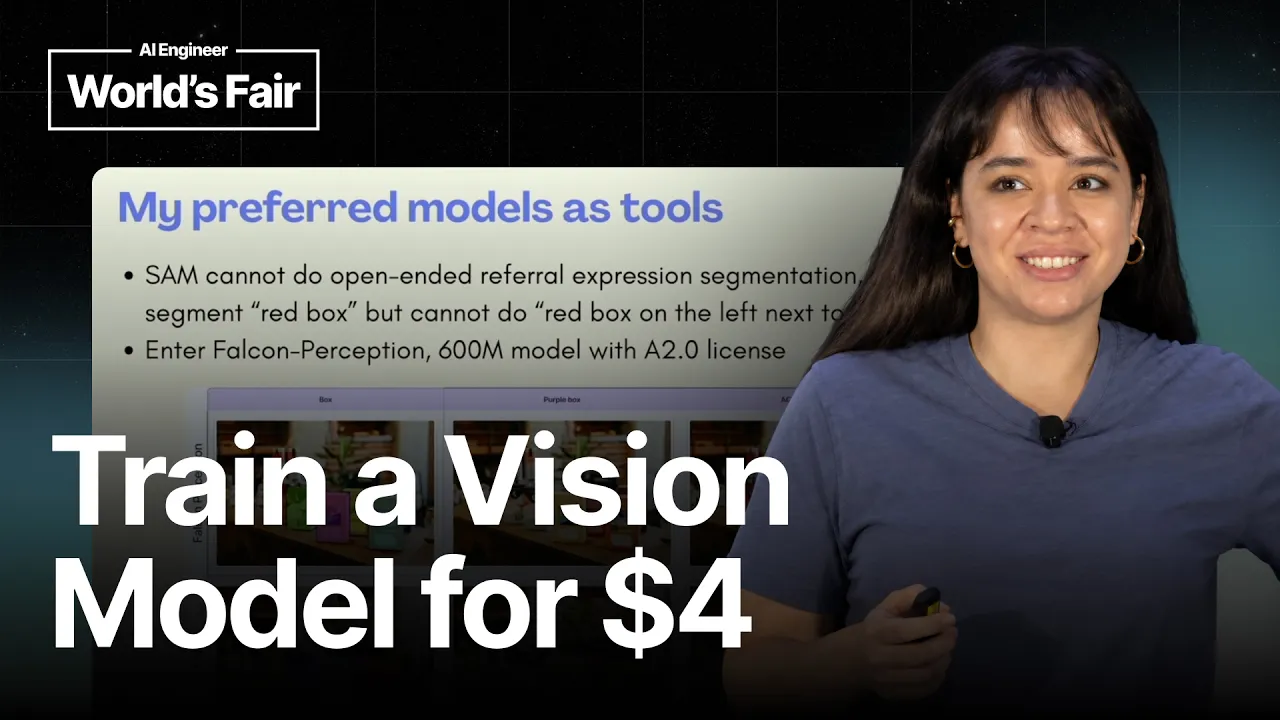
So um I keep it up to date as well but like also it's partially powered by me who likes to read the um computer vision conference papers. Um, so I would like to give a shout out to this model because not a lot of people know about this. So basically Sam cannot do open-ended reference se uh segmentation like you can do like okay segment this red car and it will do it. But if you say okay the red car next to the orange car that is next to the blue car it will not do that. and Falcon perception which is a model by TIA um can actually do it and it's only like 600 million parameters with Apache 2.0 license.
So this one does the zero shot segmentation for me and this is like a non-exhaustive list. So for posing we have the sapiance family um for the human centric tasks where you need to do human koid detection human um depth estimation and so on and for zero shot detection uh I have moon dream 3 and mm grounding dynino which is like a model with apache 2.0 license is also very good. It's very small compared to Moon Dream.
I give you the multiple models in multiple sizes depending on your hardware that you can pick like if you want to go fast just pick the tiny alternative. Um for OCR I actually took them from the OCR benchmark in different sizes and for depth estimation I actually uh discovered that the large model doesn't have a non-commercial license and the rest of them have it. So you can actually use it. That one has like an Apache 2.0 license.
And it also comes with um supervision and tracker support. They are both uh libraries from Roboflow that um allow you to do tracking of instances, bounding boxes and so on and future plans. So first off, I I could hear you say, okay, this will definitely not work for the industry use cases because industry use cases have different parts. it has like nondescribable parts like natural language is not a good gateway to it.
Um so I think in that sense image guided detection could help like if you don't know about image guided detection you basically have like instance of an image like a haggi here as an example and then you ask the model okay detect this object in this image um across all of the images. I feel like it could actually somewhat help in the industry use cases where you cannot describe it by like um natural language. Um as well as I want to try um intersection over union merger sort of basically you have like labeled boxes and then judges boxes like you ask the judge to actually generate a box and then you take the intersection over union instead of asking judge to reject or accept and I'm working currently working on the segmentation support and thanks for listening if you want to actually learn more so basically I We have a small vision repository.
It has everything about like fine-tuning models, quantizing models, multimodel models, everything around vision. Uh as well as transformers task guides. We keep them up to date has many um tutorials. Um, we also have hugging face skills that actually have computer vision specific skills as well as the infras skills that you can just do like a one prompt training. Again, um, and this is my Twitter profile and this repo is actually at GitHub Marvin uh, vision intern.
I think I have qu um, time for one question. Thank you so much. Yes, >> you have plans for training. >> Um, he's asking if I have uh plans to train train VLMs themselves like a self-improvement type of thing. That would be super exciting. But first, I want to solve this thing of like developers actually training task specific models and then deploying on edge and then that could come perhaps. Maybe one more. Yes. >> Um, not really.
I don't think so. I just use the because I wanted because a coding agent actually has the context. I wanted it to generate the prompt. Maybe one more. Okay. Thank you so much.
The words are the caption track's own and nothing is reworded or re-transcribed. Paragraph breaks are placed between sentences so the text reads as prose.
Free tools for your own script. No signup, no login.
Paste your draft and see where viewers are likely to drop off, with a rewrite for each weak line.
Paste the first 30 seconds of your own draft for a hook score and rewrites.
Check your draft against YouTube's advertiser-friendly guidelines before you record it.
Read this channel's public videos and transcripts, and download a writing brief for it.