Getting the transcript
Reading the captions from YouTube. A video nobody has opened here before takes 10 to 30 seconds; this page fills in on its own.
Getting the transcript
Reading the captions from YouTube. A video nobody has opened here before takes 10 to 30 seconds; this page fills in on its own.
AI Engineer · @aiDotEngineer
This video has no Most replayed graph yet: YouTube shows one only once a video has enough views. These are the moments viewers replayed most in AI Engineer's most watched videos.
Most replayed moment at 18:45
4.8x that video's typical replay level
that they're they're changing they're changing things in the database not yet. You want to run them through the ontology first and make sure that works. Okay. I only got an I've got I've got another I've just a short time. I'm going to try to show you some of the things that um that you can
Said at 18:37
Most replayed moment at 16:13
3.6x that video's typical replay level
method signatures, the program layout and the call stacks. So here's some examples. I don't think you'll be able to read this one, but this is like the level of abstraction we're at. It's how we're actually going to lay this stuff out and how these systems are going to interact. Dylan Mulroy from Cloudflare talks a
Said at 16:06
Most replayed moment at 2:02
2.5x that video's typical replay level
are re-bumbling around the work itself. And the important question here becomes a lot less about what is your title and more what part of the system can you own? Now, I like this taxonomy quite a lot.
Said at 1:56
The graph counts replays. It does not show where viewers stopped watching.
Words
1,346
Runtime
12:02
Speaking pace
112wpm
Reading time
6min
112 words per minute, below the 160 25th percentile of 349 measured videos. That distribution comes from the 349-video hook study.
Opening (first 30 seconds)
[music] Hello everyone. Um, this is a practitioner report uh from real production work. So, let's get into it. Um, I'll skip the generic uh yet another loop agent intro. This is about the hard part most agent demos skip. and about turning messy operational knowledge into something an agent can execute safely. This comes from
56 words, the words spoken in the first 30 seconds at 112 words per minute.
Free, no signup. See how the first 30 seconds hold attention, with rewrites.
Sentence shape
| Measure | This transcript |
|---|---|
| Sentences | 89 |
| Average words per sentence | 15.1 |
| Longest sentence | 97 words |
| Questions asked | 1 |
| Sentences containing a number | 3 |
Most used terms
Filler phrases
76 in total: uh 57 · um 17 · you know 2.
A literal whole-word count of the same phrase list the Prepublish browser extension uses, so a phrase inside another word is not counted and a phrase used in its ordinary sense still is. It is a count and not a judgement.
What this transcript is
Every word below is the caption track YouTube publishes for this video, pulled from the video itself and reproduced unchanged. It is not Prepublish's writing, not a summary, and not a re-transcription: it is the video's own published captions. English captions, generated automatically by YouTube, in the video’s original language. Source: the video on YouTube. A channel that would rather this page did not exist can ask for its removal through the contact page, and it is removed.
[music] Hello everyone. Um, this is a practitioner report uh from real production work. So, let's get into it. Um, I'll skip the generic uh yet another loop agent intro. This is about the hard part most agent demos skip. and about turning messy operational knowledge into something an agent can execute safely. This comes from real work uh in my company I'm working for supporting global shipping operations and grounded in production.
On paper it's uh one workflow usually but uh in reality every shipment is an orchestration of many parallel state machines. While they agree the happy paths work the moment one drifts you get exception work. The easy majority is already automated in many companies. What's left is the long tail and more exceptions than system built uh to handle them. That tail is uh the expensive part. And then there's my favorite category.
And it comes with a special uh plate here. See for EI builder dreams and their laptops. This what you can find outside of AI bubble in San Francisco. The signal process uh depends on many systems being coherent at once. If any step uh can't complete the happy path breaks and then it takes expert uh archist expert orchestration across uh multiple incomplete systems. All these uh variations um path pathways should be captured in SOPs.
SOPs is a standard operating procedure common and regulated industries. So an expert and the model read them uh the same way. That gap is the hard part. Stable intent detection tool calls you can guarantee are safe integrating with legacy back ends and results evaluated with experts. Uh I call this uh tribal dungeons. Uh the knowledge exists but not in a form uh agent can execute and you can safely run a process. You can't safely run a process.
The organization cannot represent standard legacy SOPs [clears throat] bunch of bunch of screenshots organized in sequence and but screenshots not uh a process. A legacy SOPs explain what a person sees and clicks. And an agent SOP needs a more complex uh setup, preconditions, uh decisions, identifiers, back end calls, validation, recovery, and evidence of uh successful execution. Experts own the what, agents own the how.
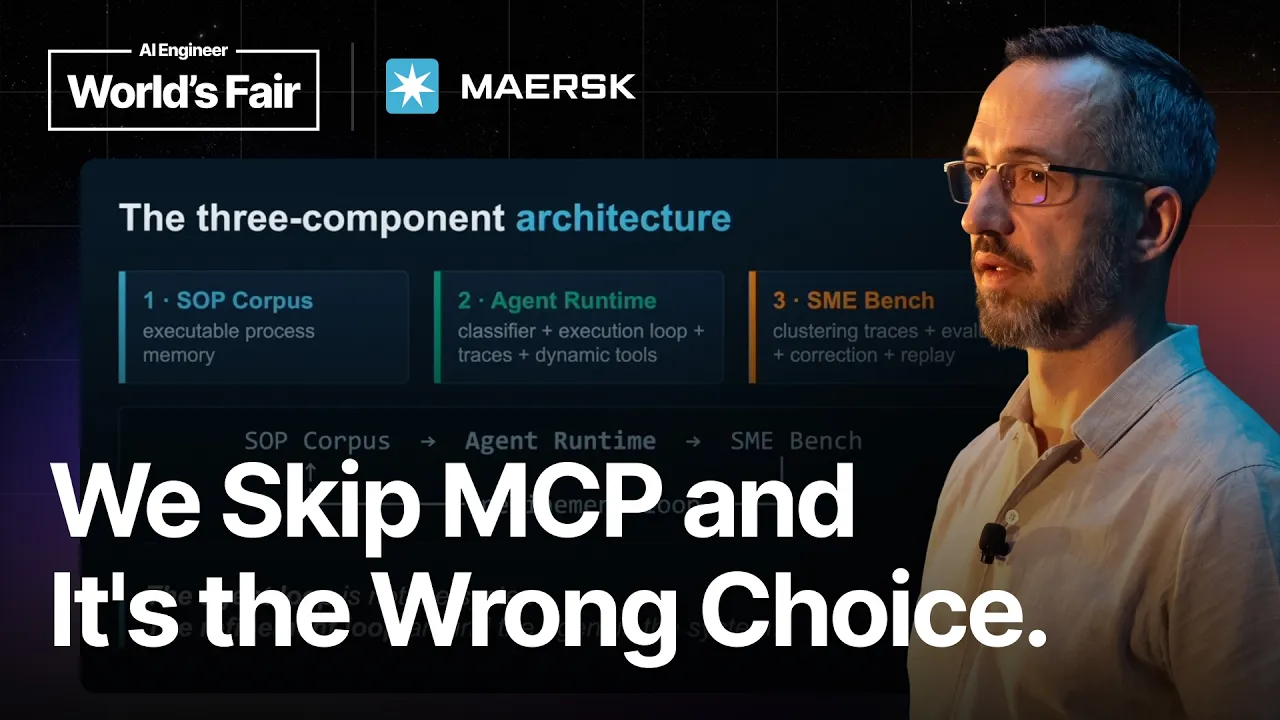
And exception becomes a guardrail. Most of the effort is the translation and negotiation between them to align on common sense. Three parts here um in this architecture it's SOP memory uh organized as SOP corpus execution runtime and theme feedback capture. The agent loop is not the system. The refining loop around the agent is the system and it's the most complex part. Oh, sorry SAP is okay. It's this slide for UK. This is correct one.
So and it's good illustration why the the same thing is means different and uh describing differently in different countries and it's creating a lot of variations between each country and that corpus is a asset the company company's process memory uh modified and aligned with every country um conditions and far bigger than than than runtime you could see the proportion 20 to1 So and this is concurrently operating system and this is the scale we run in production today over 200 instances and spikes and latencies deviates from few minutes to up to 10 minutes.
Um and mainly yeah the mainly main reason for it that u we depending on many legacy system which is uh so cannot be faster than agent loop itself. Expert time is the bottleneck. So the theme bench uh does the triage for us. It clusters the failures and hands back something you can act on. Not just look at look at it. The trace is the shared evidence that lets an expert and an engineer review the same case and agree on what happened.
A correction only counts when it becomes an executable change. And that's the line between an opinion and a production fix. And and this is where quality comes from. not from vibes uh not from a bigger model from replaying real examples with u disabled rights to uh protect the production systems and checking whether behavior improved. You can see here on the uh cognitive proportion u or this effort ratio uh between each activity in our project.
So usually uh pipe coding ends here. Here there ends um specdriven development because it cannot uh grow improve accuracy more than this stage on this scale. And this is uh where the real work starts. Nothing exotic. It's engineering common engineering sense applied at scale. So if uh you don't know all this uh terminology which developed over lastuh 30 years in software development argument to check because this is what every AI agent uh AI coding agent should know uh to help you develop reliable production systems and accuracy it's uh wasn't designed uh in one diagram up front it was earned one small correction at the time at the scale you see here.
So we have over 100,000 corrections over last 9 months in the system when we developing it [clears throat] and this um heat maps uh turned thousands of traces into priorities. is how we keep experts and engineers uh looking at the same problems and prioritize where the the most beneficial work for them. Every cell is a group of tracked scenarios we have and uh usually to turn one block in red it's around one two months of force for the whole team whole team of engineers and also AI agents um the agent failed is uh where the investigation starts not where it ends each failure maps to a specific uh fix discovery needs agent freedom and production needs a cage.
Uh the harness isn't there to give the agent more room. It's there to make the dumb mistakes impossible. So on this scale please be careful is not a guard guard. Uh if we have wrong workflow then classifier eval. If it's wrong right then right gate. If it's wrong assumption then it's a mere view. A preventive measure eliminates the unsafe path on critical paths. U review and approval stay in the loop. The engine engineering focus is uh to build safe hands offs and a trail you can trust.
The real outcome uh wasn't the agent in the system. It was the [clears throat] methodology we built around it. If you want the blueprint, then it's uh these five moves. Make work representable. Make exe execution bounded. Make behavior observable for every agent and make correction cheap. And last thing is make improvement compound. So gradually systematically improve the quality of the system. AI native um operation is more than agents in workflow.
It's a system that learns from what works and fold folds it back into code as new composite tools adapting to the applications and the people around it. The best AI models um oriented intelligence for us. The adaptive architecture we built is the asset, the final asset and we aggregating all um repeatable sequences of steps successful scenarios and uh merging them into bigger tools which uh combine the disproven scenarios into the reusable snippets by other agents.
So and then um it's possible to roll out them not only for one country but for hundreds country in one go. So this is um um all for the talk and little time for questions and I'll be around afterwards. And the final reminder you know if you you know if you are AI builder if you emotionally attached to tools not MCPS we're not using MCPS because uh for us it's uh always not the best choice. So because all all systems usually really bloated and we have to distill responses and uh tune the tools through function calling uh to our agents then we can control quality of um our software and ensure that uh it's correctly processing assigned tasks.
Thank you. Any questions? Okay, then um thanks for your attent u attention. Then I will be around so you can ask me questions if you want. [applause] >> [music]
The words are the caption track's own and nothing is reworded or re-transcribed. Paragraph breaks are placed between sentences so the text reads as prose.
Free tools for your own script. No signup, no login.
Paste your draft and see where viewers are likely to drop off, with a rewrite for each weak line.
Paste the first 30 seconds of your own draft for a hook score and rewrites.
Check your draft against YouTube's advertiser-friendly guidelines before you record it.
Read this channel's public videos and transcripts, and download a writing brief for it.