Getting the transcript
Reading the captions from YouTube. A video nobody has opened here before takes 10 to 30 seconds; this page fills in on its own.
Getting the transcript
Reading the captions from YouTube. A video nobody has opened here before takes 10 to 30 seconds; this page fills in on its own.
History Helms · @HistoryHelms
Where viewers went back to watch this video again, from YouTube's public Most replayed graph, lined up with what was said at that moment.
Most replayed moment #1
5:277.1x the video's typical replay level
forcing schools to spend thousands redesigning everything, a brilliant legal loophole emerged. Many major universities entered into gentlemen's agreements, perhaps gentlemen's loopholes, right, with [music] high schools. For example, some colleges allow high schools to use their trademarked logo
Said at 5:20
Most replayed moment #2
5:486.7x the video's typical replay level
year. Under a couple conditions, of course. The high school can't sell merchandise nationally, and their total revenue must stay below a certain cap. By the way, let me know in the comments what these schools have in common. So, instead of creating original art, thousands of high schools legally chose to just copy and
Said at 5:40
Most replayed moment #3
1:194.4x the video's typical replay level
mammal. Problem solved. Though I should mention the Indian man mascot is insanely [music] popular even today. More on that later though. But generic predatory mammal only explains the names. Why do pretty much all of them have this old cartoony
Said at 1:13
The graph counts replays. It does not show where viewers stopped watching.
Words
1,657
Runtime
8:46
Speaking pace
189wpm
Reading time
7min
189 words per minute, between the 181 median and the 201 75th percentile of 349 measured videos. That distribution comes from the 349-video hook study.
Opening (first 30 seconds)
If you went to high school in America, I'd bet your mascot was a tiger, eagle, bulldog, or panther. Funny enough, just those four animals account for nearly a third of all high school mascots. Likewise, 15% of American college mascots are one of those four. But this gets weirder. It's not just that they have the same names, they also look identical with this bizarre, hyper-muscular, usually angry, old cartoon aesthetic. Why? In simple language, this mess is all a result of a multi-million dollar one-man design monopoly and a secret gentleman's loophole that
95 words, the words spoken in the first 30 seconds at 189 words per minute.
Free, no signup. See how the first 30 seconds hold attention, with rewrites.
Sentence shape
| Measure | This transcript |
|---|---|
| Sentences | 114 |
| Average words per sentence | 14.5 |
| Longest sentence | 45 words |
| Questions asked | 13 |
| Sentences containing a number | 9 |
Most used terms
Filler phrases
19 in total: like 11 · actually 5 · right? 2 · basically 1.
A literal whole-word count of the same phrase list the Prepublish browser extension uses, so a phrase inside another word is not counted and a phrase used in its ordinary sense still is. It is a count and not a judgement.
What this transcript is
Every word below is the caption track YouTube publishes for this video, pulled from the video itself and reproduced unchanged. It is not Prepublish's writing, not a summary, and not a re-transcription: it is the video's own published captions. English captions, generated automatically by YouTube, in the video’s original language. Source: the video on YouTube. A channel that would rather this page did not exist can ask for its removal through the contact page, and it is removed.
If you went to high school in America, I'd bet your mascot was a tiger, eagle, bulldog, or panther. Funny enough, just those four animals account for nearly a third of all high school mascots. Likewise, 15% of American college mascots are one of those four. But this gets weirder. It's not just that they have the same names, they also look identical with this bizarre, hyper-muscular, usually angry, old cartoon aesthetic.
Why? In simple language, this mess is all a result of a multi-million dollar one-man design monopoly and a secret gentleman's loophole that schools [music] have been exploiting for decades. This is a deeper rabbit hole than you think. In the early days of American sports, the late 1800s, early 1900s, mascots and team names were mostly localized. If your town was a logging town, you were the lumberjacks. If you were near the coast, you were the skippers.
But things drastically changed in the '50s. Suddenly, tiny rural schools were merging into massive regional high schools. When you bring three different towns together, you can't be the lumberjacks anymore if half the kids [music] come from a mining community. You need something neutral, something safe, something fierce but completely inoffensive. The solution? Indian caricature. Just kidding. Though I did cover that a few weeks ago. >> [music] >> The real solution, generic predatory mammal.
Problem solved. Though I should mention the Indian man mascot is insanely [music] popular even today. More on that later though. But generic predatory mammal only explains the names. Why do pretty much all of them have this old cartoony look to them? This is where we uncover the secret monopoly of graphic design. Now, before the internet, if a new school opened in 1951, for example, and needed a logo, they didn't look for a brand agency, but instead looked through a catalog from a sporting goods supplier like Riddell, Russell Athletic, or a local screen printing shop.
These companies had a binder of standard pre-made clip art. If you were the Tigers, you got Tiger design number four. If you were the Bulldogs, you got Bulldog design number two. Do you see how this works? Many colleges actually did the same thing, and nobody really cared since unlike today, universities didn't see their logos as untouchable intellectual property to guard with litigation. But instead, these fun school spirit designs to sell on merch.
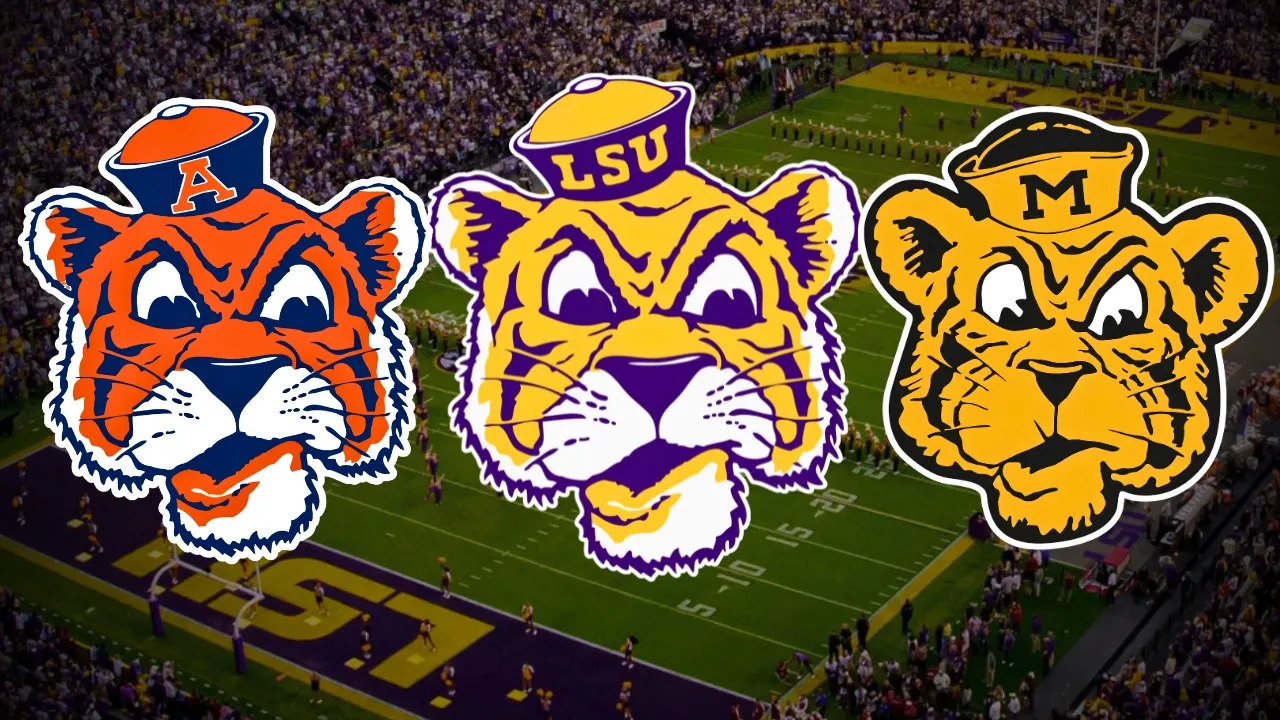
On top of that, forum boards didn't exist, and national sports cable wasn't a thing until the late '70s. So, if you were an Auburn fan, bless your heart, you wouldn't really know that the people in Columbia, Missouri were using the same exact tiger with a beanie logo with a few tweaks. These designs from the early to mid-1900s became the blueprint for what a mascot should look like, and they [clears throat] completely dominated the market.
But here's the really crazy thing, and I think you'll like this. These sports suppliers weren't actually drawing these logos. If you trace their catalogs back to the source, you land on a single decal company in California, the Angeles Pacific Company. And get this, if we trace back even further, [music] we land on Arthur Evans, the man who basically monopolized the sports logo game. Okay, now now now this really gets fun.
So, he personally hand-drew around 90% of college logos of the mid-1900s, and not just the tigers, but also North Carolina's Tar Heel, USC's Tommy Trojan, Washington State's Cougar, and so many more. They look the same because they have the same illustrator with the same style. Don't believe me? I'm going to show you the three ways to spot an Arch Evans logo, and once you see them, you can't unsee them. First, the obvious beanie, which looks like a sailor hat to us.
Then the menacing little underbite, which I always found to be really neat, right? And lastly, the eye notch, this distinct V-shaped slit inside the eye. I just find this to be so neat. If you learned anything so far, drop me a like. But I know what you're thinking. History Helms, we're in the modern age, and the names and mascots and logos are all pretty much still the same. Why? Well, that's because school tradition lives on, and so does the monopoly.
Fast forward to the digital age, and the monopoly is now moved to the internet. Today, thousands of schools buy their logos from massive stock vector sites or use free online logo generators. The artists selling on these platforms know what sells. Hyper-aggressive clean vector lines with heavy sports font. So, they copy the existing formula creating a massive feedback loop of absolute sameness. Now, some of you might be looking at your own high school logo right now and thinking, "Well, our logo doesn't look like the generic clip art.
It looks exactly like the Chicago Bears or Georgia Bulldogs logo, just recolored." Now, if you think your school stole its logo from a professional or college team, yeah, you're probably right. For decades, American high schools have practiced blatant unmitigated copyright infringement on a staggering scale. And you think professional leagues and big brands like the NFL and major universities would send in their legal dream teams to stop this.
But, they actually just let it go. Why? Well, because a multi-billion dollar corporation suing a cash-strapped public high school in a tiny town in South Carolina over a drawing of a tiger is a PR nightmare. It makes the corporate lawyers look like Disney villains. And besides that, it would give Paul Finebaum too much material. >> More. Number one, I still don't know who you are. I don't know why you're upset. I don't know why you're accusing me of lying.
So, why don't you >> But, once we reach the early 2000s, everything changes. Colleges realized they were losing millions in merchandising revenue, and they started sending out massive waves of cease and desist letters to high schools. The University of Wisconsin went after dozens of high schools using their famous motion W logo. But, instead of forcing schools to spend thousands redesigning everything, a brilliant legal loophole emerged.
Many major universities entered into gentlemen's agreements, perhaps gentlemen's loopholes, right, with [music] high schools. For example, some colleges allow high schools to use their trademarked logo with a few changes for a literal licensing fee of one whole dollar a year. Under a couple conditions, of course. The high school can't sell merchandise nationally, and their total revenue must stay below a certain cap.
By the way, let me know in the comments what these schools have in common. So, instead of creating original art, thousands of high schools legally chose to just copy and paste the branding of Texas or Ohio State for a reasonable fee. This is a pretty smart deal. For the colleges, it's free marketing and the ability to dodge the public criticism that would come from a lawsuit. And for the high school, it's a premium pre-made logo and or mascot.
However, on the other hand, the NFL is the intellectual property boogeyman, up there with Disney and Nintendo. But, they actually just let youth and high school programs use their logos for free with similar terms as the colleges. And I have my thoughts as to why, but let me know what you think about this. The NFL is notorious for sending its legal Spartans at the little guy for copyright infringement, which is why you hear companies say the big game instead of Super Bowl.
So, do you think it's fair that the league allows high schools and peewee organizations to use their imagery for free 99, or should this generosity spread out a little further? Now, there's one final layer to this mystery, [music] and it's a psychological master class. Why do we want them to look like this? Why must every bird, mammal, and even inanimate object be hyper muscular and furious about something? Well, it's actually for a really good reason I doubt most of us have even thought about.
[music] In American sports culture, a mascot and its relevant logo has a dual purpose. It has to entertain children in the stands, but it also has to project intimidation on a t-shirt. This creates a weird design paradox. You [music] can't make the mascot too scary, or toddlers will cry at games. That was me, by the way. The cartoon [music] suit creature with weird proportions was early uncanny valley material. But, you also can't make it too cute, or the rival team will make fun of your players.
Though, this hasn't really been an issue for the [music] Montgomery Biscuits. The American mascot style is a finely tuned [music] psychological compromise. It is designed by committee, optimized for maximum merchandise sales and recognition, [music] which narrows us down to only a handful of representative creatures, when you really think about it. Clip art catalogs, loopholes, this absolute beast, and a need [music] for unity among merging schools gets us some predictable mascots.
Here's the odd thing though, and I'm fully confident [music] you noticed this at some point. So, this quest for unity is a big part of why so many schools adopted the very popular, yet very controversial Native American man mascot, to the point of rivaling eagles and even tigers for popularity. Not only do the warriors, or chiefs, or braves technically satisfy that generic mammal thing from earlier, but get this, [music] Native American has American in it.
How unifying, right? And while this is all changed, even with big brands like the Cleveland Indians and Washington shifting gears, there's one brand that remains entirely [music] untouched. This seems unfair. Why do the Florida State Seminoles get to do whatever they want, while everyone [music] else had to change? Click here to find out.
The words are the caption track's own and nothing is reworded or re-transcribed. Paragraph breaks are placed between sentences so the text reads as prose.
Free tools for your own script. No signup, no login.
Paste your draft and see where viewers are likely to drop off, with a rewrite for each weak line.
Paste the first 30 seconds of your own draft for a hook score and rewrites.
Check your draft against YouTube's advertiser-friendly guidelines before you record it.
Read this channel's public videos and transcripts, and download a writing brief for it.