Getting the transcript
Reading the captions from YouTube. A video nobody has opened here before takes 10 to 30 seconds; this page fills in on its own.
Getting the transcript
Reading the captions from YouTube. A video nobody has opened here before takes 10 to 30 seconds; this page fills in on its own.
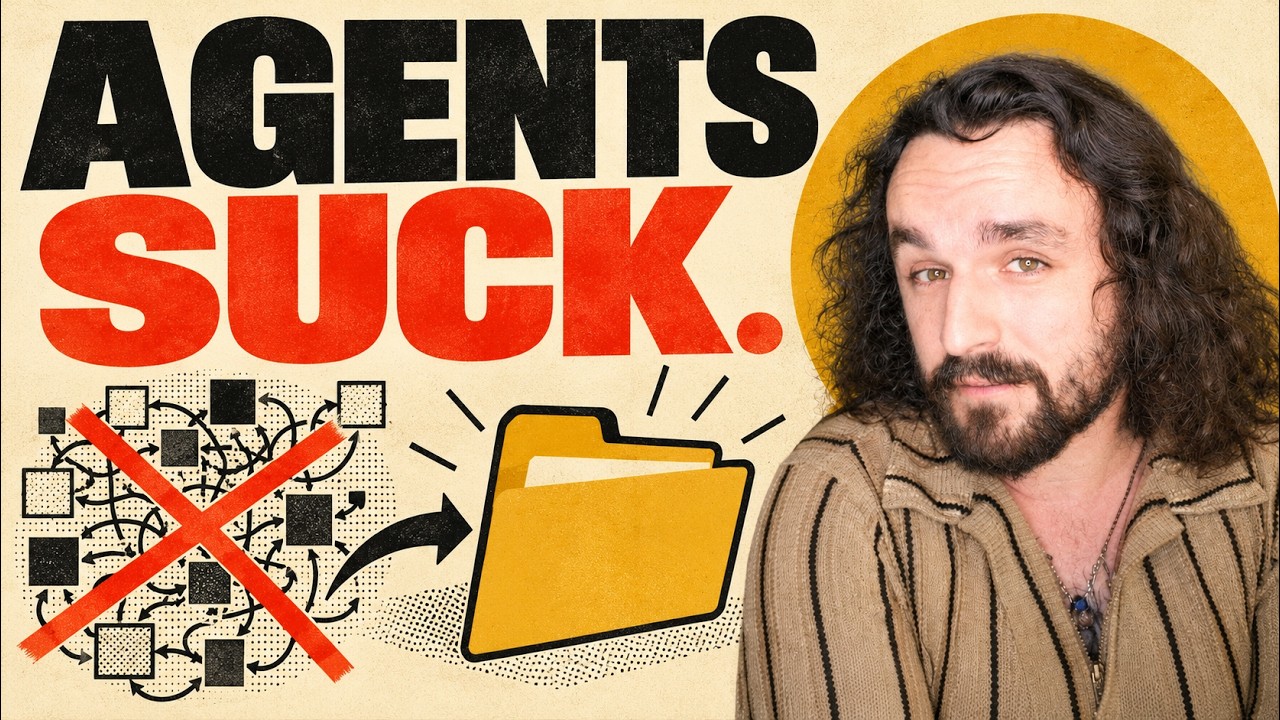
Jake Van Clief · @JEVanClief
Words
1,030
Runtime
5:10
Speaking pace
199wpm
Reading time
4min
199 words per minute, between the 181 median and the 201 75th percentile of 349 measured videos. That distribution comes from the 349-video hook study.
Opening (first 30 seconds)
Hello everyone. My name is Jake Van Cleef and I'm going to do my best to explain ICM in under two or three minutes. Essentially, a lot of people are trying to build out contexts and agents and all of these things on top of the same model and the same harness and I argue those are just system prompts trapped inside code. Those are things that you don't need to do. Right now, a lot of the models themselves can already read and write files and are really capable on their own and building out these extra routing things
100 words, the words spoken in the first 30 seconds at 199 words per minute.
Free, no signup. See how the first 30 seconds hold attention, with rewrites.
Sentence shape
| Measure | This transcript |
|---|---|
| Sentences | 52 |
| Average words per sentence | 19.8 |
| Longest sentence | 42 words |
| Questions asked | 8 |
| Sentences containing a number | 2 |
Most used terms
Filler phrases
37 in total: uh 13 · like 7 · right? 6 · sort of 4 · actually 3 · you know 2 · I mean 1 · um 1.
A literal whole-word count of the same phrase list the Prepublish browser extension uses, so a phrase inside another word is not counted and a phrase used in its ordinary sense still is. It is a count and not a judgement.
What this transcript is
Every word below is the caption track YouTube publishes for this video, pulled from the video itself and reproduced unchanged. It is not Prepublish's writing, not a summary, and not a re-transcription: it is the video's own published captions. English captions, generated automatically by YouTube, in the video’s original language. Source: the video on YouTube. A channel that would rather this page did not exist can ask for its removal through the contact page, and it is removed.
No Script X-ray for this video: YouTube shows a Most replayed graph only once a video has enough views.
Hello everyone. My name is Jake Van Cleef and I'm going to do my best to explain ICM in under two or three minutes. Essentially, a lot of people are trying to build out contexts and agents and all of these things on top of the same model and the same harness and I argue those are just system prompts trapped inside code. Those are things that you don't need to do. Right now, a lot of the models themselves can already read and write files and are really capable on their own and building out these extra routing things for context is unneeded.
Instead of building a planner agent or analysis agent or a writer agent that has to have all of that context stuck inside of it and it's not really mutable. Instead, you just take one good model with one good harness and point it at a folder structure that has all of those judgments, those prompts, those contexts inside of it. What do I mean by that? Well, essentially, I have an ICM that I'm going to run you through right now.
Every weekend, I like to do a lecture where I talk about, you know, work or software, things that we're doing and I like to take that transcript and do a lot of different things with it. And traditionally, people would say, oh, well, let's make an agent that takes the transcript and converts it into all the different files so that every single time it does it the same way. And that's great, but I think that's the wrong mentality.
Instead, I simply captured the way in which I like to edit the files, what I like to do with that and put those descriptions, those prompts into stages inside of a folder. So, if I was to do this manually, I would be creating sessions, I would be dropping my recording inside of those sessions and then I would be doing my work with it, right? So, in this case, I have my recording in here and then I would transcribe it manually, right?
And I would get those transcriptions and then maybe I would do something with it. I'd look at the transcriptions and I'd add up all the questions that are in there or maybe I would create some sort of term sheets, or some sort of maybe some other kit or or digital artifact that people would want. Uh maybe I'd make some sort of slide deck, right? This is one of the slide decks that I actually made from one of my lectures.
Um and I would need to be able to pull from various assets and things like that. Uh right? I would have uh I would have a certain way in which I like to design. I'd have fonts and UI kits. But if that's already all inside of folders, well then all I need to do is make one really good file that describes what all of those folders are and what I do inside of them, right? It's almost a simple file map uh as a markdown file that describes, "Hey, here's what's all in this folder.
Here's what's in this folder. This is what I do in this workspace." And every time I go deeper into one of the folders, I might have another set of context or descriptions on what I do inside of that folder. And what that allows me to do uh is essentially automate that whole process by pointing one good model and one good AI at that folder, and it will do all of those things as if it was an agent. Yet I'm not stuck inside of an agent.
I can use any AI. So when I point Codex or ChatGPT at this folder and say, "Can you create a uh package for the HighTide 15?" It knows nothing about any of this. This is a fresh AI. But the first thing it reads is that agent.md or that claw.md. It immediately understands what the workspace looks like, what it needs to do, and it just starts working away, right? And then next thing you know, I end up with my finished product, my finished work or sets of works that I actually wanted.
And the best part is, if I wanted to do this with any other AI, I don't have to change any code, I don't have to do anything advanced. I just point that AI, as long as it can read files and navigate them, at that folder, ask my question, and it becomes the agent I need based on just simply reading and navigating that folder and that structure. This allows me to also be able to edit and mold and do things at as I want with this structure.
I can either automate the whole process, or I can just have the AI only do one part of the process, and I can go through and edit part of it. It allows me to go back and forth. It allows me to capture it all. It allows other people to access that folder simply uh and be able to navigate and use it if I use OneDrive or some sort of deployable folder software. Uh and it just allows me to avoid a lot of the agentic hubbub and work and simply just get straight to the outcome, straight to the work that I actually need.
Just drop in the recording, and the AI will transcribe it, package it, and publish it as simply as I need, all inside of a folder structure, which is more editable by less technical people. It is more scalable, and it is simple to audit. Uh it's a little bit over uh 2 minutes, but I think that gets the idea done. Uh if you want to learn more, uh just search in Jake Van Cleef Interpretable Context Methodology. I have research papers and everything else about it.
Or you can listen in on any of the amazing lectures uh that are lecturing on all this as well. Thank you so much, everyone, and happy learning.
The words are the caption track's own and nothing is reworded or re-transcribed. Paragraph breaks are placed between sentences so the text reads as prose.
Free tools for your own script. No signup, no login.
Paste your draft and see where viewers are likely to drop off, with a rewrite for each weak line.
Paste the first 30 seconds of your own draft for a hook score and rewrites.
Check your draft against YouTube's advertiser-friendly guidelines before you record it.
Read this channel's public videos and transcripts, and download a writing brief for it.