Getting the transcript
Reading the captions from YouTube. A video nobody has opened here before takes 10 to 30 seconds; this page fills in on its own.
Getting the transcript
Reading the captions from YouTube. A video nobody has opened here before takes 10 to 30 seconds; this page fills in on its own.
Dara Denney · @DaraDenney
This video has no Most replayed graph yet: YouTube shows one only once a video has enough views. These are the moments viewers replayed most in Dara Denney's most watched videos.
Most replayed moment at 1:55
4.1x that video's typical replay level
different parts of your computer and different apps, you're going to have to give it access through connectors. And for everything that we're going to go through today, make sure that you at least have Chrome connected as well as Slack. Now, let's dive into this first one, analyzing ad libraries. Now,
Said at 1:49
Most replayed moment at 14:54
4.4x that video's typical replay level
like to use it in addition to this is right here. First, what you're going to do is go to Claude, and you're going to export your brand brain, and any other context documents that you have. If you don't have that yet, here's a really great prompt that I use for all of my
Said at 14:46
The graph counts replays. It does not show where viewers stopped watching.
Words
3,123
Runtime
16:00
Speaking pace
195wpm
Reading time
13min
195 words per minute, between the 181 median and the 201 75th percentile of 349 measured videos. That distribution comes from the 349-video hook study.
Opening (first 30 seconds)
I reverse-engineered over a thousand brands to find the ones with the best creative strategy, and these ten are the ones that actually gave me perspective and tactics that are resulting in winning ads. And this isn't just brands that I saved for inspiration, right? They actually taught me something really specific about creative strategy that is now resulting in winning ad creative for my clients. So, let's first start with a brand that completely revolutionized the way that I think about creative testing, which is Caraway Home. So, Caraway taught me how to best do creative testing
98 words, the words spoken in the first 30 seconds at 195 words per minute.
Free, no signup. See how the first 30 seconds hold attention, with rewrites.
Sentence shape
| Measure | This transcript |
|---|---|
| Sentences | 163 |
| Average words per sentence | 19.2 |
| Longest sentence | 87 words |
| Questions asked | 11 |
| Sentences containing a number | 11 |
Most used terms
Filler phrases
62 in total: like 28 · actually 18 · right? 5 · kind of 4 · you know 4 · literally 2 · I mean 1.
A literal whole-word count of the same phrase list the Prepublish browser extension uses, so a phrase inside another word is not counted and a phrase used in its ordinary sense still is. It is a count and not a judgement.
What this transcript is
Every word below is the caption track YouTube publishes for this video, pulled from the video itself and reproduced unchanged. It is not Prepublish's writing, not a summary, and not a re-transcription: it is the video's own published captions. English captions, generated automatically by YouTube, in the video’s original language. Source: the video on YouTube. A channel that would rather this page did not exist can ask for its removal through the contact page, and it is removed.
I reverse-engineered over a thousand brands to find the ones with the best creative strategy, and these ten are the ones that actually gave me perspective and tactics that are resulting in winning ads. And this isn't just brands that I saved for inspiration, right? They actually taught me something really specific about creative strategy that is now resulting in winning ad creative for my clients. So, let's first start with a brand that completely revolutionized the way that I think about creative testing, which is Caraway Home.
So, Caraway taught me how to best do creative testing in the Andromeda era. And this is specifically how they set up variations in their test. And previously, we would just swap out hooks or do really simple messaging test inside of our variations. So, this would be an example of a creative test for images. But when Caraway launches a test, their variations look like this. Different formats, different messaging, nearly no variation testing to speak of.
So, these are all the creatives for their new trash product launch. And you can also see that they did two dynamic ad tests as well. One that is more focused on the actual product and the design of the product, and another one that is focused more on the benefits. So, my big learning when looking at all of this, right, is you really need to inject creative diversity into your initial test. You do not need to split test every single little thing.
This is really the big takeaway that I took from looking at Caraway's approach to creative testing. And more specifically, that you shouldn't be scared of combining formats. Now, if you guys are interested in an updated video on creative testing, please be sure to let me know. I would be happy to do that in the next few weeks. Now, Happy Mammoth is one of my favorite brands to watch for static ads specifically. Most of you guys, every time I jump into their ads library, I feel like I see some type of format that I have never seen anywhere else before.
And honestly, that matters a lot more than people think. Statics tend to become more stale more quickly. And once they start feeling too familiar, then they stop grabbing attention. But Happy Mammoth keeps on finding new ways in. And also, they're not afraid to test AI ads, and I will keep it 100 with you. I think a lot of their ad creatives would honestly send a normal brand team into a coma. But, their approach to grids, infographics, statics that kind of look like videos, and even AI cartoons, I just can't emphasize enough that they are really winning the game at getting more creative diversity, and just testing as much as they can.
I literally always, always, always find a new static ad to get into rotation after checking out their ad library. Hey there, Dara from the future here in my new studio that I'm building out, actually. But, I just wanted to jump in and say that even though these AI statics are really, really cool, you are probably going to struggle to get performance on Meta in the coming months and years unless you continue to work with real creators and use real content.
I actually just went to the Meta Performance Summit, and something that they really emphasized was that the future that they see for paid media is that selling is going to be primarily done by creators, which is why I have really loved partnering with Storyblocks for all these years because a human-made content library is an absolute essential for both creators and UGC content. Because sometimes you're just going to need that extra shot, and Storyblocks is going to have it.
And something that I've been testing lately is actually injecting a little bit of subliminal messaging into my ads, kind of like this. Like, maybe you're making an ad about what menopause feels like, or how it feels to finally get relief from itchy, dry skin. Storyblocks has the biggest stock footage library on the market, and they are 100% royalty-free, even for ads. And their new AI features allow you to customize clips so that you can get the shot that is just right for your piece of content.
To start telling better stories with the exact tools that I use, go to storyblocks.com/daradenny. They're offering a limited-time discount off any annual plan, and that is only available through my link in the description. Now, Seed Health taught me two really big crucial things that I now keep in my toolkit as a creative strategist. And I also interviewed them in the last year about their exact approach to creative testing.
And one thing that we talked about was their biggest creative learning to date. >> It's the aspirational pooping every day. Will I poop when I'm traveling? Will I go before the big game on this big day? And I mean, it's our top value proposition on Meta. >> But just a few days ago, when I was going through their ad library, I noticed that this creative learning, this pooping every day ad angle, was still super prevalent in their ad account.
In fact, using Claude, I was able to see that one in seven of their ad creatives featured this messaging. One in seven. This truly blew my mind because it really showed me that, hey, most of the brands that I work with, and maybe most of the brands watching this channel, probably aren't doubling and tripling down enough on their core learnings. They're not replicating their winning idea by format. They're not having other creators just simply re-film the winning script.
And I always get asked this question whenever I talk about it, how long should you iterate on a concept? The answer is until it stops working. I think if brands truly understood this, then they would get better results by doing a lot less. Because you already have amazing learnings, and by taking those learnings and putting them into different formats, you're actually creating a little bit more of a funnel in an ecosystem for that core idea.
It is now actually something that I'm really passionate about doing for the brands that I work with at the agency because people need to see things more than once. It kind of reinforces this core idea, right? Oh, and the second thing that Seed is really excellent at, because I could honestly spend an entire video about how they are properly doubling and tripling down on their core learning. But the other thing that they're very excellent on is their AI images.
Now, their AI images are sexy. They look elevated. The Happy Mammoth stuff, listen, we know a lot of that is AI and like, you know, that demographic a little bit older just kind of accepts it. But, Seed on the other hand, their stuff looks good. Now, if you want to learn how to make ad creative like Seed, particularly their AI statics, let me know. My friend will actually runs the agency that makes a lot of their ad creative and he said he was interested in showing you guys how to do it, too.
Now, speaking of brands that I look to for more of that elevated inspiration, Aerie is another one that anytime I'm working with a brand that needs a little bit sexier elevated creative, they are honestly top-tier for me. They have perfectly balanced what feels brand safe and what is actually platform native in a way that actually performs. Because a lot of brands end up going too generic or they go too safe where their creative just loses all tension.
Aerie sits in a really healthy medium. This is also the brand that taught me about the hot girl stories format that I have adopted to using for several of my clients and it still continues to crush in 2026. Honestly, Aerie just really kills it for more of the aspirational girly. Great brand, great performance creative and it looks good. Now, Pact is the brand that I really look to for inspiration on internal content creator ads.
So, ads that are not made by an external content creator that you had to brief, but ad creative that is made by someone who is a full-time staff member on the brand and cranking out creative on a daily basis for them. So, when I interviewed their chief digital officer, Caylin Purker, a few months ago, she told me, "Hey, we do not have a creative strategist on staff. We actually have an internal creative strategist." Now, the reason why I want to share this is this is actually a little bit more of a creative operations model for me.
And yes, Pacha's has crushed it and they are absolutely worth studying. She made four of Pacha's top performing creative in the last year alone. Like very, very good stuff to take a deep dive on. But I think Pacha's is actually a better study on how to work with a small lean team that does really big things. In fact, I am starting a brand and I am starting from this model initially. I am looking to hire internal content creators.
I will >> also be a content creator for my own brand. And Pacha's has really given me a great model for me to go after in the early days. And another great reminder that Pacha's and brands like Pacha's have given me in general is that your creative strategist, especially if they are working with creators and making scripts for creators, they need to be able to think like a creator. Now, another brand that I really like as inspiration for the internal content creator model is Osea Skincare.
And a reason why I really like following their journey is because they initially got their start more from founders content. So often times when I am working with founders who are really starting to scale up their brand and they want to take more of a backseat from the actual content production, Osea Skincare is always a brand that I show them because I'm like, "Hey, you know, initially they had all their top performing creatives come from the founder and they were able to shift really successfully into working to with an internal content creator." >> And speaking of founders content, my go-to for founders content is Cheers Health by a long shot.
It is completely different from the generic type of founders content that I normally see that brands are creating. And like don't get me wrong, that generic stuff works. But Cheers just has a je ne sais quoi cuz they're able to really inject a ton of education into their content. They know how to stop a scroll and really pack a punch with their information and they really know how how play with cognitive dissonances well and really saying the controversial thing that maybe doesn't seem true and really tease out that storyline.
And another thing that I'll say too is they've been able to really successfully expand beyond their bread and butter founders content by incorporating more of their additional employees into the content. Like right now their head of growth is showing up in a lot of their ad creatives which seems to be doing well. So just more inspiration on how you can expand your operations and how you can see a light at the end of the tunnel if you are a founder and you're wondering like hey, am I always going to be on the hook for this?
No, there are absolutely pathways to getting other creators and other faces and other employees into your ad account and it's going to benefit you to do so. So these are the brands that I look at that have really, you know, helped bring that to life for other brands. Overnight Oats. Now Overnight Oats is another brand that honestly just had amazing EGC employee generated content. Their warehouse content is bar none the gold standard in D2C.
And for a few years they've really been masters at creating content that overcomes objections, right? Like this ad creative right here. I've probably shown it a million times on this channel. But lately I've been spying on them for something totally different. Some of what I would consider to be more of their unhinged content. Because the reality is that there is like a certain type of playbook that most D2C brands play, right?
There are 10 static formats that everyone makes sure that they test. There are five or so types of UGC scripts everyone puts into their ad account and there are three types of founder scripts everyone uses. But Overnight Oats is doing something different. They're taking a page out of what goes viral on the internet and really adapting it for their audience and for paid. I'm not going to lie. I I don't know if any of this works so report back Overnight Oats.
But just watching them go through this process has given me a lot of inspiration on how I can incorporate more viral images and more viral ideas into the ad creative of my clients. Now, Laura Geller and Jones Road Beauty, I always love keeping tabs on these two brands for their creator partnerships and more specifically their partnership ad strategy. It's not just necessarily because I'm like curious who they're working with and I'm going to try and work with them with my own clients, not at all.
It's because partnerships really tell you more about how a brand wants to be perceived and the type of audience that they're really trying to tap into. It's not just, "Oh, I'm going to work with a celebrity so that I can get more reach and drive more sales." It's actually a lot more strategic than that. It tells you about who the brand wants to be associated with, what types of audiences they're trying to get close to, and more of the type of world that they're building around the overall product.
And that's really why I like to watch both of these brands, right? You can really see, even though in many ways they have been targeting a very similar customer for the last few years, in the last year there's been a pretty big delta shift between the two of them. Laura Geller is really firmly in the 50-plus woman arena and really working with creators that really uniquely speak to her. Whereas Jones Road Beauty has actually been moving in the other direction and trying to work more with millennial moms and going towards a slightly younger audience.
Both of these brands, too, like really understand the importance of partnership ads. I think in beauty you really have to because it is such a hyper-competitive niche and market. You're not going to make it unless you are partnering with other tastemakers inside of your industry. And that's why I always like to keep it in close eye on both of these brands as well to see what their distribution of spend is between partnership ads and more of their bread and butter brand content.
And the last thing that we're going to talk about are the brands that have the best hooks in the game, and that is going to be Dr. Squatch, Rise, and The Perfect Jeans. If you want to become an elite creative strategist, the number one thing that you should study is hooks. And this is not a revolutionary or new statement. I admit that me saying this in and of itself is a little bit of a cliche. Study hooks, you need to have a good good hook.
But like, I've been in this industry for 10 years and I cannot tell you that it is still the defining factor of if a brand is going to succeed or not and if a creative strategist is really worth their salt or not. And it's because it's 100% true. Hooks are literally the 80/20 of ad creative. If you can write a great hook, you can write a great ad. You can write great messaging. So, these brands are the ones that I really love to learn hook writing from.
Now, Perfect Jean actually, I actually find that they are really really great at nailing more of the visual hooks. So, one of the things that I always like to teach when I am teaching hooks is hooks isn't just the line or the text overlay that you see. It is that really the amalgulation or the combination of the audio, the caption, the text overlay, and the visuals and movement inside the actual ad. So, there's a lot of factors that are going on in hooks.
And what The Perfect Jean always does really well is like really nailing that initial visual. And Rise specifically, I'd say is great for their combination of text overlay and what they're pairing with the audio or spoken portion of the hook. Here are a few examples. >> I'm your sitting coach and we have a problem. You're embarrassing us. Our sit-down air has been a little questionable lately. >> My husband's gas was horrifying.
So, I told him, "Your gut needs some serious help." >> Squatch on the other hand, I'd say that they are masters of the pattern interrupt. They really know how to say the big bold thing and get you to be like, "Wait, what? How's this going to end?" However, when I take a step back and look at all of the brands that I talked about today, I'd say that a lot of them, most of them in fact, are probably pretty bang on with their hooks, which I think is just more evidence to show like, "Hey, in order to be a great creative strategist, to be a brand who is worth studying and actually, you know, getting great performance, you need to know how to come to the table making great hooks already." So, these are the 10 or so brands that I keep on coming back to as a creative strategist.
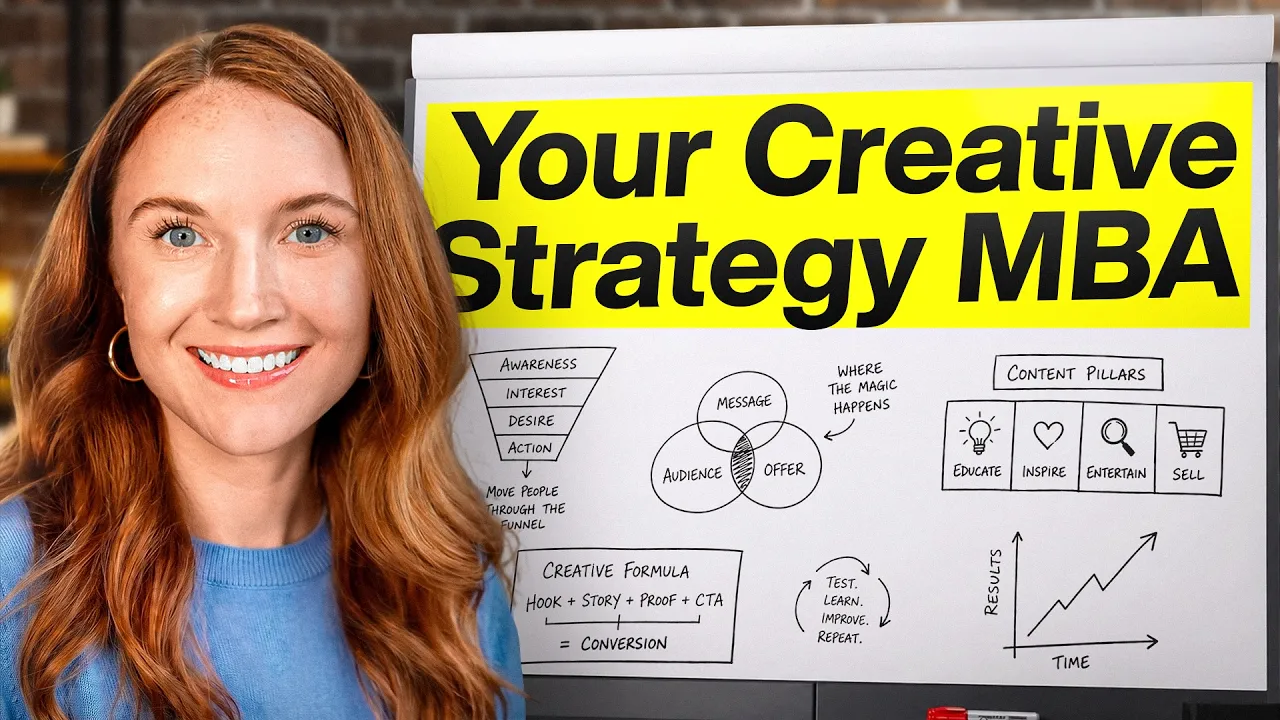
They always always teach me something new. I really think if you can exploit your learnings a little bit more and be a lazier creative strategist, put real people in your ads, and make amazing hooks, you're well on your way to having an MBA in creative strategy. All right, that's all. I'll see you next week.
The words are the caption track's own and nothing is reworded or re-transcribed. Paragraph breaks are placed between sentences so the text reads as prose.
Free tools for your own script. No signup, no login.
Paste your draft and see where viewers are likely to drop off, with a rewrite for each weak line.
Paste the first 30 seconds of your own draft for a hook score and rewrites.
Check your draft against YouTube's advertiser-friendly guidelines before you record it.
Read this channel's public videos and transcripts, and download a writing brief for it.