Getting the transcript
Reading the captions from YouTube. A video nobody has opened here before takes 10 to 30 seconds; this page fills in on its own.
Getting the transcript
Reading the captions from YouTube. A video nobody has opened here before takes 10 to 30 seconds; this page fills in on its own.
Sabri Suby · @SabriSubyOfficial
This video has no Most replayed graph yet: YouTube shows one only once a video has enough views. These are the moments viewers replayed most in Sabri Suby's most watched videos.
Most replayed moment at 5:51
3.1x that video's typical replay level
of different variations. And the way that I like to do this is I give it my winning ad and then I say, "Okay, I want you to read this ad and I want you to be the author. If we show the next ad, I'm going to ask you to write to 100 people. Not one in a 100red would be able to
Said at 5:44
Most replayed moment at 10:35
2.4x that video's typical replay level
keyword that people would be searching in order to find what it is that I am trying to sell? And I call this the coliseum keyword. There's always going to be one keyword that represents the most amount of traffic in your niche. And you want to type that in. You want
Said at 10:30
Most replayed moment at 4:44
4.2x that video's typical replay level
like, you know, the chick's not wearing any makeup and it's just a little bit more casual. That could also work depending on what it is that you're selling. But I'm going to go with this one. So, what we do is we go ahead and we download this puppy. So, we've got the static image. Now, we need to take this static
Said at 4:37
The graph counts replays. It does not show where viewers stopped watching.
Words
5,304
Runtime
23:48
Speaking pace
223wpm
Reading time
22min
223 words per minute, above the 201 75th percentile of 349 measured videos. That distribution comes from the 349-video hook study.
Opening (first 30 seconds)
I've done over 10.2 billion dollars in sales across a thousand different niches and these are the eight systems that made it all possible starting with system number one. When you're just getting started there is only one thing that matters and that is ringing the cash register. If you don't have money coming in, if you don't have clients, you don't have customers, then you do not have a business. You simply have [music] a hobby. And typically what happens when you start a business is that you are the one that is doing all of the work. You're doing the sales, you're doing the fulfillment, you're doing the procurement, you're
112 words, the words spoken in the first 30 seconds at 223 words per minute.
Free, no signup. See how the first 30 seconds hold attention, with rewrites.
Sentence shape
| Measure | This transcript |
|---|---|
| Sentences | 264 |
| Average words per sentence | 20.1 |
| Longest sentence | 58 words |
| Questions asked | 16 |
| Sentences containing a number | 31 |
Most used terms
Filler phrases
49 in total: like 33 · actually 8 · basically 3 · kind of 3 · I mean 1 · you know 1.
A literal whole-word count of the same phrase list the Prepublish browser extension uses, so a phrase inside another word is not counted and a phrase used in its ordinary sense still is. It is a count and not a judgement.
What this transcript is
Every word below is the caption track YouTube publishes for this video, pulled from the video itself and reproduced unchanged. It is not Prepublish's writing, not a summary, and not a re-transcription: it is the video's own published captions. English captions, generated automatically by YouTube, in the video’s original language. Source: the video on YouTube. A channel that would rather this page did not exist can ask for its removal through the contact page, and it is removed.
I've done over 10.2 billion dollars in sales across a thousand different niches and these are the eight systems that made it all possible starting with system number one. When you're just getting started there is only one thing that matters and that is ringing the cash register. If you don't have money coming in, if you don't have clients, you don't have customers, then you do not have a business. You simply have [music] a hobby.
And typically what happens when you start a business is that you are the one that is doing all of the work. You're doing the sales, you're doing the fulfillment, you're doing the procurement, you're doing the accounts, [music] you're doing absolutely everything in your business and then it doesn't take long for you to start to get bogged down in the day-to-day of the business. And the only way to get out of this is by playing offense and not playing defense.
So, what do I mean by that? Well, you need to set up a structure and a system in your life that allows you to create time that you can go out there and you can actually move the money needle. So, when I started my business, I'll never forget, I wrote down, "Okay, you're going to wake up at 5:00 a.m." And so, from the very next day I started waking up at 5:00 a.m. I would wake up, either go for a run or get a lift in straight out of the gate because there was no excuses to not get it in.
There's always things that are pop up when you're running a business, there's unexpected emergencies, and I can sit down at my computer by say 7:00 a.m. and there's no one bothering you at that time. There's very few people that are up actually working at 6:00 or 7:00 a.m. in the morning. You can rip through all of the admin, all the emails, everything that it is that you need to do. And I always made sure 100% that I was on the telephone by no later than 9:00 a.m. every single day cold calling businesses and bringing that cash in.
Because when I was just getting started, I was hunting by day and farming by night. There's only certain hours in the day that I can actually cold call people and people are going to be by a phone and I want to make sure that 100% that I am not using that very valuable time to actually bring in money to the business. So, here's how you can specifically apply this system to your own life. You want to think what other money hours in your work day and you want to block them out.
If you're doing creative work or you're doing sales calls or you're creating content, there is going to be a pocket of time in the day that you have the most energy, the most mental bandwidth to actually get it done. But the key here is it has to be something that moves the money needle in your business. It has to be getting attention or converting that attention and actually bringing in customers. And you need to make sure that 80% of your time in the beginning is spent on revenue producing activities.
Otherwise, all you're going to do is build a job for yourself and not a business. I want you to open up your calendar and block in a 3-hour money block for tomorrow. I don't care if it's 8:00 a.m. to 11:00, whatever it is, block it out right now. And in that time, the only thing that you're allowed to do is ask yourself the question, what is it that I can do right now to bring in more money in my business? Whether it's follow up with old leads, it's create videos, send out a text message to your whole list, come up with some type of offer.
You are absolutely 100% not allowed to do one tiny little piece of admin. Every activity must be about bringing in money. And that is system number one, money hours. Implement this system and the money will start flowing in and then you're going to start hiring people. And the moment that you do that, another enemy is going to show up. And this one enemy, this is the one thing that keeps most businesses small and it is a much bigger threat than any other competitor.
And I'm not telling you any of these systems from theory. I started my business King Kong from my bedroom with nothing more than $50 and an old computer that my girlfriend bought me and I hustled and cold called and pulled myself [music] up from my bootstraps and got myself a seat as an investor on Shark Tank, which brings us to system number two. So, now that you've got money coming in and you're focusing on ringing that cash register as much as you can, you're going to start hiring people.
And every single person that you hire is going to be like a little chickling. They're going to be asking you lots and lots of questions. And then all of those questions, they're going to slowly leech in and start ripping back some of that money time from you. Because it will always be like, "Hey, do you got a minute? Do you have a minute for me? I've just got a quick question." And every single one of these questions, it interrupts the money and it breaks you out of your flow state and it brings your attention to something that is typically going to be admin. >> [music] >> And these things, they appear to be urgent, but they are not important and they distract you from making money.
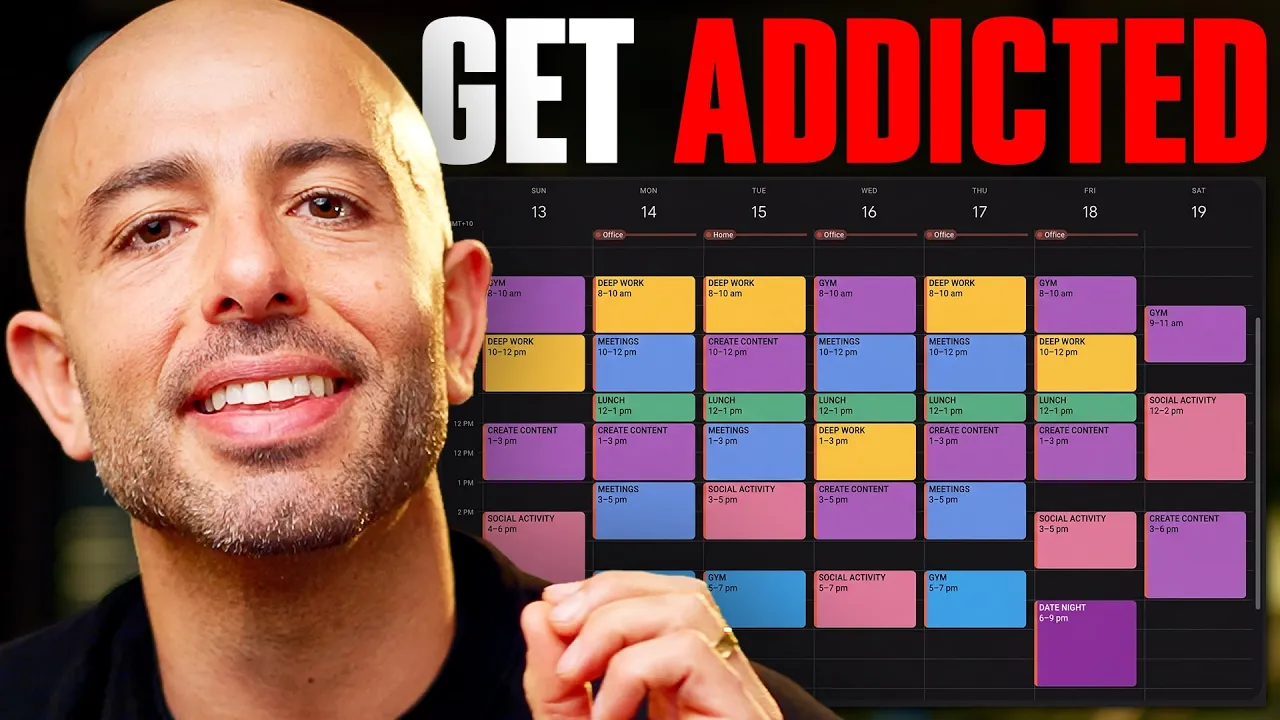
So, the way that I avoid this is I batch certain activities to [music] certain task and I have office hours that people are allowed to ask me questions because otherwise the business is going to burn to the ground if people can't ask you questions anyway. So, what I like to do is I like to do all of my meetings, all of my interviews, all of the logistic day-to-day admin that is required to run [music] any business on Mondays and on Fridays.
There's maximum of 3 days that somebody can go without contacting me and I rip through all of those things that need to get done on a Monday, all the meetings, all of that kind of stuff. So, then when Tuesday, Wednesday, and Thursday comes around, they are my deep work days. And the Mondays and the Fridays, that is what we call draining the shallows. It's all the shallow work that is necessary and it must get done, but it does not move the money needle.
It's very difficult to switch between those tasks. [music] So, what you want to do is batch those activities and it's something that I learned early on and it serves me incredibly well. So, you can just completely lock in, go very, very deep for that entire day on that task, and you get so much more done in trying to switch between these different [music] activities. And I like to group each day into one theme. Tuesday might be writing all of the ads, Wednesday might be updating course content, or coming up with incentive structures for your employees.
And then Thursday might be looking at different expansion plans where you're moving into different geographies, or different initiatives, different products, or services that you want to roll out to further grow your business. And so, you must absolutely guard your time, otherwise all the people that you hire, all the marketplace is just going to eat it up day by day. And then you get sucked into operating the business and not [music] growing the business.
And this is like the swamp that most people end up in. So, the way that you can specifically apply this in your own business and life right now is to look at your calendar and lock in at least two theme days per week where you are only allowed to go deep on one specific theme. And that is system number two, batch days. And if you protect your days like that, then you are going to get more done in three days than most people do in three weeks.
[music] However, even if you do this, I can bet you that there is still one little evil critter that is going to be eating up a lot of valuable time [music] in your day. If you're getting value out of this and you want more of that deep source, then make sure that you are subscribed cuz we are dropping multiple videos per week. Which brings us to system number three. So, now we've got money coming in, we've got a team, we're really guarding our hours, and you find yourself sitting in meeting after meeting after meeting.
First of all, you need to be extremely ruthless with what you say yes to and what you say no to, but even once you do that, you are going to have meetings. And here's a hack that I have found. One, you want to have all of your meetings after lunch. You want to stack all those meetings back to back at the second half of the day. Immediately, drop whatever they're asking for in half. And you say, "We just need to run a more efficient meeting." And therefore, a 30-minute meeting turns into a 15-minute meeting, or a 1-hour meeting turns into a 30-minute [music] meeting.
And when you compress that time on them and you put a constraint around your time, you'll be surprised that those meetings just run a lot more efficiently. It does make the last half of the day pretty hectic, but what it does is it carves out the first whole half of the day for those golden hours of more money-making activities. You're not sitting in meetings just yapping about things. As a result of doing that, you're going to start to pack on the pounds and you're going to let your health go by the wayside.
And the only way to hack around doing so is to make sure that you're doing two things at the same time. And a great way to do that is to have all of your virtual meetings out [music] when you are walking around. You whip up your phone. I do meetings with billionaires, venture capitalists. I don't give a who it is. I'm going to make sure that I have a virtual meeting that I am definitely walking. I cannot stand it when I jump into a meeting and everyone is just yapping for the first 5, 10 minutes and oh, who's this?
And they're talking about the weekend. It's like, when you jump into a meeting, it's meeting time. You've got all of these paid people that are in the meeting. You're paying for that. It's You're paying for it with your time and then all of your team members' time. So, you need to run it sharp and effective. The number one hack for doing so is compressing the time and having a set agenda. And then ending every single meeting with a who, what is the action that it is that they're going to be doing, and when is it going to be done?
And so, you're not just getting together in a room of people and having a little bit of a chit-chat and then you're walking out and then the descending some AI summary of the meeting and then no one knows what it is that they need to do. Every single meeting should progress the company forward. Here's how to apply this system to your own business and life right now. Open up your calendar and look at all the reoccurring or standing meetings that you have every single [music] week that happen before lunchtime and just move them.
Drag those little puppies to the afternoon. Get those people to accept it. And that is system number three. Absolutely no meetings before lunch. Do that and your best hours will stop being robbed from you before lunch. However, this next point is going to sound a little bit weird, but it's the exact reason why I have worn the same thing every day for 10 years. When you're running a business, you're going to be making hundreds if not thousands of decisions every single week.
And you only have so much mental RAM that you can associate to making those decisions. So, the last thing that you want to be doing is using that very precious RAM to basically make trivial decisions. Like, what are you going to wear or what are you going to eat? So you want to think about all of the decisions that you have to make every single day. You want to put a lot of scrutiny into them, and then you want to make them once so you do not need to make them every single day.
Where you put your keys, where you put your phone, when you charge it. My approach to doing this is whenever I'm going to be doing something every single day, like wearing a t-shirt, I will split test 10 different t-shirts. I will legitimately go and buy 10 t-shirts. I'll find all of the styles of black t-shirts that I think that I like and I will try all them out until I find the final lotion boss of that t-shirt, and then I'll just go and I'll buy 30 of them.
And so when I look in my cupboard, all I've got is the one t-shirt that I wear every single day. Same thing for shoes, same thing for jeans. Same thing with meals, in my house we have a rolling 14-day menu. We have all the dishes that we're going to be eating every 2 weeks. You'll be surprised, you don't need a huge variety of meals. If you plan out like a 14-day menu, it never feels like you're eating the same food, but you don't need to think about it.
In terms of when you go and work out, you have a very regimented lifting schedule where you know what your lifting days are going to look like, so you don't need to go in there and go what's sore today, what isn't sore. So this is what I want you to do right now. I want you to sit down and I want you to list out all the repetitive things that you do every single day and every single week, so that you just cut all your daily decisions to zero.
Now you don't need to be like homie and just wear the same black every single day if you don't want to, but it might be that you have three different styles of outfits that it is that you wear, and you do not need to decide that every single day. And that is system number four, kill the worthless decisions. So all these systems are good for [music] actually making money, but what you're going to find is once you do start making a little bit of money, your business is still going to be this time hungry vampire that's going to suck up all your time.
And then what typically happens is for most business owners in the first 1 to 3 [music] years, they start to put on weight because they have neglected their health. And this next system helps you to avoid this. And look, this might sound like it's wrong for this video, but it is absolutely [music] not because whoever has the most energy makes the most money. And you can only push out into the marketplace what you have within yourself because all business problems are simply personal problems masquerading as business problems.
[music] And health is the one master system that sits under all your other systems. [music] To the person that is poor, they want a thousand things, but the person that they want [music] one thing and that is their health. So, one thing speaking from experience that I wish that I would have learned early is that I have to prioritize my health. [music] And so, what I would do now if I was starting over and it's a system that I built into my own business is you must get a lift in or do some physical activity every single day.
For me, I lift 3 days a week, Mondays, Wednesdays, and Fridays, but on all of those other days, I'm making sure that I am doing some type of activity in my business. And I can tell you right now that by getting in shape, lifting, having more energy, I have certainly made a lot more money. So, the way that you can apply this into your own business is that you must have absolutely non-negotiable days that you exercise.
You cannot have a fluid schedule where you're like, "Oh, I work out when I get time." Hell no, that is never going to happen. So, what you do is you must have a time and a day that you lift every single day that is non-flexible. And even when you don't feel like it, you still get it done. Then, another hack that I want you to do is after eating that you go for a walk every single day. It's been scientifically shown that if you walk after you eat, it helps curb that insulin spike that you get after you eat that you [music] want to crash and just do nothing for the rest of the day.
It allows you to get outside, get natural sunlight in your eyes, it re-energizes you, and also you do some of your best thinking when you're walking. So, the system that I do is I lift early morning before all the chaos in my life begins, and then no matter what, I'm getting 10,000 steps as a minimum. Usually, it's 15,000. And the only way that I do that is one, walking around in the gym in between sets, and two, making sure that I get at least a 1-hour walk at lunchtime every single day.
The way that you can apply this to your own life is to look at your workout schedule right now, lock that in on the calendar. And for me, what's on the calendar is what gets done. And that is system number five, at least 10,000 steps a day. So, once you get your energy right, everything else downstream from that becomes easier. However, there is also going to be another thing that you really need to optimize that is going to critically affect the quality of decisions that you make and how much money that you make.
And that's what this next system is all about. One of the most common questions that a lot of business owners think about, they ask other business owners about, is how many hours a week do you work? And once you start looking at your time, you're going to start to see that there's a big chunk of your time every day that goes to sleep. And then so, the next question is what time do you wake up? And everybody has like a wake up time.
They set their alarm for what time they need to wake up in the morning. However, what I have found is what's far more important is to set an alarm for what time that you should go to bed. You don't want to figure out what time that it is that you need to wake up. You want to first figure out, okay, when do I ideally want to start my day? And then you want to keep on moving what time that you go to bed earlier and earlier and earlier until you naturally wake up at that time.
You look at super successful people like Jeff Bezos, he prioritizes his sleep like no other. And the reason for that is the higher that you get up in business, you go from making hundreds, if not thousands, of decisions a month, and then you need to make three quality decisions a year. And the thing that determines the quality of those decisions is usually how well rested that you are. The sweet spot is typically between 7 and 8 hours.
The other thing that I would recommend doing is seeing what type of sleep type you are. They have like a dolphin and a bear and a wolf. Just type it in sleep animal and it will tell you what type of person that you are and then you can start to optimize your schedule around that. Because you might be thinking, "Hey, I can just pound a couple more coffees, Sabri. It's really not that bad. I don't need much sleep." You're a shell of a person and then your kids see you and they get the very, very worst.
So, you got to prioritize your sleep cuz it's a lot more than just grinding through the day. It's being able to not just lie on the couch when you get home and still have energy for the people that rely on you. So, the way that you can apply this system into your own life is to set a go to sleep [music] time. Muck around with it, see what time that you naturally end up waking up and then you want to bring that forward or bring it back depending on when it is that you're waking up and how rested you are.
I highly recommend getting something like the Aura ring or the Whoop band to also measure the quality of your sleep and running some little split tests around herbal tea, sauna, going for a walk in the evening, having magnesium glycinate. Build in a nighttime routine that is you have. Everyone obsesses over morning routines and earthing and sunlight and all of that kind of stuff. You need to set a sleep routine as well of like how do you unplug, how do you reset to completely unwind for the day?
What you're going to find is you're going to get the best sleep when you basically tell your body that I go to sleep at the same time every single night. And that is system number six. Have a go to bed alarm. Sort out your sleep and your decisions are going to get sharper overnight. But one thing that is very, very important is the more that you focus on your sleep and productivity and how much money that you're making, your calendar is going to start to get full, very, very full with everything that is work.
But don't lose sight of why you started your business in the first place, which is to live your life. So, most business owners are very militant when it comes to booking in their time and sorting out the things that are priority in their business to get done. They schedule everything down, they've got recurring meetings and everything is typically in the calendar. However, when it comes to their personal life, that all just goes by the wayside, and they don't protect their own recreational time with the same rigor and the same intensity that they do running meetings or doing quarterly reports.
And what I would suggest that you do is to treat your personal life as important as your business life. Because if you leave it to chance, and if you don't have reoccurring standing meetings for fun and recreational things, then your entire calendar just fills up with work, and you become a robot. [music] Because business is a marathon. It is not a sprint. If you look at most successful business owners, due to compounding interest, make the most of their money's in the latter years of their life.
And so that means you're going to have to be in the arena playing this game for a long period of time. And the only way that you can do this is if you don't burn out. So the system that has worked very well for me is that I book in fun and recreational time in my calendar like I book [music] in sales calls. And so all the activities that I'm doing from sauntering to walking to hang out my wife, a date night, to time with my kids, to taking them to frozen yogurt, it is all booked in on the calendar, and it gets done.
And if I have got recreational time in there, I don't cancel that. I treat it with the same respect as I do a very important meeting, because I know that unless I do these things, then I'm not going to have the energy to go out there in the marketplace and be an absolute maniac and push and shove and grind and get everything that it is that I want. Here's how to apply this system to your own life. What I want you to do right now is to fire up that good old Google Calendar once again, look at your schedule, and I want you to plan at least three things as a standing meeting that are on your calendar every week.
That might be date night, it might be a walk with your dog, it might be a yoga session. I don't care what it is. Just book it in, make it a reoccurring event that happens every single week or every single fortnight, which is system number seven, book in the fun. Build in these circuit breakers and you'll be still standing while everyone else that has been sprinting simply falls flat. Even if you're doing everything right, if you fail to implement this last system, then everything else will fail [music] because this last system is what makes everything possible.
This brings us to the eighth and final system. Even after implementing all of these systems, the more that you grow, the higher that you get up the mountain, the less time you have. And you're going to have more people working for you. Hopefully, your family is growing and basically what happens as a result of that is you are going to have lots of requests for your time, both personally and professionally. And most people, their default answer is yes or maybe or let me see or let me look at the calendar.
And every single one of these open lines of communication is like death by a thousand cuts. And the way to avoid this is to make your default to every answer no. I know it sounds harsh. However, being clear is being kind. And so for me, in my life, my friends know, like don't try and book in a evening dinner with me at 8:00 p.m. at night. It's just not going to happen. So I just set up these defaults of no to everything and so that [music] when something comes my way, I simply run it through a framework of is this going to get me closer to the big priorities in my life.
And typically, the answer to that is no. If whoever these requests are coming for aren't a priority, they're not in the calendar, then the default has to be no. But even if your default is no, there is still going to be lots of lines [music] of communication that are going to people coming in with inbound asking for requests. And so the way that I have found to protect my time is by having a crucial hire that I call a professional fixer, also known as an assistant.
And all lines of communication must come through that person. As you build a company and you build a team, and you're going to have multiple teams in your business, and then there's going to be multiple division heads of the people that are then running those teams, they're going to feel like that they can come directly to you. And the more direct reports that you have, the more inbound that you have, and then you just can't [music] get to the work that actually matters.
So, when you hire a personal assistant, the first system that you set up for them is every single piece of requests for my time or inbound or anything goes through [music] you. I don't even have a work phone. I tell her straight up, "Your one job is to keep the barbarians at the gate. They're going to be rattling that gate, trying to get in. They're going to come to you with requests that seem urgent, but aren't urgent." And so, then you run them through the framework of, "Can this wait till Friday, or can it wait till Monday?" And what I do is I empower her to make those decisions.
I am very, very clear, "These are my priorities right now. These are the things that I'm working on. If it's urgent, can it wait till Monday and Friday, or is it worthy of my time in the first place?" So, then I am offloading that mental RAM to her to make those decisions. She already has the rules of engagement that are set by me, and that immediately is the first line of defense, cuts down a huge amount of inbound requests that I get.
So, the way that you can apply this right now in your own business and life is to write a one-pager that you share with all of your team. And you're like, "These are the days that I do meetings. These are the office hours. A non-irreversible thing that must get sorted right now. This is kind of how it works." And you give them those rules for engagement, so they are also clear. Because you can't expect for them not to come to you with all these things if you haven't been cleared about them with how you operate.
Then you need to tell them, "What is code red? What can they interrupt your normal schedule for? What does that look like?" Then open up ChatGPT or Claude and say, "Hey, this is the priorities. This is how I manage my time. Please craft me an email to send to all of my managers that gives them the rules of engagement and makes everything clear and then ask everybody to reply that they acknowledge it, they've received it and they understand [music] it or to come back to you with any questions.
And that is system number eight, make no your default. Now, none of these systems rely on motivation, they rely on discipline. If you're running your business based on if you feel motivated or not, you're never going to make it very far cuz there's going to be a lot of the things that you need to do day-to-day that you don't want to do, but your discipline must force you to do them. And the best way to do that is to have these eight systems implemented in your life that you run like clockwork.
And then you just run your life using these eight master systems. And if you enjoyed this video, then you'll like this one that I put together on brutally honest advice to grow your business fast. Like, subscribe and I'll see you in the next one.
The words are the caption track's own and nothing is reworded or re-transcribed. Paragraph breaks are placed between sentences so the text reads as prose.
Free tools for your own script. No signup, no login.
Paste your draft and see where viewers are likely to drop off, with a rewrite for each weak line.
Paste the first 30 seconds of your own draft for a hook score and rewrites.
Check your draft against YouTube's advertiser-friendly guidelines before you record it.
Read this channel's public videos and transcripts, and download a writing brief for it.