Getting the transcript
Reading the captions from YouTube. A video nobody has opened here before takes 10 to 30 seconds; this page fills in on its own.
Getting the transcript
Reading the captions from YouTube. A video nobody has opened here before takes 10 to 30 seconds; this page fills in on its own.
Epic History · @EpichistoryTv
Where viewers went back to watch this video again, from YouTube's public Most replayed graph, lined up with what was said at that moment.
Most replayed moment #1
2:564.9x the video's typical replay level
They are to swap places with John and his valuable cavalry, freeing them up for mobile operations. But when the reinforcements arrive at Ariminum, John refuses to obey Belisarius’s orders.
Said at 2:51
Most replayed moment #2
1:152.6x the video's typical replay level
construction of the most magnificent church in the world, the cathedral of Hagia Sophia - Holy Wisdom. Now, with God’s backing, he’s poised to complete another great objective – the reconquest
Said at 1:11
Most replayed moment #3
14:532.4x the video's typical replay level
they see fit. They burn him alive, in full view of the enemy. The garrisons of Faesulae, then Auximum, are finally starved into surrender.
Said at 14:46
The graph counts replays. It does not show where viewers stopped watching.
Words
2,544
Runtime
20:57
Speaking pace
121wpm
Reading time
11min
121 words per minute, below the 160 25th percentile of 349 measured videos. That distribution comes from the 349-video hook study.
Opening (first 30 seconds)
March, 538 AD. Rome. After more than a year, the Ostrogoths have abandoned their siege of the city, and are marching north. Eastern Roman general Flavius Belisarius, who’s masterminded Rome’s defence, has one parting gift. He waits until half the Goth army has crossed the Salarian Bridge, then attacks with every man he has. The fighting is desperate. The Goth rearguard
61 words, the words spoken in the first 30 seconds at 121 words per minute.
Free, no signup. See how the first 30 seconds hold attention, with rewrites.
Sentence shape
| Measure | This transcript |
|---|---|
| Sentences | 162 |
| Average words per sentence | 15.7 |
| Longest sentence | 69 words |
| Questions asked | 2 |
| Sentences containing a number | 12 |
Most used terms
Filler phrases
3 in total: sort of 2 · like 1.
A literal whole-word count of the same phrase list the Prepublish browser extension uses, so a phrase inside another word is not counted and a phrase used in its ordinary sense still is. It is a count and not a judgement.
What this transcript is
Every word below is the caption track YouTube publishes for this video, pulled from the video itself and reproduced unchanged. It is not Prepublish's writing, not a summary, and not a re-transcription: it is the video's own published captions. English captions, published by the channel, in the video’s original language. Source: the video on YouTube. A channel that would rather this page did not exist can ask for its removal through the contact page, and it is removed.
March, 538 AD. Rome. After more than a year, the Ostrogoths have abandoned their siege of the city, and are marching north. Eastern Roman general Flavius Belisarius, who’s masterminded Rome’s defence, has one parting gift. He waits until half the Goth army has crossed the Salarian Bridge, then attacks with every man he has. The fighting is desperate. The Goth rearguard tries to hold back the Romans. But they are overwhelmed.
The Goths push and shove to get across the bridge. Those who cannot are slaughtered, or drown in the river. It’s a final, bloody victory in the battle for Rome. In Constantinople, capital of the Eastern Roman Empire, Emperor Justinian has just overseen construction of the most magnificent church in the world, the cathedral of Hagia Sophia - Holy Wisdom. Now, with God’s backing, he’s poised to complete another great objective – the reconquest of Italy, the Roman Empire’s ancient heartland.
But the Emperor himself will help to sow seeds of division among his own armies… to undermine his greatest general… and pave the way for the destruction of one of Europe’s great In 538, Italy’s largest and most prosperous city is not Rome or Ravenna, but Milan; to the Romans, Mediolanum. Its citizens wish to be reunited with the Empire, and at the Bishop of Milan’s request, Belisarius sends a small force to aid them.
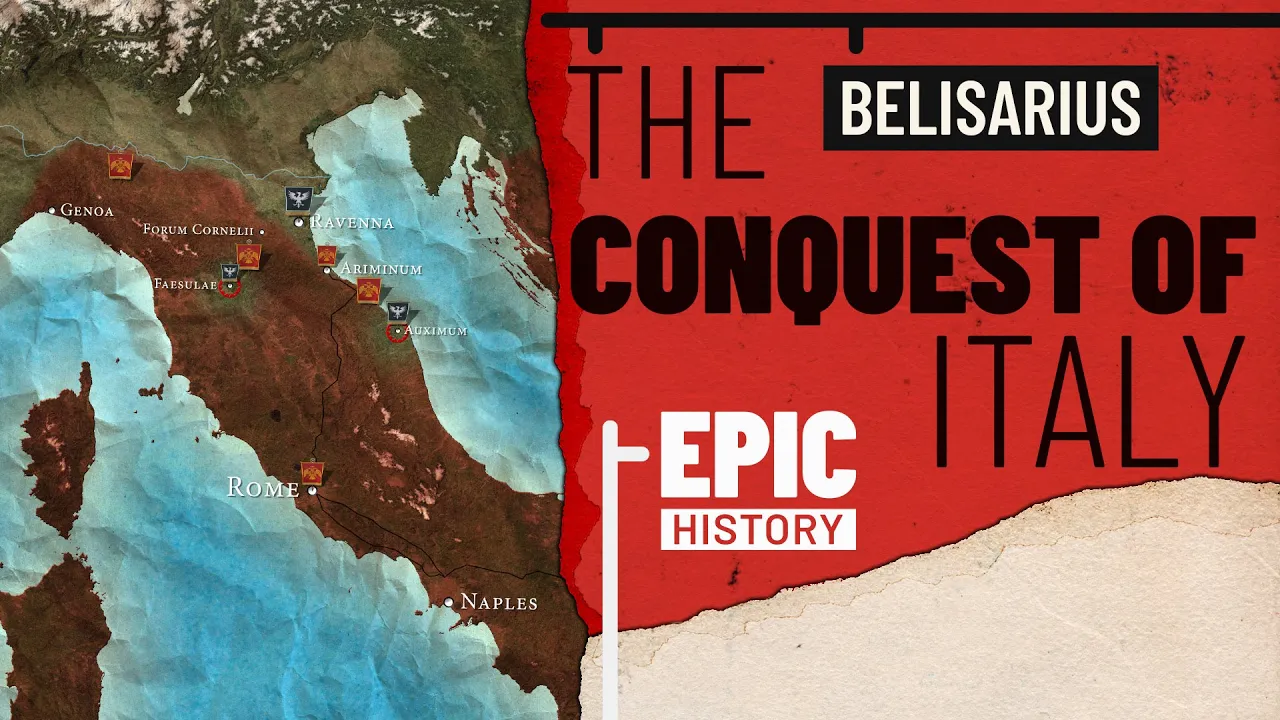
They defeat local Goth forces at Ticinum, and enter Milan in triumph. But in central Italy, Belisarius faces a dilemma. One of his best generals, John, nephew of Vitalian, has taken Ariminum with 2,000 elite cavalry. Now King Vitigis and the Ostrogoth army is marching from Rome, and will soon trap him in the city. Belisarius orders two trusted officers to get there first with infantry reinforcements. They are to swap places with John and his valuable cavalry, freeing them up for mobile operations.
But when the reinforcements arrive at Ariminum, John refuses to obey Belisarius’s orders. Instead, he adds the infantry to his own force, and prepares to hold the city. Within days, John is cut off, and under siege. The Goths make their first assault with a giant siege tower. In heavy fighting, the Romans beat them back. But John does not have enough supplies to hold out for long. John’s insubordination puts Belisarius’s entire campaign in peril.
He will lose some of his best troops if Ariminum falls. But a dash north risks leaving several, strong Goth garrisons in his rear, including 10,000 experienced Goth warriors at Auximum. Belisarius’s advance meets with early success, as the Goths at Tudera and Clusium surrender without a fight. As he ponders his next move, news arrives that 7,000 Roman reinforcements have landed near Firmium. Belisarius marches to join them, and meet with their commander… one of the most powerful men in the empire – Narses the Eunuch.
Narses - Praepositus Sacri Cubiculi – Grand Chamberlain of the Palace - is Justinian’s closest advisor. As a eunuch, he can pose no dynastic threat to the emperor, and so is entrusted with enormous power and influence. Narses had distinguished himself during the Nika Riots, bribing sections of the mob to switch sides… while Belisarius and Mundus had dealt more directly with the rest. Belisarius has military command in Italy, but he cannot simply issue orders to someone as important as Narses.
So he convenes a council of war, seeking agreement on the way forward. Belisarius’s officers argue that John has only himself to blame for his fate. They should not risk the army to save him. But Narses is close to John, and thinks differently: “If John treated your orders with insolence, most excellent Belisarius, he has already been punished enough, since it is now in your power to either save or abandon him to the enemy.
But you must ensure that neither we nor the Emperor are also punished for his mistakes. For if the Goths capture Ariminum, it will be their good fortune to capture a capable Roman general, as well as an army and city subject to the emperor. And the disaster will not stop there, but will affect the entire fortune of the war." As the council meets, a message arrives from John. His men are starving, and unless relieved, he must surrender in seven days.
It is agreed that an attempt must be made to rescue John and his troops. In an elaborate operation, 1,000 troops are left to cover the Goth garrison at Auximum. One force will advance straight up the coastal road… Another force will move up by sea, threatening an amphibious landing… While Belisarius and Narses march inland, and approach from the west. The plan works perfectly. Vitigis receives reports of Roman forces closing in from all directions.
Fearing encirclement, he abandons the siege, and hurriedly withdraws to his capital, Ravenna. But despite their success, all is not well in the Roman camp. When Belisarius invites John to thank those who’ve come to his rescue, John announces that his only debt is to Narses. His words fuel the growing distrust between Belisarius and Narses. In the words of Procopius, historian and eyewitness, “From that time on these two men began to regard each other with great suspicion.” The chain of command among Eastern Roman generals is not always clear, and is rarely set in stone.
Referring decisions back to the Emperor takes months, so a general’s authority may often rest on his ability to win over his senior officers. It’s possible Justinian encourages such a system, to hinder overmighty generals who are tempted to challenge his rule. Is this why he has sent Narses to Italy, to clip the wings of Belisarius? We don’t know. But for the war in Italy, the consequences of this system will soon lead to catastrophe.
John and other discontented officers begin to encourage Narses to oppose Belisarius. It is beneath his dignity, they tell him, to take orders from a mere general. When Belisarius reveals his plan to methodically eliminate the Goth strongholds in central Italy, prior to an advance on Ravenna, Narses objects. The strategy is too cautious. Instead, Narses proposes an immediate advance into Aemilia, to seize more territory from the Goths.
In frustration, Belisarius produces a letter from the Emperor: “We have not sent our steward Narses to Italy in order to command the army. We wish Belisarius alone to command the whole army in whatever manner seems best to him. It is the duty of all to obey him in the interest of our Republic.” To which Narses replies, ‘your strategy is not in the interest of the Republic’. The army splits into two factions, each pursuing its own strategy: a potentially disastrous situation, but fortunately for the Romans, one which Vitigis in Ravenna fails to exploit.
Belisarius is able to take Urbino when its well unexpectedly fails. Narses sends John to capture Forum Cornelii, in Aemilia. But in the north a storm is brewing. “This city of Milan far surpasses all the cities of Italy in size and population and every other sort of prosperity… this city, I say, has fallen into great danger… the urgency of the moment does not allow me to use many words…But you, I say, must defend the people of Milan in their peril with all possible speed.
If you hesitate to come to us in the present crisis, the result will be that we will perish after suffering the most cruel fate possible…” 539 AD. Milan is held by just 300 Roman troops and its citizen militia. The Goths have reacted swiftly to its loss, and the city is now besieged by Uraias, the king’s nephew. He is supported by a huge force of Burgundians sent by Theodebert, King of the Franks – a Goth ally, though how far he can be trusted is anyone’s guess.
By winter, Milan is starving. Its people are eating mice and dogs. Belisarius, besieging Urvivento, orders a force to march to the city’s aid. But when its commanders learn of the size of the Burgundian force, they halt at the River Po, and refuse to go further without support from John and his troops in Aemilia. By now, John only obeys orders from Narses. By the time Belisarius has written to Narses and persuaded him of the urgency of the situation… it is too late.
The garrison of Milan ignore their commander’s plea to die like heroes, and negotiate their own surrender… abandoning the civilians to their fate. Goths and Burgundians slaughter every male they can find in the city. Women and children are given to the Burgundians as slaves. One of the greatest cities in Italy is plundered and razed to the ground. The destruction of Milan is the direct consequence of a fatally divided Roman high command.
Shocked into action, Justinian recalls Narses to Constantinople. Belisarius once more has sole, undisputed command in Italy. The northern part of the country has now been ravaged by two years of war, in which time no harvests are gathered. Vitigis cannot campaign without supplies, and remains in Ravenna. Roman forces can be supplied by sea, with grain from Sicily and the south. But in the countryside, Italian peasants begin to starve.
“I will now tell of the appearance they acquired and how they died, for I was an eyewitness. All of them first became lean and pale, for the flesh, lacking nourishment, “turned on itself”, to use the old expression… As the evil developed, all moisture left them and the skin became so dry that it resembled leather more than anything else... They changed from a livid to a black colour, whereupon they came to resemble burned-up torches.
Their faces always wore an expression of amazement, and a dreadful sort of insane stare.” Procopius estimates that famine claims 50,000 lives in Picenum alone, with bodies left unburied, and rumours of cannibalism. When King Theodebert himself suddenly leads a great Frankish army into northern Italy, attacking Goths and Romans alike, he finds he has entered a wasteland. His army, unable to find supplies and decimated by disease and dysentery, quickly withdraws back across the Alps.
The war grinds on, as Belisarius besieges the Goth strongholds at Faesulae and Auximum. Auximum is impregnable. Only starvation will force the Goths to give up. Skirmishes are fought in the surrounding hills, as each side ambushes the enemy’s foraging parties. Belisarius is amazed by the Goths’ determination. Eventually, he learns from a prisoner that one of his own men has been passing messages from Vitigis to the garrison, promising help, urging them to hold out a little longer.
Belisarius arrests the traitor, then sends him back to his unit, for them to punish as they see fit. They burn him alive, in full view of the enemy. The garrisons of Faesulae, then Auximum, are finally starved into surrender. Belisarius grants them both generous terms. Then, with his rear secure, he begins his advance on Ravenna. Reinforcements from Dalmatia approach from the north. Ravenna is protected by a lagoon, marshes, and shoals along the coast.
Parts of its 9-metre-high, brick curtain wall can still be seen today, incorporated into later Venetian fortifications. It is strongly held. But the Roman noose is tightening. A vital grain shipment along the Po River is intercepted. A mysterious fire breaks out in the city’s granary. The Goth king puts much hope in his nephew Uraias, approaching with a relief force of 4,000 men. But when the troops learn that their own strongholds have gone over to the Romans, they leave for home.
In despair, Vitigis agrees to open negotiations. Imperial envoys arrive from Constantinople. But the treaty they offer to Vitigis is so generous that Belisarius refuses to sign it, believing he’s on the cusp of complete victory. Without Belisarius’s endorsement, the Goths also regard the treaty with suspicion. Sidelining King Vitigis, Goth nobles send their own delegation to Belisarius, with a secret offer to make him Emperor of the West if he will guarantee their security.
Belisarius swears only that no harm will come to the Goths if they surrender. An oath to rule over the Goths, he will swear later, before Vitigis himself. The Goth delegation is satisfied. What man would turn down the offer of a crown? The gates of the city are opened, and Belisarius marches into Ravenna at the head of his troops. He ensures grain arrives in the city quickly. Then he tells the Goth warriors – who outnumber the Romans - to disperse, back to their homes.
There is no plundering of private property, and no violence. Belisarius has triumphed… but it will soon emerge, he is not playing straight with the Goths. “While I watched the entry of the Roman army into Ravenna at that time, it occurred to me that the outcome of events is determined not by the wisdom of men, nor any other virtue on their part, but that there is some supernatural power that is ever warping their intentions, and leading them in such a way that nothing will hinder that which is being brought to pass.
For though the Goths were greatly superior to their enemy in number and power, and had neither lost a great battle nor been humbled by any other disaster, still they were made captives by the weaker army, and regarded the name of slavery as no insult.” The days pass. The Goths await an announcement from Belisarius that he will crown himself Emperor of the West, and rule over them. It never comes. Belisarius has no intention of betraying the Emperor.
He’s allowed the Goths to think that he’ll accept their offer, only to end the war as swiftly as possible. The Goths begin to feel they’ve been tricked – betrayed, even... Suspicions which are confirmed when Belisarius is recalled to Constantinople. He leaves with the Goth treasury and his prisoners, including Vitigis. Belisarius’s rivals ensure that Justinian hears all about the Goths’ offer of an imperial throne. But for the moment, the Emperor faces a far greater concern.
One of Vitigis’s last acts as king had been to send two secret agents to the court of King Khosrow, in far-off Persia… with a plea for aid against their shared enemy, the Eastern Roman Empire. Khosrow needs no encouragement. He’s been watching, as Justinian strips his eastern frontier of troops, for his wars in the west. Now Sassanian armies are on the march. Khosrow has set his sights on Antioch – second city of the Empire, capital of the Roman Near East.
Justinian believes only one man can stop him – Belisarius. Thank you again to our video sponsor Fishing Clash – don’t forget you can download the game using the link in our video description. Big thanks to Legendarian for providing our ‘Total War: Attila’ gameplay footage. Check out his own YouTube channel for more videos on this period, including his latest video on the Sassanian civil war of the late 6th century. Thank you also to Professor David Parnell of Indiana University Northwest, our series consultant.
You can follow David on Twitter @ByzantineProf, or via the link in our video description. And thank you, of course, to all the Epic History TV Patreon supporters, who make this channel possible.
The words are the caption track's own and nothing is reworded or re-transcribed. Paragraph breaks are placed between sentences so the text reads as prose.
Free tools for your own script. No signup, no login.
Paste your draft and see where viewers are likely to drop off, with a rewrite for each weak line.
Paste the first 30 seconds of your own draft for a hook score and rewrites.
Check your draft against YouTube's advertiser-friendly guidelines before you record it.
Read this channel's public videos and transcripts, and download a writing brief for it.