Getting the transcript
Reading the captions from YouTube. A video nobody has opened here before takes 10 to 30 seconds; this page fills in on its own.
Getting the transcript
Reading the captions from YouTube. A video nobody has opened here before takes 10 to 30 seconds; this page fills in on its own.
AI Engineer · @aiDotEngineer
This video has no Most replayed graph yet: YouTube shows one only once a video has enough views. These are the moments viewers replayed most in AI Engineer's most watched videos.
Most replayed moment at 18:45
4.8x that video's typical replay level
that they're they're changing they're changing things in the database not yet. You want to run them through the ontology first and make sure that works. Okay. I only got an I've got I've got another I've just a short time. I'm going to try to show you some of the things that um that you can
Said at 18:37
Most replayed moment at 16:13
3.6x that video's typical replay level
method signatures, the program layout and the call stacks. So here's some examples. I don't think you'll be able to read this one, but this is like the level of abstraction we're at. It's how we're actually going to lay this stuff out and how these systems are going to interact. Dylan Mulroy from Cloudflare talks a
Said at 16:06
Most replayed moment at 6:57
5.9x that video's typical replay level
do light mode. It's I It's not my nature, but sometimes. That's better, yeah? Okay. So we have we have a model and we're trying an old LG Sorry. We We shouldn't have seen that. No, we'll
Said at 6:50
The graph counts replays. It does not show where viewers stopped watching.
Words
2,747
Runtime
18:28
Speaking pace
149wpm
Reading time
11min
149 words per minute, below the 160 25th percentile of 349 measured videos. That distribution comes from the 349-video hook study.
Opening (first 30 seconds)
[music] So great being here. Uh I'm Joe Bergam. I'm the CEO of Hornet Dev and I'm here today to talk about the unreasonable effectiveness of BM25 for Agentic Search. So how many of you heard about BM25 before? Is it new or is it Well, quite a few. So that's great. Uh I'm also watching the World Cup. Norway is playing there uh against the Ivory Coast second half. Norway is leading so that's
75 words, the words spoken in the first 30 seconds at 149 words per minute.
Free, no signup. See how the first 30 seconds hold attention, with rewrites.
Sentence shape
| Measure | This transcript |
|---|---|
| Sentences | 137 |
| Average words per sentence | 20.1 |
| Longest sentence | 121 words |
| Questions asked | 19 |
| Sentences containing a number | 28 |
Most used terms
Filler phrases
115 in total: kind of 34 · uh 29 · like 19 · um 16 · right? 12 · actually 2 · you know 2 · I mean 1.
A literal whole-word count of the same phrase list the Prepublish browser extension uses, so a phrase inside another word is not counted and a phrase used in its ordinary sense still is. It is a count and not a judgement.
What this transcript is
Every word below is the caption track YouTube publishes for this video, pulled from the video itself and reproduced unchanged. It is not Prepublish's writing, not a summary, and not a re-transcription: it is the video's own published captions. English captions, generated automatically by YouTube, in the video’s original language. Source: the video on YouTube. A channel that would rather this page did not exist can ask for its removal through the contact page, and it is removed.
[music] So great being here. Uh I'm Joe Bergam. I'm the CEO of Hornet Dev and I'm here today to talk about the unreasonable effectiveness of BM25 for Agentic Search. So how many of you heard about BM25 before? Is it new or is it Well, quite a few. So that's great. Uh I'm also watching the World Cup. Norway is playing there uh against the Ivory Coast second half. Norway is leading so that's good. So yeah and at Hornet we are building retrieval infrastructure for agents and uh I've been working on search and retrieval problems for a long time.
As you can tell I'm gray hair. Uh been working in this space for more than 20 years. Um and in the talk today I'll talk about why this kind of 30-year-old lexical scoring function is uh making a strong comeback. First I will talk a little bit about what I mean by agentic search or aentic dribble and kind of define that for for you all of you. Um my definition is that agentic search is essentially search inside agent loop.
So you have an agent that is trying to accomplish a task, write a coding or do some deep research or whatever task and inside that you have some kind of information need for the agent, right? In order to get that task done successfully and you essentially need three things uh to kind of build a good agentic search system and that is you need a capable model, a model that is able to use tools and is able to formulate queries.
You also need a harness around the model and how you kind of expose the retrieval and the search functions to the model. There's different ways to do that. It could be through tool calling or it could be through code mode. Um, Edo here uh demonstrated what I call code mode for exposing retrieval infrastructure. So that's the harness part and you also need uh a retrieval engine to be able to do searches efficiently potentially over billion scaled uh document sets and to define BM25.
So BM25 actually stands for best match 25. So there were some researchers doing plenty of different experiments and experiment number 25 turned out to be the best one. So that's that's the background of the name. It's essentially a scoring function. So you can imagine you have a query and you have a document and you calculate some kind of score by interaction between the query terms and the document terms and you come up with a score and you hope that this score kind of is a good proxy for the relevancy of the document with regards to the query.
Right? So one way to calculate BM35 would be to take all the documents and score each of them you know and then figure out what are the top K documents and then there's like 30 or 40 years of interest in how you accelerate that type of retrieval top K lots of different algorithms we also invest a lot in that I'll show something in this direction but BM25 is the scoring function and there is a way to kind of accelerate top K retrieval Uh BM25 hasn't changed.
It's the same scoring function, but the change here is really that we got a more powerful user. Uh Edo talked about general knowledge. The LLMs today have a lot of general knowledge. They know about entities, they know about companies, they know about dates, they know a lot, right? And by using that kind of implicit knowledge that is built into the parametric model, uh they essentially become very good at search. Um and that's the really change uh here now that we're is kind of making BM25 more relevant and BM25 used to be a kind of a baseline function.
Any information retrieval research would include a BM25 baseline and then you would put something fancy advanced neural fancy stuff and then you would compare it with BM25. I also think it's interesting in how we evaluate search before because you will simply look at 10 blue links and you like have scan it and you compute some metrics. A lot of that is now going away because the agent is not really it's kind of powerful in the way that it can type out a lot more queries than a human can do.
So it's less relevant to think about evaluating these systems just by a single shot query. And this is one of my kind of favorite benchmarks out there. I like to talk about benchmarks. So browsecom plus is a deep research benchmark [snorts] uh published in a paper last year and it has almost or exactly 830 questions. These are riddle like think about it like a pub quiz. Do you have pub quizzes in the US? Yeah. Okay great.
So like kind of a riddle type of questions quite long and the agent the harness of this kind of or the protocol of this benchmark is that you have a model and it gets a very simple tool called search and it accepts a query string and you return some snippets back to the model and the corpus is about 105,000 or 100,000 documents. So that's kind of tiny and these are web documents and the end to end accuracy. Um all of these questions have a golden reference answer and you can kind of check if the model and the entire loop produces that exact answer.
Um but why kind of why do we need retrieval? I like to compare context windows with floppy discs because I'm old in the 80s, right? We install this kind of games on our computers using floppy discs. So one kind of you guys are so young so you don't probably have this kind of nostalgy but one floppy disc could fit about 1.4 megabytes of data and the current models before they start degrading in quality that's I in my opinion around 350,000 tokens.
So that's one floppy disc of data right. Um, so you need retrieval in order to to fetch the information that you actually need to put into the context window and browse plus really demonstrate how uh retrieval quality affects the end toend accuracy of the task. Right? The endto-end accuracy here is essentially is the model equipped with this search tool able to answer the question, right? the riddle like question and if you artificially just stuff the evidence documents that is needed to answer this question into the context window of the model the accuracy is really high right so reasoning is not the bottleneck the model given the edit evidence up front answers the question with a very high accuracy rate even GPT4 um but if you expose the model with a harness with a retrieval tool.
That accuracy falls because it now depends on the harness. It depends on the model's ability to formulate queries and the retrieval quality of the retriever. Um so for me this is also quite important because even if we get perfect models like models that are kind of agi you don't have to append make no mistakes you still will be limited to a context window that is approximately a floppy disk right so you have to decide what goes into that context window and I think retrieval is still very relevant as the previous slide showed and in this browsecom plus data set one of these riddlelike questions become a search trajectory because the model execute a query, gets some response back, reads it, reformulates the query and continues until it has kind of filled up the context window or found the answer, whatever comes first.
And we spend some time to investigate these trajectories uh to see how GPT5 is formulating queries and we found a lot of interesting aspects with that. Uh we described it in a recent blog post as well. You can find it on hornet.dev. And we like to compare it with a AOL query log. So AOL AOL was like a service back in the day had some search interface and they accidentally published um a very large sample of what people were searching for on the web and they were quite short and I have seen more recent query logs as well and the user human pattern are still searching with just a few terms.
GPD5 on the other hand it's a much more powerful user. It has the general knowledge and it can like bam write out very long queries. It can use a lot of syntax operators that are kind of useful from it has learned from web search. So site operator phrases etc. And this is a new type of workload. And on BM25, BM25 has essentially two hyperparameters that controls various aspects of the scoring function. And I talked about having a baseline and BM25 is usually a baseline and browser comp plus as well has a baseline with BM25, but it turns out that that baseline is terrible.
So when you look at fancier techniques, embedding models, what have you, um it's stands out as a much better retrieval paradigm than BM25 if you look at the original paper. But more recent research shows that the parameters that were used in the browse comp plus research paper was not really adequate to handle these kind of long documents. So I like this which BM25 do you mean? uh because it has a quite dramatic impact on that specific config benchmarks on the overall accuracy and why is BM25 now more powerful with the new user.
So I mentioned the general knowledge of the user and that he can type faster and more be more specific as a more powerful user and exact matching is still relevant right because the model knows names entities uh zip codes uh skus what have you that is not so easy to represent with an embedding model which kind of encodes all the tokens into a fixed vocabulary. Uh it's also relatively cheap especially if you take into consideration the cost of doing embedding inference right some of these embedding models have like 8 billion parameters and you encode text and you have to stand up infrastructure for this and what have you.
So it's quite simple and also the tooling uh in the overall ecosystem is quite good. Um, so it's it's readily available and it's also very easy for the model to inspect the results and understand why a certain query formulation returned the result it did, right? Because you're matching literal terms and phrases and things like that which can help it kind of reformulate the queries. So these are the three key things and now into more hot topics on like what is all you need.
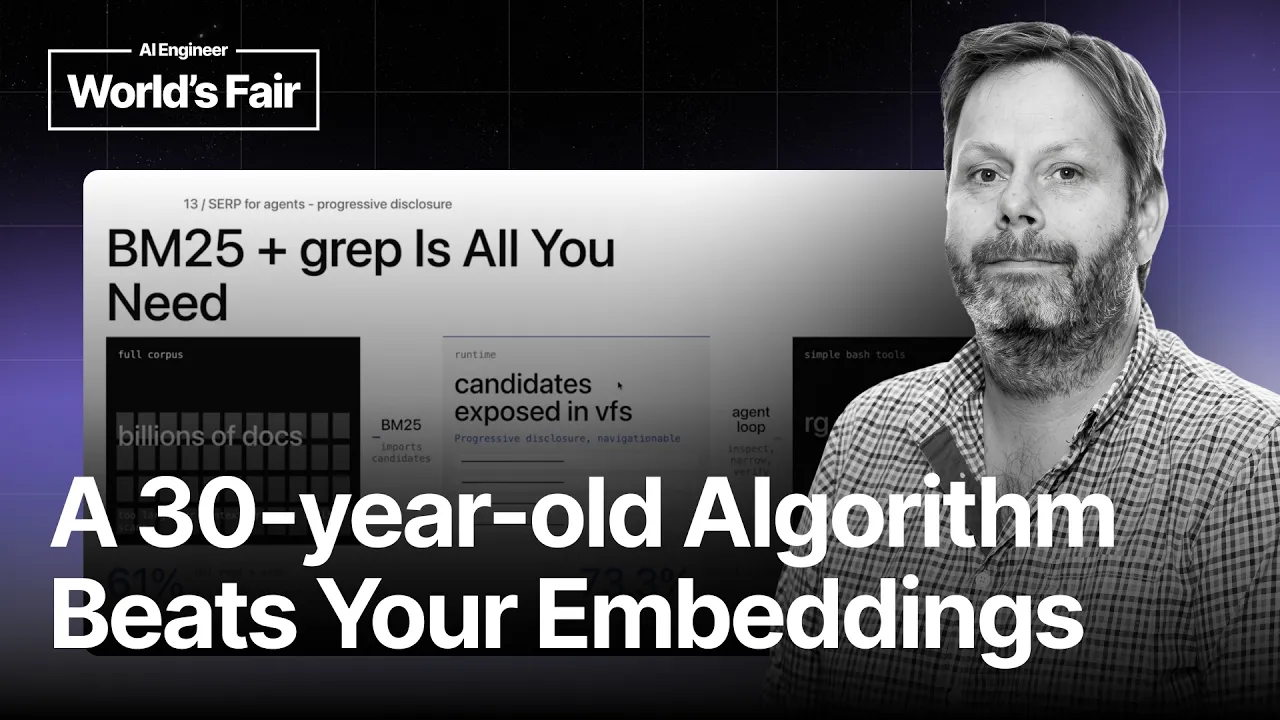
Um and this is a very recent research that came out from Waterloo from Jimmy Lynn's group up there. They are doing a great job at the information retrieval research and also on agentic search. They have a recent paper that I love. Uh it's called scaling direct corpus interaction via dynamic workspace expansion. So I'll spend some time on expanding this. So imagine you want to stand up web search infrastructure for agents.
A lot of companies are doing that at the moment. We are also working with some of these companies to help them build infrastructure for powering that kind of use case. And there you have potentially billions of documents, right? So that doesn't fit into the context window. So you obviously need retrieval and BM25 is a good baseline. So you can retrieve information over that. And the result of this is um you can imagine this as a search engine result page SER for agents because you can place these documents that are retrieved from the retriever into a workspace.
And if you organize this workspace as a file system, you can uh play into the same things that you have around skills. You can have progressive disclosure because you can have the document like the title of the document and a small snippet of the document and expose that to the model and the model can then also decide oh I need to read more of the document and when it's doing that it can use all the primitive tools that it's really good at using you all use coding agents so you all seen GP and rip gp and said and whatever it's doing to kind of manage context so here you get the benefits of both worlds and also So you get to combine sandbox infrastructure, retrieval infrastructure.
So and VFS and just bash and whatever. So it's also quite exciting, right? Because it combines all of these new type of paradigms that is happening at the moment. So I'm really excited about this type of direction. And it's also kind of a hack, right, to optimize for what the models are good at at the moment, right? Because all the frontier LLM companies are optimizing their model for cool for coding, for bash, for tool use.
So if you put your kind of end to end task on the trajectory of that you kind of whatever there's a new model you know there's going to be better at this as well right so might be that when we get AGI they can just use the browser we'll see but currently this is a very powerful way to to build uh retrieval infrastructure and a whole agentic search experience and when it comes to evaluation right I talked about this earlier as well.
In traditional information retrieval, we were used to having just one query, one rank list, compute NDG and compare it. That is no longer very relevant when the new user is agent because that agent can reformulate queries and do more queries and do expansion and all kinds of different stuff, right? So, a lot of the classical information retrieval evaluation is now kind of dead. instead look at like see if the model can perform the task it's it's set to and for example for question answering does it get the answer right and we at hornet we are betting on BM25 as one of the primitives and we have set out on a vision to kind of have the best most efficient way to evaluate uh BM25 because I think it's such a strong fundamental primitive And this illustration compares some anonymized engines comparing with Hornet on the same type of same type of hardware with um web documents, 100 million web documents on a single node.
And as you can see, Hornet has a much more efficient implementation than the other engines and can do more throughput for the same type of bucks, which for a lot of companies that are building infrastructure at the moment for web search etc. means a lot in savings. >> What is the yaxis? >> The y-axis is QPS. Sorry. >> The Y axis is Oh, sorry. The Y axis is latency. I'm sorry. So, four claims to take away from this talk.
There's a new user. It's more powerful. It's able to type faster. It's able to read faster. It's able to reformulate queries and it has a lot of general knowledge which makes simple tools like GP and BM25 more powerful. That's number one. Number two, which BM25 do you mean? Uh there are differences in implementation, in performance, in parameters. So think about that. And also why is it effective for agentic search? It's simply because it's explainable for the model.
So the model can see and also use it in combination with GP, right? Because you have literal matches and GP is almost about literal matches as well. And the combination of these two is a very strong agentic search or agentic retrieval paradigm. There's a lot of references. I think I will publish a talk uh or the talk will be published and also the the slides and if you hated it, you can tweet at me. Um there is not I was told that there's not a room for for questions but happy to chat about retrieval.
You will find me around the conference. Probably best way to reach me is through my ex account and that's it.
The words are the caption track's own and nothing is reworded or re-transcribed. Paragraph breaks are placed between sentences so the text reads as prose.
Free tools for your own script. No signup, no login.
Paste your draft and see where viewers are likely to drop off, with a rewrite for each weak line.
Paste the first 30 seconds of your own draft for a hook score and rewrites.
Check your draft against YouTube's advertiser-friendly guidelines before you record it.
Read this channel's public videos and transcripts, and download a writing brief for it.