Getting the transcript
Reading the captions from YouTube. A video nobody has opened here before takes 10 to 30 seconds; this page fills in on its own.
Getting the transcript
Reading the captions from YouTube. A video nobody has opened here before takes 10 to 30 seconds; this page fills in on its own.
AI Engineer · @aiDotEngineer
This video has no Most replayed graph yet: YouTube shows one only once a video has enough views. These are the moments viewers replayed most in AI Engineer's most watched videos.
Most replayed moment at 18:45
4.8x that video's typical replay level
that they're they're changing they're changing things in the database not yet. You want to run them through the ontology first and make sure that works. Okay. I only got an I've got I've got another I've just a short time. I'm going to try to show you some of the things that um that you can
Said at 18:37
Most replayed moment at 16:13
3.6x that video's typical replay level
method signatures, the program layout and the call stacks. So here's some examples. I don't think you'll be able to read this one, but this is like the level of abstraction we're at. It's how we're actually going to lay this stuff out and how these systems are going to interact. Dylan Mulroy from Cloudflare talks a
Said at 16:06
Most replayed moment at 13:49
2.3x that video's typical replay level
Fable uh and it runs into an unknown, ask it to log it, right? So that um you uh you can see where the deviations happened and then you can sort of figure out why as well, you know? It will usually give you some context about what happened.
Said at 13:43
The graph counts replays. It does not show where viewers stopped watching.
Words
893
Runtime
5:44
Speaking pace
156wpm
Reading time
4min
156 words per minute, below the 160 25th percentile of 349 measured videos. That distribution comes from the 349-video hook study.
Opening (first 30 seconds)
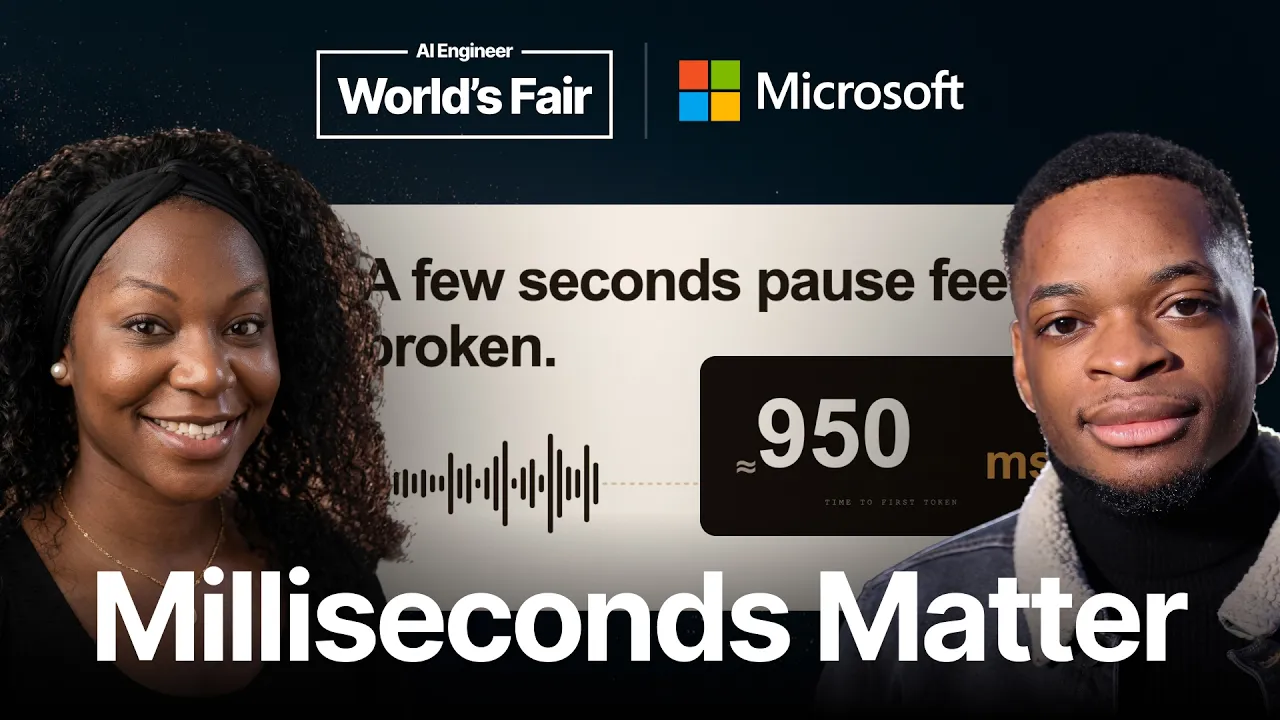
Hi, I'm Ornella, and that's Joel, and we built Ace, a live AI voice tutor. It run on a small model on purpose, and I want to tell you more why that's not a compromise. Quick gut check. That silence on a voice call, that the difference between a tutor and a broken up. When a voice agent pause for even a second, your brain says it's dead. So, when the answer fit a leader of every instant
78 words, the words spoken in the first 30 seconds at 156 words per minute.
Free, no signup. See how the first 30 seconds hold attention, with rewrites.
Sentence shape
| Measure | This transcript |
|---|---|
| Sentences | 55 |
| Average words per sentence | 16.2 |
| Longest sentence | 50 words |
| Questions asked | 5 |
| Sentences containing a number | 6 |
Most used terms
Filler phrases
17 in total: actually 9 · right? 4 · like 3 · uh 1.
A literal whole-word count of the same phrase list the Prepublish browser extension uses, so a phrase inside another word is not counted and a phrase used in its ordinary sense still is. It is a count and not a judgement.
What this transcript is
Every word below is the caption track YouTube publishes for this video, pulled from the video itself and reproduced unchanged. It is not Prepublish's writing, not a summary, and not a re-transcription: it is the video's own published captions. English captions, generated automatically by YouTube, in the video’s original language. Source: the video on YouTube. A channel that would rather this page did not exist can ask for its removal through the contact page, and it is removed.
Hi, I'm Ornella, and that's Joel, and we built Ace, a live AI voice tutor. It run on a small model on purpose, and I want to tell you more why that's not a compromise. Quick gut check. That silence on a voice call, that the difference between a tutor and a broken up. When a voice agent pause for even a second, your brain says it's dead. So, when the answer fit a leader of every instant stay, which for the smallest, biggest model.
In voice, that instant is actually a backward. Because our budget was never IQ, it's millisecond. The AI model need to start talking in about 950 milliseconds. A frontier model that think for a full second has already lost the room, no matter how good the answer is. So, we made the model small and took the hardest part jobs away from it. It doesn't decide when happen what's happen in the lesson. It had It doesn't track what the student knows.
It doesn't explain what's next. We have a system in place to do that, and they hand the model a summary every turn. What's left for the model is one thing it's really good at, talking. And that's the theory. Joel, go on and show them what it actually feel like. >> Yeah, if maybe I can add some color to what Ornella was mentioning. So, if you think about the models of today, especially the frontier model, let's take Claude 4.7, which is uh from Anthropic.
The model is really good at reasoning. You can give it a problem, in this case a lesson, and it can reason through it, it can reason through what the student asking and it can come up with the answer. But that is actually precisely the problem. Because the reasoning can take couple of seconds and those seconds are really valuable when you are building voice applications. So what we are doing is saying, "Hey, let's extract all of the thinking away from the model so that the model focuses on only what matters, which is speaking in our case." So all of the thinking is extracted into a state machine.
So for Ace, we have thought about all the scenarios that are needed for a lesson. We have built a state machine that is able to coordinate each step to the next and we also added intelligent layer on top to derive some of the mastery that a student might need for the lesson to be complete. So everything when it comes to what happens next, when it comes to what needs to be displayed, when it comes to how to actually answer a question, it's all done outside of the model.
And we simply feed that output to the model to speak out. And so let's go ahead and look at an example and see how that works in real time. So the first video here is without the implementation we've done. So it's a simple Opus 4.7. We ask a very simple question and as you can see the model is thinking, it's reasoning and it takes couple of seconds to return the answer back to the user. Hey, what In this video, we've added all everything we just talked about on Haiku 4.5, which is a much smaller model.
Same question, but now you see that the answer comes in about 900 milliseconds. And so that's the beauty of building around the model. So by removing all of the thinking, all of the logic, all of the reasoning from the model and actually putting it within the code, we actually saves a lot of time and allows us to use smaller models which are cost effective and actually better at real-time voice applications. And as you can see, this feels almost instant and again that's because all of the smart parts have already happened prior to the model actually speaking.
But I have to be honest because this isn't necessarily free. It has a cost, right? A small model like the Haiku 4.5, if it doesn't have any scaffolding, tend to drift on long structure and really needs strict rules in order to be able to stay organized. So the scaffolding piece is the price. But the good thing is you pay it once and in code, right? Not on every single turn. So here's a rule. Pick the fastest model that your latency budget allows and then spend the rest of your time actually building the scaffolding.
So [snorts] in our case, right? Maybe you build a state machine, you build a reasoning process, you think about scenarios, what happens if this happens, how should your model handle it? Everything that comes with the logic, everything that comes with the harnessing, you do that outside of the model and then allowing the model to focus on that one thing that is really good at. And so that's true for voice applications like A is, that's true for real-time applications where latency is of priority and that's really true for anything that is high volume, right?
In those cases, the model is the smallest part of the system. So this is Joel and Ornella and we are building A is again and if you have any questions, let us know. Thank you. >> Thank you.
The words are the caption track's own and nothing is reworded or re-transcribed. Paragraph breaks are placed between sentences so the text reads as prose.
Free tools for your own script. No signup, no login.
Paste your draft and see where viewers are likely to drop off, with a rewrite for each weak line.
Paste the first 30 seconds of your own draft for a hook score and rewrites.
Check your draft against YouTube's advertiser-friendly guidelines before you record it.
Read this channel's public videos and transcripts, and download a writing brief for it.