Getting the transcript
Reading the captions from YouTube. A video nobody has opened here before takes 10 to 30 seconds; this page fills in on its own.
Getting the transcript
Reading the captions from YouTube. A video nobody has opened here before takes 10 to 30 seconds; this page fills in on its own.
Ali Dymock · @AliDymock
Where viewers went back to watch this video again, from YouTube's public Most replayed graph, lined up with what was said at that moment.
Most replayed moment #1
3:534.2x the video's typical replay level
roof, the maximum height can be 3 metres. 8. Within 2 meters from a boundary, no part of the outbuilding can be over 2.5 metres in height. As gardens in the UK can be quite narrow this rule is quite restrictive as most
Said at 3:49
Most replayed moment #2
1:373.6x the video's typical replay level
2. On designated land, if the outbuilding is more than 20 metres from the nearest wall of the house, the outbuilding cannot be more than 10 square metres to be permitted development. This is quite restrictive, so if you do live in one of these areas, consider building closer
Said at 1:31
Most replayed moment #3
4:561.7x the video's typical replay level
4 direction. If any of these criteria are not met, you will need to apply for planning permission which is currently £172 for most homeowners. So let's now turn our attention to building regulations.
Said at 4:49
The graph counts replays. It does not show where viewers stopped watching.
Words
1,128
Runtime
7:03
Speaking pace
160wpm
Reading time
5min
160 words per minute, between the 160 25th percentile and the 181 median of 349 measured videos. That distribution comes from the 349-video hook study.
Opening (first 30 seconds)
In the previous video I knocked down my existing garage and I now have a reasonably flat area ready to build my workshop but before I could begin I had to look into what planning permission and building regulations would apply. It took me a while to figure it all out so I thought I’d sum up exactly what you need to know before you start building. This applies to the UK and more specifically to England. So what is
80 words, the words spoken in the first 30 seconds at 160 words per minute.
Free, no signup. See how the first 30 seconds hold attention, with rewrites.
Sentence shape
| Measure | This transcript |
|---|---|
| Sentences | 55 |
| Average words per sentence | 20.5 |
| Longest sentence | 60 words |
| Questions asked | 1 |
| Sentences containing a number | 31 |
Most used terms
Filler phrases
2 in total: like 2.
A literal whole-word count of the same phrase list the Prepublish browser extension uses, so a phrase inside another word is not counted and a phrase used in its ordinary sense still is. It is a count and not a judgement.
What this transcript is
Every word below is the caption track YouTube publishes for this video, pulled from the video itself and reproduced unchanged. It is not Prepublish's writing, not a summary, and not a re-transcription: it is the video's own published captions. English captions, published by the channel, in the video’s original language. Source: the video on YouTube. A channel that would rather this page did not exist can ask for its removal through the contact page, and it is removed.
In the previous video I knocked down my existing garage and I now have a reasonably flat area ready to build my workshop but before I could begin I had to look into what planning permission and building regulations would apply. It took me a while to figure it all out so I thought I’d sum up exactly what you need to know before you start building. This applies to the UK and more specifically to England. So what is the difference between planning permission and Building regulations?
Well, planning permission, that considers the appearance and the use of buildings as well as highway access, the neighbourhood architecture, environment and any impact a construction site has on the surrounding area. Building regs are slightly different, and they set standards for the construction methods (things like health and safety, energy performance and generally just to stop buildings falling over). The two are separate and need to be applied for independently of each other.
So let’s take each in turn and see if I needed either for my project. First up, planning permission. Garden rooms are often allowed under something called permitted devleopment, meaning you don’t need planning permission, but there are a number of criteria that need to be met: 1. On “designated land” (that includes national parks, the Broads, Areas of Outstanding Natural Beauty and World Heritage sites), outbuildings to the side of the house are not permitted development. 2.
On designated land, if the outbuilding is more than 20 metres from the nearest wall of the house, the outbuilding cannot be more than 10 square metres to be permitted development. This is quite restrictive, so if you do live in one of these areas, consider building closer than 20 metres from the house. 3. If you live in a listed building, one judged to be of architectural or historic interest, outbuildings are not permitted development within the grounds. 4.
Outbuildings are not permitted development forward of the principle elevation of the original house. The term original house means the house as it stood on July 1st 1948, if it was built before that date, i.e. not including any extensions built since that date. This one can be slightly contentious as some houses have the front door to the side of the house or maybe the side is closer to the highway than the front is, so determining which side is the principal elevation is up for debate.
If this is the case, you’re probably best speaking to your local planning officer. 5. The proposed outbuilding when added together with extensions to the original house and other buildings including sheds, greenhouses, garages, swimming pools, ponds, sauna cabins, kennels, tennis courts, chicken coops and bee hives cannot exceed 50% of the total area (which does include land to the front and side) around the original house.
Essentially 50% of the original land around the house needs to remain. 6. Any new building must not be separate, self-contained, living accommodation and must not have a microwave antenna. Self contained in this instance means having all the facilities needed to live without using the main house so having a bathroom, a kitchen etc. So if you were planning on building a granny flat for example then you would need planning permission. 7.
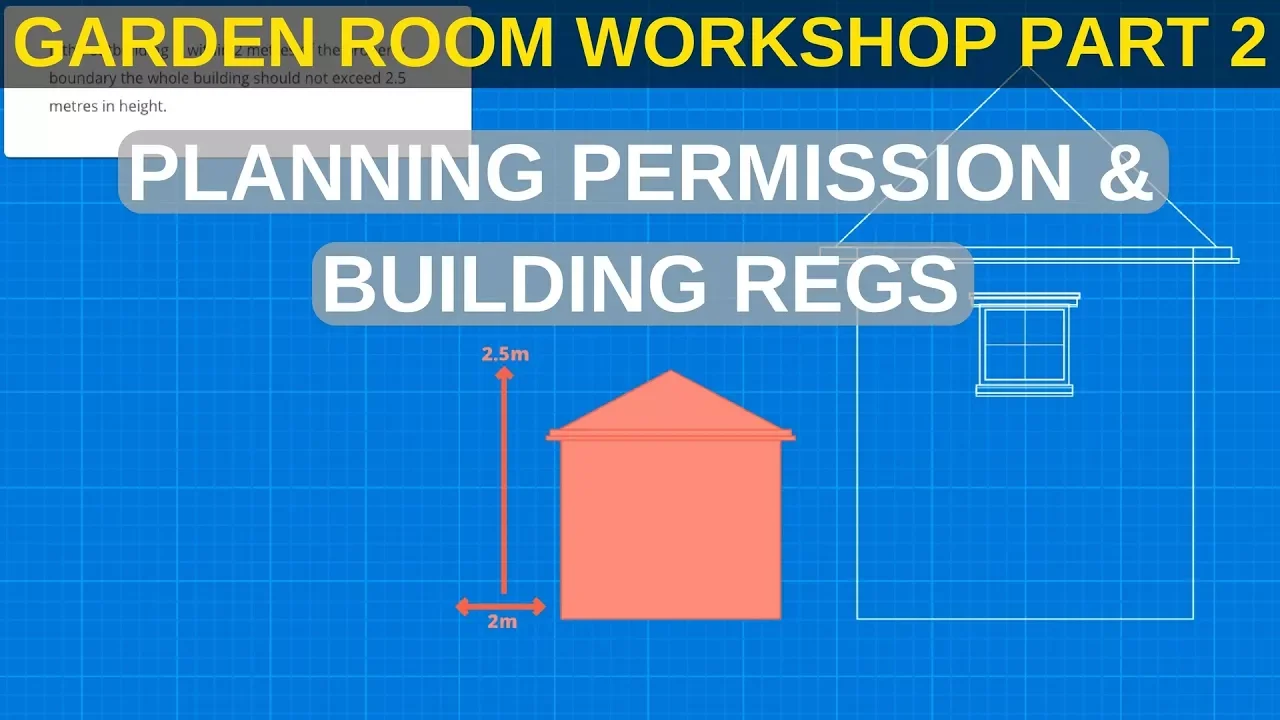
Outbuildings must be single storey only. The maximum eaves height, that is where the walls meet the roof, is restricted to 2.5 metres. The highest point must be no more than 4 metres high if the the roof is dual pitched, or 3 metres in any other case. This is ambiguously written but does seem to mean that if you have a flat or mono-pitch roof, the maximum height can be 3 metres. 8. Within 2 meters from a boundary, no part of the outbuilding can be over 2.5 metres in height.
As gardens in the UK can be quite narrow this rule is quite restrictive as most people will not want to waste 2 metres of their garden on each side of their outbuilding. This usually means the building will need to have a flat roof to remain under 2.5 metres. 9. Finally, there must be no balconies or verandas and any surrounding decking must be no higher than 300mm (30cm). For quick reference here is the full list that an outbuilding needs to comply with to be permitted development.
These apply to houses only as outbuildings are not permitted development for flats or maisonettes. Lastly, you should also check with your Local Planning Authority whether permitted development rights apply – in some places they have been removed under what is known as an Article 4 direction. If any of these criteria are not met, you will need to apply for planning permission which is currently £172 for most homeowners.
So let's now turn our attention to building regulations. If you are self-building your garden room and if like me you are not an experienced tradesman it’s likely that you’ll want to avoid having to have building regulations inspections. So let’s look at the criteria: Building regs do not apply to outbuildings if: 1. the floor area is less than 15 square metres and contains no sleeping accomodation. and 2. the floor area is between 15 and 30 metres squared, contains no sleeping accommodation and is either: A) at least one metre from any boundary or B) is constructed of substantially non-combustible materials.
So there are few things to note here: the first is that the floor area refers to the INTERNAL floor area so you can build slightly bigger than 15 or 30 square metres if, when the area covered by external walls and the internal partition walls is deducted from the external area, the internal floor area is below those thresholds. The second is if you are planning a building that is between 15 and 30 metres squared, made from timber (which is obviously a combustible material) AND it’s going to be closer than 1 metre from a boundary there is a way to avoid building regs which I will explain in the next video.
The third thing is just because building regs don’t necessarily apply to your building doesn’t mean that it’s not a good idea to build it to building regulations standards, especially if you want to change its use for sleeping accommodation in the future and in doing so creates a more well-made building overall. If you do need building regulations approval it can cost upwards of £200, depending on the scale of the building.
This video has become a bit longer than I expected so I'll break it down into 2 parts and in the next video I'll explain my design and whether or not I needed planning permission and building regs.
The words are the caption track's own and nothing is reworded or re-transcribed. Paragraph breaks are placed between sentences so the text reads as prose.
Free tools for your own script. No signup, no login.
Paste your draft and see where viewers are likely to drop off, with a rewrite for each weak line.
Paste the first 30 seconds of your own draft for a hook score and rewrites.
Check your draft against YouTube's advertiser-friendly guidelines before you record it.
Read this channel's public videos and transcripts, and download a writing brief for it.