Getting the transcript
Reading the captions from YouTube. A video nobody has opened here before takes 10 to 30 seconds; this page fills in on its own.
Getting the transcript
Reading the captions from YouTube. A video nobody has opened here before takes 10 to 30 seconds; this page fills in on its own.
Mark Manson · @IAmMarkManson
Words
1,621
Runtime
8:20
Speaking pace
195wpm
Reading time
7min
195 words per minute, between the 181 median and the 201 75th percentile of 349 measured videos. That distribution comes from the 349-video hook study.
Opening (first 30 seconds)
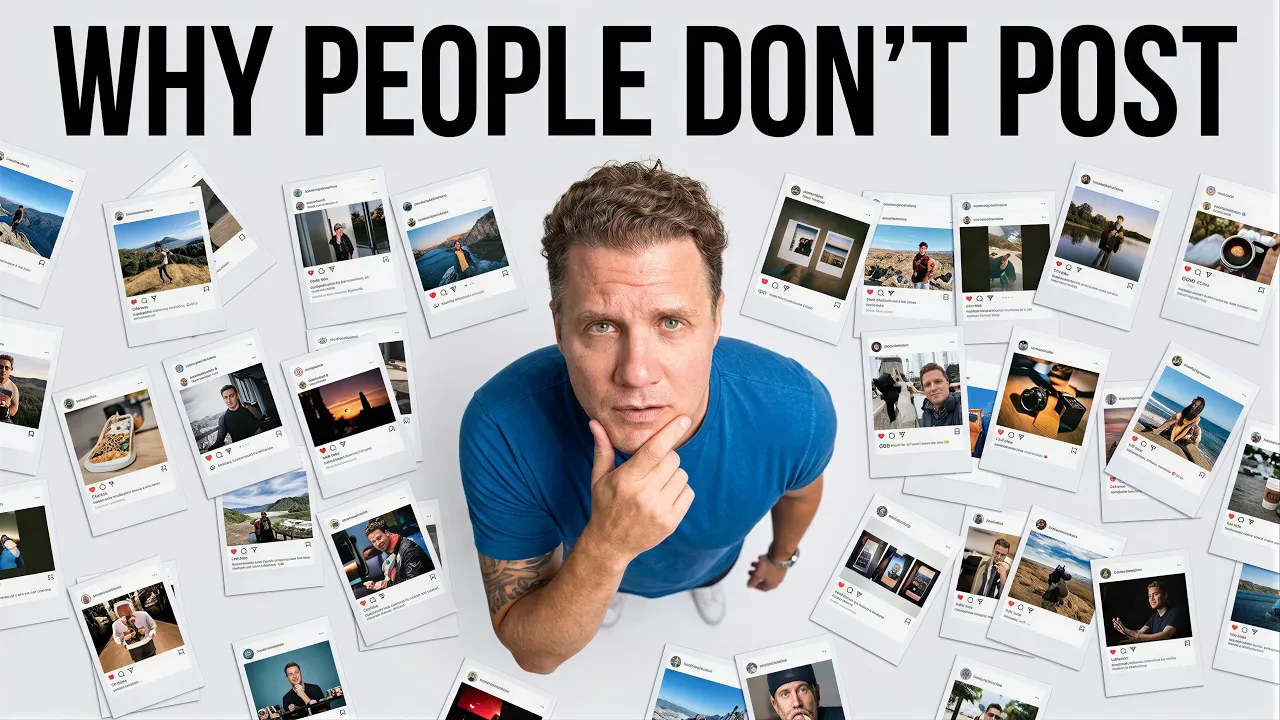
There's a certain type of person in the world who goes on an incredible vacation or eats an unbelievable meal or has a big birthday party and then doesn't post any of it online. The only proof that it ever happened was that they tell you about it in person. I mean, if somebody has a birthday party and doesn't post about it on Instagram, did it ever really happen? Now, we've all met people who don't engage in social media, don't use social media, never post on social media, don't even have accounts. I've met a number
98 words, the words spoken in the first 30 seconds at 195 words per minute.
Free, no signup. See how the first 30 seconds hold attention, with rewrites.
Sentence shape
| Measure | This transcript |
|---|---|
| Sentences | 93 |
| Average words per sentence | 17.4 |
| Longest sentence | 58 words |
| Questions asked | 4 |
| Sentences containing a number | 4 |
Most used terms
Filler phrases
29 in total: like 16 · actually 9 · I mean 2 · kind of 1 · literally 1.
A literal whole-word count of the same phrase list the Prepublish browser extension uses, so a phrase inside another word is not counted and a phrase used in its ordinary sense still is. It is a count and not a judgement.
What this transcript is
Every word below is the caption track YouTube publishes for this video, pulled from the video itself and reproduced unchanged. It is not Prepublish's writing, not a summary, and not a re-transcription: it is the video's own published captions. English captions, generated automatically by YouTube, in the video’s original language. Source: the video on YouTube. A channel that would rather this page did not exist can ask for its removal through the contact page, and it is removed.
No Script X-ray for this video: YouTube shows a Most replayed graph only once a video has enough views.
There's a certain type of person in the world who goes on an incredible vacation or eats an unbelievable meal or has a big birthday party and then doesn't post any of it online. The only proof that it ever happened was that they tell you about it in person. I mean, if somebody has a birthday party and doesn't post about it on Instagram, did it ever really happen? Now, we've all met people who don't engage in social media, don't use social media, never post on social media, don't even have accounts.
I've met a number of these people over the years. Maybe you are one of these people who's considering getting rid of all of your social media. And on the one hand, it seems so appealing, but on the other, it seems so strange, so cut off from the world, like you're blinding yourself in one eye cuz you're sick of looking at things you don't like. This is the strange psychology of people who don't use social media. So, I've put together four reasons that I think people drop out of the internet entirely and only live in the analog universe.
So, number one is what I call the photographer's paradox. My wife, she's one of these people. Every good meal she has, every cool sunset, every interesting place that we go or fun experience we have, she wants to take picture of it. And it drives me crazy because as soon as you stop and want to take a photo of something, you are removing yourself from the experience of that thing. Now, as somebody who really likes to be in the moment and try to be as present as possible, this bugs the out of me.
Like, you're completely pulling me out of flow state to try to take an objectively beautiful picture of something that is may or may not be as good as the picture looks. And then, of course, one picture is never enough. Like, you got to get different angles, and then you got to do the vertical and the horizontal and the zoom out and the wide lens and it never ends, guys. It never ends. So, I get that part of it. But, to me, social media, it's a little bit of a devil's bargain.
I don't like being interrupted throughout my life, but I will say as the years have gone on, I am so glad I have tons of photos and videos of certain experiences that I had in the past. And if it was up to me, I wouldn't have a lot of those photos and videos. So, credit to my wife for making me take them. But I think the second reason is actually the bigger reason why people disengage. And that is it's simple social comparison.
See, evolutionarily speaking, we are wired to always compare ourselves to the people in our environment. Our brain is constantly ranking us on an apparent social hierarchy of what our social status is compared to the people around us. Now, you have to understand that that comparison machine that's going on in our brain, it evolved over hundreds of thousands of years in small tribes of a few dozen people. You're comparing yourself to others, but it you're comparing yourself to like Unga Munga and like how well you can bash a antelope in on the skull.
It's not really high stakes, and there's not a whole lot of stuff to compare. But suddenly, when you're online and you're exposed to literally millions and millions of people from around the world, pretty much all of which you're never going to meet in real life and you're never going to interact with, that machinery is still going on where you are unconsciously comparing your social rank to each of those people. And the worst part of that is that the social media algorithms are designed to show you everybody else's highlight reel while you are stuck in your humdrum daily grind of a life.
So, the comparison is an unfair one to begin with. And I think people who are particularly sensitive to these comparisons or people who fall into the perceptual bias of assuming that what they see online is a representation of what the world is like, social media can kind of their brain up. So, the next time you feel like the world is caving in on itself, maybe try to relax with some nice tunes. Brain.fm uses music that's designed, like actually backed by neuro science and real researchers, to help your brain shift into whatever mode that you need at that moment.
Could be deep work, relaxation, meditation, or actually falling asleep before 2:00 a.m. for once. I love Brain.fm because it's not just background noise. It's not some dude on YouTube playing rain sounds through a tin can. It's stuff that's engineered and music that's crafted to change your brain state within minutes. It gets past your lazy frontal lobe and hits the good stuff underneath, the part that actually gets [music] things done.
Now, whether I'm writing, reading, or just trying to keep my attention span from melting into TikTok soup, I throw Brain.fm on and it helps me lock in. Brain.fm, it's super easy to use. You can use it on your phone. You can use it on your computer. You can use it anywhere you go. And I love it. And because you guys know I don't promote crap that I don't use, they are giving you 30 days of unlimited free access if you sign up with the link below.
That's a full month to train your brain, to stop being such a nut job, and actually get things done. So, the next time the world feels shitty, give Brain.fm a shot. Check out the link in the description or the link below to get your 30-day trial right now. But, here's the interesting part. Because a lot is made these days about how social media is like ruining everybody's mental health and how it's like the decline of the younger generations and blah blah blah.
If you actually dig deep into the research, what you find is that people's experiences with social media vary quite widely. For some people, they actually benefit from it. Social media actually makes them happier. Some people, it makes them absolutely miserable. And what's interesting is that social media doesn't necessarily take a happy person and make them unhappy. It takes somebody who's predisposed for a lot of social comparison or a lot of insecurity or a lot of obsessiveness or narcissism, and it simply amplifies those facets of their personality.
So, if you are somebody who is already very susceptible and sensitive to social comparison, if you were somebody who is already overly worried about your appearance or how you come across to people or your particular status or ranking, then yeah, social media is probably not going to be a fun time for you. And this is particularly true for people in the third point, which is that social media favors extroverts. Interestingly, when you look at the data on who is most engaged and active on social media and online, it tends to be more extroverted people.
It tends to be more social people. People who are highly introverted, they don't really feel like they're missing out on much. So, it's much easier for them to give up the supposed connection to the outside world, especially if they're constantly being bothered and annoyed by these obnoxious social comparisons. Off the top of my head, I can think of three people that opted out of social media and just being online entirely many years ago.
But when I think about those three people, it was funny cuz when all three of them got off, I remember thinking to myself, this is back in the ancient days of Facebook and Twitter and like the early 2010s. I remember thinking to myself, I'm like, they'll be back. There's way too much cool going on on here to like completely opt out. I mean, where are they going to get their memes? How how could you even function? What's interesting is that everybody I know who has opted out of the whole online social media game, they never came back.
I actually have no clue what they're doing today. And it feels really weird because everybody I've ever known, I can go check and see what they're doing today, except for those three people. I have no clue. I don't know where they are. I don't know what they're doing. I don't know what they do for work. They could be homeless, they could be billionaires. I have no idea. But I do find it fascinating that they never came back.
Because one thing that I notice as I disengage more and more from being online and focus more on the day-to-day people around me, is that I don't experience FOMO. FOMO is what you experience when you're online too much, because you're overexposed to what everybody else is doing. What I experience is JOMO, the joy of missing out, because I feel joy in that I don't have to be aware of what everybody else is doing. I can simply enjoy what I'm doing in the moment.
So, if you are chronically online and it is driving you crazy, I invite you to experience a little bit of JoMo. Go on a digital detox. Delete all the apps off your phone. Maybe go buy a shitty burner phone for a couple weeks. See what happens. Who knows? Maybe you'll never come back.
The words are the caption track's own and nothing is reworded or re-transcribed. Paragraph breaks are placed between sentences so the text reads as prose.
Free tools for your own script. No signup, no login.
Paste your draft and see where viewers are likely to drop off, with a rewrite for each weak line.
Paste the first 30 seconds of your own draft for a hook score and rewrites.
Check your draft against YouTube's advertiser-friendly guidelines before you record it.
Read this channel's public videos and transcripts, and download a writing brief for it.