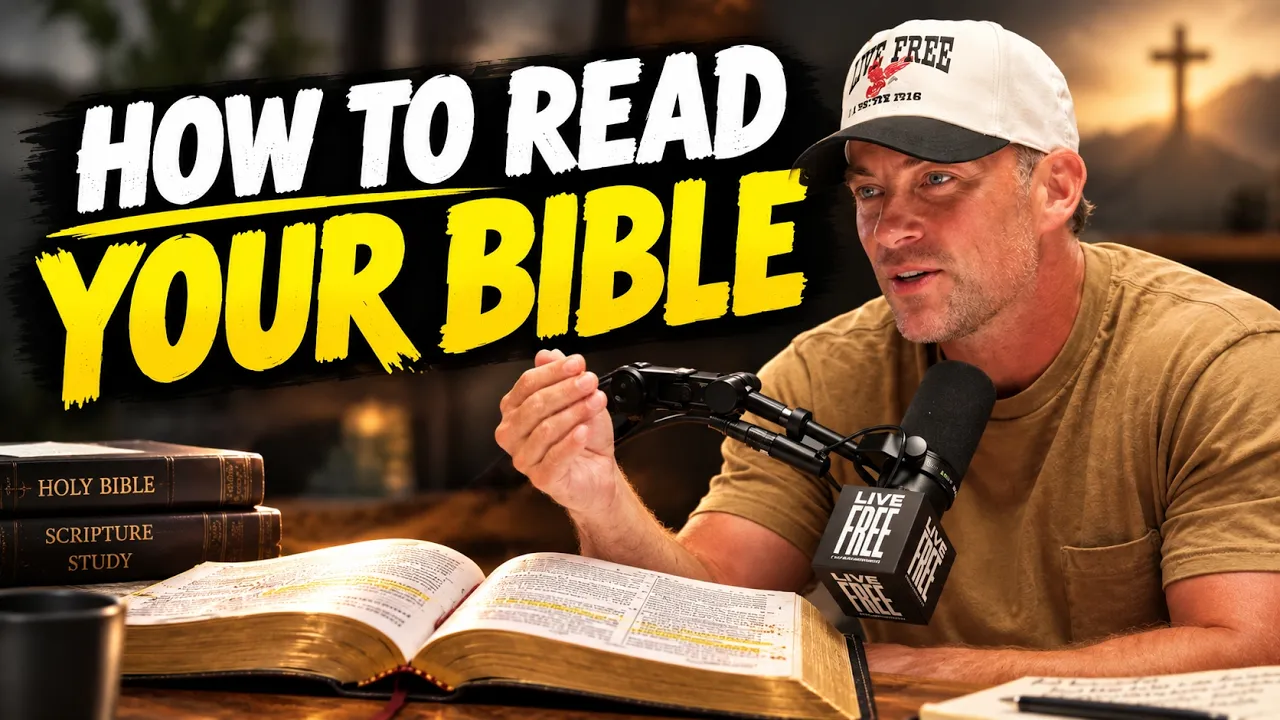
4 WAYS TO READ YOUR BIBLE (very important!) transcript
thegoodshepherd · @thegoodshepherd7
Words
6,239
Runtime
25:15
Speaking pace
247wpm
Reading time
26min
247 words per minute, above the 201 75th percentile of 349 measured videos. That distribution comes from the 349-video hook study.
Opening (first 30 seconds)
Developing this habit will be arguably the most important thing you ever do. >> Yes. >> Bible study methods are like diets. What's the best diet? The one you'll do. What's the best way to study the Bible? The one you'll do. >> An intentional plan is going to work better than a haphazard one. >> One of the most frequently asked questions we get on this podcast is how the heck do you guys get that stuff out of the Bible that I never see when I'm reading it? So, I'll just let's do this real quick. Let's like we want to equip people to be good workmen unto God. >> Yep. >> So, Shadrach, Meshach, and Abednego, you want to run us
124 words, the words spoken in the first 30 seconds at 247 words per minute.
Sentence shape
| Measure | This transcript |
|---|---|
| Sentences | 506 |
| Average words per sentence | 12.3 |
| Longest sentence | 84 words |
| Questions asked | 64 |
| Sentences containing a number | 17 |
Most used terms
- bible61
- study42
- word35
- people30
- god29
- read28
- hey24
- reading22
- yeah19
- passage18
- man17
- actually16
Filler phrases
185 in total: like 93 · you know 18 · actually 16 · uh 16 · um 16 · kind of 12 · literally 6 · I mean 4 · right? 2 · basically 1 · sort of 1.
A literal whole-word count of the same phrase list the Prepublish browser extension uses, so a phrase inside another word is not counted and a phrase used in its ordinary sense still is. It is a count and not a judgement.
What this transcript is
Every word below is the caption track YouTube publishes for this video, pulled from the video itself and reproduced unchanged. It is not Prepublish's writing, not a summary, and not a re-transcription: it is the video's own published captions. English captions, generated automatically by YouTube, in the video’s original language. Source: the video on YouTube. A channel that would rather this page did not exist can ask for its removal through the contact page, and it is removed.
Transcript
Developing this habit will be arguably the most important thing you ever do. >> Yes. >> Bible study methods are like diets. What's the best diet? The one you'll do. What's the best way to study the Bible? The one you'll do. >> An intentional plan is going to work better than a haphazard one. >> One of the most frequently asked questions we get on this podcast is how the heck do you guys get that stuff out of the Bible that I never see when I'm reading it?
So, I'll just let's do this real quick. Let's like we want to equip people to be good workmen unto God. >> Yep. >> So, Shadrach, Meshach, and Abednego, you want to run us through real quick like three or four ways to study your Bible? >> Yeah. Uh when people ask me this question, man, how how did you learn all this sort of thing? I always tell them like, there's nothing special about you, me, or Carlos. The difference between you and someone that you look up to who really knows the Bible is time and intentionality. >> Time and intentionality.
It takes time. Like I am the sum accumulation of about 47,000 meals that I've had in terms of just physically. Can't remember but a handful of them, but I'm the sum total of all of them. In the same way, man, I you the three of us or I'd say that we're the sum total of all the times we've read God's word. >> That's >> We may only remember a handful of those times that really stick out to us, but man, over time the accumulation it just adds up.
The intentionality part is really important as well. So, it's not just so I'm going to flip open to a random page and see what's there. Like no, like an intentional plan is going to work better than a haphazard one. And so, I tell people like, you want to be doing two things and I'll give you four study methods to do these two things. You want to number one be exposing yourself to as much of scripture as possible over the course of a year or two. >> That's right. >> Get a Bible reading plan.
Um it can be a year, a two-year, it could be a three-year plan, but that's where you're going to be reading more scripture. It runs just be exposed to as much scripture as possible. But number two, man, go deep on a book or two of the Bible a year or a topic a year. >> Yes. >> And do both of those. >> Yes. >> And I tell people this seems like insane, but I'm like, if you will do that every year, if every year you expose yourself to as much scripture as possible through a Bible reading plan, and you will pick a book or two of the Bible or a theme or two of the Bible and go deep in them, in the course of two to three decades, you could have insanely I hate to say master the Bible, but you'll be like there.
You would have exposed yourself to the depths of scripture and you'll be a fundamentally different person because of that. So, those two kind of broad-based approaches expose yourself to a lot but then go deep in a few. But then you're four good methods of how to do that. Now I want to walk people through them and really focus in on two of them because two of the methods it's best if you get a book and I'll recommend some but two will walk step by step as you do these.
So, if So, people listening here's what I'd say >> I'm going to say two things. One, people might they may hear four and they may go, "Well, hey Paul, which one's the best one?" I'm going to go on and answer this question. Okay? When people it's the same thing what I say is Bible study methods are like diets. What's the best diet? The one you'll do. What's the best way to study the Bible? The one you'll do. So, just pick the one that you that you do.
The other thing I'll say where our personalities might be different, honestly for me what'll happen is I'll do one of these and then honestly I'm going to shoot you real straight, I get bored. >> [laughter] >> I'm serious. I get bored of doing the same thing every day and then I just switch. >> Yep. >> So, it's like what I would say is which one's best one? The one you'll do. And then if one starts lagging on you, we'll just switch.
Just keep yourself interested. Now, >> Yeah, I've got actually a chart for you. We love charts. We got a chart. Four methods: devotional, inductive, deductive, and biblical theology. Okay, I'm going to walk through just briefly each of these and then we'll double click specifically on devotional inductive and kind of walk you step by step through these methods. But each of these serves a different purposes and really they're about different questions you're asking.
So, devotional, this is best for your bread and butter Bible reading. This is really asking the question of how can I respond to what God has said today by reading the word of God today. How can I read it? So, this is also great for like when I'm trying to take in a lot of scripture at a time, this is me. I'm going to sit down. This is probably more like 10 to 15 minutes, maybe up to 30. So, this is best for your like daily Bible reading.
I tell people if you can do this one three to four days a week, it's a great thing to do. Um inductive is really more of I go go ahead. >> You're going to explain how to do them. >> Yeah, I'm going to explain how to do them. I'm going to come back through then actually explain how to do them. Inductive Bible study is where I'm asking the question, what does this passage communicate? This is a little bit more of in-depth Bible study.
Kind of think of it this way. Whereas devotional Bible study is more like, hey, I got 10 to 15 minutes, maybe up to 30. In-depth Bible study or inductive Bible study is more like, man, 30 to 40, maybe even up to 60 minutes of your time. Um this is great for diving deep into a passage or if you're wanting to study the book of the Bible. So, we've been going through 2 Timothy, you could do that on your own and just take a little bit of it at a time, 30 minutes up to 60 minutes, and just being honest with you here, boy, I'm probably not going to do that every day.
Most people don't have time for that every day. So, for me, I'm going to do like as much as I can every day, more of a devotional reading that's short, asking God, what do you have to say to me through this today? Inductive is then maybe once or twice a week I'm going to go deep. And again, if you do that over the long >> long haul, it really adds up. >> Big time. Deductive Bible study is more of the idea that, hey, there's big topics and themes in the Bible, and we're asking, what does the whole Bible have to say about that given topic?
So, instead of looking at an individual passage and say, what is God trying to communicate through this specific passage, it's saying, hey, what does the whole Bible say about hope? >> Yeah. >> What does the whole Bible say about the Trinity or about any given topic? This is where I would say, hey, it's best if you get a guide to help you. Someone who's written a systematic theology. So, I've got here Wayne Grudem's Systematic Theology is a great one.
Um also John MacArthur's Knowing God's Truth >> every Christian dad should have a copy of Systematic Theology in his house. Yep. That's your go-to when your kid asks a question that you don't know how to answer. Here's what you do. You say, I don't know, but I'm going to find you the answer, and you go right to that book. >> Exactly. And so, let me give you an idea. Like [clears throat] the last year or two I've really wanted to dive deep back into the Trinity.
And so, what I do is I take a book like Wayne Grudem's or others, and I'll use that as a guide, but here's the key. So, you're not just reading Wayne Grudem's words, you want to get into the word. As you'll read his stuff, but then what will happen is is in all the stuff he's writing, you'll see Bible references and verses. Then go look them up and read it for yourself. That's the key. Otherwise, you're just taking his word for it.
You actually want to go to the word and see what it says. >> All right, bro. I'm just going to clarify. So, one of the things that people listen to podcasts will be like, "Bro, how do you guys do that?" >> Yeah. >> So, like the stuff he did at the beginning about oil press and it was used in for four different things. And then he starts connecting it I'm going to use a big theological word, christologically, in how the four uses of the of oil throughout the scriptures are fulfilled in Christ.
Okay, how you get that is through deductive Bible study. So, this is one thing we may talk about in a second. One of the things that frequently blows my mind is all very intentionally chase rabbit trails. >> Mhm. >> So, I may talk about this in a second. Like I'm reading I'm in Numbers and the other day I'm I'm in like Numbers 4 and it keeps insisting that the entrance to the tabernacle will face east. >> Yes. >> So, honestly, dude, here's what I do.
I'm in my Bible study and I'm like, "You know what? I'm going to chase the rabbit trail." >> great question. >> Okay, I'm going to trace the rabbit trail and I just start digging in. What is the theological significance of the directions east and west in the Bible? And right around the five time, sting it blew my mind. I'm like I got it was like hands up, tears down, worship pouring out of my heart just chasing the rabbit trail on Tuesday morning.
What's the theological significance of east and west in the Bible? That's deductive Bible study. >> Yes. >> Yeah. Oh. >> I got to be careful. You're going to make me chase a rabbit trail. >> No, don't do it. Don't do it. Keep going. Keep going. >> that's where you can see, "Oh yeah, like the Garden of Eden and the tabernacle are modeled almost exactly the same in terms of directions they're facing, how it's constructed, cherubim, all the things." But again, if you have a guide like Wayne Grudem, you're like, "How do you we learn this stuff from other people.
We learn it, but then you saturate yourself in it, you go into the word and it's amazing. Um you know, again, even like here's a two practical encouragements on this then I'm going to give the fourth category and let's double click on SOAP and inductive and give people kind of a starter course so they can get going on their own. Um which is a practical thing. I actually find for like deductive more like topical or systematic study, if you know how to use AI, it can actually be really helpful right here. >> Fact.
You got to double-check it. >> to double-check it. >> But fact. >> But caveat, too. If you know how to use it, whereas like hey, can you get me all the relevant Bible verses on and then you give it a topic that you want to do. And so even like I know for some people they they kind of have like here's my word for the year that I feel like God has given me. A great thing you could do is then chat GPT it or whatever. Say hey, what does the Bible have to say about your word?
And then spend that year diving into those verses on that word. It's a great way to do a more deductive study. >> This is what I did on the east and west thing. Yeah. I'm I'm literally sitting there and I'm grocking. God I got grock expert. And I'm like list for me every theologically significant verse that mentions the directions east and west in the old and new testaments. And that's literal. I just sit there and I'm doing my I'm looking up in my actual physical Bible.
So I'm making sure I'm not relying on the AI. >> Mhm. >> And and that's all of a sudden I'm like Like my mind's like >> [laughter] >> being filled by glory. >> It's amazing. One again, begin put pieces now give the last study method. It's for me most days I'm trying to do a more devotional study. Trying to get exposed myself to the word as often as possible asking God, what do you have to say to me today through your word?
Once and for all. But then maybe just a couple times a week, I'm going to go with more to that deductive study and go a little bit deeper and it adds up over the course of the year. Final category, biblical theology. This is actually a a really fun one. This is asking Google the question of hey, how does a particular theme develop across scripture? So I'm going to say like when people hear about the connections you make Carlos between the old and new testament Pastor Josh, you did the amazing thing the same way.
This is biblical theology. It's taking something that is a theme and it starts in the old testament but then shows how it's fulfilled by Christ in the new testament. >> Which is in every single page of the Bible. >> And every single page. It's insane. There are multiple layers on every single page of the Bible. >> Oh, crazy. Well, and even to help people understand, like one reason for example that the book of Revelation is really difficult for people, in addition to it just having a lot of symbolism and symbolic language in it, it is Old Testament saturated.
And because people don't know the Old Testament as well, it's hard for them to then to catch these things it's alluding to all the time. But again, this is a a method, it's great to have a guide. So, a couple books, um God's Big Picture by Vaughan Roberts is a great introductory one. And then also trace tracing God's story is a good one. What's great about this one, uh my daughter and I have started going through his systematic theology together, is every chapter he'll take you through the theme, but then he actually gives you reading assignments from the Bible.
So again, you're not simply reading John Nelson's word, he is going to make you read the word. And I think you had another recommendation, right? >> Because I'm too dumb to read Paul's books a lot of times. Uh this is uh throw that other one out there, Trinity, the book that I did. So honestly, if you're going to my opinion, if you want to do one and you're like, "Hey man, I'm trying to figure out the you know, Bible I I'm kind of new to this thing.
What are they even talking about? Like how the Old Testament and the New Testament relate and all Where do they get all that mind-blowing stuff? That In my opinion, that's where you start. It's called Epic of Eden by Sandra Richter. That book stinking blew my mind. The first time I read it, you'll never read your Bible the same again. >> Yeah. So, all this Pick one of these resources we've given if you want to do one of these other study methods, use them as a guide, but again, I can't emphasize enough, don't just read their words.
Read the words. So, if you see one of those references, go look them up. Now, let's do maybe a quick walk-through of SOAP in the >> that SOAP study to actually just show you how to do this. So, we've got the graphic for SOAP up there. SOAP is uh simply, you know, it's an anagram that stands for scripture, observation, application, and then prayer. So, if you're not watching this, I highly encourage you to do it later.
Maybe we can also put this in the guide um as well. I've got up there even recommendations of how long you spend on each of these sections. So, the idea is like, for me, I've got my Bible open. Um I've got a Bible reading plan that I'm coming out of. I've got my Bible open. Usually I have a journal and a pen, so I can stay focused and not get on my phone. Um and I get distracted by my phone. And so for me then I'm going to just simply follow S O A P.
So scripture, choose a passage, and I usually encourage people read it slowly at least once. Read it slowly. Don't skim through it really fast. Just read it slowly and intentional at least once. And then for me this is more of a recommendation than than a you have to. Write a verse that stands out to you. A verse or a phrase. And even often what I'll do and this is important to say actually. But the first thing you needed to do do before you do anything is to stop and pray for a moment.
And just recognize you talk about God your words are important. The idea of like God spoke the universe into existence. And that same God spoke this word into existence and he wants to speak to me. And so I'll sometimes say God what do you have to say to me today? So I'm going to read it slowly. Usually thinking is there any phrase or or verse that sticks out to me? Then there's observation. Here's a mistake a lot of people make.
A lot of people will immediately then say what does this mean to me? >> Yeah. Who >> cares? Nobody cares. >> Terrible question. >> [laughter] >> It does not matter what it means to you. It matters what does it mean? Period. Once and for all. So an observation you're really asking yourself hey what does this mean? What did he mean to say once and for all? So you can ask a few questions like hey what's happening in the passage?
What does the passage reveal about God or about people? And you're like also noting words that stick out as hey is he saying these words about us? You're simply spending five or six minutes and you're saying hey like what seems to be like the main message the main things that being communicated here. Don't worry about by the way if you get everything. This is devotional reading. You're not trying to write a thesis. You're simply trying to get a few basic things.
Then there's applications. This is where you ask not does it what it mean to me but actually what does it mean for me? So there's what does it mean and then you're asking okay based on what it means what does that mean for me? How do I actually live differently in light of this? So you can ask some of these questions. How does this truth meet my life right now? Is there something that I need to believe or change or do?
And here's what I usually encourage people, choose one specific thing. If you have multiple things, great, but it's going to be say, hey, if one thing changed today about what I believe or what I do or how I feel based on this passage, what would it be? And then the final thing, P is prayer. Take a moment, thank God for what you learned, and ask him for the grace to apply the thing that he showed you. Anything that you guys would weigh in on this and say and and double click on? >> On the observation, I mean, that's a the word that we use traditionally for observation and kind of application a little bit is the word meditation.
That's the word the Bible uses and I mean, this is from Psalm 1. Blessed is the man whose delight is in the law of the Lord and on this law he meditates day and night. He is like a tree planted by streams of water that yields its fruit in its season and its leaf does not wither. In all that he does, he prospers. That word to meditate in in Hebrew the word which is literally the same word that the prophet Isaiah uses when he's talking about a lion growling over its prey.
So, in the same way that you see a lion looking at its prey and it's a growling and it's kind of pondering and it's looking at it and it's about to eat it, that's how Christians are called to approach scripture. We look at scripture and we meditate, we ponder it, we we're hungry for it. And basically, that's that's what you just described Paul on observation. >> It's good. >> Anything Pastor Josh on more devotional reading and also? >> Yeah, a couple couple things real quick.
So, here here's I just want to highlight a couple things you said. First of all, man, like developing this habit will be the arguably the most important thing you ever do. Because I'll just say the same thing I say all the time, man. It starts out sounding sacrilegious, but just stick with me. Praying is not powerful. Reading the Bible is not powerful. Going to church is not powerful. Singing a song is not powerful. You know what is powerful?
Reading the Bible every day. That's powerful. Praying daily. That's powerful. Going to church every week. That's That'll change your life. So, it's the thing over time. When it comes to observation for me, a lot of times I'll for some reason for me the number 30. I'll sit down and I'll read like like passage and I'll just go, okay, I'm going to make 30 observations." >> That's good. >> And it I mean, it's basic stuff.
I mean, like Paul's talking to Timothy. >> Yes. >> That's an observation. >> Mhm. >> You know? This is the fourth time in this book he said this. That's I'll just force myself to do 30, and I I just, you know, I get my brain does this thing. So, if I can have a a pin right there, and force myself to do it, like, okay, 30. It just gets it my heart marinating in it. Now, to what Carlos just said, you know, I've heard the little analogy before, uh you got the example from the scriptures that the word is like a sword.
You got that analogy that you want to grip a sword with five fingers. >> Mhm. >> So, here's what here's what I'll kind of do sometimes is like five ways that I want to interact with the Bible, and they kind of all flow into these different study methods. >> Yep. >> You want [snorts] to read the word. This is all five fingers grip the sword. Here's the five fingers. Read the word, study the word, memorize the word, meditate on the word, pray the word. >> Mhm. >> If I can get those five, I'm gripping the sword with all five fingers. >> Okay. >> So, and then when it comes to meditate, really meditation is like a prayerful form of what you just said.
So, like, this is 2 days ago, I just needed it. I took my little long walk, and I got my Life Application Note with a bunch of lyrics of hymns. You know, I look like a crazy I actually had a church member stop and be like, "Are you okay?" They saw me cuz they see me I'm like crying out to the Lord, you know, they're like, "You okay?" Yeah, I'm worshiping. Uh >> You're like, "Leave. Leave." >> Get out of here. I'm busy. >> Hey, man.
[laughter] There's things you shouldn't >> Mind your own business. >> There's things you think, but you don't say. And uh you know, >> I love you, but I uh >> Yeah, yeah. Uh Jesus loves you. And uh but so, meditate So, like, meditating it's it really goes back to it's a prayerful form of what Paul's talking about. Yeah. So, like, meditating, I'm meditating on that passage. Uh I can't remember the which number. Um oh God, you are my God. >> Mhm. >> So, like, I'll just sit there.
And so, really what I'm doing is making prayerful observations. I'm just going, "Oh God, man. And I'm just stopping. Man, you are Lord. You are sovereign over the universe. You own the cattle on a thousand hills. Not a sparrow falls to the ground apart from I'm just I'm just like naming and saying back to him the aspects of his godness. Then I go to the next word. You are my God. Man, I have been adopted by my heavenly father.
It's not just that I'm yours, it's that you're mine. You're my God. This is a covenant relationship. And then earnestly I seek. So, but these here's what I'm I'm you know, what I'm driving at is these are prayerful observations about the text is what we're driving at. So good. >> Yeah, let's keep going. >> It's so good. >> Yeah, let me talk walk through the inductive. We shouldn't take a long time because actually SOAP and the inductive method are really similar.
Again, devotional reading the point is usually is shorter and mainly it's hey, I do want to know what the text means not what it means to me, what it means. But it usually is driven towards hey God, what do you have to say to me today >> That's right. >> my reading plan. Whereas inductive study is really more you're doing a deep dive into a passage usually in a book of the Bible in context and you're going to walk through it a little bit at a time cuz you're just trying to be a person who masters the word and can handle the word correctly.
But you'll see a similar pattern in that inductive study moves from observation to interpretation to application. So again, different letters than before of SOAP, but it's still a lot of the same stuff. It's observation, interpretation, and then application. So again, I usually tell people hey, read, choose one complete passage. So for example, if we're reading 2 Timothy, we would do the passage this week. And you're going to read that passage slowly.
For this one I'd say two to three times. So before it's like hey, read it once if it's more devotional. If you're going in depth, read it two to three times depending on the length of the passage. Then what you're doing on an observation is you're marking repeated and important words. You're like man, the Apostle Paul seems to talk about words a lot. >> That's right. >> He says the word teach a lot. Okay, that seems to be really significant.
Let me circle that, highlight it or whatever it is. I'll look for contrast and commands and reasons. So like if Paul or whoever it is in one of the books is giving commands, okay, write that down. What is the command that he's given? You mentioned I love the observation thing. It sounds simple, but like that's important. It's like what I do if you looked at my journal when I'm writing stuff, it's usually not as profound as people would think.
It's literally I'm just trying to catch if hey Paul commands this. He says this kind of a thing. And then I would say for this one write down at least five. So you went 30, you did six times more than me. You're like advanced level compared to me kind of a thing. But it's like write >> Professional pastor over here. >> Write at least five observations. Then investigate. This is where you're going to ask questions that are raised by whatever you have um been reading.
So ask questions. This is one of the best ways to learn. So if you don't understand it, begin asking questions. Why does Paul say this like this? Hey, why does he mention their names? You're just asking questions and you may not even be able to answer them at first. And this is where it's helpful I find to have a good study Bible. Now I do I do tell people on this, don't go there first. >> What's your recommendation on study Bible? >> ESV study Bible is amazing.
NASB study Bible is fantastic as well. Those are my Any besides those two that >> Uh ESV is the one that I typically go to. I've got a MacArthur study Bible that I like. >> Yep. >> Yep. And I tell people don't go there first because it'll become a crutch. Instead wrestle with it, but then you're like, hey, like I don't I still don't get it. That's where having that good study Bible is a helpful tool for you. >> Yeah, and I will say this Paul cuz honestly to for me this is probably one of the ways that I've grown the most like over time.
Just I have a lot of questions. You know I you know I just when every single literally I think every single day when I read my Bible it's question after question. Like today I was reading this morning the temptation of Jesus and it says that Jesus was in the desert with Satan. And then it says that Satan took Jesus to the top of the temple. And I'm like, wait a minute. I've I've been there now so I know that the desert's over here, but the temple's like literally did they like teleport?
Like so that's a question that I have. And like again I think some people get discouraged because when they read it they're like, man I don't understand it. Well, did you write down the questions that you have? Cuz that's That's That's how you move from not knowing towards finding the right answer. >> Exactly. If you write write down the questions and then go look for the answers, right? This is usually the place that's going to take you the longest.
It's you're writing down the questions and then you're going after the answers. You get a guy to help you. Go ahead. >> It's usually where you get the best up. >> It is where you get the best up. >> That's usually where you get the best up. >> I'm so glad you said that. That's a really key thing is shallow Bible study to in-depth Bible study, this is the difference. >> is where you will ask the questions and then take the time to go look for the answers yourself.
Okay, then finally let's begin wrapping this up, summarizing it. This is where I encourage people when you're doing more in-depth study for the particular text or passage you've got, try to summarize the author's main point in one to two sentences max. >> That's good. >> Keep it simple, keep it in your language, don't try You're not impressing anybody. This is for you. But summarize and say, "If I could boil all this down into the what's the main point of this in one to two sentences?" Man, that's good.
And then respond. Then you are asking, "Hey, again, what should I believe? How should I change in light of this?" Here's what I tell people for this or for SOAP. Here Here's the analogy I use. Remember when you when we were growing up and we had to write five paragraph essays? >> Mhm. >> The idea that they were doing is, "Hey, they're trying to teach us how do I introduce something I want to say? How do I write some things to support it?
And then how do I conclude the argument?" Since you learned how to write a five paragraphs essay, have you ever written one again? >> No. >> No. But what [laughter] stayed with you, you over time the more they forced you to do it, it became second hand to where now you still got the same concepts, but now you just do it without thinking about the five paragraph essay. Same thing for these methods, whether it's SOAP or then more inductive thing of observation, interpretation, application.
When you begin to do this, it may have to be a little bit more rigid and you may even write out those words about beside them and then fill them in your paper. You will begin to do this naturally. It'll just become a part of who you are and what you do. That's part of it again, it takes time. If you need some more help, again, a great book especially for the inductive study is either How to Study Your Bible by Kay Arthur, but there's also a great one called A Noble Word by Peter Kroll.
And what I love that he does is throughout the book, it's about 160 pages, he takes you through the same passage in Genesis. And he says, "Okay, this chapter is on observation. Here's how to do it. >> that's fascinating. >> Yeah. All right, here's an Here's Here's interpretation. He does a case study. And it's the same passage. So, then it's like, here's interpretation, he teaches you some tools, and it's like, all right, now go do it.
And so, that's a really good one that I'd recommend as well. >> All right. Any Anything on those things that you think I left out or be good to give some tips on? >> mean, just to add what you just said, Paul, you know, obviously, as you keep studying it, learning more things matters. It is important. It is necessary. I think we have a responsibility. We have a faith that seeks understanding. That's a good thing. Um but, I think also having the right posture of your heart is also essential.
Um because when you look at scripture, the Bible says that Satan and demons actually know their Bible quite a bit. Today, you will find atheists that have a lot of degrees more than probably the three of us combined but actually are not in Team Jesus. And so, when you do read it, uh you know, I would just say three things. You read it and you study it with a heart that is reverent. The Bible says in Isaiah 66 that this is the one to whom I will look.
So, God is saying, "I'm going to pay attention to this person. He who is humble and contrite in spirit and trembles at my word." And so, when you open up, when you study, when you do all the books, when you read all the things, make sure that you have a heart that is literally trembling. This is like God Almighty speaking to me right now. Um read it with expectation. Ultimately, Paul, you said this is God speaking to you.
He's going to not just speak to you in a generic way, but this is your heavenly father giving you a word that you need for today. It is your daily bread. And then, the last thing I would say, read it humbly. Uh 2 Timothy chapter 3, all scripture is God-breathed and is useful for teaching, rebuking, correcting, uh and training in righteousness so that the servant of God, that's you and me, may be thoroughly equipped for every good work.
Um we don't go go scripture and study it so that it affirms what I wanted to say. We go to it so that it corrects us and so that we can be grown. We don't go just to be informed, we go to be transformed. We don't want you to think free. The whole point is for you to actually live free. So, that's that's it, man. >> So good.
The words are the caption track's own and nothing is reworded or re-transcribed. Paragraph breaks are placed between sentences so the text reads as prose.
Use this transcript
Three free tools that work on the material around a video like this one. No signup, no login.
Hook Analyzer
Paste the first 30 seconds of your own draft for a hook score and rewrites.
Policy Pre-Flight
Check your draft against YouTube's advertiser-friendly guidelines before you record it.
Channel Skill Generator
Read this channel's public videos and transcripts, and download a writing brief for it.