Getting the transcript
Reading the captions from YouTube. A video nobody has opened here before takes 10 to 30 seconds; this page fills in on its own.
Getting the transcript
Reading the captions from YouTube. A video nobody has opened here before takes 10 to 30 seconds; this page fills in on its own.
The Purist Football · @thepurist_
This video has no Most replayed graph yet: YouTube shows one only once a video has enough views. These are the moments viewers replayed most in The Purist Football's most watched videos.
Most replayed moment at 9:25
8.2x that video's typical replay level
at saso he could not achieve his European ambition only after moving to England did his dreams start to become a reality which serves as an important reminder that a football coach no matter how talented is only as good as the quality of their players and that's
Said at 9:18
Most replayed moment at 3:06
6.7x that video's typical replay level
you like it you can go to squarespace.com theep purus football for 10% off your first website or domain good luck so how has pep taking the defensive side of the game to another level well according to opta Pep's Manchester city are the Premier League team with the longest possessions and
Said at 2:59
The graph counts replays. It does not show where viewers stopped watching.
Words
1,628
Runtime
9:30
Speaking pace
171wpm
Reading time
7min
171 words per minute, between the 160 25th percentile and the 181 median of 349 measured videos. That distribution comes from the 349-video hook study.
Opening (first 30 seconds)
When a football club loses both its center [music] forwards in the same transfer window, you expect them to have a problem. But not, apparently, FC [music] Barcelona. In losing both Robert Lewandowski and Ferran Torres, Barca lost 30% of [music] last season's league goals in a single window. But rather than doing what any sensible club would do and replace [music] those players directly, Barcelona have taken an unusual and unexpected route, replacing them not with new signings, but players they already [music] had. Players
86 words, the words spoken in the first 30 seconds at 171 words per minute.
Free, no signup. See how the first 30 seconds hold attention, with rewrites.
Sentence shape
| Measure | This transcript |
|---|---|
| Sentences | 90 |
| Average words per sentence | 18.1 |
| Longest sentence | 38 words |
| Questions asked | 3 |
| Sentences containing a number | 4 |
Most used terms
Filler phrases
9 in total: like 6 · actually 3.
A literal whole-word count of the same phrase list the Prepublish browser extension uses, so a phrase inside another word is not counted and a phrase used in its ordinary sense still is. It is a count and not a judgement.
What this transcript is
Every word below is the caption track YouTube publishes for this video, pulled from the video itself and reproduced unchanged. It is not Prepublish's writing, not a summary, and not a re-transcription: it is the video's own published captions. English captions, generated automatically by YouTube, in the video’s original language. Source: the video on YouTube. A channel that would rather this page did not exist can ask for its removal through the contact page, and it is removed.
When a football club loses both its center [music] forwards in the same transfer window, you expect them to have a problem. But not, apparently, FC [music] Barcelona. In losing both Robert Lewandowski and Ferran Torres, Barca lost 30% of [music] last season's league goals in a single window. But rather than doing what any sensible club would do and replace [music] those players directly, Barcelona have taken an unusual and unexpected route, replacing them not with new signings, but players they already [music] had.
Players like Raphinha, Dani Olmo, and Fermín López, none of whom, as you may be aware, are considered center [music] forwards. And yet, the result has been incredible. Not only is this [music] alternative solution matching what the previous version could do, but may actually >> [music] >> eclipse it. In the first seven games alone, they scored a ridiculous 33 goals. But perhaps most remarkably, this is not even the first time Hansi Flick [music] and the Barcelona staff have managed something like this.
Taking what everybody assumes is a huge hole in the squad and finding a solution that should have been obvious, but absolutely nobody saw coming. So today, we'll be looking at this new version of Barcelona and trying to understand [music] why this team is able to defy conventional team building, to evolve in ways that very few can predict. What is it that Hansi Flick is seeing that the rest of us are missing? To figure that out, we have to first understand the foundation [music] upon which Flick has built this team.
And on the surface, he has simply achieved what many coaches have been [music] able to, to create a clear identity which coordinates Barcelona on and off the ball. >> Maybe sometimes you have to national more risk. >> Raphinha, he goes through. Could be his fourth goal of the season, and it is. Nobody can stop him right now. >> More specifically, Barca's style of play is built around a shared understanding of [music] space.
What you start to notice if you watch them carefully is a constant synchronization of [music] movement into space. As one threatens the space in behind the defense, others are coming short. If one goes inside, the other goes outside. These movements, known as [music] counter movements by coaches, can be subtle, but they force the defenders to move and create space to attack. And once you've seen it, you start to see it all over the pitch.
Most obviously from the forwards who create space to attack the back [music] line, but also from midfielders whose counter movements create the space to beat high pressure. This shared understanding of space acts like a common language amongst the Barcelona [music] players and keeps them coordinated and in sync as the game develops. >> [music] >> But there's an important caveat. Because while Barcelona are built on this shared understanding, it feels as though the players have still retained their individual footballing personalities.
The differences that make them unique and authentic. And that's incredibly important because in elite football, [music] it isn't always the case. There are coaches out there who take the concept of shared identity to the extreme. And the example I always use is Roberto De Zerbi who has one of the clearest visions for how his team should play and is incredibly specific about his players' behavior. >> If the pressure [music] start from the number eight, we finish at number eight.
[music] >> This means that as a player, you must conform to De Zerbi's way of understanding football. You can look at the midfielders he's coached who all come from different footballing cultures, but in his systems, they play the game almost identically, [music] taking up the same positions and repeating the same patterns. Now, I use De Zerbi as an extreme example, but it's not uncommon for players to be molded in this way around a very specific tactical vision.
But, what does this have to do with Barcelona and center forwards? Well, the point is that Flick and Barcelona have managed to strike an important balance where the players are coordinated, yes, but they haven't gone so far that they've lost their individuality. And it's that very foundation which allows them to evolve in surprising ways. Let's take two players who take up similar positions on the pitch, Raphinha and Dani Olmo.
Particularly this [music] season, these two have been rotating a lot, occupying center forward and attacking midfield positions. But, the way they interpret the game from these positions [music] is notably different. Raphinha's game mainly revolves around movement in behind. He's [music] extremely dynamic, and much of what he's doing is manipulating the defenders around him to create [music] space to attack. But, Olmo is different.
He interprets the game more in terms of connection. So, in the same position, rather than looking at the opponent and manipulating [music] their movement, he's instead looking at his teammates to see how he can combine. Now, as a teammate of these players, that naturally changes how you interact [music] with them over time. You're going to start developing different relationships. With Olmo, it makes sense to get fairly close to him [music] and be ready for these combinations.
This is actually something that Ferran Torres did very well last season. With Raphinha, though, you might not want to get as close [music] and instead perhaps move away in order to create space for him to exploit. So, now we've gone from having a team with basic shared understanding >> [music] >> to one with a set of unique relationships based on the subtle differences in player understanding. And of course, the stronger those relationships are, the less you actually need abstract tactics telling the players how to solve problems.
In fact, [music] the team may end up doing things that were never part of the initial plan or even take them in a different direction to the model initially imagined by the coach. Which is what brings us back to Barcelona's center [music] forward situation. When the team lost Ferran Torres and especially Lewandowski, Hansi Flick and the Barca executives [music] didn't just look at the qualities they'd lost and tried to replace those directly.
Instead, [music] they focused on the relationships that had already developed in the team. For example, one of particular importance is that of Raphinha and Fermín López. What we have here is two players who are incredibly dynamic, who love to attack space, and [music] are exceptional finishers. In other words, it's a partnership with the potential for goals. >> [music] >> Now, individually neither of them might jump out as center forward replacements.
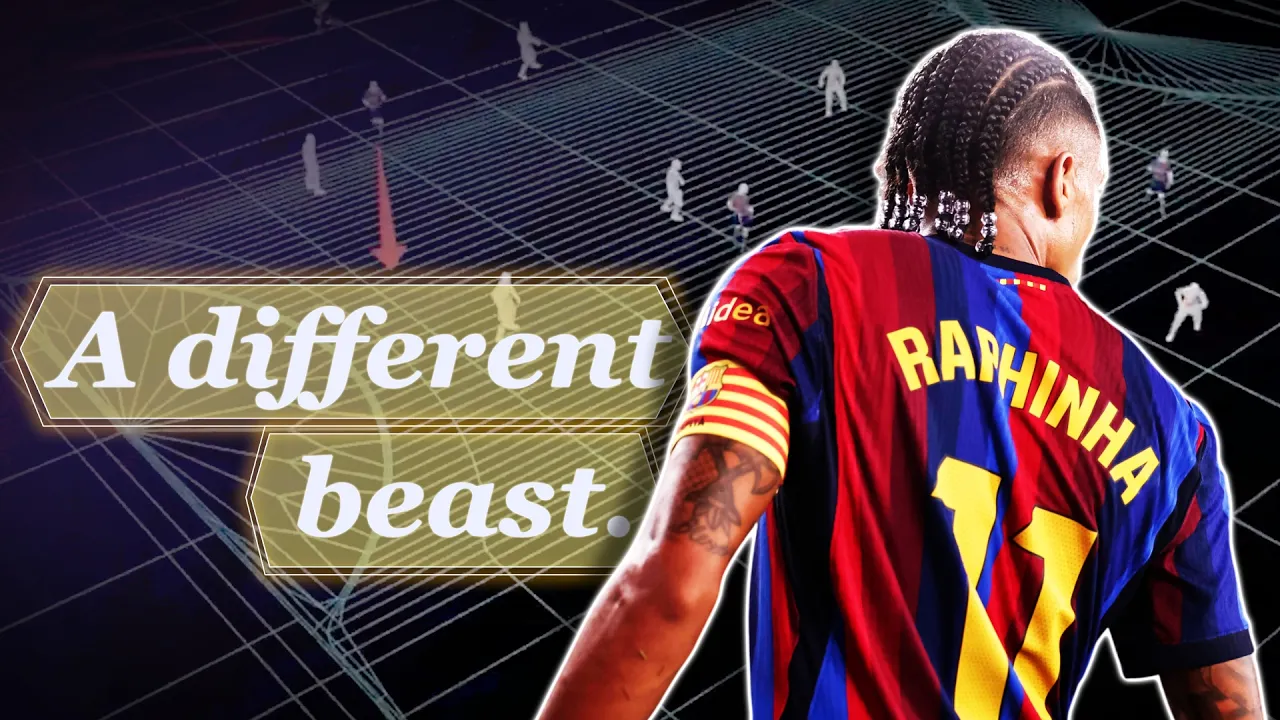
One is considered a winger and the other [music] an attacking midfielder. But seeing the potential for goals in their relationship, Flick decided to lean into this dynamic. So, at the start of this season, he's been using both of them in a very mobile front line with lots of movement and rotation around positions. >> [music] >> Raphinha is on paper the center forward, but that doesn't mean he's doing lots of hold up and winning aerial duels. >> [music] >> It means he's playing the same game he already understands, attacking space with players around him who already share that intention.
And the [music] result has been emphatic. 28 league goals at the time of recording. Raphinha [music] with nine of them, Lamine Yamal with seven, and Fermín López with four. In hindsight, this already looks like it should have been an obvious move. But the decision to rely on Raphinha, or more specifically [music] his partnership with players like Fermín, was only possible because Flick did not default to the way the team had attacked before or should attack in theory.
Instead, he allowed his players to play the game as they understand it and build on the unique relationships that developed. And that is not always the case. Often, when we look at football teams, we treat them as if they are machines. We look at the system as an arrangement of individual parts where a missing or underperforming piece can simply be replaced by another better one. But, we must remember that football teams are not mechanisms, but organisms.
And when you stop seeing the game based on individual function, but [music] instead on these relationships, it creates a completely different perspective on how the team might evolve. >> [music] >> In 2023, after Sergio Busquets left Barcelona, the team spent an entire season lamenting the lack of an elite defensive midfielder. But, when Flick came in, he changed [music] the conversation entirely. And rather than just signing a new Busquets, he leaned into a relationship that already [music] existed.
That of Frenkie de Jong and Pedri. Of course, I don't know for sure how Barcelona are being run or coached behind the scenes. [music] But, from the outside, it certainly feels like more of an organic evolution than a mechanical reconstruction. Where the question is not what does the model require us to do, but instead, how do we nurture the relationships that already exist? And that philosophy appears to be at the core of their evolution.
Behind the style of play and the players that are brought in to complement those relationships. If you want to see me break down some of those new signings using full game clips that are free from YouTube copyright issues, check out my bonus content over on Patreon. I've already covered Anthony Gordon and Rodri, and there'll be plenty more coming throughout [music] the season. But, otherwise, I hope you enjoyed this one, and I'll see you next time.
The words are the caption track's own and nothing is reworded or re-transcribed. Paragraph breaks are placed between sentences so the text reads as prose.
Free tools for your own script. No signup, no login.
Paste your draft and see where viewers are likely to drop off, with a rewrite for each weak line.
Paste the first 30 seconds of your own draft for a hook score and rewrites.
Check your draft against YouTube's advertiser-friendly guidelines before you record it.
Read this channel's public videos and transcripts, and download a writing brief for it.