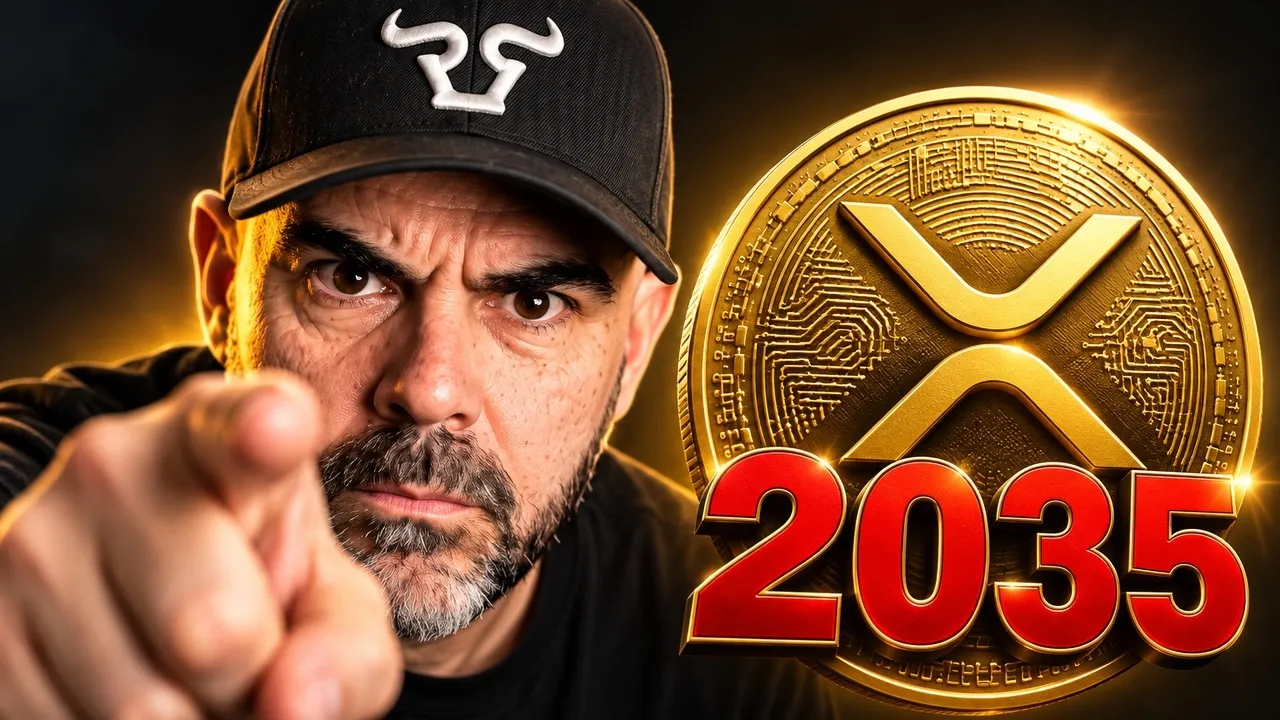
XRP QUANTUM: BLACKROCK'S OWN FILING SAYS THE FIX NEEDS A FORK NOBODY PROMISED… transcript
BULLRUNNERS · @Bullrunners
Words
4,440
Runtime
25:51
Speaking pace
172wpm
Reading time
19min
172 words per minute, between the 160 25th percentile and the 181 median of 349 measured videos. That distribution comes from the 349-video hook study.
Opening (first 30 seconds)
For more than 50 years, encryption has safeguarded our data from theft and misuse. We've had the luxury of a set it and forget it mindset, trusting its strength by default. That error is now ending with quantum computing. 2035. That is the date the United States government has already published. And it is also attached to the exact thing that proved you own XRP. Not the coin, the signature. The thing your wallet does when it says confirm. Both of the two ways that you
86 words, the words spoken in the first 30 seconds at 172 words per minute.
Sentence shape
| Measure | This transcript |
|---|---|
| Sentences | 338 |
| Average words per sentence | 13.1 |
| Longest sentence | 53 words |
| Questions asked | 13 |
| Sentences containing a number | 37 |
Most used terms
- quantum33
- xrp21
- crypto17
- key15
- ledger15
- public15
- link12
- transaction12
- algorithms11
- document11
- system11
- table11
Filler phrases
23 in total: like 8 · actually 5 · kind of 4 · literally 2 · right? 2 · you know 2.
A literal whole-word count of the same phrase list the Prepublish browser extension uses, so a phrase inside another word is not counted and a phrase used in its ordinary sense still is. It is a count and not a judgement.
What this transcript is
Every word below is the caption track YouTube publishes for this video, pulled from the video itself and reproduced unchanged. It is not Prepublish's writing, not a summary, and not a re-transcription: it is the video's own published captions. English captions, generated automatically by YouTube, in the video’s original language. Source: the video on YouTube. A channel that would rather this page did not exist can ask for its removal through the contact page, and it is removed.
Transcript
For more than 50 years, encryption has safeguarded our data from theft and misuse. We've had the luxury of a set it and forget it mindset, trusting its strength by default. That error is now ending with quantum computing. 2035. That is the date the United States government has already published. And it is also attached to the exact thing that proved you own XRP. Not the coin, the signature. The thing your wallet does when it says confirm.
Both of the two ways that you are allowed to sign an XRP transaction are on that table by name with a date next to it. So, we are going to read the document, the actual one, not a headline. There's two things in that that nobody in this space is talking about. The first is a correction, and most of what you've been told about quantum computers and your crypto is wrong. And I will show you the paragraph that says so in the government's own document.
The second is something you can do about it this week that Ripple's own chief technology officer described on the record. Stay for that one because it is the only part of this video that changes anything. [music] Are you still bullish on XRP? Absolutely. Listen, I believe XRP is going to be one of the biggest beneficiaries of the next wave of institutional money. And here's why. You see XRP as a function beyond people just buying it and hoping that the price goes up as a store of value.
It can act as a bridge between currencies, helping people move money through the XRP ledger, big banks, financial institutions, even everyday retail investors. And that's the kind of financial utility that I'm watching as Washington opens the door to onchain markets. But my team at Bullr Runners isn't just stopping at XRP. We've identified six more projects for our short list. And that's seven names that we believed are positioned for what we call the great crypto rotation.
Now, what is Washington actually doing with crypto? Well, if you look up project crypto, the SEC and the CFTC, they're working together to build the regulatory framework for this market. We're talking about the groundwork for financial markets to move on chain. So, stop and think about that for a second. This goes way beyond just another company deciding to accept a currency like Bitcoin. It's about the infrastructure behind how assets are issued, traded, and held.
And my investment thesis is actually very simple. It's followed the projects that have a real job and that solve real problems in the new financial [music] system, not just the ones making the most noise or the most hype out there online. Now, how do you avoid writing your crypto gains back down so you can maximize your results in this market? Well, you decide how you'll take profits before you're staring at a screen or a chart convincing yourself it'll go higher forever.
You see, picking a coin is only part of the plan here. That's why we developed a three-part system at Bullr Runners and Altcoin Pro called the SGS system. It simply stands for secure, grow, and scale where you secure your portfolio foundation so that way one bad decision doesn't put everything at risk and just blow up your entire portfolio, right? And then you grow by evaluating ways to put your existing crypto to work to earn passive income and yield that the institutions are leveraging that they don't want you to know about, which is the reason why they're fighting the Clarity Act, the banks, so they can keep the yield to themselves.
So, we reveal that to you and then scale into research opportunities with position limits and profit taking plans established before you ever hit the buy button. You know when you're exiting, you have a plan for what you own, how you manage it, when you take money off the table, and that's what the system brings together [music] for you. and to show you how we apply it to the great crypto rotation. We're hosting a free live webinar where we're going to walk you through our seven altcoin picks, why we chose them, and how to use our SGS system to build your own plan moving forward.
And if you stay live all the way through the end, you're also going to get our project crypto field guide completely [music] for free. So, tap the link below, reserve your seat right now, come for the seven altcoin names, and leave with a framework for actually what to do next. So, click the link, and I'll see you there. You have heard this before and I know exactly what you're going to say. Quantum has been 10 years away for 20 years.
Every 18 months there's a chip announcement, a headline about a broken encryption, a video with a red arrow on it and then nothing happens and Bitcoin is still there. Hi, I'm Julian Kelly, director of hardware at Google Quantum AI. And today, on behalf of our amazing team, I'm proud to announce Willow. >> That is Google announcing Willow. And announcements like that are why the panic cycle keeps restarting. I'm not here to tell you that a quantum computer will empty your wallet next spring.
Nobody serious is saying that. But the reason this video exists is that the deadline in that document has almost nothing to do when a computer of quantum arrives. And once you see why, the whole conversation changes shape. NIST internal report 8547 transition to postquantum cryptography standard published November 2024. NIST decides which cryptography American federal systems may use which in practice sets the rest of the world to build around as well.
And one caveat right here said early rather than buried. This is an initial public draft. It says so on every page and the dates are proposed not final. So be suspicious of anybody who quotes it without telling you that. But a draft from the body that sets the standard is still the clearest published statement of where this is going. And Washington is not treating it as hypothetical. >> Much of our digital security relies on encryption to protect sensitive communications, verify identities, and secure critical systems.
Advances in quantum computing raises serious questions about whether today's encryption methods will remain effective [clears throat] in the future. Our adversaries understand this risk and are already planning including by collecting encrypted data now with the expectation that it may may be accessed later. That is a House Homeland Security Committee hearing. Adversaries already collecting encrypted data now expecting to read it later.
So remember that because I'm going to show you why it does not mean what everybody in crypto thinks it. Page 13, table two, quantum vulnerable digital signature algorithms. ECDSA at 112 bits, deprecated after 2030, and disallowed after 2035. ECDSA at 128s or greater, disallowed after 2035. ED DSA at 128 or greater, disallowed after 2035. RSA, same two dates, four families, two dates. The whole table fits on half a page.
Now, the reason I care and the reason you should care, the XRP ledger supports exactly two signing algorithms. SECP256K1, which is ECDSA, and ED25519, which is ED DSA. ECDSA is row one of two of the table. ed DSA is row three. There is no third option. Whichever one your account uses, it is on that page with a date beside it. And Bitcoin is on there, too. SECP25K1 is what Satoshi picked all the way back in 2009. So, which one is yours?
And you can find out about in about a minute. And then this stops being abstract the moment you see it. Every transaction ever sent on the XRP ledger carries the public key that signed it in public. I pulled three real payments off the live ledger this morning. All three signing keys start with the letters E D, which is how the ledger tells you the key is ED25519. If it starts with O2 or 03, then it is SECP256 K1. Open any XRP explorer.
Find a transaction that you have sent. Look at the signing public key. There's two characters. That is your row on the table. Deprecated and disallowed sounds like the same word wearing a different hat and they are not. Deprecated means keep using it if somebody signs off on the risk. Disallowed means no longer allowed for the stated purpose. Full stop. And there is a third term that matters more than either. Legacy use.
The algorithm may only be used to process already protected information to verify a digital signature. Verified old ones, not make new ones. But 2035 is not NIST invention. And that is what makes it stick. It comes from national security memorandum 10 which NIST quotes directly the United States must prioritize the transition to quantum resistant cryptography with the goal of mitigating as much of the quantum risk as is feasible by 2035.
That is a presidential memorandum not a standards body opinion. 2035 is a policy target a federal agency has planned against. And one thing before the correction, because this is why I make these, everything so far came off a federal document anybody can download and almost nobody opens. Doing that reading against your own holdings rather than against the headline is the work the SGS system inside of Altcoin Pro does with people.
That is the first link down in the description. If you would like to get a crypto audit, someone walking you through how crypto works. If you have any questions, click the link free to sign up. Get your appointment today. Also, we are on our way to 400,000 subscribers. We're currently at 395,000. Make sure you smash that subscribe button if you're new here. By the way, I'm Ryan Huggin, aka Win with Ryan. Welcome to the channel.
Now, let's talk about the correction I promised, and it is the part of this document that nobody in crypto reads. Everybody has heard of the phrase harvest now, decrypt later. Somebody records your encrypted data today and then cracks it 15 years when the machine exists. That is real and it is in this document repeatedly and it is why the governments are moving early. But NIST says something different about signatures and it is in one sentence.
Quote, unlike with encryption where there is a threat of harvest now decrypt later, an authentication system remains secure as long as the cryptographic algorithms and keys used to perform the authentication are secure when the authentication is performed. A signature is not encryption. Nobody records your transaction today and steals your coins from it in 2040. So every video telling you quantum computers are quietly hovering over your wallet so that they can crack it later has the mechanism wrong.
But that same paragraph does not stop there. And the second half is the one that should hold your attention. quote, "Authentication systems may continue to use quantumverifiable algorithms until quantum computers that are capable of breaking current quantum vulnerable algorithms become available, at which point authentication using these algorithms will need to be disabled." Disabled, that is the word in a federal document describing what has to happen to signature schemes your wallet uses.
So the good news and the bad news arrive in the same sentence. You are fine right up until the day the machine exists and the response that day is not a patch. The scheme gets switched off. For a bank, disabling an algorithm is a software rollout. Painful, expensive, and entirely within one company's power to schedule. A blockchain cannot schedule anything. It can only get agreement. To disable a signature scheme on the XRP ledger or on Bitcoin, you need validators, node operators, exchanges, wallet software, and custodians all moving roughly together.
Everyone who moves in time keeps their coins. Everyone who does not is holding an account secured by a signature the network no longer accepts. And the accounts whose owners are dead or lost the seed phrase in 2017 or simply are not paying attention never move at all. That is not a theory. The largest asset manager on earth wrote that into an SEC filing. This is the iShares Bitcoin Trust Prospectus filed on the SEC's own system.
I pulled it from July 2025 version this morning and I searched it. Quantum appears eight times. quote, "There is a risk that quantum computing could result in the cryptography underlying the Bitcoin network becoming ineffective, which could allow a malicious actor to compromise the wallet holding Bitcoin owned by the trust, which would result in losses to shareholders." Black Rockck in a filed prospectus telling shareholders a quantum computer could compromise the wallets holding the funds own Bitcoin.
But the sentence after that is the one that matters because it's about the fix, not the threat. Quote, "There is no guarantee the new quantum proof architectures will be built and appropriate transitions implemented across the network at scale in a timely manner. Any such changes could require broad consensus within the Bitcoin network community. A fork or multiple forks and no assurance consensus would be achieved. XRPL is not quantum resistant.
It could be made so, but with the present mechanisms we have, the result would kind of suck because the quantum resistant algorithms we know of all have painful disadvantages in blockchain applications. >> See that he lost me there with quantum resistant algorithms. >> [sighs] >> That is Black Rockck's lawyers in a document that they can be sued over saying the repair job may not be deliverable, which is the obvious next question.
If that is the problem, what is being done about it on the XRP ledger? And actually, more than I expected and it's published April 20th of 2026, Ripple's own site, post quantum readiness on the XRP ledger. Four phrases ending a full transition to postquantum signatures. their own words. We have milestones for the first half of 2026 and are targeting full transition no later than 2028. So put the three dates on one line because this is the whole video in one frame.
Ripple 2028 NIST deprecates the weaker family after 2030 and 2035 is when they come off the approved list entirely which is alone the presidential target. If Ripple hits the 2028 XRP ledger is already ready seven years early and one of the first with a published plan and a date on it. If it slips and the roadmap slips, a public ledger is running on cryptography federal systems are no longer permitted to use. Neither is a catastrophe.
Both are worth knowing before somebody starts to try to sell you a countdown clock on. And the person who is building it has been very direct about it for years in a way that surprised me and that is no other than David Schwarz who designed the XRP ledger answering the question directly. The XRPL is not quantum resistant. It could be made so but with the present mechanisms the result would in his words kind of suck because the quantum resistant algorithms that we know of all have painful disadvantages in blockchain applic.
Now, I have to flag the date on this. The answer is from August of 2022. It is four years old. Ripple's published road map is the current position and it is more advanced than this. But he was saying the quiet part out loud long before there was a road map. And what he said next is the useful. His stated approach, monitor the state-of-the-art and implement the best quantum resistant algorithms whenever the risk looks within about 5 years of materializing.
And then he says, I do not think we are there yet. That is a sensible engineering rule and I want to be fair about it. You do not rebuild a settlement network around an algorithm that might be superseded. But notice it is a different kind of clock from the NIST table. NIST's dates are on a calendar. Schwarz's trigger is a judgment call about a threat that nobody can see coming. One of those you can plan around, the other you just have to be right about.
But he kept writing. And the next part of this is the reason I made this video. >> Wallets, >> cold wallets that hold only XRP and have never performed a transaction are already quantum resistant. >> Cold wallets that only hold XRP and have never performed a transaction are already quantum resistant. And the reason that works is mechanical, not mystical. Your XRP address is derived from your public key by hashing it.
The public key itself never appears on the ledger until the first time you sign something. An account that has received XRP and never sent any has never publish its public key. There is nothing on the ledger for a quantum computer to work backwards from. Which means owning coins does not create the exposure everybody worries about. Spending them does. And this is not an XRP quirk. It is true of Bitcoin for the same reason.
The moment you spend from an address, the public key goes on the chain and it stays there. And then he gave the move for accounts that have already transacted, which is most of them. If you disable the master key and set a new regular key, your account is quantum resistant until you perform another transaction and then you can change it again. The documentation backs it up. Your master key is permanently tied to your address.
You cannot remove it, but you can disable it. A regular key is a second key that you authorize and you can replace it at any time without changing anything else about the account. So, the exposed key can be retained and replaced on an address that stays the same. I'm not going to be walking you through the transaction on camera because getting it wrong locks you out of your own account permanently, but it exists and it is documented and almost nobody mentions it.
Which leaves the next piece that gets skipped every single time sitting in the same NIST document. Quote, "Hardware modules must be upgraded or redesigned to support PQC algorithms, which often have larger keys and different computational requirements. Hardware modules, that is the security chip inside of a hardware wallet. The device in your drawer or safe with your seed phrase behind it was designed around the math that's on the table.
A postquantum signature is bigger and computes different. >> But there is a trade-off. Blockchains are public ledgers, meaning every single transaction you send is recorded on a list that anyone in the world can see. Locking a physical device in a desk drawer offers little protection when the mathematical blueprint of your lock is permanently posted on the public internet. Locking a physical device in a drawer does not help much when the mathematical blueprint of the lock is already published on the public ledger.
So the thing you bought precisely so you would never have to think about any of this ever again is on the list too. And nobody has ever given you a date for it. So I know a lot of this information maybe even going over your head. So document it, write it down. This is very very important information though. very important information to cover in a video for our community. Our job is to help you get smarter when it comes to crypto.
Now, if this stuff is going over your head, if you're like spinning right now, oh my gosh, I don't even want to listen to this anymore. I don't want to talk about it. That is what the SGS system is designed for. Secure Growth Scale. Join our team at Altcoin Pro. There's a link down below. Sign up for a free interview. See if you qualify. If you do, great. If not, that's totally fine, too. But it is very helpful. You have to prepare for this upcoming bull run.
You have to prepare. Look what's AI is doing. Imagine when quantum computing hits. Be prepared. Get in that interview immediately. And also, if you're getting value from these videos, make sure you smash that subscribe button. We're on our way to 400,000 subscribers. We're going to get there with your help. We're at 395,000 subscribers right now. Smash that like button. Smash that subscribe button. And make sure you leave me a comment down in the description.
And by the way, if you are clicking the link down in the description, there's a little button if you're watching on a phone that says more. That's what opens up the description bar. That's where you can find the link. So, what is this worth to you? There's three questions. So, first, which signature scheme is on your account? There's two characters on any transaction that you've sent and both are on the table. So, this one is curiosity rather than action.
And two, has that account ever sent a transaction? If it has, its public key is on the ledger and always will be. If it genuinely never has, then you're in the category that Schwarz described. And then three, when did you last look at where your coin sit rather than at the price? And that brings me to the thing that I want you to take away, which is not about quantum computers at all. 2035 is not a prediction about when a quantum computer will exist.
Nobody in that document claims to know that. 2035 is the date an algorithm stops being allowed. It is an administrative act and it happens on a calendar whether the machine shows up or not. A government retires an algorithm by publishing a table. A bank retires one by scheduling a roll out. A blockchain can only retire one if enough strangers agree to move at the same exact time. And Black Rockck's own lawyers wrote down that there is no assurance that that happened.
So the risk was never about the quantum computer. It is the coordination which is why the right response is not fear and it's definitely not selling anything. It is knowing which row of that table that you're actually on and knowing the network that you chose has a published plan with a date on it which most of them do not. So there are two ways to hold this. You can hear Quantum and then stop listening and then find out in 2032 that the wallet software stopped being updated or you can read the four documents in this video one and know exactly what would have to happen and in what order.
The second takes an afternoon. And if you want to find those documents, they're going to be linked down below. So again, under the video, you're going to see our description bar. There's a button that says more. You click that, it's going to unfold everything. All of the information is there. Click the link to get signed up for an appointment. Click the link for the actual documentation to find all this information. It's all down there.
But the most important thing is we want you prepared. If you're watching us, we thank you for watching us. We completely are grateful for the support and we want you to be safe no matter what. This topic is not the most exciting topic. It's not XRP to $10,000 by December, right? This is very dull. It's very deep information and it might have gone over here like I said. So that's why we have a partnership that you can get that help.
So do me one favor in the comments. Go and look at one transaction from your own account if you've ever spent it and then tell me the first two characters of the signing public key. Is it ED or 02 or 03? Just two characters. I want to see the split because I have a guess and I would like to be wrong. I hope most of you are cold custodying and not sitting on Coinbay. So, there's four documents. An NIST report, a presidential memorandum quoted inside of it, an SEC prospectus, and a road map on Ripple's own site.
All public, all free, and all long and dull with nothing telling you to read them except for me telling you right now to click the link. The documents are down below. And that really is the work. So, if you don't want to read them, reading the paperwork sucks. It's boring. It's long. You probably don't want to do that. Most people don't. But that's why we do that for you inside the SGS. That's literally our job is to go through these documents, make sure you're safe, make sure you're prepared.
We go through a system called the SGS system. Secure, grow, scale in that order. Why secure first? Because you have to have secure crypto. And we work with you for the next 5 months, literally one-on-one on a Zoom call every 7 to 10 days. So, if you're holding crypto right now and nobody has ever gone through where it lives and what would have to be true for you to lose access to it, well, that is who this is for. So, click the link in the description and get started.
Now, if you're not ready, that's totally fine. Keep watching these. These videos are free and we're not going to stop making them. And if this investment, the crypto money is something that you and your spouse decide on together, make sure you bring them on the call. So, again, it's very easy. Go down below description bar, click more, pull it up. You're going to see the link. We do also have a really great free training program going on this weekend.
It's this weekend only. If you're watching this, hurry up and get there. Book a call. Crypto carries risk and past performance doesn't guarantee future results. This is education, not financial advice. Do not buy or sell anything we talk about on this channel. And you know what to do. Stay bullish and I'll see you at the top. Make sure you click that subscribe. Help us get to 400,000. >> [music] >> Hey hey. [music]
The words are the caption track's own and nothing is reworded or re-transcribed. Paragraph breaks are placed between sentences so the text reads as prose.
Use this transcript
Three free tools that work on the material around a video like this one. No signup, no login.
Hook Analyzer
Paste the first 30 seconds of your own draft for a hook score and rewrites.
Policy Pre-Flight
Check your draft against YouTube's advertiser-friendly guidelines before you record it.
Channel Skill Generator
Read this channel's public videos and transcripts, and download a writing brief for it.