Getting the transcript
Reading the captions from YouTube. A video nobody has opened here before takes 10 to 30 seconds; this page fills in on its own.
Getting the transcript
Reading the captions from YouTube. A video nobody has opened here before takes 10 to 30 seconds; this page fills in on its own.
Game Devs of Color Expo · @GDoCExpo
Words
2,441
Runtime
15:47
Speaking pace
155wpm
Reading time
10min
155 words per minute, below the 160 25th percentile of 349 measured videos. That distribution comes from the 349-video hook study.
Opening (first 30 seconds)
(upbeat music) - DEIA has become a favorite four-letter watch word on the right. And yet, it's hard for me to understand what to be afraid of when it comes to making spaces more diverse, equitable, inclusive, or accessible to everyone. We've seen the ways that the industry has flourished by bringing more people from the margins into the fold, but that doesn't seem to be the way that much of the discussion and the money is flowing
78 words, the words spoken in the first 30 seconds at 155 words per minute.
Free, no signup. See how the first 30 seconds hold attention, with rewrites.
Sentence shape
| Measure | This transcript |
|---|---|
| Sentences | 133 |
| Average words per sentence | 18.4 |
| Longest sentence | 48 words |
| Questions asked | 0 |
| Sentences containing a number | 4 |
What this transcript is
Every word below is the caption track YouTube publishes for this video, pulled from the video itself and reproduced unchanged. It is not Prepublish's writing, not a summary, and not a re-transcription: it is the video's own published captions. English captions, published by the channel, in the video’s original language. Source: the video on YouTube. A channel that would rather this page did not exist can ask for its removal through the contact page, and it is removed.
No Script X-ray for this video: YouTube shows a Most replayed graph only once a video has enough views.
(upbeat music) - DEIA has become a favorite four-letter watch word on the right. And yet, it's hard for me to understand what to be afraid of when it comes to making spaces more diverse, equitable, inclusive, or accessible to everyone. We've seen the ways that the industry has flourished by bringing more people from the margins into the fold, but that doesn't seem to be the way that much of the discussion and the money is flowing as of late.
Still, if you're like me, you recognize and understand and hear the importance, but it can still feel a little confounding here when reading so much hate and vitriol, easy to lose a little bit of your way. Thankfully, this talk is a bit of a healing balm. Our speaker describes this as the most uplifting DEIA talk you'll ever see. She's the narrative designer and writer on the upcoming game Rooster. Here to talk about diversity, equity, inclusion, and accessibility, please welcome to the stage, Deb Chantson. - Hi, this is "Achievement Unlocked: Diversity Success." My name is Deb Chantson, and for the purposes of this talk, these are the things that you should know about me.
I use she/her pronouns. I identify as Canadian-South African-Chinese-American, so I am a game dev of color. I'm currently living in the Vancouver, Canada, area. I'm a writer and narrative designer for Sticky Brain Studios. I'm also a TV and interactive writer who mostly does preschool and educational projects. I'm the author of "Past Perfect Vacation," a time travel romance novel, which was published on Valentine's Day this year, and I'm also a certified Accessible Player Experiences practitioner.
I wanted to show you the trailer for Rooster, the game that we've been working on. The voice that you'll hear on it is Connie Choi, who is our art director and concept creator. (gentle music) - [Connie] Rooster is a beautiful point-and-click narrative adventure based on the animals of a Chinese zodiac, bringing together the best elements of Chinese culture. (bell dings) Rooster is a terrible party guest at the lunar New Year party.
Rooster's obnoxious actions even make Rabbit cry. Dragon conjures a powerful potion (bright music) sending Rooster hurdling back in time to ancient China to learn some life lessons. Each level has a different kind of game play, representing the different Zodiac animals, like hidden object, dating sim, cooking, puzzles, paper cutting, garden design, tower defense. It's full of delightful surprises with an emotionally engaging story about helping others, creating joy and showing love in the best ways possible.
Wishlist Rooster on Steam (chicken squawks) to follow us as we bring Rooster to the world. (bright music) - Rooster gave me a chance to do my best work. So there's a difference between the good work that applies to everyone, in terms of environment and things that you need, versus things that give you your best work. So for good work, you like what you're working on, your role uses your professional experience and skills, your environment makes you feel okay, you contribute, and you learn things.
In terms of doing your best work, which applies to Game Devs of Color, there's enjoyable project content relevant to you. There's a reason for me to put my heart and soul into Rooster because it reflects my Chinese culture and things really personal to me. You not only shine, but sparkle in your professional role. I can be immensely proud of how much I contributed to the game story and design, as well as playing a significant part in securing its funding.
It made me a better writer and narrative designer. My sense of humor is physically present in puzzles, characters, dialogue, cut scenes. There are honestly some of the best fart jokes of my career in this game. Your environment makes you feel safe, psychologically, emotionally, physically. You are never marginalized or othered. There are some deeply personal references to things from my real life in Rooster. If Rooster makes you cry, that will honestly be my greatest compliment.
It's because I was feeling safe enough with my team to feel vulnerable enough to bring that material, and thus, that comes to our audience. You feel like you can be your authentic self, seen, heard, and validated, where you are an individual recognized as a talented, skilled professional without being visually confused for anyone else. There are tangible ways to grow and flourish. You level up in your skills and your craft with transferable skills.
What I'm really grateful for while working on Rooster is that four of us got to have media training, and it's because of that media training that I'm able to lecture these days and participate in media interviews, where I wasn't able to do that before. Rooster also gave me things I didn't know I needed for professional work, and one of those things was to be in the racialized majority. There's a certain level of instant ease and a shorthand for lived experience that's really fantastic when you're with other people of color.
People just get your jokes. You don't have to explain why you need racially diverse characters. You don't have to police language. You're not worried about being that person to bring up issues of race on behalf of every person of color everywhere from the beginning of time. You have so much more energy to just make the work beautiful, and it helped that I had a vested interest in the project, because it was celebrating my Chinese culture.
I was also a creative lead on the project, and I think this gave me even more room to freely volunteer ideas. I find that visibly marginalized people often develop a tendency to not volunteer ideas, because they've been trained, inadvertently or sometimes explicitly told, and expect to be shut down. So we're often too timid or too tired to volunteer ideas, knowing that they're not gonna go anywhere. That wasn't the case here.
I got all the things I needed. And when you get all those things, there's joy and exhilaration and creativity and innovation in the things that you are able to do. I do have a potato here as a reminder to myself, like a loaded baked potato. The caveats are that not all the things I wanted to have in the game were implemented, and no team is perfect, but for the things I brought to the team and the work that I produced, I feel really fantastic about, knowing that was my best work.
And this talk is about diversity success. I want this to be the most positive DEIA talk you've ever heard to date, because I absolutely know that these initiatives are worth fighting for, and they're worth looking for in terms of the potential for phenomenal work and awesome teams. And just to be clear, DEIA stands for diversity, equity, inclusion, and accessibility, and diversity is the one that really matters the most to me.
So how we got diversity success. Admittedly, it's way harder to change a large, established company culture than build it from the ground up. Ted and Sasha are our company founders. They identify as white and disabled. Connie was on the team because Rooster is her concept. I was brought on for creating cohesive narrative. And, in general, growing a diverse team really comes from several factors. Project content is the thing that really draws people to your game.
I tend to shy away from things that involve combat or violence. Saying I work on a cozy puzzler with a beautiful narrative really draws the kind of people that wanna work on the game. Known network really helps. Ted and Sasha and I had worked on a project many years ago and won an award for it, so they knew I was gonna do the work, and well. Internal referrals are really important for growing diverse teams, because they reflect an already established level of professional trust.
Sasha being a college professor is really a great advocate for mentorship and growing the next generation, so she tapped into co-op student programs and the Black Youth Action Plan, and some of these team members actually stayed on past the terms of their programs. Job postings referring to project content, also about drawing the type of people that wanna work on that kind of game. And one of the things I really love about our studio is that artists get an honorarium for art tests if they're that far in the interview process.
It's really about valuing people's time, and without ranting about it, I wish this was the standard industry practice for all job-related tests. So at its peak, our team was 70% racialized, 76% female or gender marginalized, 30% disabled and 30% queer. Most of our team was also intersectionally marginalized, which means that they belong to two or more marginalized groups. So for example, I am an East Asian woman of color, so it's hitting gender and race or ethnicity.
So I love that I get to give this talk to the Game Devs of Color Expo. I don't have to frame this talk like I do usually, in terms of white fragility. So there's a couple of things I wanted to mention. The ideal diversity is visual. That means a majority racialized team. The term diversity or diverse really gets thrown around a lot by white people who love being in rooms with other people who look like them. I will say, nobody can identify your sexual preference or invisible disability from a corporate photo.
Remember, the A in DEIA is for accessibility. I would encourage Game Devs of Color to consider applying for the AbleGamers Developers Promoting Accessibility and Diversity, or DPAD Initiative, for free registration to the Certified Accessible Player Experiences Practitioner training course. We are really grateful to the AbleGamers organization for allowing six of us to qualify as certified APX practitioners. Your "I am the only" shouldn't feel like tokenism, especially if you're saying "I'm the only person of color on my team." If you are cool with that, that's great.
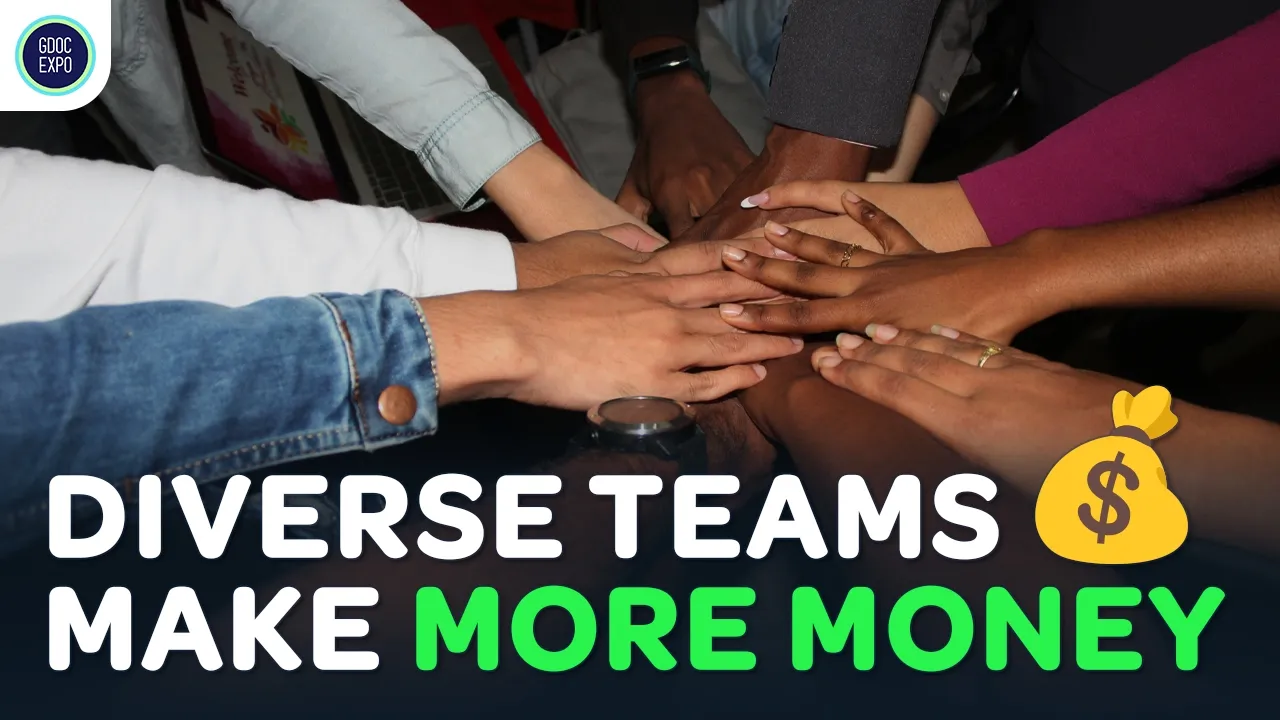
If you feel confident and secure in where you are, I applaud you for that. I am gonna say that you can stay for many years with a company, and the tokenism will catch up to you. So it might be something that's weighing you down and unnecessarily burning your energy without you even knowing it, so it's something to be aware of. In a time where diversity initiatives are under fire and being canceled all the time, I wanted to give people a little bit of ammunition to know that DEIA initiatives are actually economically beneficial.
They make you money, so canceling them makes no sense. According to Forbes, companies with greater diversity are 70% more likely to capture more markets. This is because if you have people on your team of different cultures, they have access to different cultures. That means different markets, languages, diaspora communities. Having disabled team members means being able to internally vet and prioritize important accessibility features, serving a variety of demographics and needs.
This means that if you have someone on your team who needs to advocate for a certain feature, there's a name and a face prioritizing that for your team to know that it's important and why. Having accessibility features in your game helps boost potential unit sales when extending reach to disabled players, who comprise approximately 20% of the nearly three billion gamers worldwide. That 600 million. Diversity of team members relates to different interests and media from which to draw a variety of references.
What I mean by this is that if you have a number of people on your team who play different games on different consoles, different platforms from different eras, that means you have a better sense of what's been seen before, versus what's definitively new and innovative. For our team, we had people who really loved interactive fiction and different kinds of games so they could see, "Okay, this works better for something," and "This doesn't work." "This is how we can improve it," and genuinely say, "Okay, I haven't seen that before in a game." Regarding characters, the culmination of different racialized lived experiences reduces or eliminates a dependence on stereotypes and/or cultural appropriation.
This means that if you have characters in your game based on team members, that means you're thinking of an actual person, as opposed to thinking of an idea of person, and that's how we get stereotypes. We reference things that are generalized, and if you have an actual person there, they can speak to the authenticity of a character or traits, things like that. This, in turn, becomes an improved end user experience, and what I like to say is that authenticity will garner a deeper connection to your game content when people can resonate and identify with it.
And that is an original quote. So for the takeaways from this talk, DEIA initiatives, whatever we call them, are worth fighting for. There are economic benefits to having a racially or disability-diverse team. If you haven't found it yet, there are conditions in which you can thrive. It is very possible to do your best, most heartfelt work, as I did. And in the end, my hope is that all racialized and Indigenous creatives get a chance to feel the kind of professional joy that I did.
That's my talk. Thank you for your time and attention. I can be reached through my website at debchantson.com or through LinkedIn. - Thank you so much for that talk, Deb. So much of the rhetoric in the modern moment is made to make us feel negatively about these programs that give us access to a seat at the table, so thank you for being some of that counterbalance. And it's not hard to look at our industry and see all of the ways that amazing things come from having diverse, equitable, inclusive, accessible game dev.
Look at Venba, look at South of Midnight. These are both incredible games that dial into culture and how many other games are out there. And just look at Game Devs of Color Expo. If you don't get it, I don't know what to tell you, but I'm glad that you brought that perspective, Deb. Thank you so much. If you'd like to know more about Deb's work, including maybe some of her TV writing experiences, you can follow her on Instagram or Bluesky at Deb Chantson. (upbeat music)
The words are the caption track's own and nothing is reworded or re-transcribed. Paragraph breaks are placed between sentences so the text reads as prose.
Free tools for your own script. No signup, no login.
Paste your draft and see where viewers are likely to drop off, with a rewrite for each weak line.
Paste the first 30 seconds of your own draft for a hook score and rewrites.
Check your draft against YouTube's advertiser-friendly guidelines before you record it.
Read this channel's public videos and transcripts, and download a writing brief for it.
Most used terms
Filler phrases
18 in total: like 11 · kind of 4 · actually 2 · I mean 1.
A literal whole-word count of the same phrase list the Prepublish browser extension uses, so a phrase inside another word is not counted and a phrase used in its ordinary sense still is. It is a count and not a judgement.