Getting the transcript
Reading the captions from YouTube. A video nobody has opened here before takes 10 to 30 seconds; this page fills in on its own.
Getting the transcript
Reading the captions from YouTube. A video nobody has opened here before takes 10 to 30 seconds; this page fills in on its own.
AI Engineer · @aiDotEngineer
This video has no Most replayed graph yet: YouTube shows one only once a video has enough views. These are the moments viewers replayed most in AI Engineer's most watched videos.
Most replayed moment at 18:45
4.8x that video's typical replay level
that they're they're changing they're changing things in the database not yet. You want to run them through the ontology first and make sure that works. Okay. I only got an I've got I've got another I've just a short time. I'm going to try to show you some of the things that um that you can
Said at 18:37
Most replayed moment at 16:13
3.6x that video's typical replay level
method signatures, the program layout and the call stacks. So here's some examples. I don't think you'll be able to read this one, but this is like the level of abstraction we're at. It's how we're actually going to lay this stuff out and how these systems are going to interact. Dylan Mulroy from Cloudflare talks a
Said at 16:06
Most replayed moment at 6:57
5.9x that video's typical replay level
do light mode. It's I It's not my nature, but sometimes. That's better, yeah? Okay. So we have we have a model and we're trying an old LG Sorry. We We shouldn't have seen that. No, we'll
Said at 6:50
The graph counts replays. It does not show where viewers stopped watching.
Words
1,511
Runtime
9:36
Speaking pace
157wpm
Reading time
6min
157 words per minute, below the 160 25th percentile of 349 measured videos. That distribution comes from the 349-video hook study.
Opening (first 30 seconds)
[music] Okay, today I'm going to talk about where reinforcement learning will take search and some some background on me. Uh I'm the founder and CEO of Citi. We're a stealthish AI lab for search. We're backed by some pretty amazing people. Uh, and we're hiring. Okay. Agents are a new paradigm for search. You can now get vastly higher quality results. Um, twice as likely to find the right documents. But it's incredibly expensive. um about a hundred
79 words, the words spoken in the first 30 seconds at 157 words per minute.
Free, no signup. See how the first 30 seconds hold attention, with rewrites.
Sentence shape
| Measure | This transcript |
|---|---|
| Sentences | 99 |
| Average words per sentence | 15.3 |
| Longest sentence | 83 words |
| Questions asked | 4 |
| Sentences containing a number | 6 |
Most used terms
Filler phrases
75 in total: um 24 · like 20 · uh 18 · kind of 6 · you know 4 · actually 3.
A literal whole-word count of the same phrase list the Prepublish browser extension uses, so a phrase inside another word is not counted and a phrase used in its ordinary sense still is. It is a count and not a judgement.
What this transcript is
Every word below is the caption track YouTube publishes for this video, pulled from the video itself and reproduced unchanged. It is not Prepublish's writing, not a summary, and not a re-transcription: it is the video's own published captions. English captions, generated automatically by YouTube, in the video’s original language. Source: the video on YouTube. A channel that would rather this page did not exist can ask for its removal through the contact page, and it is removed.
[music] Okay, today I'm going to talk about where reinforcement learning will take search and some some background on me. Uh I'm the founder and CEO of Citi. We're a stealthish AI lab for search. We're backed by some pretty amazing people. Uh, and we're hiring. Okay. Agents are a new paradigm for search. You can now get vastly higher quality results. Um, twice as likely to find the right documents. But it's incredibly expensive. um about a hundred to a thousand times more expensive than what you'd get out of a classical search query and it is extremely slow.
You're looking at minutes and not milliseconds like turboroper. And what this means is that agents spend 30 to 50% of their tokens on searching. And this is usually at the beginning of some task. It finds the right context to then do whatever you ask it to do. And the idea here is quite simple. First, instead of having the main agent do the searching, you pass the searching to a sub agent and you train a model to be a great sub agent.
And the question here that we'll answer today is how much cheaper and faster can we make this with reinforcement learning? And this is really our target. So this is a benchmark across legal, finance, knowledge basis, science, email, a bunch of different tasks, some academic benchmarks, some internal benchmarks. And this is where you currently are. You see reranker and vector only performance at the bottom and you can see frontier models essentially kind of like go through here at the cost of spending many many you know minutes per question.
And can we get a model to kind of like be extremely accurate um have extremely high recall but also be incredibly fast and cheap. And let's quickly look at classical search. This is the pipeline that many of you guys will be familiar with. A question comes in, you might have an LLM that rewrites the question. You then execute that on a search backend. You might have a reranker. Um and you get your results at the end of the day.
Um, it is essentially a pipeline of chained locally optimized models and all of the decisions are baked in at design time and you expend a fixed amount of compute per question. And this one is really important. The re-ranker might know that the results are insufficient at answering the question, but the re-ranker can't take action. It can only essentially return the results even when they're bad. And what this means is that in practice a pipeline like this acrrues a long tail of failure where unexpected questions come that you know the designer didn't have something for.
And in practice this usually means people add lots of edge cases um to essentially fix these. But of course you can't design infinite edge cases and you can't add infinite tweaks. And so the strategy here is one that we've seen before. machine design outperforms human design. Um, and we saw this in computer vision where you had your, you know, primitive edge detection algorithms. You then had the box around a dog generation of models um that were very good at this like very narrow task and locally optimized for it.
And then you had VLMs that were extremely good at all parts of the search pipeline. You saw this again with chess with IBM Deep Blue being largely a collection of human written rules. um stockfish bridging the two and then alpha zero and mu0ero essentially completely just putting it all inside of the model and we're going to see something similar happen to search where we have our existing algorithms like BM25 and page rank um then we had an evolution from that with small models that did some task very well like vectors and re-rankers and now essentially this new paradigm of pure RL where we actually don't bake any design decisions into the model.
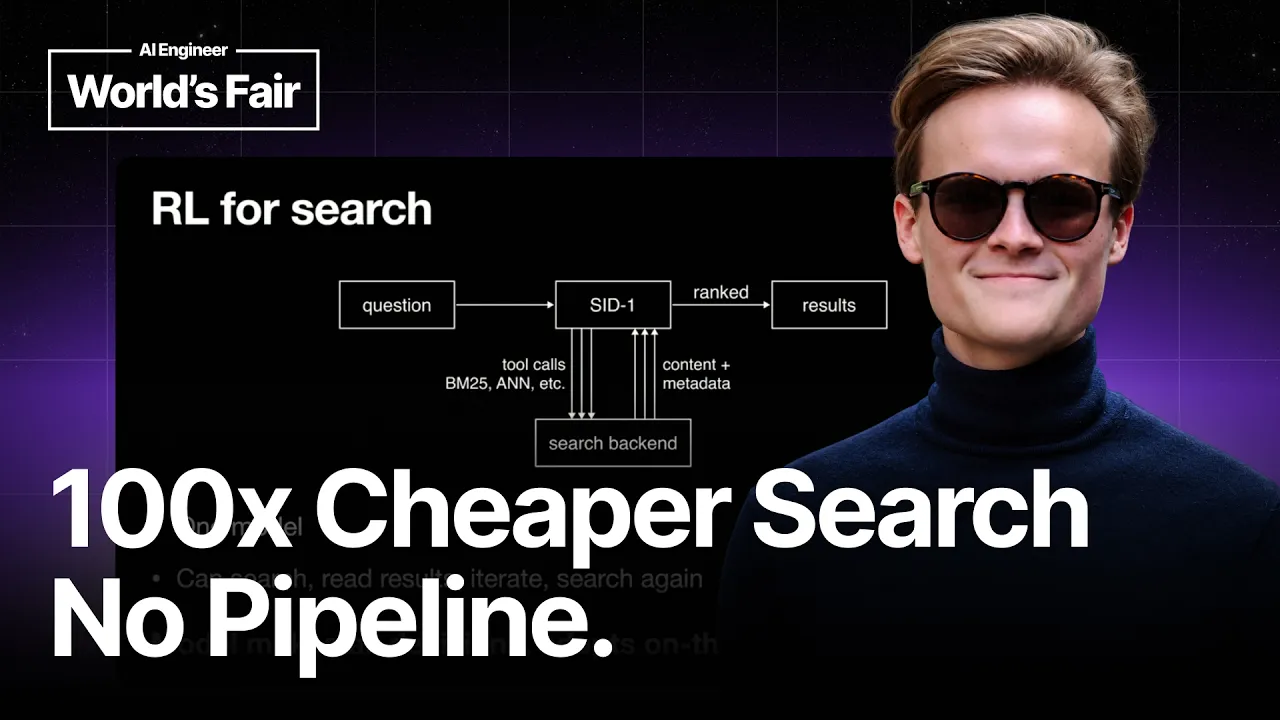
And what this looks like in practice is um something like this. Um so you have one model uh it goes back and forth with the database. It can search, it can read results, it can iterate. Uh it can search again until it is happy. It can set metadata filters on the fly. It can constrain its search. It can try as much as it wants. Uh and in the end, it produces a ranked list of results. Uhhuh. And what you get is a model that makes all of the decisions and can adapt to any question on the fly and for example use much more compute if a user asks a very difficult question.
And what helps us here is that search is verifiable. Um and reinforcement learning needs rewards that are verifiable and grindable. Verifiable here means for a given question, did you find the correct document? And we can design this and tell this quite easily. Um, and is there an environment where the model can attempt this question loads and loads of times and in practice for us this means uh thousands of times per second during a training run.
Uh, and the second part is kind of like can we turn the models that are currently very general and very general purpose into something that is much more specialized and it turns out we don't actually need most of the parts of a language model to be extremely performant at search. Uh and similarly with like CPUs and GPUs and AS6, um a CPU in theory can do anything that a GPU can do, but you would never want to use a CPU to do LLM inference, for example.
Um because the much more specialized version is much more effective. And this really makes search an ideal target for RL. Um and this is what happens when you train a model on this task. And so again, here we added the vector and reranker only baselines. This is of an earlier task. And what we see is that search quality increases very predictably with compute. And we can mix in other rewards like latency um and different kind of like retrieval strategies to make it even more performant.
Importantly, we don't really tell the model what to do. Much like in Alpha Zero and chess, we want it to discover its own strategies and its own tricks to essentially search. Well, uh, and we don't know whether this method has no ceiling, but we're definitely not yet seeing a ceiling to this approach. And these are the results. Uh, so this is the same chart as before. And this is SID one and then SID one um with some parallel execution on the left hand side.
And so what this ends up meaning is you get you're about 20 times faster. So instead of taking around 2 minutes, you take around 5 seconds on average. And it's about a hundred times cheaper than using a frontier model for this task. Uh there's some more detail here, but like yeah, the cost and kind of like speed are just completely incomparable. Uh you can yeah um it's not quite at the latency of a vector and reranker pipeline, but in practice we think we can get there quite quickly.
And how does this look like in production? So this is a usual kind of like agent execution trace. The agent does some searching here. It finds some good stuff. It finds some bad stuff. Um, but all of the bad stuff that it finds is essentially polluting its own context window. And what we can instead do is use um a sub agent here that does all of the searching and thinking and iterating for the main agent. And the main agent only ever sees great results.
And this means that the main agent sees more good stuff, which means it's more likely to be correct. And it is also um extremely cost- effective uh where those 30 to 50% tokens that were earlier used by the main agent to do searching can now be passed off to this just you know 100x cheaper search sub agent. Uh and where will this take us? Scaling RL will give us arbitrarily good search in any domain and RL models will become even faster which will allow them to be used in things like voice and e-commerce.
They'll become even cheaper than we are currently. Um so the charts that you saw there but like I think we can move even further. Uh and better search will unlock more knowledge work tasks. Uh the web is actually quite small uh in comparison to the entirety of data that is there that is out there. Uh and the most valuable information is not on the internet. For example, how to run JP Morgan is nowhere on the web but it is deep inside of the databases at at JP Morgan.
That's it for me. Thank you. [applause] >> [music]
The words are the caption track's own and nothing is reworded or re-transcribed. Paragraph breaks are placed between sentences so the text reads as prose.
Free tools for your own script. No signup, no login.
Paste your draft and see where viewers are likely to drop off, with a rewrite for each weak line.
Paste the first 30 seconds of your own draft for a hook score and rewrites.
Check your draft against YouTube's advertiser-friendly guidelines before you record it.
Read this channel's public videos and transcripts, and download a writing brief for it.