Getting the transcript
Reading the captions from YouTube. A video nobody has opened here before takes 10 to 30 seconds; this page fills in on its own.
Getting the transcript
Reading the captions from YouTube. A video nobody has opened here before takes 10 to 30 seconds; this page fills in on its own.
AI Engineer · @aiDotEngineer
This video has no Most replayed graph yet: YouTube shows one only once a video has enough views. These are the moments viewers replayed most in AI Engineer's most watched videos.
Most replayed moment at 18:45
4.8x that video's typical replay level
that they're they're changing they're changing things in the database not yet. You want to run them through the ontology first and make sure that works. Okay. I only got an I've got I've got another I've just a short time. I'm going to try to show you some of the things that um that you can
Said at 18:37
Most replayed moment at 16:13
3.6x that video's typical replay level
method signatures, the program layout and the call stacks. So here's some examples. I don't think you'll be able to read this one, but this is like the level of abstraction we're at. It's how we're actually going to lay this stuff out and how these systems are going to interact. Dylan Mulroy from Cloudflare talks a
Said at 16:06
Most replayed moment at 13:49
2.3x that video's typical replay level
Fable uh and it runs into an unknown, ask it to log it, right? So that um you uh you can see where the deviations happened and then you can sort of figure out why as well, you know? It will usually give you some context about what happened.
Said at 13:43
The graph counts replays. It does not show where viewers stopped watching.
Words
1,577
Runtime
9:57
Speaking pace
158wpm
Reading time
7min
158 words per minute, below the 160 25th percentile of 349 measured videos. That distribution comes from the 349-video hook study.
Opening (first 30 seconds)
[music] >> Hi everyone. So I'm Joan from Poolside. If you haven't heard of us, we're one of the handful of companies that are making their own foundational model from scratch their own LM and coding agents. Check us out if you if you're not aware some cool stuff and you should hear more soon. But what I want to talk to about today is this. You have people seeing AI and using AI and getting vastly different experiences.
79 words, the words spoken in the first 30 seconds at 158 words per minute.
Free, no signup. See how the first 30 seconds hold attention, with rewrites.
Sentence shape
| Measure | This transcript |
|---|---|
| Sentences | 120 |
| Average words per sentence | 13.1 |
| Longest sentence | 65 words |
| Questions asked | 16 |
| Sentences containing a number | 3 |
Most used terms
Filler phrases
37 in total: like 26 · you know 6 · actually 3 · basically 1 · sort of 1.
A literal whole-word count of the same phrase list the Prepublish browser extension uses, so a phrase inside another word is not counted and a phrase used in its ordinary sense still is. It is a count and not a judgement.
What this transcript is
Every word below is the caption track YouTube publishes for this video, pulled from the video itself and reproduced unchanged. It is not Prepublish's writing, not a summary, and not a re-transcription: it is the video's own published captions. English captions, generated automatically by YouTube, in the video’s original language. Source: the video on YouTube. A channel that would rather this page did not exist can ask for its removal through the contact page, and it is removed.
[music] >> Hi everyone. So I'm Joan from Poolside. If you haven't heard of us, we're one of the handful of companies that are making their own foundational model from scratch their own LM and coding agents. Check us out if you if you're not aware some cool stuff and you should hear more soon. But what I want to talk to about today is this. You have people seeing AI and using AI and getting vastly different experiences.
If you're on Reddit, if you're on Twitter, you're going to see people that say, oh yeah, I'm never like touching code anymore. The AI is is doing everything for me. It's fantastic. And others that say, what are you talking about? I'm trying it in my production app. It produces absolute garbage. What are you guys working on to do apps? What are you doing? And there is multiple ways to try to to understand what's going on there.
One way is to say, this guy is a shill from open AI trying to sell you AI. Or this one is an entity that doesn't care about anything and is just like lying. He didn't even try it. Another is to say, well, maybe someone is working on a greenfield app and that's nice and easy. Whereas someone else is working on brownfield on a legacy application. That's complicated and agents are not there yet. But personally, I think that doesn't quite hold up.
We've seen people using AI in legacy applications with good success. I have myself. So at least on my own experience, I know that can work. So what's the difference? What's the difference really between brownfield and greenfield? The difference is that with greenfield, the agent's intuition is correct. The agent's writing the code and expect, you know, if I write the components here, if I write the service, it's going to work.
I I think that's going to be fine. And he's right cuz it has very good intuition. On brownfield, however, there be dragons. You're going to have things that the agent is not expecting. Maybe you know, like dead ends, code that's not used anymore, things that it is not aware of in in different part of the code that it hasn't even looked at. And that's where the big difference between those two is the feedback loop. And everybody is somewhat talked about it in in in the background of the talks we've seen over the past three days.
But I think that's the difference with getting these results. So you you've got your agent that says, yeah, I've implemented the new auth flow and it's all working perfectly. What the agent means really is, well, to the best of the of my capabilities, to the best of what you have given me, that sounds like it should work. Maybe the agent was able to verify its work. Maybe it wasn't. But as far as it knows, it's working.
If you're a skeptic of AI, you're going to see that first quote, see that it's indeed not working and just sees, you know, I'm a liar, I'm incompetent or like you cannot trust the AI. And that's I think where this cleavage in between those two type of users. Like the first category is going to see some things. Oh yeah, actually, you know what? It's not working agent. Can you try again? Check those logs or whatever. Whereas those ones are just going to give up.
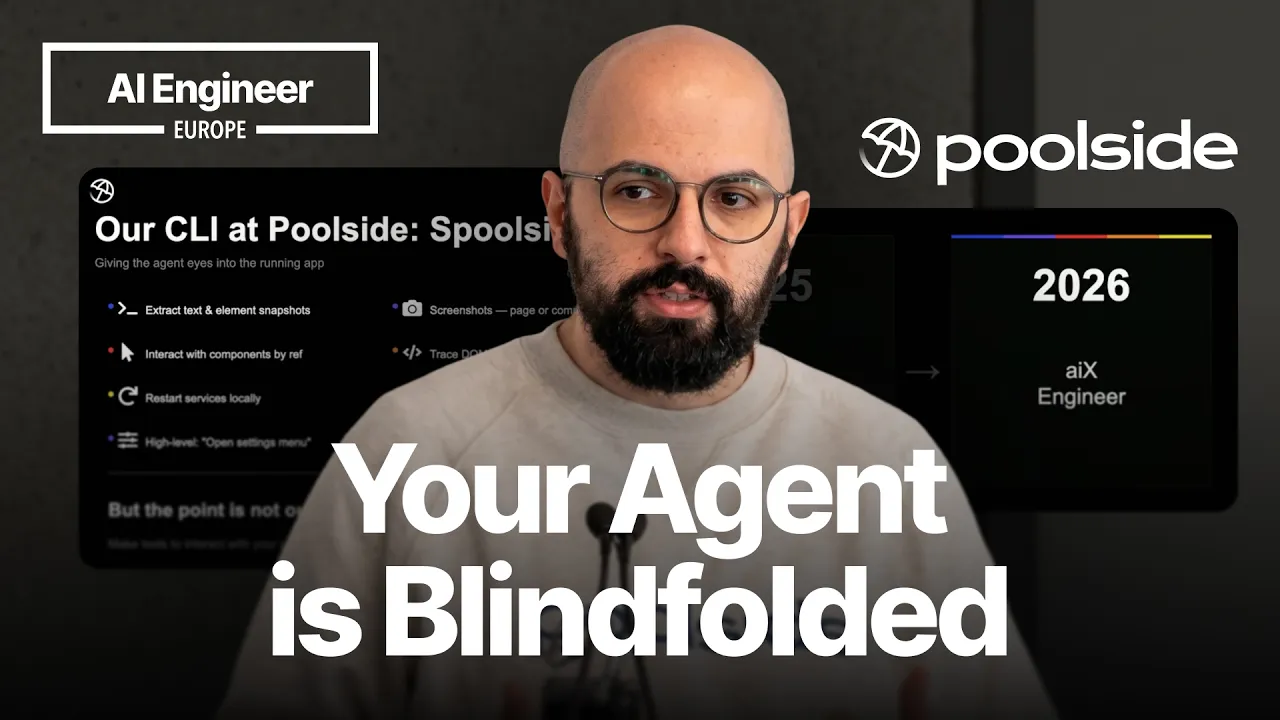
But I think we can make this still better. At Poolside, I've created a little CLI tool called Spoolside. Yeah, I might be good at programming. I'm not good at naming things. That basically allows it to test our applications effectively. Some of the stuff you've already seen in things like G stack for instance being able to take screenshots of the applications, being able to take a snapshot, that is to say like a very token compressed version of what's going on on a web page and use it.
But our application is not a web page. It's an extension within VS code. So already lucky takes an extra step to get there. But with that, our AI can interface with it just like it would with a normal web page. But we take it further. We have thing to extract logs from different services, from the back end, from the front end, ways to restart different services, high level commands. Can you access a specific menu? Can you go to this page?
Can you send a message to the agent? Wait for it to reply, send another message, upload an image and do that and it can stack things like somewhat efficiently and a bit like we've talked with coding tools this morning. And that's pretty useful cuz then the agent is able to test what it's doing. If it's working on a bug, it can actually reproduce the bug before it starts working on that on that. The agents are very eager.
Yeah, I know what's going on. You just need a margin there. You just need to go and add this code. But until it reproduces the bug, I don't trust you. And that's the big thing. It's maybe without that the agent is able to still have good intuition and fix the issues. But I don't trust it and then I'm going to have to go and verify it myself and I'm wasting time and I cannot then take that agent and start running it overnight for instance.
This is a first step to trust. And the point of this is not Spoolside. It's not something you're going to find on GitHub to use for yourself. It's to build your own. I think as engineers, that's our new role. We are going to have to focus less on the product and more on trying to make the AI work on the product. How can we make it easy for it? That can be those tools. That can be improving the code base so that it's easier to work on.
That can be improving knowledge bases. You can implement this as a CLI, as a skill, as an MCP. In my case, it's a CLI cuz I like things simple. But like there are many different variations of it and I think it's going to be different from people to people and problem to problem. But yeah, I think in 2025, we had product engineers that were, you know, like very focused on doing everything with the product. But now that AI is getting quite good, you want to focus more on making sure that that velocity is not a trap, that you're not going to multiply errors or compound errors, that you're going to actually verify what you're doing, making it easy for you to to verify as well with like presenting the work that the AI done and everything around that.
And so I think we're all going to become AIX engineers essentially. And yeah, it's a bit like when you're in an airline and they say, oh, you put your mask on yourself before you fit you put your your mask on your children. It's the same with AI. You need to put the mask on the AI. You need to make sure that it's self-served before you try to work on features. Even if it slows you down right now, it's an investment that pays off as soon as you start multiplying agents and running things over time.
And that's me done with two minutes to spares. So thank you very much. Any question from anybody? Yes. I think they're quite ephemeral in the sense and that I guess is a personal preference. But I do feel like automated test can be sometimes a bit too rigid and hard to predict and hard to like work over time. So I like something that mimics the way I would test it like a human would go and test the application. The way I find those is in the first stage where I work with the AI, I try even though, you know, like I can see that the button is a bit to the left and I want to tell the AI that.
What I want is the AI to realize that by itself. So whenever I encounter that sort of problem, I take a step back and try to think on how to make the AI realize the problem by itself. Another thing is re-attractive loop. After you've done that many times, look past over your logs, ask an AI, did you notice any issues, any any stink? Are you doing sleep for instance? Calling sleep parentheses 15 everywhere is a stink that like there is something that should be wait for whatever like a comment that could be there.
Is there anything that you keep doing over and over like running storybooks? And another thing is really think about like your own product. If you're making, say, a game in Unity, like do you want an ASCII representation of your 3D world in for for your AI? If you're making something with lots of permissions, different logins that your AI can take very easily. It's it's really your new role to think about all that. That's what I think anyway.
And I think we're it for time. Thank you very much. >> [music]
The words are the caption track's own and nothing is reworded or re-transcribed. Paragraph breaks are placed between sentences so the text reads as prose.
Free tools for your own script. No signup, no login.
Paste your draft and see where viewers are likely to drop off, with a rewrite for each weak line.
Paste the first 30 seconds of your own draft for a hook score and rewrites.
Check your draft against YouTube's advertiser-friendly guidelines before you record it.
Read this channel's public videos and transcripts, and download a writing brief for it.