Getting the transcript
Reading the captions from YouTube. A video nobody has opened here before takes 10 to 30 seconds; this page fills in on its own.
Getting the transcript
Reading the captions from YouTube. A video nobody has opened here before takes 10 to 30 seconds; this page fills in on its own.
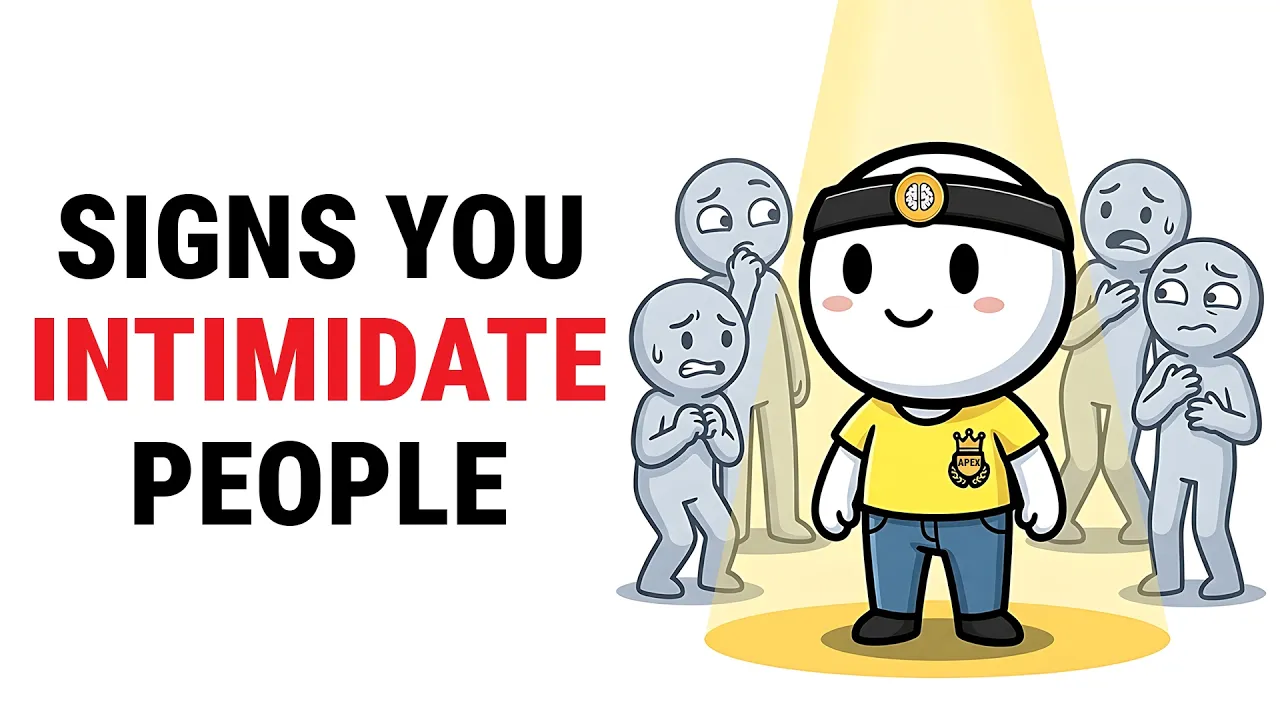
Apex Psychology · @ApexPsychologyYT
Where viewers went back to watch this video again, from YouTube's public Most replayed graph, lined up with what was said at that moment.
Most replayed moment #1
6:044.6x the video's typical replay level
polite answers, a direct question from you makes that familiar script stop working. They suddenly have to think more carefully and give a more honest answer than they first planned. Even though your question comes from a completely good place, it can still make other people become more cautious because to them, it
Said at 5:57
Most replayed moment #2
11:333.5x the video's typical replay level
people, approval from the outside, the nods, the compliments, or the number of followers can become an important part of how they define their self-worth. The need for validation sometimes makes people adjust themselves more than they truly want to. You seem less dependent
Said at 11:26
Most replayed moment #3
10:222.2x the video's typical replay level
say very quickly, and also what they purposely avoid mentioning. You are not necessarily trying to pick anyone apart. Your brain just naturally reads the room before responding. But for the person across from you, that feeling is sometimes not pleasant at all. Human instinct is extremely
Said at 10:15
The graph counts replays. It does not show where viewers stopped watching.
Words
2,742
Runtime
14:48
Speaking pace
185wpm
Reading time
11min
185 words per minute, between the 181 median and the 201 75th percentile of 349 measured videos. That distribution comes from the 349-video hook study.
Opening (first 30 seconds)
Have you ever walked into a room and felt like everyone around you suddenly became a little more careful? You did not do anything special. You did not talk over anyone. You did not demand attention. You were not even trying to impress anybody. And yet, there is still something about you that makes other people choose their words more carefully, keep a little distance, or act more relaxed than usual. Maybe you have been called unapproachable, too serious, too cold, or you have heard someone say, "At first, I thought you were
93 words, the words spoken in the first 30 seconds at 185 words per minute.
Free, no signup. See how the first 30 seconds hold attention, with rewrites.
Sentence shape
| Measure | This transcript |
|---|---|
| Sentences | 172 |
| Average words per sentence | 15.9 |
| Longest sentence | 44 words |
| Questions asked | 9 |
| Sentences containing a number | 1 |
Most used terms
Filler phrases
15 in total: like 10 · kind of 2 · you know 2 · actually 1.
A literal whole-word count of the same phrase list the Prepublish browser extension uses, so a phrase inside another word is not counted and a phrase used in its ordinary sense still is. It is a count and not a judgement.
What this transcript is
Every word below is the caption track YouTube publishes for this video, pulled from the video itself and reproduced unchanged. It is not Prepublish's writing, not a summary, and not a re-transcription: it is the video's own published captions. English captions, generated automatically by YouTube, in the video’s original language. Source: the video on YouTube. A channel that would rather this page did not exist can ask for its removal through the contact page, and it is removed.
Have you ever walked into a room and felt like everyone around you suddenly became a little more careful? You did not do anything special. You did not talk over anyone. You did not demand attention. You were not even trying to impress anybody. And yet, there is still something about you that makes other people choose their words more carefully, keep a little distance, or act more relaxed than usual. Maybe you have been called unapproachable, too serious, too cold, or you have heard someone say, "At first, I thought you were really intimidating." And all you can do is wonder, "What are they seeing in me that I cannot see in myself?" But, here is what no one tells you.
There is a hidden psychological mechanism behind that reaction. Sometimes, people are not reacting to what you do, but to the tiny signals in the way you carry yourself. Signals so small that you almost never notice them, but other people can feel them very clearly. I am Apex. Today, we are going to explore seven signs that you make other people feel intimidated without even realizing it. Sign one, silence. In most social interactions, silence is often treated like a system error, an uncomfortable gap that needs to be filled right away.
If you pay attention when a conversation suddenly falls into a silence that lasts longer than 3 seconds, you will see the other person start showing signs of restlessness. They may look around, pick up their phone, clear their throat, or quickly throw out any random meaningless topic like a comment about the weather or some shocking news online just to keep some sound in the air. Why are people so afraid of silence? From the perspective of evolutionary psychology, our brains are wired to connect sound with the safety of the group.
When there is talking, when there is feedback, people know that their place in the group is secure. On the other hand, unexpected silence often triggers a mild anxiety response in the amygdala, the part of the brain involved in threat detection. When things go silent, people lose the data they need to read the situation. They start questioning themselves, "Did I just say something wrong? Are they bored with me? Or are they judging me?" But the way you respond to silence is the complete opposite of most people.
You do not see silence as a problem that needs to be solved. You are completely comfortable sitting with someone without needing to constantly make noise. To you, silence is a functional space. It is the moment when you are digesting the information you just heard, the moment when you are thinking so you can give a high-quality answer, or simply the moment when you feel there is nothing truly valuable left to say. You do not feel the need to speak just to fill the gap or make the conversation seem more pleasant.
This calmness can accidentally create a huge amount of pressure. While they are rushing to find a way to break the silence, the fact that you can still sit there quiet and composed makes them feel like they are losing control. In nonverbal communication, the person who is more comfortable with silence is often the one who controls the pace of the conversation. Because they cannot read what is going on inside your head, their subconscious automatically switches into alert mode.
They may call you cold or hard to approach, but sometimes what makes them uncomfortable is simply that you are not reacting to the rhythm of conversation they are used to. Sign two, staying out of drama. Look at how social groups, workplaces, or friend circles often operate. Most people bond very quickly through one common ingredient, drama. Complaining together about a boss, gossiping about a coworker, or acting outraged over something on social media is one of the fastest ways to create a sense of belonging.
When people all react strongly to the same situation, they are quietly sending each other a safety signal. I feel the same way you do. I am on your side. I am part of this group. When you do not join that connection, other people may find it hard to guess where you stand in the group. When something noisy happens, instead of easily getting swept up in the shared energy of the crowd, you choose to take one step back. You take in the information, but you do not rush to judge.
You do not add more comments that pour fuel on the fire. And most importantly, you refuse to let your emotions be pulled around by stories that are not truly related to your personal life. You tend to keep a certain emotional distance before you react. For people who are used to bonding through quick agreement and strong reactions, your neutral attitude can make you hard to read. They feel disoriented. They cannot use gossip to pull in your attention.
They cannot use rumors to trigger anger in you. A person who is not easily swept along by the crowd is usually also hard to pull into instant emotional reactions. People who are used to influencing others through emotion may not know how to approach you. Their caution around you is not necessarily dislike. It may simply be confusion in front of someone who has clear boundaries and does not easily change their position just because of pressure from the people around them.
Sign three, going straight to the core. In social communication, there is an unwritten rule that most of us follow, small talk. When someone asks, "How have you been?" they usually only expect a standard answer like, "I'm good, thanks." These scripts are like basic social procedures. They help people interact politely, keep the atmosphere light, and make sure no one has to go too deep into anyone else's personal life.
But for you, maintaining these surface-level social procedures often does not feel very interesting. Not because you are rude or cold, but because your mind naturally wants to move towards something more real. When you truly enter a conversation, you bring genuine curiosity with you. You tend to skip the warm-up and ask questions that go straight to the point. Instead of asking harmless throwaway questions, you might ask, "What made you decide to choose this job?" From the perspective of neuroscience, many people with this trait have a nervous system that processes information at a deeper level than average.
This means your mind does not stop at taking in surface-level information. It automatically analyzes and looks for the core of the issue being discussed. However, for the person across from you, suddenly having to face this level of depth can sometimes create awkwardness. When they have only prepared safe, polite answers, a direct question from you makes that familiar script stop working. They suddenly have to think more carefully and give a more honest answer than they first planned.
Even though your question comes from a completely good place, it can still make other people become more cautious because to them, it does not simply feel like they are being asked a question. It feels like their inner world is being seen through before they are really ready. Sign four, staying rational during conflict. When an argument or conflict breaks out, the natural human instinct is to raise the voice, speak faster, and let emotions take over.
In psychology, there is a phenomenon called emotional mirroring. When someone is angry with you, they unconsciously expect you to react with a similar level of emotional intensity. That mirroring, even when it is negative, gives them the feeling that they are being heard, that their anger makes sense, and that it is affecting you. But you do not give them that mirror. When the pressure rises while other people let the emotional part of the brain, the amygdala, take control, you automatically activate the rational part of the brain, the prefrontal cortex, to stay in control.
Your voice may become slower, calmer. You separate the emotions from the core issue. You focus on finding the cause and the solution instead of pushing the argument into even more tension. This mismatch can create a huge amount of frustration for the other person. When their emotions are rising, your calmness creates a very clear gap in the conversation. Instead of being seen as a good quality, this attitude may be interpreted as arrogance, contempt, or cold indifference.
They may feel confused or irritated, especially when they are expecting you to react as strongly as they do. The fact that you do not get swept up in emotion at that moment makes the difference between the two ways of reacting very clear. And not everyone feels comfortable noticing that difference right in the middle of a conflict. Sign five, a firm refusal. One of the biggest invisible pressures in modern society is the disease of people pleasing.
From a young age, we are taught that saying no is a sign of being selfish, uncooperative, or unfriendly. That is why to reduce guilt, people have invented the art of refusing. When they cannot meet a request, instead of saying no directly, they often use the sandwich technique, wrapping the refusal between countless apologies, long explanations, excuses that sometimes do not truly reflect what they want, and promises to make it up in the future.
All of this is meant to soothe the listener and soften the truth that they are saying no. You may see this differently. The process of shaping your own identity has helped you draw extremely clear personal boundaries. You are very aware of your limits in time, energy, and tolerance. When a request crosses those limits, you give a simple answer, "No." You say that word clearly and firmly without adding a long explanation and without feeling more guilt than necessary.
You see no as a complete sentence, carrying the full message without needing to be decorated with indirect reasons. This honesty and wholeness in your behavior is extremely rare. For people who are used to continuing negotiations after being rejected, your firmness can feel like a boundary that is very hard to cross. They no longer have much room to keep negotiating. Their usual pressure tactics may no longer work on you.
And when they are not used to a clear boundary, they may interpret you as rigid, uncaring, or arrogant. That uneasiness sometimes comes from realizing that your decision is not easily changed by outside pressure. Sign six, making others feel seen through. In a group, many people are busy thinking about how they are being seen. They think about what they should say next, when they should laugh, and how they should act to look more confident, friendly, or interesting.
Because they are so focused on their own image, they often miss many small signals happening around them. You are the opposite. Because you are not in a rush to take the spotlight, you have more space to observe what is going on. You see things that other people often miss. Before you speak, you have already collected a lot of data. Eye contact, tone of voice, breathing rhythm, sitting posture, hesitation before an answer, a real smile, and a smile used only to hide discomfort.
You notice what people say very quickly, and also what they purposely avoid mentioning. You are not necessarily trying to pick anyone apart. Your brain just naturally reads the room before responding. But for the person across from you, that feeling is sometimes not pleasant at all. Human instinct is extremely sensitive to other people's eyes. Even when you do not say anything, the subconscious mind of the people around you can still feel that they are being watched closely.
For those who are trying to maintain a certain image in front of the crowd, your calm, observant gaze can make them feel a little uncomfortable. They may feel as if you notice more than what they are showing on the outside, even though you have not said or judged anything. This ability to observe can create invisible pressure, especially for people who are trying to appear stable in a situation that does not truly feel comfortable.
Sign seven, not needing validation. This may be one of the deeper reasons why your presence feels hard to read to people who are used to relying more on outside feedback. The society we live in runs on an economy of validation. Many daily interactions are actually hidden emotional transactions. I will praise you and agree with you so you will like me. In return, you must also approve of me and recognize my value. For many people, approval from the outside, the nods, the compliments, or the number of followers can become an important part of how they define their self-worth.
The need for validation sometimes makes people adjust themselves more than they truly want to. You seem less dependent on that kind of exchange. The concept of individuation in Carl Jung's psychoanalysis describes the process of integrating every part of yourself to become a whole and independent person. Maybe you are learning how to build a value system from within instead of only relying on other people's reactions.
You know clearly how capable you are. You understand which life principles you cannot compromise, and you accept even the imperfect parts of yourself. Most importantly, your sense of value does not fully depend on how much other people approve of you or praise you. You do not need the whole room to agree with you before you believe your opinion has value. You still exist within the community, but you do not let your entire worth depend on the reaction of that community.
When you are less dependent on validation, many social pressures also have a harder time affecting you than before. Group pressure, quiet rejection, disapproval, or sarcastic remarks, the kinds of pressure that once made many people change themselves may no longer affect you as strongly as they used to. This makes some people unsure how to read you. In psychology, this can lead to a defense mechanism called projection.
When someone is still highly dependent on outside validation, standing in front of someone who seems calmer and more independent can make them feel confused, even uncomfortable. Instead, your self-control may accidentally compare the way they themselves are reacting. The discomfort, caution, or sense of threat they direct towards you is not really a reaction to what you do. In many cases, it may be a reaction that comes from their own experiences, expectations, or personal pressures.
They may feel confused in front of someone who is not as tied down by the standards they are still trying to meet every day. If you recognize yourself in these signs and often get labeled as scary, hard to approach, or cold, then it may be time to stop questioning yourself so much. It does not necessarily mean you are doing something wrong, or that you have a problem with your communication skills. And you absolutely do not need to force yourself, hide your sharpness, or push yourself to be louder just to satisfy the expectations around you.
The threat you create does not come from bad intentions. It is the natural result of a self that has been shaped firmly. In a world where many people are used to adjusting themselves to fit social situations, the fact that you live honestly, calmly, and independently can become a very clear difference. You cannot fully control how other people react to your self-possession. People who are truly whole and aware will recognize the core value behind your silence.
They will appreciate your honesty, respect your boundaries, and stay. And if some people feel threatened, it may simply be because they are not used to a clear, calm personality that is hard to pull off balance. Understand that their reaction does not automatically make you wrong. It only shows that not everyone knows how to receive this kind of presence. Out of these seven signs, which one do you experience the most?
Leave a comment below. And if you know someone who is always misunderstood simply because they live too honestly as themselves, send this video to them. I am Apex. Thank you for listening, and I will see you again.
The words are the caption track's own and nothing is reworded or re-transcribed. Paragraph breaks are placed between sentences so the text reads as prose.
Free tools for your own script. No signup, no login.
Paste your draft and see where viewers are likely to drop off, with a rewrite for each weak line.
Paste the first 30 seconds of your own draft for a hook score and rewrites.
Check your draft against YouTube's advertiser-friendly guidelines before you record it.
Read this channel's public videos and transcripts, and download a writing brief for it.