Getting the transcript
Reading the captions from YouTube. A video nobody has opened here before takes 10 to 30 seconds; this page fills in on its own.
Getting the transcript
Reading the captions from YouTube. A video nobody has opened here before takes 10 to 30 seconds; this page fills in on its own.
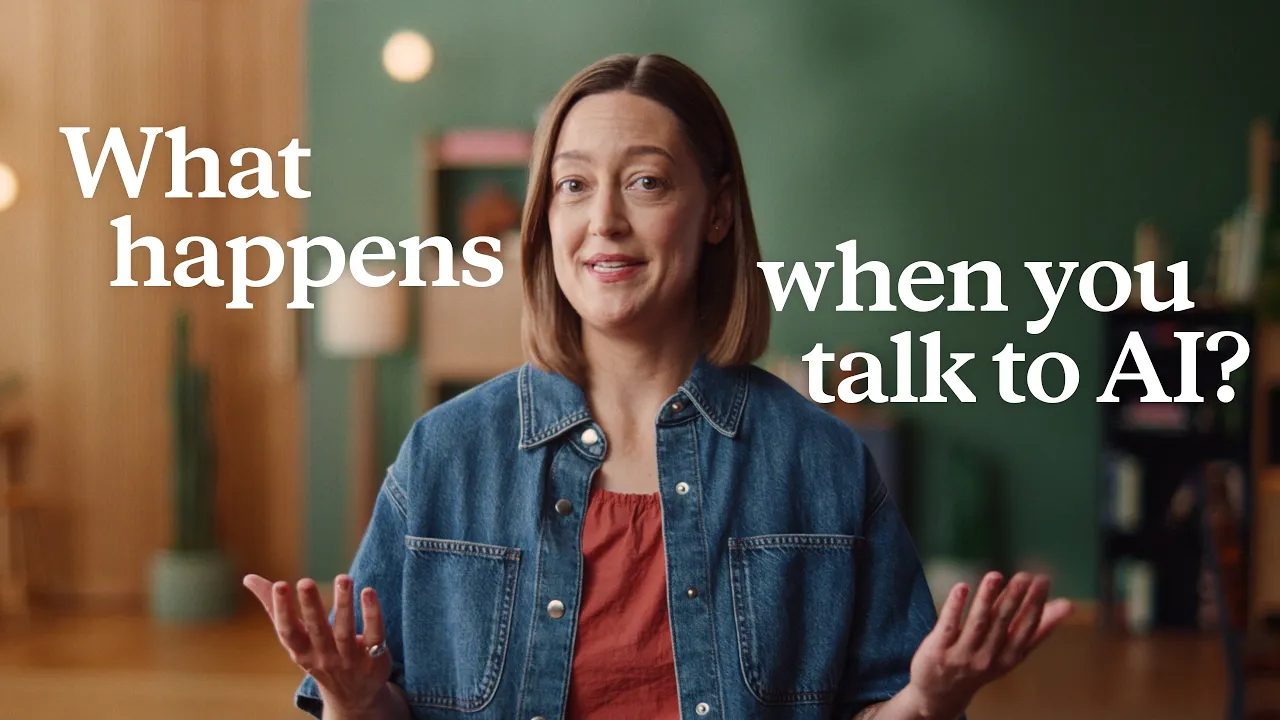
Where viewers went back to watch this video again, from YouTube's public Most replayed graph, lined up with what was said at that moment.
Most replayed moment #1
1:382.0x the video's typical replay level
of the same exercise: see some text, guess the next word, see how close it got, adjust slightly, go again. Later, in a second stage called fine-tuning, the model's full answers are rated– sometimes by people,
Said at 1:31
Most replayed moment #2
1:521.8x the video's typical replay level
the model's full answers are rated– sometimes by people, sometimes against a written set of guidelines– and the model is nudged toward answers that are more useful and less likely to mislead or cause harm. Both processes contribute to a model's generative capabilities.
Said at 1:45
Most replayed moment #3
2:561.6x the video's typical replay level
The model takes into account everything that came before– your uploaded documents, memory, system prompt, your prompts, your conversation history– before outputting the next word or even syllable. And then that whole process repeats for the next one, and so on, until the response is done.
Said at 2:50
The graph counts replays. It does not show where viewers stopped watching.
Words
901
Runtime
4:47
Speaking pace
188wpm
Reading time
4min
188 words per minute, between the 181 median and the 201 75th percentile of 349 measured videos. That distribution comes from the 349-video hook study.
Opening (first 30 seconds)
When you send a message to an AI, there's a moment where it appears to be "thinking". But what's actually happening? Is it reading the entire internet? Is it copying answers from a database? Is it just a fancier search engine? I'm Jane, and I work on user experience here at Anthropic, the company that makes Claude. Here's what's actually going on. AI models like Claude work by prediction. When you send a message, the model reads that message, and draws on everything it learned during training to write back a response a little
94 words, the words spoken in the first 30 seconds at 188 words per minute.
Free, no signup. See how the first 30 seconds hold attention, with rewrites.
Sentence shape
| Measure | This transcript |
|---|---|
| Sentences | 56 |
| Average words per sentence | 16.1 |
| Longest sentence | 42 words |
| Questions asked | 6 |
| Sentences containing a number | 0 |
Most used terms
Filler phrases
10 in total: like 6 · actually 4.
A literal whole-word count of the same phrase list the Prepublish browser extension uses, so a phrase inside another word is not counted and a phrase used in its ordinary sense still is. It is a count and not a judgement.
What this transcript is
Every word below is the caption track YouTube publishes for this video, pulled from the video itself and reproduced unchanged. It is not Prepublish's writing, not a summary, and not a re-transcription: it is the video's own published captions. English captions, published by the channel, in the video’s original language. Source: the video on YouTube. A channel that would rather this page did not exist can ask for its removal through the contact page, and it is removed.
When you send a message to an AI, there's a moment where it appears to be "thinking". But what's actually happening? Is it reading the entire internet? Is it copying answers from a database? Is it just a fancier search engine? I'm Jane, and I work on user experience here at Anthropic, the company that makes Claude. Here's what's actually going on. AI models like Claude work by prediction. When you send a message, the model reads that message, and draws on everything it learned during training to write back a response a little bit at a time.
You'll see it appear word by word, and each one is chosen based on everything that came before it. Here's what surprises most people: the model writes one word at a time, but it doesn't <i>think</i> one word at a time. We'll come back to that in a moment. You've likely seen something like this before. When your phone's keyboard suggests "been" after you type "how have you," that's prediction, too. The keyboard has learned which words tend to follow which.
But there's a key distinction here: your simple predictive keyboard is only looking at the last two or three words. It has no idea what you're trying to say or where the sentence is going. An AI model goes much further than this. It's been trained on an enormous amount of text and other kinds of information– this is known as training data. And when an AI model predicts, it isn't just looking at the last two or three words the way your keyboard does.
What it's actually doing turns out to be much deeper, and we'll see exactly how in a moment. Long before you ever talked to it, the model went through billions of rounds of the same exercise: see some text, guess the next word, see how close it got, adjust slightly, go again. Later, in a second stage called fine-tuning, the model's full answers are rated– sometimes by people, sometimes against a written set of guidelines– and the model is nudged toward answers that are more useful and less likely to mislead or cause harm.
Both processes contribute to a model's generative capabilities. All of that takes place up to a certain date, called the training cutoff, after which the model doesn't reliably know about facts or information without leaning on other tools such as internet search. While the model <i>can</i> search the internet to access information beyond the cutoff (if the tool has search available) you can't assume the model has done a web search to craft its response.
To be sure, you can ask it to, and when it does, it will typically share sources that you can review to confirm the output's accuracy. Now back to how the model thinks. "Predict the next word" sounds almost mechanical– like the model is just reacting one word, then the next, then the next. But to predict the next word <i>well</i>, you can't just look at the last few words. You have to work out where the sentence is going, what the paragraph is arguing, what a good answer would actually be.
The model takes into account everything that came before– your uploaded documents, memory, system prompt, your prompts, your conversation history– before outputting the next word or even syllable. And then that whole process repeats for the next one, and so on, until the response is done. So why should you care about any of this? Because when you understand that an AI model is a prediction system, you are able to work with it and interpret its outputs much better.
The fact that it can write you something that's never existed before makes sense once you remember it's generating, not just pulling answers from somewhere. The fact that it sometimes states something false with total confidence? Same reason. It's producing what a good answer would look like, and <i>usually</i> that lines up with reality. Occasionally it doesn't– which is why your judgment still matters. Knowing all that, a few habits that can get you better results: One: Give it context to work with.
Tell it who you are, what you're working on, and what a good result looks like. All of that becomes part of the pattern. Two: Remember the cutoff. The model's knowledge stops at a certain date– so for anything recent, like prices or the news, it could be out of date unless the tool tells you it searched the web. Three: Ask for options. Because it's generating– not retrieving information– there's no single stored answer.
So ask for a few versions of the draft or have it try again in a different tone. We encourage you to explore. Four: And above all, double-check the AI's outputs. A confident tone or a polished-looking result is just how the output comes out– it isn't proof that the output is accurate or done well. Consider the stakes of your question and double-check facts if wrong information would cause an issue. So that's the basic shape of how AI works.
Every time you send a message, you're handing it the start of a pattern, and it completes that pattern based on everything it learned in training. Different models will likely complete that pattern in different ways, so it's worth experimenting to see what works for you. We'll keep sharing our research on this topic on Anthropic's blog.
The words are the caption track's own and nothing is reworded or re-transcribed. Paragraph breaks are placed between sentences so the text reads as prose.
Free tools for your own script. No signup, no login.
Paste your draft and see where viewers are likely to drop off, with a rewrite for each weak line.
Paste the first 30 seconds of your own draft for a hook score and rewrites.
Check your draft against YouTube's advertiser-friendly guidelines before you record it.
Read this channel's public videos and transcripts, and download a writing brief for it.