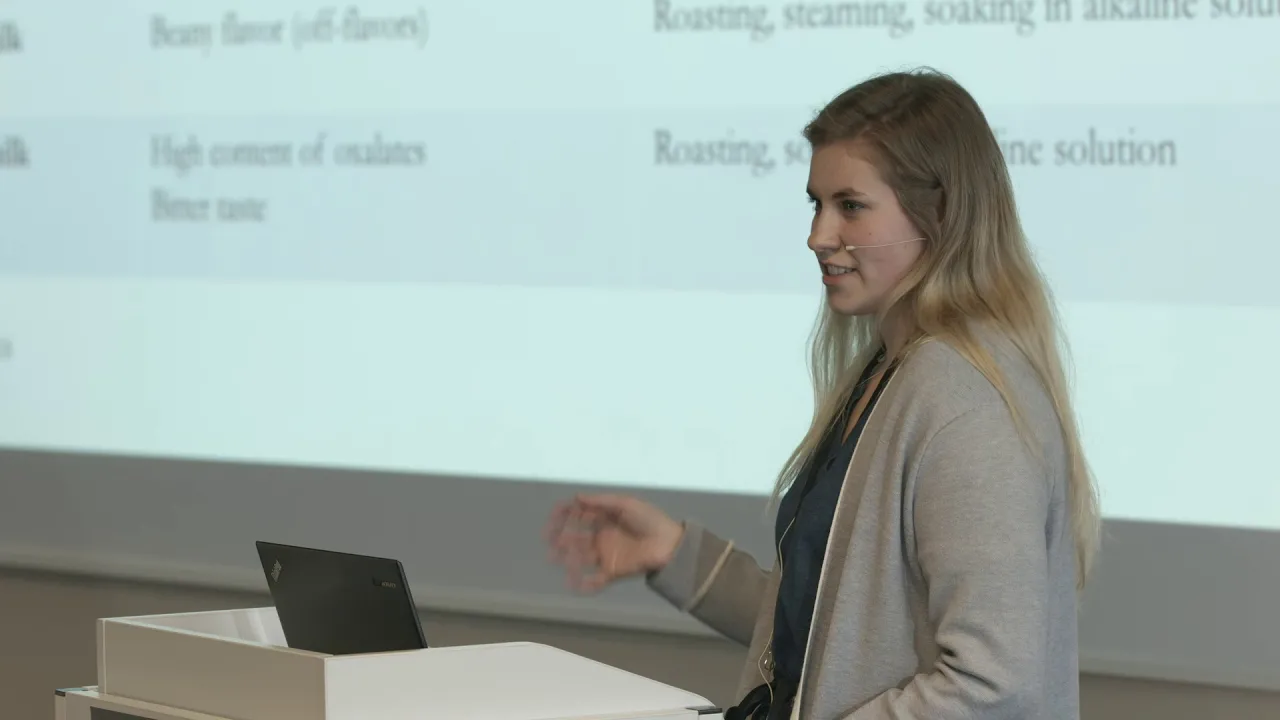
Food Innovation Summit 2018: Mari-Liis Tammik (TFTAK) transcript
Nähtamatud Loomad · @nahtamatudloomad8004
Words
2,169
Runtime
18:15
Speaking pace
119wpm
Reading time
9min
119 words per minute, below the 160 25th percentile of 349 measured videos. That distribution comes from the 349-video hook study.
Opening (first 30 seconds)
thank you for the introduction so my name is Marilee stomach and I am a researcher and the plant based product developer at center of food and fermentation technologies so today I would like to briefly talk about who we are and what we do in general and then move on to specifically talking about plant based products so we
60 words, the words spoken in the first 30 seconds at 119 words per minute.
Sentence shape
| Measure | This transcript |
|---|---|
| Sentences | 1 |
| Average words per sentence | 2169.0 |
| Longest sentence | 2,169 words |
| Questions asked | 0 |
| Sentences containing a number | 1 |
Most used terms
- products26
- different19
- lot16
- based15
- work15
- plant13
- plant based13
- example12
- companies11
- protein11
- milk10
- product10
Filler phrases
25 in total: like 12 · kind of 10 · actually 2 · basically 1.
A literal whole-word count of the same phrase list the Prepublish browser extension uses, so a phrase inside another word is not counted and a phrase used in its ordinary sense still is. It is a count and not a judgement.
What this transcript is
Every word below is the caption track YouTube publishes for this video, pulled from the video itself and reproduced unchanged. It is not Prepublish's writing, not a summary, and not a re-transcription: it is the video's own published captions. English captions, generated automatically by YouTube, in the video’s original language. Source: the video on YouTube. A channel that would rather this page did not exist can ask for its removal through the contact page, and it is removed.
Transcript
thank you for the introduction so my name is Marilee stomach and I am a researcher and the plant based product developer at center of food and fermentation technologies so today I would like to briefly talk about who we are and what we do in general and then move on to specifically talking about plant based products so we are research institution and we were founded in 2004 and we are located near the campus of Tallinn University of Technology we are an R&D company in the field of synthetic and system biology so this means that we can observe processes at cellular level and use different biotechnological methods in the industry we mainly focus on lactic acid bacteria and yeasts so how to use those microorganisms for example products like pier bread or even milk and as we we do a lot of scientific work but we it is really important for us to implement those results and knowledge in the industry as fast as possible and this is why we do a lot of collaboration work with different companies as we are a scientific organization we have a motor lab for different work groups highly qualified personnel with different PhDs and graduates graduate students also we do a lot of work with different universities and as I mentioned before we have a lot of different partners international ones and here in Estonia so here are some of the work we do for example fermentation group has a really good understanding of cell metabolism they do a lot of work with as I said we'd like the Casa criteria and different yeast and how to use those in different processes I work in the the department so we do a lot of work with plant-based foods different fermented drinks alcoholic and non-alcoholic and pregnant bakery and so on also we have a very interesting nutrition group they do a lot of work with our microbiome so they research how does our diet affect our microbiome and finally we have a really cool assessment sensory assessment group they are professionally trained Assessors they give feedback to the companies about their products about their texture taste do they have any off flavors and so on so now I would like to focus more on our work mainly plant-based alternatives in the case of meat and dairy when you look at the food pyramid that has been conducted by the Health Organization in Estonia on the left you can see Estonia nutritional recommendation per week and on the right you can see our actual food choices so Estonians eat three to four times more meat and it's recommended so this actually is a major problem at your health but also at the sustainable food system and therefore to the environment and this understanding has also triggered us to do more R&D on plant-based products luckily today at the same time we can sense the global flexitarian movement so flexitarians are people who eat meat and dairy but also choose meatless meals on some days and this is very popular in Germany UK and in the United States and for example companies like impossible food or beyond marker pian burger have made a mission to develop these kind of products and we also want to go under strain so not only to have products vegans and vegetarians but also to have products that everyone would choose so when we look at the market changes we can see that products like tofu seitan or tempeh there have been in the Asian cuisine for centuries when these kind of products Tyler started to emerge on Western market back in the 60s companies started to make meat analogues from soy and wheat mainly and as from Nicole's presentation we saw that those first generation meat analogues weren't very tasty or appetizing so today new generation vegetarian products use texturized vegetable protein which will I talk about a little later and also they use alternative proteins not only from soy and wheat but from different sources like grains legumes maybe from algae fungi and so on so there are clearly two different ways companies are developing their products first meet on first sight so for example kebabs or Bacon's from plants but we can say in sense that more and more companies want clearly vegetarian products so for example pulled out by cold and green and what is interesting is that a lot of companies from this traditional industry from meat and dairy are coming to us to help them develop these new kind of plant-based products so as I mentioned before a lot of those products contain texturized vegetable protein so this is a method to restructure proteins I didn't come in empty-handed I have some examples from the lab so maybe we can help them distribute them around I wasn't allowed to leave this box so I cannot do as myself so yes this is the raw ingredients for texturising this is soya protein powder and the other ones are texturized protein so not only does this give a really nice and chewy texture to the product it also helps to break down any anti nutrients that are in plants so these are molecules that the plants itself synthesizes to protect them from higher organisms but if we eat those kind of molecules then it may inhibit protein digestion so we had to lose them and make healthier products also it has longer shelf life so this I think there are dry ones their shelf life is almost a year so it is really good for the companies to have a really nice stock in the warehouse it doesn't go bad or anything and also when we create this texture through this technology we don't have to add any additives to the product so this is a short video clip so this is a pilot scale extruder and we also used soy protein so of course in the labs there are smaller machines but in the industry there are a lot bigger so as you can see the protein comes from the cooling area the protein powder gets texturized and this is the vessel where you put the protein powder in it so quite a simple machine quite easy technology and it creates really good and interesting textures so here are some examples that we have done with different partners for example so a meat for bones oil brown rice and P Parker's for Ithaca foods and P protein means for prana foods so all of these products contain TVP and also different fibers so for us it is important to develop products that have really good sensory properties texture smell and taste this is the most important thing then people will buy those products but at the same time it they have to be highly nutritious when I look some of the alternatives that are on the market right now they contain a lot of salt a lot of additives so if we can make those kind of products with new technology well we don't have to add any additives that we don't need then I think this is the key also and also we can have different fibers so it is good for our gut and our main goal is also to research alternative proteins not only from soy and wheat but from different grains like oats legumes beans and why not even from fungi algae or East so this is really important for us and we see the future in that so we also do a lot of research in in plant-based milk alternatives as you can see the possibilities are endless for plant-based milks so mainly from grains legumes nuts seeds and pure grains we mostly done research on oat soy and different nuts at the production of plant-based milk is quite easy you have a raw material for example nuts grains receipt you extract the water filter it you may add some additives usually commercial mix have different stabilizers then you have to pasteurize it and package it but when you look at the Nutrition Facts actually commercial plant-based milks different quite greatly from the traditional milk usually it doesn't have enough energy protein or fat in it so it is challenging to implement the same technology from the dairy industry to plant based product development and here are some examples about the product production challenges for example when you took out to milk it has a very weak emulsion stability because of the high starch content I don't know if anybody has made oat milk before it separates really quickly it can be really slimy so but the solution for this is to treat it with enzymes so enzymes are molecules that basically cut really long sugar molecules into smaller units so this oat milk becomes more stable and also a lot of land-based milks contain auntie nutrients where I called what I talked about earlier and some of flavors that people don't like so the main solution for this is temperature treatment ultrasound treatment blanching and for nuts roasting or steaming and when we talk about fermentation lactic acid bacteria is the key so these are organisms that are involved in the manufacture of thousands of fermented foods so they consume carbohydrates produce lactic acid with which gives the product six it's sour and tangy taste when we talk about fermentation in dairy products mainly for microorganisms are used as commentary starters but as we seen in our work usually these kind of bacterias don't work with plant-based milks so it is really important to choose the right culture for example some there is a starter culture cultures give Pleasant sour aroma and taste yet some have very unpleasant and peeny smell taste and smell so it is really important to do scientific work with those and to figure out well what works with milks the better best so this is just one example what we did in the lab and an experience with commercial starter and it showed that for example in soya milk it worked really well it produced energy we saw that these kind of organisms are growing in that media it has enough food to eat yet in some milk it didn't work at all so this is why I want to stress that it is really important to do scientific work with those kind of things to have a high quality product and as I mentioned before monitoring the growth and activities or of this culture is very important to guarantee a very high quality products so my methods based on measurements are different you can look at the acidity metabolic analysis and also heat flow with equipment called micro kilometer II which we have in our lab also so this is a very interesting machine as you see it before the curves it measures the energy or heat that the microorganisms are producing so we can get a really good knowledge of what those kind of starters doing that media and so we can give companies examples of what starter cultures to use for example another thing is improving the product development test ability sorry a lot of commercial milks and products use additives but if we use scientific methods like high pressure homogenization or ultrasound processing we can get a really good stability milks and products and we don't have to add any additives so this is a project that we did with pon soya our aim was to developed a soy yogurt as soy yogurt often has a really beany taste a lot of people don't like them so our mission was to get rid of those of flavors and one way is by blanching with a sodium carbonate solution so first we did soya milk when we also got a really interesting Ross a residue Okara which reminds something like a curd I don't know if you copy him in Estonia and it is really interesting to do also further experience with that residue also so we don't have to waste anything then we have added pectin and inulin which are naturally occurring fibers they give this very silky texture to the yogurt and then we had the awkward cultures and fermented it so as you can see there are many steps and I think it is really important for companies to do research and cooperation with this kind of institutes so that we can have a really high-quality product so to conclude the necessity and need for a plant-based product is increasing we can sense that the market is ready for all kinds of products yes developing these products can be a bit tricky but this is where the science steps in and helps companies to get really good products and I think more cooperation between fruit producers and research institutes is necessary thank you [Applause]
The words are the caption track's own and nothing is reworded or re-transcribed. Paragraph breaks are placed between sentences so the text reads as prose.
Use this transcript
Three free tools that work on the material around a video like this one. No signup, no login.
Hook Analyzer
Paste the first 30 seconds of your own draft for a hook score and rewrites.
Policy Pre-Flight
Check your draft against YouTube's advertiser-friendly guidelines before you record it.
Channel Skill Generator
Read this channel's public videos and transcripts, and download a writing brief for it.