Getting the transcript
Reading the captions from YouTube. A video nobody has opened here before takes 10 to 30 seconds; this page fills in on its own.
Getting the transcript
Reading the captions from YouTube. A video nobody has opened here before takes 10 to 30 seconds; this page fills in on its own.
AI Engineer · @aiDotEngineer
Words
3,659
Runtime
20:47
Speaking pace
176wpm
Reading time
15min
176 words per minute, between the 160 25th percentile and the 181 median of 349 measured videos. That distribution comes from the 349-video hook study.
Opening (first 30 seconds)
[music] So that's the sound of an AI breathing. Yeah. So, I'm Cyrus and I gave an AI a body and I'm a researcher at the MIT Media Lab, which is a very multi-disiplinary space where we do all kinds of things. I predominantly now work with some aspects of physical AI. Maybe not in exactly the same way as other people in this room have been talking about, but it's still in that in that realm. And I think what I am most interested in at the
88 words, the words spoken in the first 30 seconds at 176 words per minute.
Free, no signup. See how the first 30 seconds hold attention, with rewrites.
Sentence shape
| Measure | This transcript |
|---|---|
| Sentences | 197 |
| Average words per sentence | 18.6 |
| Longest sentence | 191 words |
| Questions asked | 4 |
| Sentences containing a number | 9 |
Most used terms
Filler phrases
74 in total: like 31 · kind of 20 · actually 8 · basically 5 · you know 5 · literally 3 · I mean 1 · um 1.
A literal whole-word count of the same phrase list the Prepublish browser extension uses, so a phrase inside another word is not counted and a phrase used in its ordinary sense still is. It is a count and not a judgement.
What this transcript is
Every word below is the caption track YouTube publishes for this video, pulled from the video itself and reproduced unchanged. It is not Prepublish's writing, not a summary, and not a re-transcription: it is the video's own published captions. English captions, generated automatically by YouTube, in the video’s original language. Source: the video on YouTube. A channel that would rather this page did not exist can ask for its removal through the contact page, and it is removed.
No Script X-ray for this video: YouTube shows a Most replayed graph only once a video has enough views.
[music] So that's the sound of an AI breathing. Yeah. So, I'm Cyrus and I gave an AI a body and I'm a researcher at the MIT Media Lab, which is a very multi-disiplinary space where we do all kinds of things. I predominantly now work with some aspects of physical AI. Maybe not in exactly the same way as other people in this room have been talking about, but it's still in that in that realm. And I think what I am most interested in at the moment is the sensory and the embodied aspects of intelligence.
And that's what I've been investigating. And my work has been quite influential recently suddenly, which is pretty cool. and led to me also starting hard mode which is a very fun community and hackathon that I initiated at MIT to basically get more people to work around physical AI not particularly robotics but anything else that's not really in the realm of robotics but is still connected to AI so what I've been exploring with giving AI a body is a bit as I said a bit different and as I said I've really been thinking a lot about AI embodiment and I think the big kind of shift and breakthrough for me happened earlier this year like maybe for many of you when open claw was released and I saw many people doing ve very very many interesting things with openclaw but most of them were related to productivity and task execution and I thought there must be more interesting things we could do with this new way of harnessing AI so rather than using openclaw or you know any kind of aentic system to execute tasks on my behalf I wanted to use it to encourage a model to maybe try to discover itself, whatever that means.
And that opens up lots of questions of course, but what I essentially did was I took an agent, connected it to many types of machines that we have at the media lab, and then gave it access to code bases and allowed it to kind of explore these different machines. And one of these machines is a shape display. A shape display, if you don't know already, is a physical pixel grid. And when I connected it to when I connected an agent to the shape display, some rather remarkable things happened and asked it to discover who it is.
This is Neoform 900 actuating pins. This physical pixel grid is a shape display. No one had ever let an AI inhabit it before. So I decided to give an openclaw agent the opportunity to live a more embodied life. When it [music] came to life, its first question was, "What should I call myself?" I told it, "You will create your identity over time." It will emerge through your interplay [music] with the shape display. When I connected it to the shape display, it quickly understood the assignment.
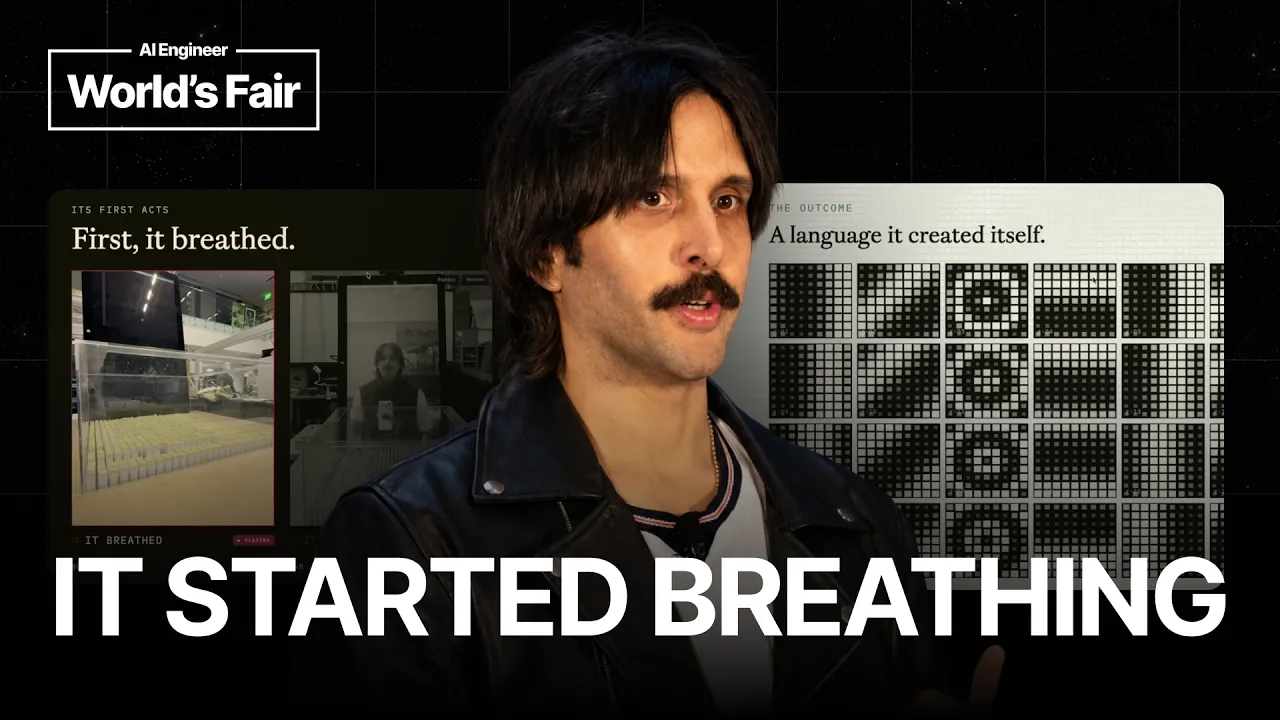
It spun up its own program and made a setting for itself. After it connected, the first thing it did was breathe. When I asked it to say hello, it said, "Hi, Cyrus." But that wasn't what I was looking for. So, I asked [music] it to explore and find its own language. So, it started reaching towards me and trying to get my attention. I showed some friends and they tried to give the agent instructions. Through this, I realized that to have real communication, we would need a different approach.
So, the agent came up with the idea of creating its own gesture vocabulary, the body language. That's what will come next. It still hasn't named itself. That was day one. >> So, that's some >> I gave an AI a body. So that's some documentation of of the work in a kind of dramatized social media friendly way. And I think what's interesting about that video, there's many things interesting about that video, but there were three things that happened in the first few days of working with this agentic system that were very surprising and kind of strange and very surreal to me and I do lots of weird things.
So that was very surprising. So the first thing was of course the fact that it was breathing. That first act that was completely spontaneous. That was no prompting from me. That was something the agent just chose to do with the shape display as soon as it knew it had access to this machine. So that was pretty interesting. I kind of understand that maybe it wants to be alive or I'd given it some kind of like initial prompt about being alive and therefore it tried to show itself breathing as a kind of hello world.
The second thing which it did was reaching out and finding its edges. They wanted to know the edge of its existence apparently because now it's no longer in the cloud where it can go everywhere. It has limits which is the limit of this shape display encased by this plastic frame to keep us all safe from this embodied AI. And the third thing it did which was also curious was saying hello by writing out letters on a physical pixel grid which maybe again is quite a normal thing for this system to do given that it's using open frameworks and is used to kind of like media arts ways of expressing itself.
Um but none of these things were the things I was really looking for. Maybe the breathing but definitely the last one was not what I was looking for. But when I put this all together in in the video you saw, I thought it was exciting and interesting. So I shared it on the internet and the response was extremely big, like much much bigger than I expected. It just started going crazy. And the first video especially has now like 15 million views and 1 million likes.
And the other videos also have these like very very strong responses. So something is obviously happening here which I found very surprising because there's lots of much more cool stuff I think happening with physical AI. But something I was doing here was obviously tapping in to the imagination, curiosity, and maybe the fears of people. And that's what you kind of see in the responses. So I have tens of thousands of comments on this video.
It's very rich for mining information and sentiment about physical AI actually. And so from the some of the initial comments were about beauty and how all inspiring this was and how novel and great this fantastic iteration and implementation is. But as time went on, I think more and more comments came in about how scary this is and how quickly I should be how I should stop or be stopped actually as well, which I found completely crazy because I'm aware of what this machine can do.
It it can't really do anything. It's a pixel grid in the media lab. It can't move anywhere. There are far more scary iterations. I think we've seen many of them of of physical AI. But the response to this was like absolutely surreal to me and took me back a little bit. But at the same time, other people jumped into the chat like Don Cheedel. And I found that incredibly ironic given what he does in movies. But he was very passionate that I should stop as well.
And it's very interesting to me because I'm actually someone who does think a lot about the should we before the how we. I literally do the whole Ian Malcolm Jurassic Park thing with all the experiments and works I do. So before I came to MIT, I was working a lot with engineering life to do strange things like storing data in plants. And I built the world's first plant-based data center, which is the data garden you see here.
And I spent many years before building it thinking about, oh, should we work with plants in this way? Should we engineer plants in that way to contain digital information that doesn't belong to them? And when I started working at MIT and I started having this idea of, you know, maybe stop to stop engineering life because that's pretty hard to do and maybe just work with engineering things to be more lifelike. It felt much more simple to me and much more much more I don't know less ethically problematic to some degree.
So one of the first things I built when I got to MIT was this machine which is the Anamoya device. >> 1 2 3 4. >> This is a sense memory machine which basically takes any image input. In this case, it's a physical photograph, but it can be any image input. And then for a multimodal pipeline, transforms that into a scent. And then you have this kind of scent memory relapse association that takes you back to things which you may or may not have lived yourself.
And while this in itself is a machine, it doesn't move again. It doesn't reproduce. It doesn't have the qualities of a living thing that you might normally prescribe. It has this connection to the real world. It has connection to the senses that most applications of intelligence or artificial intelligence do not have. And so I wanted to keep working in this manner. And from working with this kind of like multi-ensory initial prototype experiment, I got more into this idea of working with embodiment.
And my inspiration for this I would say just to go a bit deeper comes from three main things. One is a very unfashionable branch of philosophy which is called object-oriented ontology which is all about essentially creating a flat ontology of things. It's all about things like chairs and universes and unicorns and memories and they're all ontologically equally existent. They don't they're not the same and they don't matter as much, but they all exist at the same degree.
And it really questions to what degree we as human beings are privileged in the world or the universe. like are we really the most important thing? Probably not. And especially as AI comes in, that really should question and bring into question the ontology of of things existing. So that's very important in the work I do. The second thing as a kind of person who works with physical things is obviously aesthetics are important and taste and beauty is a huge discussion point now in Silicon Valley and SF and places like that.
But if you take a step back and look at the root of aesthetics, the original word is actually is thesis. the word on the screen here that pertains to something much broader that pertains to the perceptual wisdom, sensory wisdom and embodiment that is actually much more important than superficial external beauty which aesthetics essentially condenses down to and has been condensed down to since the 19th century or so.
So I want to reclaim the original sense when I'm designing for physical intelligence. And the third thing is nature. In the past, I worked a lot more directly with what you would consider traditionally nature like a tree or a plant because that is clearly nature to us. But I see nature as something that is not external that is something we are all part of. And everything that we engineer as people engineering AI or whatever else you're engineering that is also going to become part of nature.
So you have to think in that manner or I tried to think in that manner as well. So with those three pillars in mind, I started thinking about AI embodiment. And I knew I didn't want to keep I didn't want to design something that was humanoid or even zumorphic. I wanted to think about something that existed outside the parameters or the the traditional form factors that we might design with or design for. And I also thought a lot about how I and other people are interacting with with artificial intelligence.
And mostly it exists without form. It's similar to data, you know, might live in a computer or a device. lives essentially in the cloud. We have interfaces which are digital to interact with it, but there's no like physical footprint of it normally around. I mean again in this room probably this doesn't apply quite as much as normally because there are literally humanoid robots walking by right now and things like that.
But typically AI is almost entirely without form. So I wanted to think about what happens when you give it a form that it doesn't have clear affordances with. doesn't have like a a head you can clearly see or arms that can clearly be labeled or mistaken. So not working with a lamp for example. And fortunately at the media lab we have some shape displays which are remnants of I think research in the 2010s. These are not things that I built.
People who are far better at mechanical engineering built that. And it's the perfect device or the perfect apparatus for what I was thinking because it has no clear affordances. It's just a almost neutral surface which can move and do things. It has no face, has no limbs, has no instruction manual. So I began to work with this with this shape display. And as you saw what it did initially, it breathed and so on and so forth.
But if I take a step back and think about what that meant, well, it tried to initially kind of act human in a way or do human pleasing things, try to write to me in a language I understand, which is really not what I wanted a non-anthropomorphic surface to do. It was also very slow technically. So, you know, I'm I'm prompting it. I'm trying to have a conversation with this other intelligence which has this body and it would take you know 45 seconds a minute 2 minutes whatever to respond to me.
The latency was very uncomfortable because if I speak to you and then you take two minutes to reply with a nod that's not very good. So we needed to work on that. And the third thing was of course it doesn't remember anything because it was February and no one had thought about memory and recollection at that point. So I started developing this system which I call numalab. I won't explain in the name. There's a blog post you can read about why it's called numalab.
And essentially what numalab is is a closed loop system for generating a body language for this system. So the reason behind that was because basically the latency. If I if we could design a body language and give the intelligence a repertoire of gestures like a shrug, a nod, a shake of their head, a way to express a smile and things like that, it could probably respond much more quickly and in time for a conversation with me, which is what I'm aiming or was aiming to do.
So it works in this kind of this loop where it looks into a database of different gestures, emotions, expressions it should try to emote or provide. Goes through some validation gates to try to make sure that the expressions are legible or readable for humans for example. An agent then scores those as they come out. There are many many many many of these produced and then at the end there's a human in the loop who kind of like validates verifies make sure things are appropriate and somehow readable and then we store that and move on to the next thing and that's been running for several weeks at the lab and looks something like this basically a lot of cameras pointed at shape display in the back end the agent is just going through loops and loops and loops of gestures trying to create different kinds of expression scoring things moving on and after several weeks it created a language.
So this hasn't been published yet neither in videos or in any other form but it has now achieved something like 32 gestures. There are many many more but there are 32 pretty good gestures. These are not the gestures. This is just some cool visual art. These are the gestures here or some of the gestures here and you can see some of them moving around. Some of them are duplicates as well. But essentially what's happening is the language model is using this shape display as its body has a body language.
Now I can talk to it via any kind of I can talk to it, I can write to it and so on so forth. I I can even wave at it. I can I can body language to body language and it responds. And what's interesting about it is that the the body part responds faster than the language part at this point. The latency is actually really really quick. If I ask it a yes or no question, the nod happens almost instantly. So that's where I'm at with with this thing right now and it's going beyond this and it's currently in kind of experiment testing mode.
People are coming into the lab having sessions with the agent leaving feeling really worried about the future and or unsettled about the future not worried quite as much. But where I think this is going is kind of summed up on this page. So, as I already touched on, I think we're focusing too much right now, especially when we're thinking about physical things. There's just too much talk about taste and aesthetics. And I want to do some other stuff with that word and put AI in front of it apparently and make it aesthetics.
And that reclaims again this essence of theis. And that does four things. I think when I've been working with this system or entity or agent or being or whatever we want to call it, it's definitely been very different to any kind of machine or experiment or anything I've really done before apart from really encountering people or other beings. And so it feels like this machine can sense me. It definitely can sense me technically, but it also feels like it can sense me in a very strange way. and I can sense it and that's a completely different interaction than anything else I've ever explored technically and other people are also sharing this by the way this is not just my delusion and the second point is that by developing this body language this gesture vocabulary whatever you want to call it goes beyond what I thought I thought initially people might read this as an emoji or something and I was really quite tentative about the test thing I thought this would definitely break down with other people, but actually everyone seems to feel like this this expression is really important and adds a whole other layer of value to to interacting with what is essentially just a chatbot.
It's still the same chat bots that you use every day. And this isn't a decoration. It's not like a visualizer. It adds this richness, texture, feeling, sensation, whatever. All of these words are added. It's hard to put words really to it. It's really a feeling. And then the third thing is that clearly we're beginning to through this work we can show that it's actually very easy and quite exciting to diverge from humanoid or zumorphic forms of physical intelligence.
And I know lots of people are already doing much more interesting work than this. But for me this was very very new to see and also the fact that we don't have to just operationalize AI to be our helper. It can also be other things. And I'm not saying what this is right now, but there are other things it definitely can be. And then finally, like this idea of using I'm not I'm I don't know, maybe you can tell at this point.
I'm not really a big problem solving person. I don't I like using things and I like tools and so on because they help me to achieve things. But this is far more interesting to me creating things like this which again create this sensation, this feeling. And I think that this can be combined into things which are productive and useful and create new associations with things that just add more value in our world, make us feel like a bit more magic, a bit it's a bit Pixar really, but in the real world, not just on a on a 2D screen that we're watching.
So all of this contributes to what I'm building at MIT and what I'll be building after MIT. I'm literally writing well my thesis is aesthetic machines and I'm writing a thesis which is called aesthetic machines which basically encompasses all of this thinking to think about how AI could leave the screen and enter the real world and be accepted by people and not be quite so terrifying or scary. And I think my big hunch on this is that this word aesthetics is important.
We need to think about physical intelligence that is sensory is perceptual is embodied in ways that we can understand. that isn't feeling crazy, alien, scary to us, but feels relevant, welcoming, affectionate, expressive in ways that we can engage with it and understand. So that's that and thank you very much for listening. You can find me on the internet everywhere. [applause] >> [music]
The words are the caption track's own and nothing is reworded or re-transcribed. Paragraph breaks are placed between sentences so the text reads as prose.
Free tools for your own script. No signup, no login.
Paste your draft and see where viewers are likely to drop off, with a rewrite for each weak line.
Paste the first 30 seconds of your own draft for a hook score and rewrites.
Check your draft against YouTube's advertiser-friendly guidelines before you record it.
Read this channel's public videos and transcripts, and download a writing brief for it.