Getting the transcript
Reading the captions from YouTube. A video nobody has opened here before takes 10 to 30 seconds; this page fills in on its own.
Getting the transcript
Reading the captions from YouTube. A video nobody has opened here before takes 10 to 30 seconds; this page fills in on its own.
Professor Historian · @TheHistorianProfessor
Words
2,383
Runtime
14:45
Speaking pace
162wpm
Reading time
10min
162 words per minute, between the 160 25th percentile and the 181 median of 349 measured videos. That distribution comes from the 349-video hook study.
Opening (first 30 seconds)
Every era thinks it invented the con artist. It didn't. The ancient world had insurance fraud, fake gods, forged prophecies, and men who sold an empire for cash. 10 of the boldest scams from a thousand years of human greed, starting with the captain who tried to drown his own crime. Hegestratos' sinking ship insurance scam. It's 322 BCE and a Greek merchant named Hegestratos is standing on the deck of his own ship off the coast of the Aegean. Doing
81 words, the words spoken in the first 30 seconds at 162 words per minute.
Free, no signup. See how the first 30 seconds hold attention, with rewrites.
Sentence shape
| Measure | This transcript |
|---|---|
| Sentences | 118 |
| Average words per sentence | 20.2 |
| Longest sentence | 49 words |
| Questions asked | 1 |
| Sentences containing a number | 15 |
Most used terms
Filler phrases
7 in total: like 5 · actually 2.
A literal whole-word count of the same phrase list the Prepublish browser extension uses, so a phrase inside another word is not counted and a phrase used in its ordinary sense still is. It is a count and not a judgement.
What this transcript is
Every word below is the caption track YouTube publishes for this video, pulled from the video itself and reproduced unchanged. It is not Prepublish's writing, not a summary, and not a re-transcription: it is the video's own published captions. English captions, generated automatically by YouTube, in the video’s original language. Source: the video on YouTube. A channel that would rather this page did not exist can ask for its removal through the contact page, and it is removed.
No Script X-ray for this video: YouTube shows a Most replayed graph only once a video has enough views.
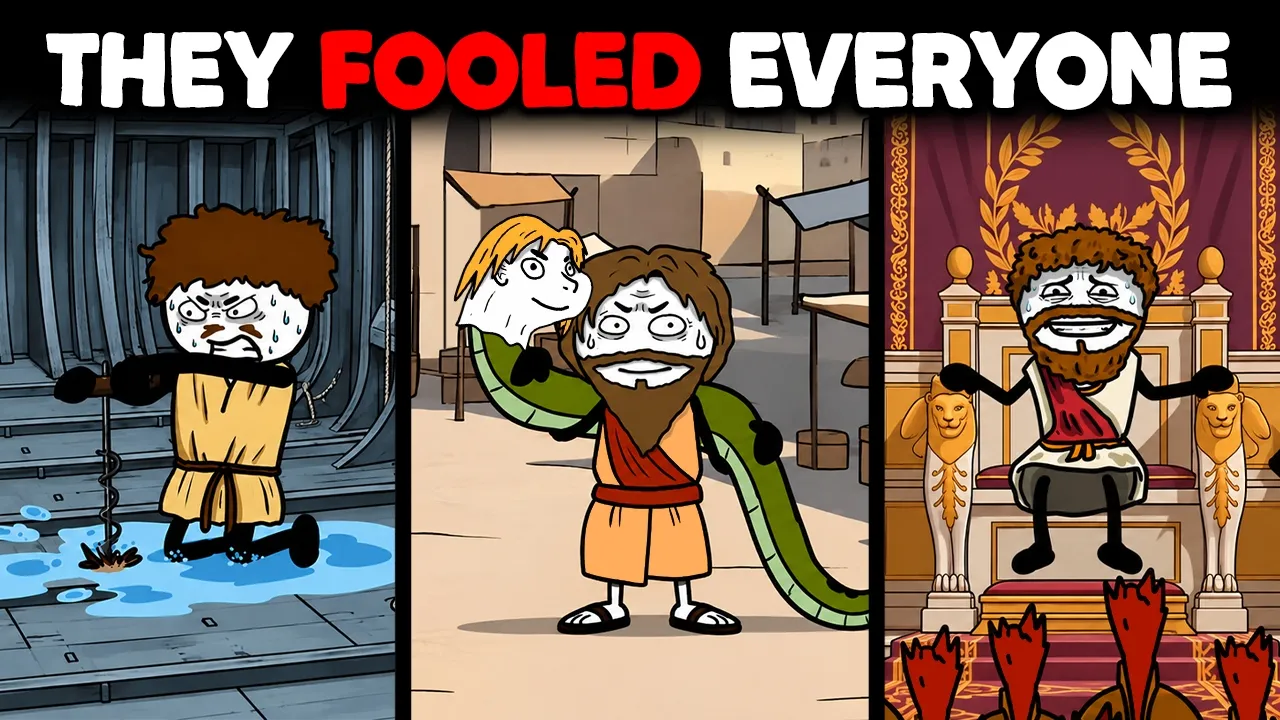
Every era thinks it invented the con artist. It didn't. The ancient world had insurance fraud, fake gods, forged prophecies, and men who sold an empire for cash. 10 of the boldest scams from a thousand years of human greed, starting with the captain who tried to drown his own crime. Hegestratos' sinking ship insurance scam. It's 322 BCE and a Greek merchant named Hegestratos is standing on the deck of his own ship off the coast of the Aegean.
Doing math that only makes sense if he plans on dying rich or not at all. He's taken out a bottomry loan from investors in Syracuse, borrowed against his ship and its cargo of Sicilian corn, due once the goods reach port at Athens. The catch is the cargo doesn't exist anymore. He's already sold it off quietly elsewhere and pocketed the cash. Now the ship just needs to disappear before anyone checks the hold. If it sinks, the loan gets wiped out as an act of the gods.
And he's been paid twice for grain that only ever existed once. At night, with the crew asleep above him, he creeps into the hold with an auger and starts drilling into the hull below the waterline. Wood groans louder than he expects. A sailor wakes, comes down, and finds his own captain kneeling over a hole with seawater already hissing through the planking. The crew doesn't wait for an explanation. They chase him across the deck with murder in their eyes.
With nowhere left to run, he throws himself over the side hoping to reach the ship's boat. He never makes it. He drowns off his own ship. The crew patches the hull and sails home, cargo hold empty just like it was supposed to be, minus the captain who tried to profit from its destruction. Alexander of Abonoteichus and his fake snake god. It's 150 CE and a former stage performer named Alexander is standing in a market square in Paphlagonia holding a large tame snake with a linen sack pulled over its head about to invent his own religion.
Alexander has spent years touring with traveling magic acts learning stagecraft and exactly how far crowds imagination will stretch when it's desperate to believe in something bigger than itself. He fits the snake with a fake human head sculpted from painted linen, plaster, and horsehair and rigs a hollow crane's windpipe through its coils so a hidden accomplice can throw a hissing half-human voice across the square.
Weeks earlier he'd planted a goose egg with a live snake inside a half-built temple's foundation, then cracked it open before a stunned crowd letting them watch a newborn god wriggle free. Days later he unveils the fully grown puppet as that same god now impossibly matured. He names it Glycon. Pilgrims start arriving from across the empire within months. Alexander sets up a booth charging a fee for any written questions sealed inside a scroll, then quietly lifts each wax seal without breaking it, reads the question, reseals it, and delivers a vague prophetic answer that could apply to almost any life.
Roman senators pay for career guidance, generals pay before campaigns, even an emperor sends offerings to a snake with a fabric head. For over 20 years Alexander runs the cult of Glycon as one of the most profitable religious operations in the Mediterranean and dies wealthy, worshipped, and never once formally exposed while he lived. Onomacritus, the oracle forger. It's 520 BCE in Athens and a respected scholar named Onomacritus is hunched over an ancient scroll by lamplight carefully adding lines of prophecy that no oracle ever actually spoke.
He's been trusted by the ruling Peisistratid family to compile and preserve the sacred oracles attributed to Musaeus, a legendary seer whose predictions are treated as near scripture and consulted before wars and major public decisions. Instead of simply preserving what exists, Onomacritus starts quietly slipping in verses of his own invention, phrased in old, deliberately cryptic language, but shaped to support whatever outcome benefits the family currently paying him.
Nobody questions it for years because who has the nerve to fact-check a text supposedly older than the city itself? Then a rival poet named Lasus, working on the same collection beside him, catches him red-handed inserting a fabricated prophecy claiming a nearby island will one day sink beneath the sea. Lasus drags him straight before Hipparchus, the ruler's own son, and exposes the forgery in front of witnesses. He's stripped of his position and banished from Athens outright, expelled for corrupting a sacred national record.
Years later, in exile, the same family that punished him quietly recalls him anyway because a man who can forge prophecy convincing enough to fool a city is still too useful to leave unemployed. The Olympic champion who bribed his opponent. It's 388 BCE at Olympia and a boxer from Thessaly named Eupolus is moving quietly between three men's tents the night before competition, pressing coins into their hands to buy himself a gold medal he has no intention of earning.
The ancient Olympic Games are supposed to be untouchable, competed under sacred truce in the name of Zeus, before a stadium of tens of thousands. Eupolus treats it as a simple transaction. He offers each of his three scheduled opponents payment to lose their bouts on purpose, and all three quietly take the deal. The next day, each fight ends suspiciously fast, strong young boxers folding under punches that shouldn't have finished them.
Eupolus is crowned Olympic champion without ever facing a real contest. Bribed men talk especially once the money is spent. Rumors spread through the athletes' camps before Eupolus even makes it home, and the story reaches the Hellanodikai, the judges guarding the games' integrity. Faced with disgrace, the boxers admit exactly what happened. The judges fine all four men heavily and use the money to commission six bronze statues of Zeus, placed directly along the entrance path every athlete has to walk before competing.
Each inscribed with a warning that victory must be won through strength, never silver. Those statues, called Zanes, stand at Olympia for centuries, a permanent walk of shame built from the very bribe money that paid for the corruption. Roman tax farmers who invented debts. It's the 2nd century BCE in a Roman province, and a group of publicani, private tax collection contractors, are standing in a village square informing frightened farmers that their debts to Rome have somehow doubled since the previous season.
Rome auctions off the right to collect provincial taxes to private companies who pay the treasury a lump sum up front and are then legally free to extract as much as possible afterward, keeping the difference. The publicani inflate land assessments far past real value, invent late fees and penalties out of nothing, charge compounding interest on debts that barely existed a month earlier, and back every demand with hired enforcers who make the consequences of refusal painfully clear.
Villages have almost no realistic way to fight back. The publicani carry the full legal backing of Rome and soldiers to enforce it, while provincials have no standing in Roman courts. Farmers sell land worked by their families for generations. They sell livestock and tools, and in the worst cases sell their own children into debt bondage just to make the number stop climbing. The scheme continues for generations across provinces from Sicily to Asia Minor, generating a slow grinding resentment that never fully fades.
One of the quiet compounding reasons entire regions eventually turn against Roman rule. Verres' art collecting extortion racket. It's 73 BCE and the newly appointed Roman governor of Sicily, Gaius Verres, is standing in a wealthy citizen's courtyard admiring a bronze statue he has absolutely no intention of paying for. Verres treats his three years governing Sicily like a private looting expedition. He fabricates legal charges against wealthy landowners and temple officials.
Then offers to quietly drop them in exchange for their finest possessions, statues, engraved silver, and sacred temple treasures untouched for centuries. If an owner refuses, his men simply take it anyway, and the courts he controls leave no path to justice. He strips gold and ivory statues out of temples older than Rome itself, and ships crate after crate back to his private villa. For three years, nobody with real power stops him.
Then the Sicilians, desperate, hire a young lawyer named Marcus Tullius Cicero to prosecute him. Cicero personally travels the island gathering sworn testimony from hundreds of victims until the case becomes an avalanche of documented theft so overwhelming that Verres' own defense team quietly advises him to flee Rome before the verdict is read. Verres runs into exile in Marseille with much of his collection intact and lives out decades in comfortable wealth.
He's only finally killed nearly 25 years later on Mark Antony's orders over a set of Corinthian bronzes he still refused to give up. Ancient counterfeiters who plated sheep coins. It's somewhere across the Roman Empire, any given year over three centuries, and a forger crouched over a small workbench is heating a thin sheet of genuine silver, carefully wrapping it around a solid core of cheap copper, about to pass off a worthless coin as real Roman currency.
The trick is simple and brutally effective at scale. Take a base metal blank, coat it in a thin wash of real silver or gold using heat and pressure, strike it with a legally cast dies that mimic the emperor's coinage down to the lettering, and let it enter circulation through ordinary trade. It passes untouched through hundreds of hands before the plating finally wears thin at the edges and the dull copper underneath starts to show.
Roman authorities respond by making counterfeiting punishable by death, and inspectors start test cutting suspicious coins to check what's hiding beneath the surface. The situation gets stranger when emperors themselves start debasing the official currency during financial crises, cutting the real silver content down to a fraction of what it used to be just to stretch a shrinking treasury. By the 3rd century CE, so much counterfeit and officially debased silver is circulating side by side that the entire Roman monetary system starts to buckle under coins nobody can fully trust anymore.
Fake relics manufactured for Egyptian pilgrims. It's the Ptolemaic period in Egypt, and inside a cramped workshop near a temple complex, an embalmer is carefully wrapping a bundle of loose bones, dust, and reed fragments in fine linen. Preparing to sell it to a grieving pilgrim as a sacred mummified ibis. Votive animal mummies are enormous business across Egypt. Pilgrims travel from every corner of the country to buy them from temple embalmers as offerings to gods like Thoth, paying to have a sacred cat, ibis, or falcon mummified and buried by the millions in vast catacombs as a prayer made physical.
Demand grows so explosively that it completely outpaces what honest embalming can supply. So, the workshops cut corners in ways buyers have no way of detecting. Some bundles contain only a single feather or bone fragment padded out with rags. Some contain mud, sticks, or broken eggshell shaped roughly into form. Some contain nothing organic whatsoever, just enough wrapping to feel real in a mourner's hands before it's sealed away in stone.
Modern researchers running CT scans on these mummies thousands of years later discovered that a staggering percentage are partially or entirely fake. Hollow devotion sold to hopeful people who had no way of ever checking what was inside. The Roman landlords who profited from fires. It's the 1st century BCE in Rome, and Marcus Licinius Crassus is standing at the edge of a burning apartment block, calmly offering the terrified owner next door a laughably small sum for a building that isn't even on fire yet.
Rome's crowded insulae catch fire constantly in a city built largely from timber and mud brick, and there's no real municipal fire department. Crassus assembles his own private brigade, roughly 500 trained men. But he doesn't send them rushing in to help. He sends them to wait, and when a fire breaks out, he arrives in person and makes the panicking owner an offer, a fraction of the property's real worth. Take it now while flames are still spreading, or watch it burn to nothing for free.
Desperate owners sell on the spot. Only once the paperwork is signed as Crassus finally sends his men in to fight the blaze, and it barely matters whether they save it because he already owns the land underneath. He repeats this maneuver across Rome for years, until he becomes, by several ancient accounts, the wealthiest private citizen in the history of the Republic. A fortune built out of other people's ashes. The Praetorian Guard's auction of the Roman Empire.
It's March 28th, 193 C, and the Praetorian Guard, having just murdered Emperor Pertinax inside his own palace hours earlier, are standing along the walls of their fortified camp, shouting out a price for the entire Roman Empire. With no emperor and no clear line of succession, the guard realizes it's holding the one thing that actually decides who rules Rome, the loyalty of the soldiers controlling the capital. They announce the throne is open to whoever offers the largest payment, and two wealthy senators arrive separately at the camp gates to compete, shouting escalating bids back and forth while guardsmen watch from the walls above like spectators at a sporting event.
A senator named Didius Julianus finally wins by promising every guardsman 25,000 sesterces, more money than most soldiers would otherwise see across an entire career. Convinced, the guard throws open the gates and formally declares him emperor on the spot, with no Senate vote and no public support behind him. Julianus barely gets to enjoy what he paid for. The Roman public, disgusted at watching their empire auctioned off like livestock, refuses to him as legitimate from the first day.
Provincial armies along the frontiers revolt within weeks, and a hardened general named Septimius Severus begins marching on Rome. Just 66 days after buying the throne outright, Julianus is dragged from the palace and executed, closing out the shortest and most expensive reign in Roman history.
The words are the caption track's own and nothing is reworded or re-transcribed. Paragraph breaks are placed between sentences so the text reads as prose.
Free tools for your own script. No signup, no login.
Paste your draft and see where viewers are likely to drop off, with a rewrite for each weak line.
Paste the first 30 seconds of your own draft for a hook score and rewrites.
Check your draft against YouTube's advertiser-friendly guidelines before you record it.
Read this channel's public videos and transcripts, and download a writing brief for it.