Getting the transcript
Reading the captions from YouTube. A video nobody has opened here before takes 10 to 30 seconds; this page fills in on its own.
Getting the transcript
Reading the captions from YouTube. A video nobody has opened here before takes 10 to 30 seconds; this page fills in on its own.
Jason Murray · @jason_swet
Where viewers went back to watch this video again, from YouTube's public Most replayed graph, lined up with what was said at that moment.
Most replayed moment #1
13:353.3x the video's typical replay level
I hadn't looked at the problem in that way before." I've got a lot more resources in here about it. Mark Pollard, I've learned a lot from watching his videos, from consuming his content. He's a an amazing strategist and has a great book on strategy. Check out his stuff. One of the bibles of
Said at 13:28
Most replayed moment #2
14:322.6x the video's typical replay level
message to life in a powerful, memorable, and scalable way. It's the core theme that drives a campaign, making it distinctive, emotional, and culturally relevant. Essentially, a concept or an idea needs to have an insight, and an idea is just what you do with that insight. If the insight is
Said at 14:25
Most replayed moment #3
10:152.4x the video's typical replay level
especially working with brands like Lululemon, Brooks running shoes, some stuff at Amazon, but the film and television world, that personally is a is a lot more foreign to me. Even though I've worked on commercials and been on set a lot, I haven't touched movies, haven't touched TV, and there's a lot of
Said at 10:08
The graph counts replays. It does not show where viewers stopped watching.
Words
4,599
Runtime
23:50
Speaking pace
193wpm
Reading time
19min
193 words per minute, between the 181 median and the 201 75th percentile of 349 measured videos. That distribution comes from the 349-video hook study.
Opening (first 30 seconds)
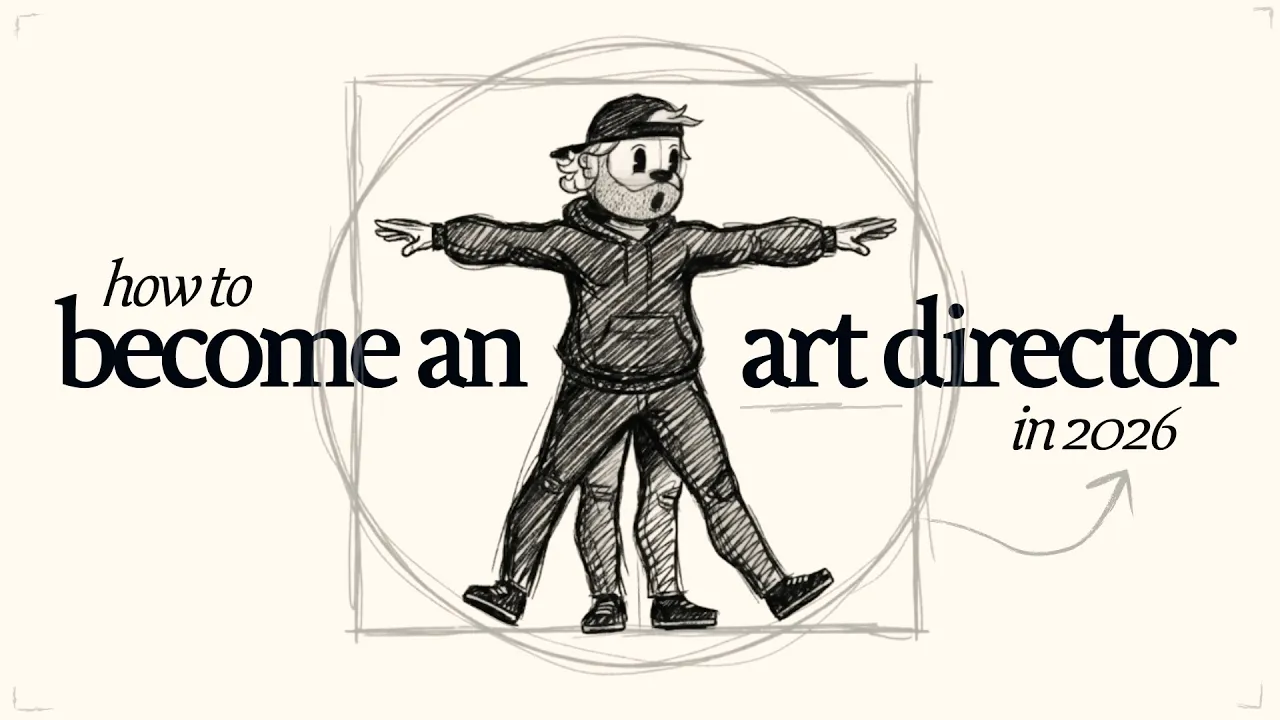
How to become an art director in 2026? I think art direction is going to be one of the most in-demand skills of 2026. Despite the fact that the advertising industry and ad agency models seems to be crumbling, I'm seeing so much more demand for art direction from brands, especially working in-house, from creators and creator-led brands, and for freelancers and entrepreneurs who are wanting to succeed with content in the new year. Art direction is one of those skills that is going to set you apart. that a lot of creatives that are focused just
97 words, the words spoken in the first 30 seconds at 193 words per minute.
Free, no signup. See how the first 30 seconds hold attention, with rewrites.
Sentence shape
| Measure | This transcript |
|---|---|
| Sentences | 289 |
| Average words per sentence | 15.9 |
| Longest sentence | 54 words |
| Questions asked | 9 |
| Sentences containing a number | 10 |
Most used terms
Filler phrases
39 in total: like 17 · actually 6 · kind of 6 · literally 4 · sort of 3 · basically 1 · uh 1 · you know 1.
A literal whole-word count of the same phrase list the Prepublish browser extension uses, so a phrase inside another word is not counted and a phrase used in its ordinary sense still is. It is a count and not a judgement.
What this transcript is
Every word below is the caption track YouTube publishes for this video, pulled from the video itself and reproduced unchanged. It is not Prepublish's writing, not a summary, and not a re-transcription: it is the video's own published captions. English captions, generated automatically by YouTube, in the video’s original language. Source: the video on YouTube. A channel that would rather this page did not exist can ask for its removal through the contact page, and it is removed.
How to become an art director in 2026? I think art direction is going to be one of the most in-demand skills of 2026. Despite the fact that the advertising industry and ad agency models seems to be crumbling, I'm seeing so much more demand for art direction from brands, especially working in-house, from creators and creator-led brands, and for freelancers and entrepreneurs who are wanting to succeed with content in the new year.
Art direction is one of those skills that is going to set you apart. that a lot of creatives that are focused just on execution end up finding themselves in a rut. Not all, but it's these thinking skills, these conceptual skills that that used to be a lot more gatekept. Those are the skills that are going to allow you to keep progressing in your career, whether you stay as a designer, executor, specialist, or if you decide to pivot to art direction.
I was never supposed to be an art director. In fact, when I was in college and before then, I was a lot more of a content creator. I was a video editor, a lot more of a videographer, sort of content creator. And even in college, when I was learning advertising and how to think conceptually, I was in the content creator track. I never took any design classes. So, if anyone can figure out how to become an art director and teach others how to figure out as well, I'm your guy.
I've built a career in art direction and now creative director, working for some of the biggest brands in the world. And absolutely no hyperbole there. Despite a traditional background, I came to the table with the ability to make. I had the spirit of a of a maker, a figure-outer. And then learning these conceptual skills allowed me to get a job straight out of college as an art director. So, especially if you're mid-career and you do have those design and craft skills, I can teach you how to become an art director, and let's let's talk about it.
So, the art director roadmap. I made this last year in a FigJam, and since then, I've made quite a few updates. It's essentially a path, a way that you could learn the different skills of becoming an art director in advertising and brand marketing, especially. And you could do that all on your own. I have a bootcamp that I teach called Next Art Director, and you're more than welcome to join that, and I will teach you how to become an art director live over Zoom.
Four-week bootcamp, four classes, four office hours, guest speakers. But I don't want to gatekeep the art direction career at all. So, I'm trying to put out as much as possible so that you could do it on your own. Before I dive into this and walk you through the path, I want to talk about the art director role first. What even is an art director? There's a lot of misconceptions out there, so I want to give you a glimpse actually into the first class of my bootcamp, Next Art Director.
This is literally the first 20 minutes that we talk about. An art director creates and develops concepts and defines look and feel of those concepts across channels and mediums. They are responsible for visual execution, often directing and collaborating with designers, photographers, filmmakers, and more. This is my definition of an art director, especially and I emphasize especially in advertising and brand marketing.
That's what my experience has been. I've been an art director at ad agencies, and I've been an art director in-house at Amazon, helping brands like Coca-Cola, Pepsi, Kraft Heinz, some of the biggest CPG brands in the world and others do interesting creative advertising on Amazon. But I found this definition applies pretty well to some of the other fields and industries that art directors live in. There's a lot of differences though, and we're going to get into that.
But the big thing is is an art director creates and develops concepts. They do that often with a copywriter. Uh we'll we'll talk more about that because the art director and copywriter are often partnered together. In this modern landscape, that's not always the case, but they'll work under a creative director developing concepts, but then the art director is responsible visually. They're responsible for the look and feel, they're responsible for the visual execution.
So, not only are they planning the ideation and the concepts, once they get over into actual execution, that art director either needs to be able to craft it themselves or be able to direct, communicate, speak to partners and other specialists who can help them craft it. Totally depends on the budget there. So, the emphasis is concepts and craft. And that's why I think I could help a lot of designers become art directors if that's something they want to do.
Some designers would absolutely hate being an art director, but the ones that want to be an art director and could handle living in decks and pitch decks more than actually in their design software, the concepts part of it is is what you really need to learn. So, if that hasn't been clear, art direction is not design. I have a personal opinion about the fact that within the design studio landscape and within the design career path, art direction is a rank.
And that's totally fine that an art director would be directing a team of designers. I just think it kind of ignores a little bit of the fact that art direction is also a craft, it's also a discipline. So, it's not to say that art direction and design are totally different things. Most art directors need to be good designers. The best art directors are good designers, and some of the best designers would be a lot better art directors than I am.
But it's just super helpful to separate them and to think of them as separate things. Art direction involves set design, it involves the talent, wardrobe, it involves photography. There's a lot of mediums and channels that art direction encompasses, and I also see that art directors and designers have a lot more respect for each other when they understand the different domains. A designer, not always, but often is more focused on the function, utility of what they're creating.
While an art director, honestly, function goes out the window and they're just so much more focused on attention, especially in advertising and brand marketing. It's what can grab people's attention. It's about what visuals are going to hook people in. It's about what visuals are going to create this world that can persuade somebody to buy a product, maybe. And this is backed up by Sir John Hegarty. He's the H in BBH, one of the most famous ad agencies.
He says, "A designer versus art director, they're two roles, one industry, polar opposites. People think they do the same job, and they're wrong. The designer, you're the architect of clarity. Your job, make chaos orderly. Everything you touch is simpler, more logical, more usable. You create the rule that the message follows. Your task is maximum effect. Designers distill and refine. On the flip side, the art director, you're the creative anarchist.
Your job, make order chaotic. Everything you touch is spontaneous, irreverent, raw. Your ideas don't merely join the conversation, they explode it. Your task is maximum impact. Maximum effect versus maximum impact. Art directors amplify and provoke." And briefly, I'll give you an idea of where the art director sits within an actual project. As you're working at a company, you're working on a project, this is kind of where the art director sits in the creative pipeline.
First, strategy. They're working with the client, they're working on a brief. They will brief in a creative team, and the art director is part of that creative team that will be responsible for ideation, concepting ideas for advertising campaigns, marketing campaigns, whatever creative problem-solving is needed for that business. Then, when those concepts are sold in, the art director is also responsible for executing that work.
And I try to emphasize that an art director is not more senior than a designer by default. They can be more senior depending on the experience they have in the industry or that company, but they are just usually involved earlier in the pipeline, and that's where I think a lot of the confusion happens. Obviously, like I said, in a design studio, they often are a higher rank. But in a lot of other creative departments, they are not more senior.
So, the fact that the designer's underneath the execution and underneath the art director here, that's that's not important. But what is important is if there is budget, an art director will often get to collaborate with other specialists like a designer. So, in execution, they may be a little more hands-off. They are directing, they are not bossing, but they're helping the designer catch the vision because obviously the art director was just earlier in the process.
There's a lot of times where a designer might also be involved earlier in the process. And I love when there's scope for that, when we can have a designer earlier to be involved in the concepts, involved in pitching in the deck itself. But there's also a lot more people. I mentioned the copywriter working hand-in-hand with an art director. The copywriter is not above the art director in rank. They're they're hand-in-hand, but it's just a visual.
The creative director though is usually above all of these people in in terms of rank. And the art director copywriter are reporting back to the creative director, making sure they are nailing the brief, making sure they're nailing the vision because the creative director might have more insight into the entire business of that brand. But what I love about art direction is it's not just working with designers. I get to work with producers, I get to work with photographers, directors, DPs, animators, set builders, doing IRL pop-ups and activations, fabricators, really anything to bring this vision to life, to bring our concepts to life.
So, like I said, art direction is not creative direction. There there can be a lot of confusion between the two, but I think one thing that's important about creative direction is that it is just not an entry-level role. You can get into art direction a lot sooner in your career. I got into art direction straight out of college because I had the skill set and I created a portfolio that was worthy of it. But if you're a creative director at the beginning of your career, I would consider rethinking your title and rethinking your path because there is high high expectations for a creative director to have experience, to have the answers, and to be able to guide a creative team because it's also a manager role.
Whether they're just managing a project or managing the entire team, you're just not going to have much respect from your team if if you don't have more experience than them. And within my boot camp, we also talked briefly about the differences between art directors across different industries. My experience is mostly in the advertising and design world. I've touched a bit of fashion, especially working with brands like Lululemon, Brooks running shoes, some stuff at Amazon, but the film and television world, that personally is a is a lot more foreign to me.
Even though I've worked on commercials and been on set a lot, I haven't touched movies, haven't touched TV, and there's a lot of crossover skills, but the industries are pretty siloed. Regardless, one big thing that I would emphasize about an art director is you need to be multilingual. There are art directors that are great at photography, cinematography. They're also great with environment styling, props, editing and animation, casting and talent.
They know color, but maybe they're lacking a little bit in iconography, illustration, typography. That's totally fine. You don't have to know everything. There are other art directors that are amazing typography, illustration, color designers, and then they also understand a little bit of styling and props, but maybe photography is not really their world. That's also fine. There's different styles of art directors. What I think is most important is that you do have multiple lanes.
You understand the language of different realms. Because there's going to be a lot of times where you have to do everything yourself. But if you do run into a situation where photography isn't your your skill set, you might be able to bring in somebody else on the team or bring in a specialist or someone who can help elevate the craft. In the same way, this is probably more me. I'm not as good at typography, iconography.
I'm good with illustration, and color, casting, photography, edit editing and animation, that's more my thing. And so I've done really well working on big campaigns that also involve TV spots and commercials, animation. There's a lot of other mediums, too. Hopefully that just gives you an idea of what an art director is. We've talked a lot about that. But let's get back to this road map. If you want to become an art director, where do you start?
How do you start learning it on your own? Well, like I said, I've updated this quite a bit, and this is the path that I think you could take to learn art direction on your own. This FigJam is linked in the description of the video. All these videos, links, and everything, you can click it, research on your own, start working on your own path. But let's talk about it a bit. First, learn the craft. Like I said, if you're coming to the table already with craft skills, you're a great designer, graphic designer, animator, videographer, creator, there might be some other visual languages you want to learn.
Like I said, you want to be multilingual, so maybe you need to work on your photography skills if you want to work on more photography campaigns, get on set, get in the studio. Or maybe you're wanting to do TV spots, you need to start thinking about your storytelling craft. Cuz even though you're an art director in in charge of the the visuals, you're also working with a copywriter, and you guys are building the story together.
So, learn the craft. Next, learn to think conceptually. Dive into this a bit. There's some great resources, but one of the biggest things to learn is what is an insight. Advertising has some interesting vocabulary and syntax that we use for concepts. But essentially, a concept is an idea that has an insight, that is an insight-driven idea. So, what is an insight? An insight is a revelation, or it's an unspoken human truth.
It's one of those things that when you say it, it changes the way you see the world, or it changes the way you see yourself. You kind of go, "Oh, I I hadn't thought of that before." Or, "Oh, I hadn't looked at the problem in that way before." I've got a lot more resources in here about it. Mark Pollard, I've learned a lot from watching his videos, from consuming his content. He's a an amazing strategist and has a great book on strategy.
Check out his stuff. One of the bibles of creative advertising, if you ever go to college for this, they'll they'll probably have you read Hey, Whipple, Squeeze This. Pick it up, read it. It's going to teach you also how to think conceptually and how to think for advertising campaigns. And then, Julian Cole is another strategist that I just love the way he defines insights, the way he talks about strategy. So, learn insights, but then you need to start learning what ideas are, and specifically big ideas.
I'm using the word big literally here. Big as in large. There's a scale to ideas. A big idea in advertising is the overarching creative concept that brings a brand's message to life in a powerful, memorable, and scalable way. It's the core theme that drives a campaign, making it distinctive, emotional, and culturally relevant. Essentially, a concept or an idea needs to have an insight, and an idea is just what you do with that insight.
If the insight is that revelation, the why behind people's behavior, the idea is what you're going to do to get other people to feel it. The What are you going to do with that insight to help other people also have that moment, that revelation. But in advertising, we're obsessed with big ideas. Have here what I call the idea sizing chart. At the top, there's business strategy, positioning. This is stuff brand builders, startups, the CMOs, they're really thinking about.
Below that, we've got branding. There's an idea behind branding often. There's often insight behind branding. But where most art directors and copywriters, and even most creative directors spend their time, is in this category of big ideas for platforms and campaigns. Essentially, do you have an idea that can be a platform? This is not not a social media platform like Facebook, Instagram. I'm talking more like a platform, almost like a political platform, or a brand platform.
When the idea is large enough, when the idea is rooted in a more universal truth, it can apply across so many assets, so many campaigns. Every execution and tactic could essentially be laddering up to the same thing, reinforcing and emphasizing this big idea. Campaigns need big ideas. They might be a little more specific, and even single executions can be rooted in an insight and have a sort of big idea to them. But it's when you start getting into one-offs and tactics, you might think like, "Oh, this is a great idea." But in advertising, we just don't really call them big ideas unless there's a simple concept that can almost just be written down on an on a sticky note, that's the big idea.
So, I would argue that if there is one-off executions and you're only thinking about a one-off execution, if it's a good idea, there's probably a big idea behind it. You could pull back and ladder it back to a big idea. If this is really ambiguous and vague, jump into some of these resources, especially from the author of Hey, Whipple, Squeeze This. He talks about brand platforms, which is in the category of a big idea.
But I have some examples here, too. Most creatives are familiar with Snickers, their standing tagline and campaign, You're Not You When You're Hungry. There's a really strong insight behind it, and that's hunger doesn't just affect energy, it temporarily changes how people behave and how they treat others. It makes them act out of character. And from that insight, you can start to see like, "Oh, what could we do with this?" Well, what they did is they wanted to show that Snickers can snap people back to being themselves when hunger turns them into something they're not, or someone they're not.
The big idea there, they articulated it with a great name and title, You're Not You When You're Hungry. And then, there's a description here of what the executions were. They basically had people act wildly out of character. They actually showed them as different actors even, portrayed as exaggerated versions of someone else until they eat a Snickers and instantly turn back to normal. Similarly, Dove has this great campaign called Real Beauty.
I don't know if they're still doing it, but the insight is is that most women judge their appearance far more harshly than others do. They they judge their own appearance. So, the big idea was to show women how others see them. Show them they can give themselves permission to see their own beauty, and they titled it Real Beauty. Similarly, I love this Nike campaign, Winning Isn't For Everyone, from this last year. Most people like the idea of winning, but very few are willing to accept the sacrifice, the obsession, the unlikability it often requires.
Winning means not always being the hero. So, the big idea is when you when you understand that truth, that human truth, you can do something with that. So, they will flip and it's nice to use verbs when you're writing out your big idea. Let's flip the traditional hero narrative and spotlight the darker, more uncomfortable reality of what it takes, what it actually takes to win, articulating it as Winning Isn't For Everyone.
So, there's some examples, and what we do in my boot camp is we actually go through so many more examples, and I workshop them with you, and I help you come up with your own ideas, and we workshop those insights, those ideas, the craft of those ideas, executing those ideas. But if you dive into this, you could potentially do this on your own. The next thing is, when you've come up with your own ideas, start making them real.
In advertising, a spec campaign or a speculative campaign, spec project, it's a totally acceptable thing. These are fake projects, which means there's nothing holding you back. You can literally make the ideas you want to come up with. Your portfolio can be completely fake, and that's okay. Everyone understands that. It's not even just advertising, other industries, animation design, it is an understood practice to create speculative work.
Because you need to show your potential employers what you could do if they hired you. And your portfolio is everything. If they can see it, it helps them imagine, "Oh, if if they're doing that for fake, and it looks this great, what if I just, you know, paid them to do it for real?" I also have a bit in here about passion projects. It's not too hard to pivot some of your own projects, personal projects, hobbies, or even past design projects, and talk about them in a way that emphasizes the why, emphasizes the concept more than just the craft and the function, and those could be strong art direction projects.
I give you a bunch of examples, a lot of student portfolio websites where you can kind of compare your competition, cuz even if you're mid-career and you're making a pivot to art direction, your competition is great creative students coming out of school. But, I've also got here a sort of rubric. It doesn't have to be exact, but this would be my recommended approach to a portfolio. You're going to make one to two 360 campaigns.
I've got examples there of what those could look like. You've got one really craft-focused or design-focused project. Maybe that's something you already have. And then, totally optional, but you could get a little more experimental, non-traditional. You could do something more focused on social and content. Got some examples there for that. And preferably, you include a passion project as well, because passion projects, personal projects, they really help people see your personality.
They can see how you think, see what you care about. Stunt or cultural response project could be one. And in total, ideally, you have four to six strong projects, no weak projects. They can all be spec, they can all be fake. They could also, maybe you've got a great idea and you just make it for real. I had a Venmo spec campaign for a homeless shelter where we decided, "Oh, that's actually a really great idea. Let's Let's just do it for real." We did this stunt and raised a whole bunch of money.
Honestly, that would be ideal if you have any ideas that you could just do for real, whether they're tied to a brand or not. But, what matters here is that not only is the craft strong, but you need to show that there's a really strong idea. Show that you can think in terms of big ideas. Show that you can think about a full campaign, a 360 campaign, or show that you can think outside the box in different channels. Inevitably, you're going to get paid for the kind of work you're already making.
So, make the work you want to make, and then you'll eventually get a job paying you to make that kind of work. From there, apply for internships, or a lot of you could probably just go straight for a junior art director or even mid-level art director jobs, especially if you're a mid-career senior designer and you're like, "I want to go art direction now." You could do it, and you don't have to do it just at ad agencies.
There's design studios that honestly are modeled a little bit more similar to ad agencies. There's a lot of social-first agencies where art direction is starting to become more important. But, you could also go in-house. This isn't an exhaustive list that I've included here, but just some inspiration to start getting your brain going and start thinking, "Where could I work to get experience as an art director once I made a portfolio?" That's how to become an art director in 2026.
There's so much more. I wish I could cover everything in a single video, but I've linked that FigJam in the description of this video. But, if you really are serious about becoming an art director, I'd love to have you join me in Next Art Director. I teach you modern art direction in 30 days. It's a 4-week live boot camp. I teach you how to think conceptually. We dive into art direction craft. We'll have some great speakers in January.
Ash Heiken, she's widely known for creating the art of deck making. That's another resource I need to add into that FigJam. Jason Gold, one of my good friends. He's a amazing creative director and art director. He's worked at OpenAI, Amazon's Brand Innovation Lab, Droga5, RGA. He's done some amazing work. And this is the curriculum. Again, I'm not trying to gatekeep anything. You can look at all four weeks, and if you can figure out how to do it all on your own, I would love that, because I can't teach everything in a YouTube video.
But, the big thing that you'd gain from coming and learning with me, as like these past students have mentioned, you get my personal feedback. I work with you. We've got a private Slack community. That's where you're going to get feedback on your art direction concepts. Yeah, I give you homework, and I really push you to do it every week. Because if you want to become an art director in 2026, you're literally 30 days away from having a portfolio that is an art director portfolio.
Again, this isn't my sales video for my boot camp. Giving you the concepts, I've given you the principles. I really think the art direction skill is going to become more and more valuable. If you have any questions, feel free to leave a comment below, and we'll dive deeper in a future video.
The words are the caption track's own and nothing is reworded or re-transcribed. Paragraph breaks are placed between sentences so the text reads as prose.
Free tools for your own script. No signup, no login.
Paste your draft and see where viewers are likely to drop off, with a rewrite for each weak line.
Paste the first 30 seconds of your own draft for a hook score and rewrites.
Check your draft against YouTube's advertiser-friendly guidelines before you record it.
Read this channel's public videos and transcripts, and download a writing brief for it.