Getting the transcript
Reading the captions from YouTube. A video nobody has opened here before takes 10 to 30 seconds; this page fills in on its own.
Getting the transcript
Reading the captions from YouTube. A video nobody has opened here before takes 10 to 30 seconds; this page fills in on its own.
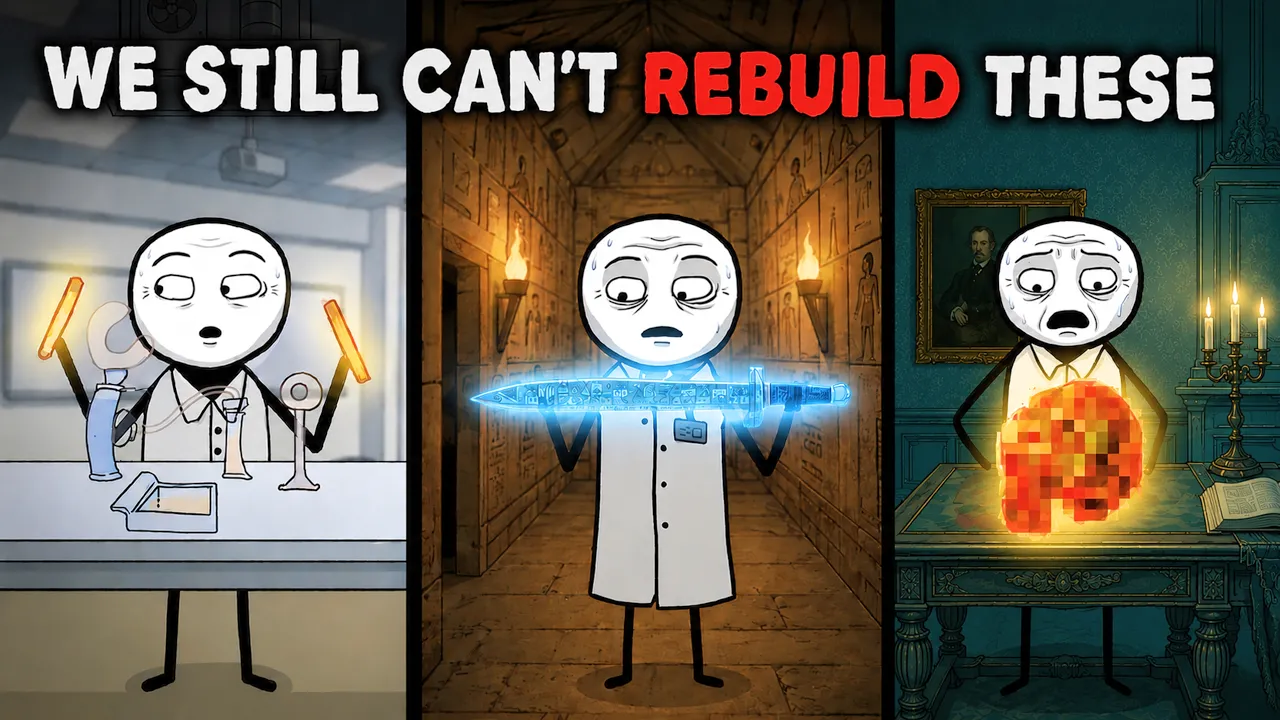
Professor Historian · @TheHistorianProfessor
Where viewers went back to watch this video again, from YouTube's public Most replayed graph, lined up with what was said at that moment.
Most replayed moment #1
14:074.5x the video's typical replay level
mountain. The Voynich Manuscript. Sometime in the early 1400s, someone wrote a 240-page book in a language that has never been identified. The pages are filled with illustrations
Said at 14:01
Most replayed moment #2
6:093.7x the video's typical replay level
carbon atoms arranged at the molecular level that are among the strongest materials known to science. We discovered carbon nanotubes in 1991, and consider them cutting-edge nanotechnology. Medieval blacksmiths were forging them into swords 800 years
Said at 6:02
Most replayed moment #3
11:373.4x the video's typical replay level
cat figure was found during conservation work. It had been sitting there for two millennia and nobody had noticed. Now for the supporting cast. These are a little shorter, but equally mind-bending. The Baghdad Battery. Around 250 BC,
Said at 11:31
The graph counts replays. It does not show where viewers stopped watching.
Words
2,481
Runtime
16:36
Speaking pace
149wpm
Reading time
10min
149 words per minute, below the 160 25th percentile of 349 measured videos. That distribution comes from the 349-video hook study.
Opening (first 30 seconds)
Today, we're going over ancient technologies that we still can't fully explain. And I don't mean like, "Oh, that's kind of interesting." I mean inventions and constructions from thousands of years ago that modern scientists, with all our fancy labs and supercomputers, still look at and go, "How the hell did they do that?" Some of these are so advanced that they shouldn't exist. And yet, here they are. Let's start with the big ones.
75 words, the words spoken in the first 30 seconds at 149 words per minute.
Free, no signup. See how the first 30 seconds hold attention, with rewrites.
Sentence shape
| Measure | This transcript |
|---|---|
| Sentences | 192 |
| Average words per sentence | 12.9 |
| Longest sentence | 44 words |
| Questions asked | 7 |
| Sentences containing a number | 40 |
Most used terms
Filler phrases
18 in total: like 10 · actually 2 · kind of 2 · literally 2 · I mean 1 · basically 1.
A literal whole-word count of the same phrase list the Prepublish browser extension uses, so a phrase inside another word is not counted and a phrase used in its ordinary sense still is. It is a count and not a judgement.
What this transcript is
Every word below is the caption track YouTube publishes for this video, pulled from the video itself and reproduced unchanged. It is not Prepublish's writing, not a summary, and not a re-transcription: it is the video's own published captions. English captions, generated automatically by YouTube, in the video’s original language. Source: the video on YouTube. A channel that would rather this page did not exist can ask for its removal through the contact page, and it is removed.
Today, we're going over ancient technologies that we still can't fully explain. And I don't mean like, "Oh, that's kind of interesting." I mean inventions and constructions from thousands of years ago that modern scientists, with all our fancy labs and supercomputers, still look at and go, "How the hell did they do that?" Some of these are so advanced that they shouldn't exist. And yet, here they are. Let's start with the big ones.
Number one, the Antikythera mechanism. It's the year 1901, and a group of Greek sponge divers are exploring a shipwreck off the coast of the island of Antikythera. The ship went down around 65 BC, and down there, among the barnacle-covered statues and corroded amphoras, they find a lump of corroded bronze that nobody thinks twice about. It gets thrown into a box with the rest of the artifacts and sits in a museum for months.
Then, one day, an archaeologist notices something unusual. The lump has cracked open, and inside are what appear to be tiny bronze gears. Dozens of them. Interlocking. Precision-cut. In a device that is over 2,000 years old. What they had found was essentially an analog computer. The Antikythera mechanism contained at least 30 bronze gears arranged in a complex system that could predict solar and lunar eclipses, track the positions of the five known planets, calculate the dates of the Olympic Games, and model the irregular orbit of the moon.
Something that requires insanely advanced mathematics. Let me put this in perspective. After this device was built, humanity would not create anything even remotely this mechanically complex for another 1,400 years. That's like if someone found a working laptop in a Viking burial mound. It just shouldn't be there. And yet, it is. Scientists have spent over a century studying this thing with X-rays, CT scans, and 3D modeling, and they still haven't been able to fully replicate it.
We know what it does. We mostly know how it works. But, the precision of the gears, the sophistication of the astronomical models, and the sheer ambition of cramming all of that into a device the size of a shoebox, that part still blows people's minds. Whoever built this was operating on a level that the rest of the world wouldn't catch up to until the Renaissance. And here's what's really wild. This was found in a shipwreck.
Meaning, it was being transported somewhere. Which means this wasn't some one-of-a-kind miracle. Somebody was just casually shipping this thing across the Mediterranean like it was no big deal. How many more of these existed? How many are sitting at the bottom of the ocean right now? Number two, Greek fire. It's 672 AD, and a massive Arab fleet is bearing down on Constantinople, the capital of the Byzantine Empire. The Arabs have been conquering everything in their path, and now they've brought hundreds of ships to finally take the jewel of the Eastern Mediterranean.
The Byzantines are outnumbered, and things are looking grim. Then, the Byzantine ships sail out to meet the fleet and unleash something the Arabs have never seen before. Liquid fire projected from tubes mounted on the bows of their ships that sprays across the water like a flamethrower. But, unlike normal fire, this stuff doesn't go out. It burns on the surface of the water. Sailors who jump overboard to escape are consumed by flames that follow them into the sea.
Entire ships are engulfed in seconds. The Arab fleet is decimated. This was Greek fire, and it was the Byzantine Empire's ultimate weapon for nearly 800 years. They used it to repel invasion after invasion, and it was so effective that enemy fleets would sometimes turn around and flee at the mere rumor that Greek fire ships were nearby. But, here's the thing. Nobody knows what it was made of. The formula for Greek fire was the most closely guarded state secret in Byzantine history.
Only a handful of people at any given time knew the recipe, and they were sworn to take it to their graves. When Constantinople fell in 1453, the secret died with the empire. Modern chemists have been trying to figure it out for centuries. The leading theories involve some combination of petroleum, pine resin, sulfur, quicklime, and possibly saltpeter. But, nobody has been able to create a substance that matches all the historical descriptions.
A liquid that could be sprayed through tubes, that ignited on contact with water, that stuck to surfaces, and couldn't be extinguished. Some of those properties actively contradict each other from a chemistry standpoint, which is part of why it remains such a mystery. The Byzantines took one of the most powerful weapons in human history and erased it from existence. That's either the greatest act of military secrecy ever, or the biggest fumble in the history of technology.
Maybe both. Number three, Damascus steel. Sometime in the early Middle Ages, swordsmiths in the Middle East began producing blades that were unlike anything the world had ever seen. They called it Damascus steel, and the swords made from it were legendary. These blades could cut through European swords like they were made of tin. They could slice a falling silk scarf clean in half. The blade was so sharp, and the edge so fine, that the fabric's own weight was enough to split it.
When you looked at the surface of a Damascus steel blade, you'd see these distinctive swirling patterns that looked like flowing water. It wasn't decorative. Those patterns were a byproduct of the forging process itself, and they were a sign that the internal structure of the metal was something special. Fast-forward to 2006. Scientists at a German university put fragments of a genuine Damascus steel blade under an electron microscope and found something that made their jaws hit the floor.
The metal contained carbon nanotubes. Cylindrical structures of carbon atoms arranged at the molecular level that are among the strongest materials known to science. We discovered carbon nanotubes in 1991, and consider them cutting-edge nanotechnology. Medieval blacksmiths were forging them into swords 800 years earlier. The problem is that nobody knows exactly how they did it. The technique was lost around 1750, when the specific ores used in production ran out or trade routes shifted.
Blacksmiths have been trying to recreate true Damascus steel ever since. And while some have come close, nobody has been able to produce a blade that matches the originals in both structure and performance. The carbon nanotubes appear to have formed accidentally through some quirk of the specific ores and forging temperatures used. But, reproducing that accident on purpose has proven basically impossible. We can build particle accelerators and land robots on Mars, but we cannot make a sword as good as some guy in a workshop in the 12th century.
Number four, Roman concrete. The Pantheon in Rome was built in 125 AD. It has the largest unreinforced concrete dome in the world. It has stood for nearly 2,000 years through earthquakes, floods, wars, and the general passage of time. It's still standing right now. You can go visit it. Meanwhile, modern concrete, the stuff we use to build highways and parking garages, starts crumbling after about 50 years. We literally pour billions of dollars into concrete maintenance every year because the stuff we make today can't hold a candle to what the Romans were mixing with their bare hands two millennia ago.
For centuries, nobody could figure out why Roman concrete was so much more durable. The recipe was known, volcanic ash, seawater, lime, but nobody could explain why it got stronger over time instead of weaker. Then, in 2023, scientists at MIT finally cracked part of the mystery. They discovered that Roman concrete contains tiny white chunks of lime called lime clasts that were previously thought to be imperfections. Turns out they're not imperfections at all.
When cracks form in the concrete and water seeps in, these lime clasts dissolve and recrystallize, essentially filling in the cracks automatically. Roman concrete self-heals. The material literally repairs itself when damaged. The Romans accidentally or deliberately created a construction material with built-in maintenance that activates when exposed to water, which is why their harbors and aqueducts have lasted so long.
Seawater, which destroys modern concrete, actually makes Roman concrete stronger. Scientists are now actively trying to reverse-engineer this for modern construction, but mass-producing it has proven incredibly difficult. The specific volcanic ash the Romans used came from a particular region of Italy, and has chemical properties that are hard to replicate with modern materials. So, for now, the Pantheon just sits there in Rome, quietly flexing on every building constructed in the last century.
Number five, the Nazca Lines. Sometime around 500 BC, the Nazca people of Southern Peru walked out into the desert and started drawing. Not small drawings, enormous drawings. A spider that stretches 150 ft across. A monkey with a spiraling tail that spans over 300 ft. A hummingbird. A condor. Geometric shapes and straight lines extending for miles across the desert floor. Some of these figures are over 1,200 ft long.
And here's the thing that gets everyone. They're only really visible from the air. From the ground, you'd barely notice them. They look like random paths scratched into the dirt. But from a few hundred feet up, they resolve into these incredibly precise, perfectly proportioned images. The Nazca people did not have aircraft. They did not have hot air balloons. They did not have any known technology that would allow them to see their own work from above.
And yet the proportions are so accurate that they appear to have been designed to be viewed from the sky. How did they do it? The honest answer is, we're not entirely sure. The most accepted theory involves using small-scale drawings and a grid system of stakes and ropes to scale them up. Kind of like projecting a sketch onto a massive canvas. And experiments have shown this is possible. But doing it across miles of open desert with this level of precision using rope and stakes?
That's still impressive enough to make you pause. There are over 800 straight lines, 300 geometric figures, and 70 animal and plant designs spread across 170 square miles of desert. The Nazca carved them by removing the reddish pebbles on the surface to reveal the lighter ground beneath. The dry, windless desert has preserved them for over 2,000 years. New ones are still being discovered. In 2020, a new cat figure was found during conservation work.
It had been sitting there for two millennia and nobody had noticed. Now for the supporting cast. These are a little shorter, but equally mind-bending. The Baghdad Battery. Around 250 BC, somebody in Mesopotamia, modern-day Iraq, created a series of small clay jars with copper cylinders and iron rods inside. When scientists filled a replica with vinegar or grape juice, it produced about 1.1 volts of electricity. 1,800 years before Alessandro Volta invented the battery.
Now, some scholars argue it was just a storage vessel and the electrical properties are coincidental. But the design is suspiciously specific for a jar. You don't accidentally assemble copper, iron, and an electrolyte in that exact configuration. The Lycurgus Cup. A Roman glass cup from the 4th century AD that changes color depending on how you look at it. Green in reflected light, blood red when lit from behind. For centuries, nobody could explain how the Romans pulled this off.
Then scientists analyzed the glass and found it contained gold and silver nanoparticles at 50 nanometers in diameter. That's nanotechnology. Deliberate, precise nanotechnology embedded in a drinking cup from ancient Rome. The color change is caused by the way light interacts with these metallic nanoparticles. A phenomenon we only understood in the 20th century. Whether the Romans stumbled onto this by accident or actually understood what they were doing is still hotly debated.
But the fact that they could reproduce it reliably enough to make a finished product suggests it wasn't just a happy accident. The Walls of Sacsayhuamán. High in the Andes above Cusco, Peru, the Inca built a fortress with walls made of limestone blocks weighing up to 130 tons each. These blocks are fitted together so precisely that you cannot slide a piece of paper between them. No mortar, no cement. Just stone on stone interlocking like a 3D puzzle.
And the whole structure has survived over 500 years of earthquakes in one of the most seismically active regions on the planet. We have no solid explanation for how they cut stones this precisely with the tools available to them. Let alone how they transported 130-ton blocks up a mountain. The Voynich Manuscript. Sometime in the early 1400s, someone wrote a 240-page book in a language that has never been identified. The pages are filled with illustrations of unknown plants that don't match any known species, astronomical charts, and for reasons nobody can explain, drawings of naked women bathing in green pools connected by an elaborate plumbing system.
Every major codebreaker from World War II cryptographers to the NSA to modern AI has taken a crack at deciphering it. All of them have failed. The text shows consistent linguistic patterns that suggest it's a real language, not gibberish. But nobody can read a single word of it. It just sits in Yale University's library. 240 pages of absolute mystery. And finally, Puma Punku. A temple complex in Bolivia sitting at 12,800 ft above sea level.
The site contains H-shaped stone blocks that look like they were cut by machines. Perfectly flat surfaces accurate to fractions of a millimeter. Fill holes that are completely uniform in diameter. Interlocking pieces that fit together with the precision of LEGO bricks. All carved from Andesite and Diorite, two of the hardest stones on Earth by a civilization that had no iron tools, no steel, and no writing system that we know of.
The precision is so extreme that modern engineers have said they'd struggle to replicate it with today's equipment. So there you have it. 10 ancient technologies that our ancestors created thousands of years ago that we either can't explain, can't replicate, or both. The Antikythera Mechanism is an ancient computer we can't rebuild. Greek Fire is a weapon we can't recreate. Damascus steel contains nanotubes we only discovered 30 years ago.
And Roman concrete self-heals in a way that makes everything we build today look embarrassing. Makes you wonder what else has been lost. How many discoveries were made, used, and then forgotten over the centuries? How much did ancient civilizations know that we're only now beginning to figure out again? I don't know. But maybe the next time we find a weird lump of bronze in a shipwreck, we should probably take a closer look.
The words are the caption track's own and nothing is reworded or re-transcribed. Paragraph breaks are placed between sentences so the text reads as prose.
Free tools for your own script. No signup, no login.
Paste your draft and see where viewers are likely to drop off, with a rewrite for each weak line.
Paste the first 30 seconds of your own draft for a hook score and rewrites.
Check your draft against YouTube's advertiser-friendly guidelines before you record it.
Read this channel's public videos and transcripts, and download a writing brief for it.