Getting the transcript
Reading the captions from YouTube. A video nobody has opened here before takes 10 to 30 seconds; this page fills in on its own.
Getting the transcript
Reading the captions from YouTube. A video nobody has opened here before takes 10 to 30 seconds; this page fills in on its own.
This Messy Happy · @ThisMessyHappy
Where viewers went back to watch this video again, from YouTube's public Most replayed graph, lined up with what was said at that moment.
Most replayed moment #1
7:504.2x the video's typical replay level
result, I got injured both times. If I'd have taken a step back and perhaps taken three or four days out, I wouldn't have missed three or four weeks like I did. So, here's the solution for each of the three problems as I see it. Pain, straight away, take a step back, [music] fix it. Like we've mentioned before, go
Said at 7:43
Most replayed moment #2
6:324.0x the video's typical replay level
This is an interesting one, so go with me on this. It is the concept of prioritizing your running over prioritizing yourself. Alistair Brownlee, Jonny Brownlee, and their coach that they had a saying that every single session they do is crucial and
Said at 6:26
Most replayed moment #3
1:092.4x the video's typical replay level
roller. All of these purchases are I wouldn't call them frivolous. I'm not saying that. [music] But they are purchases that I wanted to make because A, either I wanted to test out whether they work or B, I like the look of them. But what I see a lot of in the early
Said at 1:02
The graph counts replays. It does not show where viewers stopped watching.
Words
3,180
Runtime
16:19
Speaking pace
195wpm
Reading time
13min
195 words per minute, between the 181 median and the 201 75th percentile of 349 measured videos. That distribution comes from the 349-video hook study.
Opening (first 30 seconds)
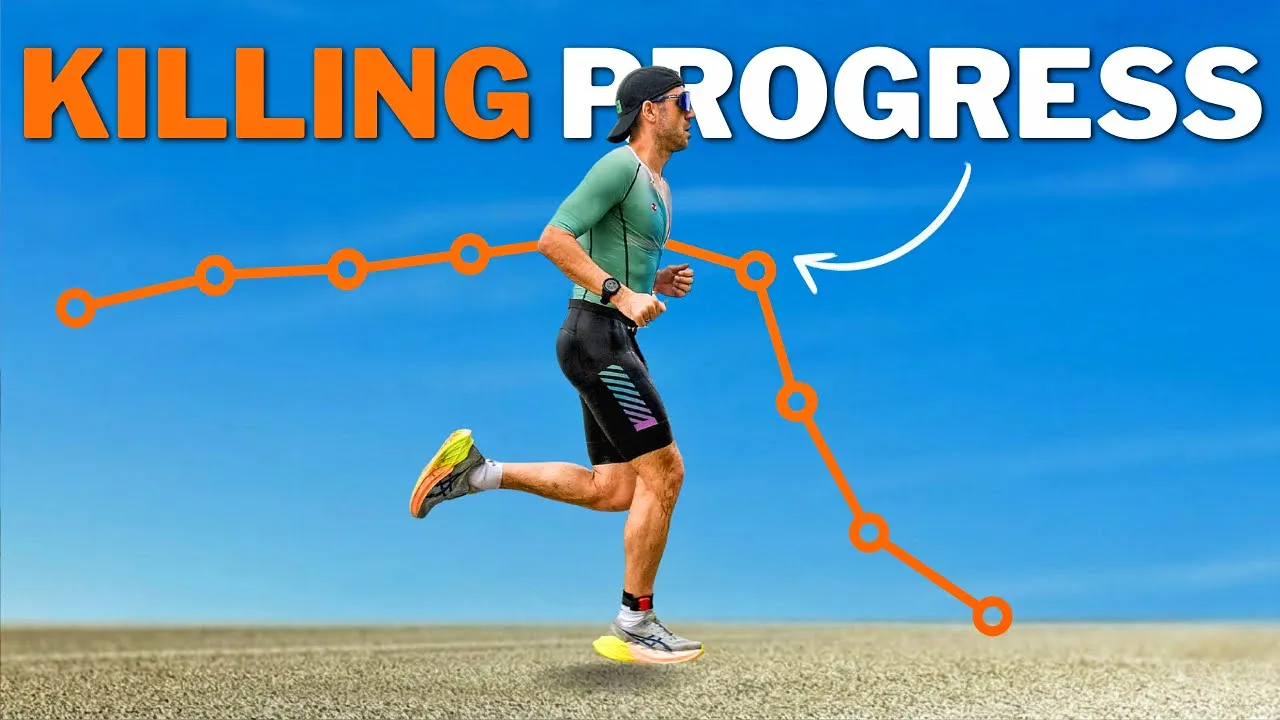
There are things we can do as runners that can massively and positively impact our running. However, there are also things that we can do as runners that can kill progress instantly. So, essentially, I'm going to give you the six biggest progress killers that I can think of. And not only am I going to give you the progress killers, I'm going to give you the solutions to work around them so that you can fulfill your potential and you don't have to make mistakes I've seen in my 20 years of coaching and as a 244
98 words, the words spoken in the first 30 seconds at 195 words per minute.
Free, no signup. See how the first 30 seconds hold attention, with rewrites.
Sentence shape
| Measure | This transcript |
|---|---|
| Sentences | 173 |
| Average words per sentence | 18.4 |
| Longest sentence | 68 words |
| Questions asked | 7 |
| Sentences containing a number | 13 |
Most used terms
Filler phrases
23 in total: like 14 · you know 4 · I mean 2 · actually 1 · kind of 1 · right? 1.
A literal whole-word count of the same phrase list the Prepublish browser extension uses, so a phrase inside another word is not counted and a phrase used in its ordinary sense still is. It is a count and not a judgement.
What this transcript is
Every word below is the caption track YouTube publishes for this video, pulled from the video itself and reproduced unchanged. It is not Prepublish's writing, not a summary, and not a re-transcription: it is the video's own published captions. English captions, generated automatically by YouTube, in the video’s original language. Source: the video on YouTube. A channel that would rather this page did not exist can ask for its removal through the contact page, and it is removed.
There are things we can do as runners that can massively and positively impact our running. However, there are also things that we can do as runners that can kill progress instantly. So, essentially, I'm going to give you the six biggest progress killers that I can think of. And not only am I going to give you the progress killers, I'm going to give you the solutions to work around them so that you can fulfill your potential and you don't have to make mistakes I've seen in my 20 years of coaching and as a 244 marathon runner.
And straight into it, number one, the one that I see all of the time, spending your money on the wrong things. So, running's exciting and I get that. And there is a lot out there that is exciting to buy. And we have been suckered in by the way many a time. Yes, I saw Kipchoge and Hassan wearing a running headband to cool them down. I went and bought one for the purposes of YouTube, by the [music] way. I also have compression leggings.
I have calf sleeves. I have an ice bath. [music] I have a massage gun. I have a foam roller. All of these purchases are I wouldn't call them frivolous. I'm not saying that. [music] But they are purchases that I wanted to make because A, either I wanted to test out whether they work or B, I like the look of them. But what I see a lot of in the early days of running is the priority of people to perhaps buy carbon plated shoes or buy a cooling headband when really the money could be best spent elsewhere.
[music] And I don't want to call it tat, but what I do want to say is there is a lot of gold standard stuff you can do with your running to make huge progress [music] rather than kill it in the early days. Things like I would always recommend if if runners are starting and they're worried about their technique or they're getting aches and pains in the early days, the gold standard is to get a proper run analysis. Go to someone who's a specialist in this field and get yourself a proper run analysis to identify ahead of time [music] any weaknesses in your technique, any things that could potentially cause you an injury.
But off the back of that as well, let's just talk about a mid-range pair of shoes being easily [music] in the £150 range, you could probably get two physio appointments [music] for that. So again, if you're getting aches and pains, what are you going to do? Buy carbon plated shoes or are you going to repurpose [music] and redirect that money into maybe in regular physiotherapy? Like [music] over the years we've gone for physiotherapy and we still do as tune-ups.
[music] We've had dry needling. I've even been to a university in Thailand and had all of my muscle balance testing [music] done to see if I could highlight a weakness perhaps between my hamstrings and my quadriceps. >> [music] >> So what I'm not saying is that you should not spend your money in these cooling headbands and these ice baths and these leg compression [music] boots. But what I'm saying is if you have an amount of money to distribute and the choice is there and you can't afford both, gold standard, run analysis, physiotherapy, muscle balance testing, like the things that are really going to move the needle rather than kill the progress.
To me it's that simple and I think it should be that simple to every runner. Secondly, and it's not going to surprise you surely, you can kill your progress so quickly with poor diet choices. And I put diet choices I suppose into two categories. [music] One is portion distortion which I've been super guilty of in the past, as in eating more than you probably need in any one meal, [music] but also generally poor food choices, poor fueling.
You know that old adage, you can't outrun a bad diet and I buy into this. Just because we're training, just because we're training hard, perhaps your marathon training, it's going to make you a lot hungrier, doesn't mean that you can put trash [music] into the engine. We're not the DeLorean, we don't run on junk, we run on really good [music] foods. It does make a huge difference. I mean, I'm not going to a huge detail here, but it is the difference between processed and unprocessed foods [music] generally.
But, I found it's really about making consistently good choices. And And when I say consistently, you are still allowed cake, you're still allowed pancakes, you're still allowed to eat sausages. [music] The world would end if I wasn't allowed to eat sausages, but what I mean is consistently across the week I make pretty good [music] choices that mean I can then every now and then eat the foods that I love cuz I am a sucker, unfortunately, a sucker for bad foods.
I don't know why. [music] I've had to train myself over the years so that I don't eat them regularly, but I can, if I want to, eat them every now and then. And we've got a system that works really well for us. And it's about environment setting. That's how you're going to make the good [music] food choices over the bad. So, generally it goes like this for us. When we're training hard, we're hungry [music] all the time.
When we're hungry all the time in the wrong settings, we can make the wrong decisions. So, we know that that's going to happen, and ahead of time we plan for it. Number one, >> [music] >> we write a list of everything that we want to buy from the supermarket before we go, and we make sure that we have the meals sorted [music] for the week. We know what we're going to buy when we go in there. But, on top of that, we don't go into any supermarket hungry because again, it's when we make bad decisions.
If [music] we're already hungry, maybe we buy a little bit more of that, maybe we buy some crisps or some chocolate. Absolutely don't go into a supermarket hungry. Have a plan, stick to it. And then you're not going to buy the snacks that you know that you will default to when you get home and when you're weak. For us, for me personally, it's chocolate. I know if I have it in the house, I'm going to eat it, so it's never in the house.
And it's the same with things like crisps or generally processed food. If it's in the house, then probably I'm going to default to it when I'm hungry and need a quick win. Whereas, if our environment is crafted so that it's not in the house, I don't default into that. We have apples and bananas if we want a snack. Ultimately, I know I'm weak and so therefore, I craft my environment to not allow the weakness to win. I because it would if I let it.
We've done whole different videos about the ideal diet for runners, which we'll link at the end, but suffice to say this is the way we get around poor diet choices because they can absolutely torpedo progress and quick. This is an interesting one, so go with me on this. It is the concept of prioritizing your running over prioritizing yourself. Alistair Brownlee, Jonny Brownlee, and their coach that they had a saying that every single session they do is crucial and yet no session they do is crucial.
And what that really means is the ethos is we make every session happen if we can, but at the same time they recognize that life happens and if they can't make one of the sessions, it's to be kind to themselves because no one session is going to make or break your overall training cycle. So, when I see athletes who have crazy busy lives, when I see [music] athletes on the edge of burnout, just still making the runs happen, pushing themselves to their limit because they think this is going to be the thing that causes their progress.
And ultimately, and this is the bit I'm going to get to is the gold standard of whatever distance you're training for [music] is consistency. Let's take Seville or New York as a good example from me. Both times I was training [music] in discomfort. I was training in pain, and I was thinking, "Well, I've got to get these runs [music] done because I've got to make it to the start line and I want to be in the best possible shape." I pushed myself both times over the edge because I ignored myself, and I just prioritized just doing [music] the running, and as a result, I got injured both times.
If I'd have taken a step back and perhaps taken three or four days out, I wouldn't have missed three or four weeks like I did. So, here's the solution for each of the three problems as I see it. Pain, straight away, take a step back, [music] fix it. Like we've mentioned before, go and see a physiotherapist, see someone that will be able to help you. Maybe it's a run analysis, maybe it's a physio, it doesn't matter, but rest doesn't always make something go away.
There's something causing that problem. If you're tired, if you're over fatigued, then [music] prioritize number one, your sleep. Sleep, if doctors could prescribe it, they would. It can solve so many issues, and if you're feeling over fatigued, on the edge of burnout, then that's the way to get out of it is prioritizing sleep over running. And finally, if you have a particularly stressful work life, we used to as teachers, it's crazy life, and we [music] would get home, and then I would work on this YouTube channel all evening.
I had to get good at monitoring my HRV, which is heart rate variability. [music] Now, there are various ways of doing it. There are apps, there are rings, >> [music] >> even watches do it now if you keep them on when you sleep, but essentially, it's a way of telling you when you [music] should be dialing back your training, and when you should be okay to train based on the stress that [music] you're getting from life and work, rather than the stress that you're getting from running.
And that is a key difference here. People just don't appreciate that yes, you've got [music] your running, and you see pros doing it, but they don't have the other stuff, like the work life. So, monitoring my HRV has got me through a [music] few tricky spots, and I would recommend it to anyone. Lots of people get themselves in trouble and kill their progress because they are comparing where they are at to someone else, or even worse, they're comparing where they're at to where they used to be at.
And we all know that fitness goes in ebbs and flows. You can't just keep your foot on the accelerator and be like that, fitness, fitness, fitness. Like that's not possible. So, you have to let your foot off the accelerator sometimes. And a classic example of this is Mary. When we go to the track, we do lactate threshold sessions. Now, we hit particular paces in these sessions, but we don't aim for paces. We aim for a heart rate.
But Mary used to get anxious. "Well, what if I'm not able to run the paces that I could do when I did this [music] training session last time?" Well, theoretically, that won't happen in the early days, and you might build to those paces and beyond. But the way we get there is we forget about paces generally. We do a lot of training to feel and to heart rate, because feel is the gold standard. As a runner, we all know that this is where we want to get to is being able to run on feel, so that if your watch or your heart rate monitor stopped working, it wouldn't matter.
Heart rate training allows you to train where you're at rather than where you want to be, and it allows you also to get better at feeling what's going on in the body. You can't simply get to being good at feel without kind of monitoring your pace and heart rate in the early days. That's not possible. But also, if Mary were to compare herself with someone else, then theoretically, she shouldn't be able to run a sub-3-hour marathon, because before she ran Tokyo and ran 3:00:02, people were saying, "You you're not anywhere near a 3-hour marathon because you've only done a 1:28 and something half marathon." And if she'd have listened to them, perhaps that would have just maybe taken the edge off of her progress, taken the edge off of her confidence.
But Mary is not everybody else. People didn't appreciate that a 1:28 in the heat of Thailand is more like a 1:25 in temperate climate Europe. But also, people [music] can run at different paces for different lengths of time. So, it's a such a [music] silly thing to compare yourself to anyone else. Mary ran a 1:28 half marathon and then ran a 3:00 marathon and I'm convinced is able to go even faster. So, if she were to compare herself with other people, that wouldn't be a fair [music] assessment.
She is who she is and by stopping comparing herself to anyone else or even her from a different training cycle, she's able to make these incredible steps in progress. >> Ah, what about the PB chasers? So, we coach a lot of people and have been these people in the past that when we get to a good level of fitness, we are fooled into thinking, "Well, we should use this fitness for everything. We should race week in, week out. 10Ks, 5Ks, half marathons.
We should get PBs everywhere because we we we don't want to waste the fitness." Now, imagine you've got a matchbox and you've got a certain amount of matches in there. I see that as my season and every time I do an all-out effort, I burn a match. Perhaps a marathon is, you know, at all-out effort is burning a number of matches. Perhaps a half marathon is a match and maybe a 5K burns a match a little bit, but you get the analogy, right?
You're burning matches and eventually you'll have an empty matchbox. So, being strategic about running PBs is a much better way of doing this and therefore it means you can still have a crack at PBs, but it's just within structure. Things like park runs at the end of a recovery block is a great shout. 10Ks factored in outside of your marathon training cycle so you can have a go, maybe one or two within a couple of blocks period.
Maybe a half marathon structured within the marathon training cycle or its own training cycle of 10 to 13 weeks. I think it comes down to what's your ultimate goal here. If you are training for a marathon, but at the same time you just want to see if you can PB each week or of the other distances, you're probably going to burn too many matches ultimately to have a real full crack at the marathon. So, it's about [music] just winding the ego back.
We've all been there. I've been there, but now I structure it entirely. The shame of it is that there have been times that I believe that I've been very [music] capable of running a 5K PB within marathon training, but it would be a cost of perhaps a long run or cost of perhaps a different run that I'm supposed to be doing, and so I haven't done it. And I have to live with that. And for me now, that's okay. [music] Maybe this is the worst one.
Maybe this is the biggest one that I see is the idea of just throwing volume at the problem. If you didn't reach your goal last time, why not make my long run longer when I do the next marathon training cycle? Why not go from 80 km a week to 100 km a week? >> [music] >> It The body and training doesn't work like that. Everybody has a sweet spot, and it's about [music] finding out what that is. Obviously, it's good to get easy volume in your training.
Pros run lots of volume and for a reason, because they know that that's how they get faster. We're not pros. We have a life to work around. We have families. We have jobs. So, you've got to appreciate what volume can you do within the structure of your life, and what is safe. [music] Look at Mary's progress over the last few years. The volume has gradually built. It hasn't just gone She's not at suddenly four or five 100 km a week from [music] doing an 80 km a week.
We've done this block on block. We've safely [music] experimented. And you can even see in the Chicago block here, she took a step back. [music] She went from five days of training and a 30 km long run week on week to [music] four days of training and a structured long building run because we went over the edge and we learned a harsh lesson. I am aiming to run more volume in my Chicago block, but I'm aiming to do it safely.
I've been experimenting over the last year. I've been in the gym more. I've been putting a little run on a Wednesday just to see how my body responds to five runs instead of four a week and fingers crossed all things look positive right now. But I haven't just blindly gone into it. I'm not just throwing volume at it. I am super cautious because I know consistency is going to be the thing that actually gets me where I want to be.
And if you liked the video, then this is the video about how we built Mary to her high mileage training over the number of years and the video below it is one where we're going to be looking at how we're now going to try and get Mary under the three hour marathon in the Chicago training block. All really exciting as a journey. I hope this video has helped you. >> [music] >> If you know of any other progress killers, pop it in the comments and we'll see you Wednesday.
The words are the caption track's own and nothing is reworded or re-transcribed. Paragraph breaks are placed between sentences so the text reads as prose.
Free tools for your own script. No signup, no login.
Paste your draft and see where viewers are likely to drop off, with a rewrite for each weak line.
Paste the first 30 seconds of your own draft for a hook score and rewrites.
Check your draft against YouTube's advertiser-friendly guidelines before you record it.
Read this channel's public videos and transcripts, and download a writing brief for it.