Getting the transcript
Reading the captions from YouTube. A video nobody has opened here before takes 10 to 30 seconds; this page fills in on its own.
Getting the transcript
Reading the captions from YouTube. A video nobody has opened here before takes 10 to 30 seconds; this page fills in on its own.
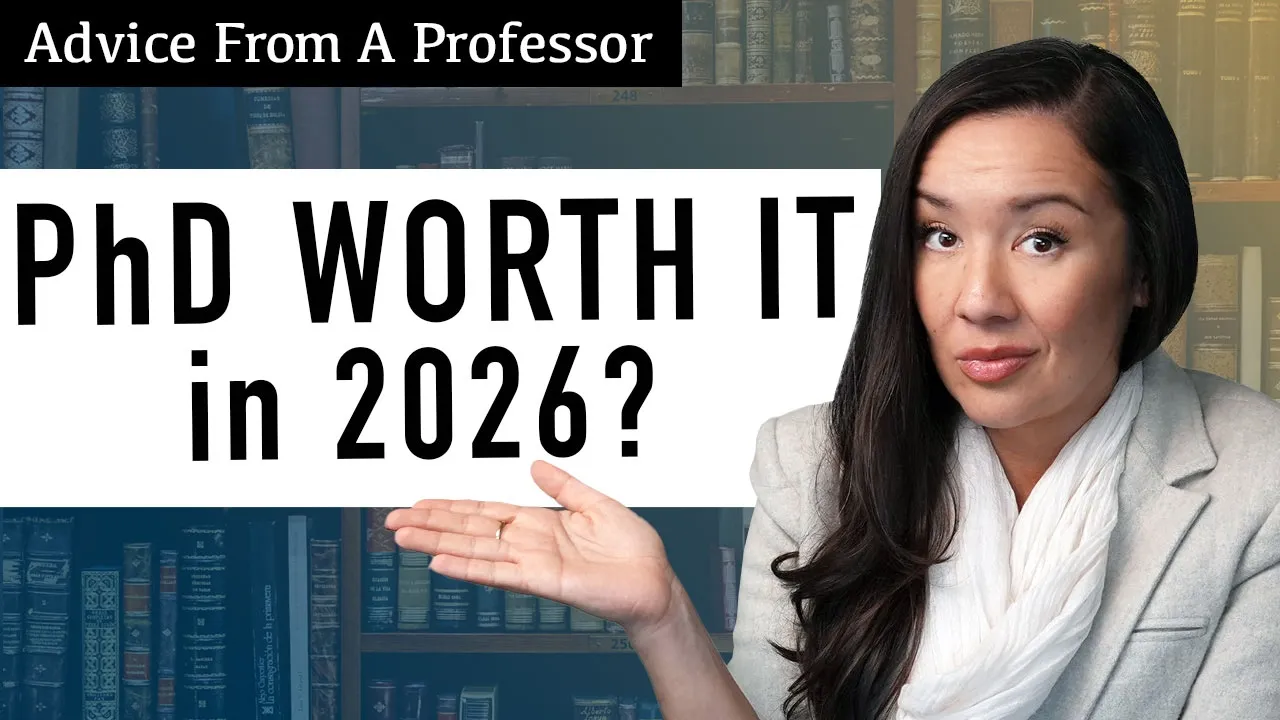
Professor Lace Padilla · @DrDataVIS
Where viewers went back to watch this video again, from YouTube's public Most replayed graph, lined up with what was said at that moment.
Most replayed moment #1
9:454.8x the video's typical replay level
replaced by AI, that should be more concerning. Most of the jobs that we're seeing that are getting replaced by AI are ones that are wholly on a computer. Things like web developers or data analysts, uh, copy editors, that thing, that type of thing. If your field has a physical component where you're working
Said at 9:39
Most replayed moment #2
3:204.5x the video's typical replay level
six, sometimes seven years. That is a really long time and you know the prime of your life to be devoting to something. Along with that time commitment is that it's regionally constrained. When you're applying for PhD programs, you are not going to get the option to live [music] anywhere you
Said at 3:15
Most replayed moment #3
8:573.3x the video's typical replay level
sentiment that you might be seeing online. So, if you're concerned about that in 2026, I actually don't think you need to be that terribly concerned. Something I do think you should think deeply about is the relationship between AI and the field that you're going into. It is possible that the field that
Said at 8:49
The graph counts replays. It does not show where viewers stopped watching.
Words
2,888
Runtime
13:21
Speaking pace
216wpm
Reading time
12min
216 words per minute, above the 201 75th percentile of 349 measured videos. That distribution comes from the 349-video hook study.
Opening (first 30 seconds)
Hi, my name is Dr. Padilla. I'm a professor in computer science and psychology. I've been a professor for over 5 years now. Last year, I did a video on is it worth it to get a PhD in 2025, and I thought I would update the video for 2026. Lots of things have been happening in academia. Some things that were continuing from 2025 on and now they're maybe a little bit more important, but I thought I would give you my advice now. [laughter] if you're thinking about applying to grad school or maybe you're thinking should you continue on in the program is it worth
108 words, the words spoken in the first 30 seconds at 216 words per minute.
Free, no signup. See how the first 30 seconds hold attention, with rewrites.
Sentence shape
| Measure | This transcript |
|---|---|
| Sentences | 195 |
| Average words per sentence | 14.8 |
| Longest sentence | 95 words |
| Questions asked | 7 |
| Sentences containing a number | 12 |
Most used terms
Filler phrases
49 in total: like 12 · um 11 · you know 11 · kind of 7 · uh 3 · right? 2 · actually 1 · basically 1 · literally 1.
A literal whole-word count of the same phrase list the Prepublish browser extension uses, so a phrase inside another word is not counted and a phrase used in its ordinary sense still is. It is a count and not a judgement.
What this transcript is
Every word below is the caption track YouTube publishes for this video, pulled from the video itself and reproduced unchanged. It is not Prepublish's writing, not a summary, and not a re-transcription: it is the video's own published captions. English captions, generated automatically by YouTube, in the video’s original language. Source: the video on YouTube. A channel that would rather this page did not exist can ask for its removal through the contact page, and it is removed.
Hi, my name is Dr. Padilla. I'm a professor in computer science and psychology. I've been a professor for over 5 years now. Last year, I did a video on is it worth it to get a PhD in 2025, and I thought I would update the video for 2026. Lots of things have been happening in academia. Some things that were continuing from 2025 on and now they're maybe a little bit more important, but I thought I would give you my advice now.
[laughter] if you're thinking about applying to grad school or maybe you're thinking should you continue on in the program is it worth it to get a PhD in 2026. So let's jump on in. So let's begin by just talking about [music] why is it useful to get a PhD at all? The number one reason that you should get a PhD is if the job that you want requires a PhD. It sounds simple but that is really the number one criteria I think.
Do you want a job that requires a PhD? There are lots of jobs out there that are uh elite, very top level that don't require a PhD at all. Maybe some people have it, but maybe it's not required. So, you really deeply need to think about what is the exact job that you want and does it require a PhD. If not, [music] then maybe a PhD isn't the only way you need to go. Now, apart from a job in particular, you may just love to learn.
Okay? Maybe you want a PhD for personal reasons. [music] Maybe you just enjoy it so much. Maybe you don't care about the job. of you just personally want to get it because it's going to satisfy something in you. It's one of your main interests and you just want to see where that takes you. I really think that's a great reason, [music] but you do need to weigh that internal desire to get a PhD with the things that you will be trading because there are many trade-offs.
You can't do two things at once. So during that time of the PhD, the five [music] six years, you could be building a career in another field. You could be building wealth, you could be working on your family. So there is real trade-offs that you need to consider. But maybe you just really want to get a PhD because you love to learn. I get it. I love to learn myself. It was always just a major goal of mine. I thought it would be amazing, dream come true if I could get a PhD.
So that was a major factor for me as well. And for me, the major determinant of wanting to get a PhD is I wanted to stay in academia. The job that I wanted was a professor. I thought it was the best job out there. All the professors I met were so happy and they seemed like they had the best job. I've had a lot of jobs in my time. I was a bartender. I was a janitor, believe it or not. And it just seemed like of the jobs available, this is an amazing job.
[music] They got to focus on their own intellectual work. They got to bring that work with them if they changed institutions. So, it's kind of like they were building a small business. They got to work with some of the brightest minds that invigorated them with ideas. It all seemed really, really great. The people that I knew in academia were really good role models, had a great work life balance, and were truly, really, really happy.
So, I wanted a job in academia. The only way that you can get a job in academia is with a PhD. So, that was an automatic yes for me. Now, let's talk about the reasons not to get a PhD. As I said, there are trade-offs. So, I think number one thing is it is a huge time commitment. When you invest time into one thing, it takes away that time. You'll never get it back. So, you don't have the opportunity to invest that time in other ways.
PhD is generally five to six, sometimes seven years. That is a really long time and you know the prime of your life to be devoting to something. Along with that time commitment is that it's regionally constrained. When you're applying for PhD programs, you are not going to get the option to live [music] anywhere you want. There are certain cities that have more institutions and there's just universities in certain places.
So you might not want to live in any of those places, but you will have to to get a PhD in that area. So, there are some really serious sacrifices that you might not be willing to make that just are required for the PhD. Another reason you might not want to get a PhD is that it is straight up hard. It is hard work. It's not for everyone. And I will say all jobs are hard. Literally, all jobs are hard. When I was a bartender, that was a really, really hard job.
I personally do not think getting a PhD is as hard [laughter] as being a bartender. It's hard in a different way, I guess, but hard in an enjoyable way. um rather than having to work 9 to5, you get to set your hours, you get to invest your mind into things. You have to work hard, but it's not hard per se. You just have to actively try all the time at it. That's kind of unique for me, though. I think other people might [laughter] have different perspectives where, you know, they might say it's harder than a different job.
I don't know. I think all jobs are hard. I like the specific unique advantages of a PhD versus [music] things like being a janitor or a bartender. I thought those jobs were frankly harder, but it is hard work. There's no way around it. And I think the thing that's a little different about the PhD is that you need to make it to the [music] end. So if you give up midway, you might get a masters along the way, but you won't get the result of that.
You can quit a job at any point and it's okay. You're not losing that time. But [music] for a PhD, you need to make it to the end. So it is hard and you have to make it through. And I think that's something that people can really struggle with. We'll say certain PhDs in different fields are harder than others. There are truly really hard PhDs and some less hard PhDs. And I think the really hard ones have to do with the specific lab and the type [music] of research.
There are certain expectations from particular adviserss that can be exorbitant. They might be asking you to work 60 80 hours a week, right? That's the way that one person does the job. That's not how science has to be done. So [music] I think there's people who get in situations that are very very hard and unsustainable and other people who have an easier time in their PhD. So you want to think about that. Hopefully you luck out and don't get the [music] you know awful um you know slave labor type of PhD.
But I do think that's the minority. [music] We hear about these stories online of these you know really extreme horrible circumstances. And I do think that that is the minority of situations. Most people have kind of a regular 40hour type of work week for their [music] PhD. But that's not to say it isn't hard. It's still quite hard. Now, the last thing I'll say that applies to all years for PhDs is that it can be really emotionally draining, maybe more than other types of jobs.
Again, other jobs are different in terms of emotion. Emotionally, it can be hard, for example, to be a bartender because you have to deal [music] with crazy clients coming in. But for the PhD, it is emotionally hard because your work often you associate with yourself. So when you get rejections, you might personally feel [music] rejected. That is not the case. But if you're susceptible to feeling um really extreme emotions associated with rejection, it might be harder on you than others.
Also, you're going to get better as you go. So you're not going to be good at the job when you start. [music] Of course, that's the same with all jobs, but I think that can be really hard on people when they're seeing other people advance. they're comparing themselves to others. That could just be really, really emotionally hard on them. Also, like I said, your relationship with your adviser could be very hard. Again, that's the same with all jobs, right?
You have a manager, you have a boss. Um, but in particular, for whatever reason, [music] there can be lots of emotional conflict between your adviser and you, and that can be really, really hard. So, that's really a summary of just the general things that apply all years. Let's talk about some stuff that's specific to 2026. 2026 is a [music] particular interesting time in history especially for the US and I think it can be scary to want to get into academia because there is a general sentiment of aversion towards science and academia if you are focusing online you see lots of anti-science sentiment um on you know many forums out there you see it sometimes in my videos in fact my most popular video I think people were hate watching because they were you know anti-science um and that's just kind the state of online American culture right now.
So, that can be really scary. I get it. If you're online, you're seeing all of this, you know, anti-science rhetoric. That can be very nerve-wracking. [music] But, I will say as someone who's prominent online as a scholar, I think that that rhetoric and that sentiment is stronger online than it is in person. I have lots of friends and family, the most the majority of my family is [music] frankly has different beliefs than myself and are kind of more leaning towards anti-science.
It's not that they are anti-science, but they're part of groups that that are more anti-science [music] sentiment. And they don't express those things towards me. [laughter] What they want is they want science to help them. They want science to [music] be used to better their lives and make sure that they for who they are can have a healthier and safe life. And I get that. That's what I want too. Okay? So, they don't think I should lose my job, that, you know, academia should be burned down, the types of things that you uh read online.
Um, but they just really want to make sure that science, their tax dollars to some degree, um, are being used effectively. And I I totally get that. So, I will say I don't think unless you're wanting to be a public-f facing person on the internet, you know, advocating for science like I am myself, you're not going to get as much of that strong anti-science sentiment that you might be seeing online. So, if you're concerned about that in 2026, I actually don't think you need to be that terribly concerned.
Something I do think you should think deeply about is the relationship between AI and the field that you're going into. It is possible that the field that you're going into for a PhD is highly impacted by AI. And that can happen in two ways. One is that you need to utilize AI heavily within your field. Another form of it is that your field might be kind of going away or dying because of AI. Maybe a lot of the jobs in that field are being replaced by AI.
Okay. So, I think you need to evaluate those two things. If your field heavily uses AI, you need to ensure that whatever programs you're going into provide you that training because that is not going away. And if you're not trained in those skill sets, you will be behind and at a major disadvantage during hiring. Okay? If the job is being replaced by AI, that should be more concerning. Most of the jobs that we're seeing that are getting replaced by AI are ones that are wholly on a computer.
Things like web developers or data analysts, uh, copy editors, that thing, that type of thing. If your field has a physical component where you're working with people or with equipment, your job is probably safer for the time being. Um, but I just want you to think deeply about is there a long-term place for your field in light of how AI is being integrated into fields and how it is replacing many jobs. Along with that, I think you need to think carefully about if your program is training you with the top methods.
If you're at threat of being replaced by AI, as many fields are, there are some ways to kind of buffer yourself from that. One is you just have to outperform AI. So maybe there's some functions that AI could do well and some that they can't. Definitely train yourself in advanced methods for that. So you're not just competing against all the people in your field, you're also competing against AI and you need your program to train you for that.
I think a lot of programs are on the back foot and maybe not prepared for how to kind of deal with this circumstance. So just be crystal clear-minded and focused that if your field is at threat of being taken over by AI, replaced by AI, there's certainly ways to give yourself a competitive advantage and you want to ensure that your program is setting you up to do that. The last major thing I'll talk about that I think is specific to 2026 is for institutions in the US.
I think that it can be really challenging for students outside of the US to be in the US um being educated at this time. So first I think it can be pretty emotional to be an international student in the US at this particular time. There are so many uncertainties and it can feel like some of them might be directed at you and I totally get that. I think that it is more challenging for international students in the US right now than in the past and certainly more challenging than students from the US.
I think in addition like a very explicit practical example is that some of my students and students that I know are having difficulty traveling to conferences [music] based on their visa situation. Um so traditionally when you're in a PhD program you apply to conferences and part of the fun is that you travel and get a single places and present your research. About half of the students that I know are not allowed to travel based on various visa situations because they might have a hard time entering the US after that travel.
And I I totally get that. So that basically means that a major factor of their education, an important part of their learning experience, they don't get access to and that is very unfortunate. I think you should think deeply if you're a student outside of the US applying to US schools. I think it can be pretty challenging right now, maybe more than any other time in history. I definitely don't want to discourage you from doing it.
I think if that's, you know, if you have the school you want and it's perfect for you, I think that is great. I think that education in the US is still the top in the world. So, it would be useful to have access to that education, but you have to go into it opened and know that there will be more challenges for you as an international student attending university in the US, unfortunately. Okay, so that sums it up for all of my updates to 2026.
Like I said, I think that being in academia is the best job in the world. I [music] love it to pieces. I always feel truly so blessed that I had the opportunity to have this job, opportunity to work with amazing students, amazing collaborators. [music] I'm just in awe that I was able to get this opportunity. I hope that you get this opportunity as well. [music] I know you can if you keep trying. If you found this video useful, please give it a like and subscribe for more videos on academic success.
Academia can be tough, but you don't have to go through it alone. Keep learning, keep growing, and I'll see you in [music] the next one. Bye. I feel good.
The words are the caption track's own and nothing is reworded or re-transcribed. Paragraph breaks are placed between sentences so the text reads as prose.
Free tools for your own script. No signup, no login.
Paste your draft and see where viewers are likely to drop off, with a rewrite for each weak line.
Paste the first 30 seconds of your own draft for a hook score and rewrites.
Check your draft against YouTube's advertiser-friendly guidelines before you record it.
Read this channel's public videos and transcripts, and download a writing brief for it.