Getting the transcript
Reading the captions from YouTube. A video nobody has opened here before takes 10 to 30 seconds; this page fills in on its own.
Reading the captions from YouTube. A video nobody has opened here before takes 10 to 30 seconds; this page fills in on its own.
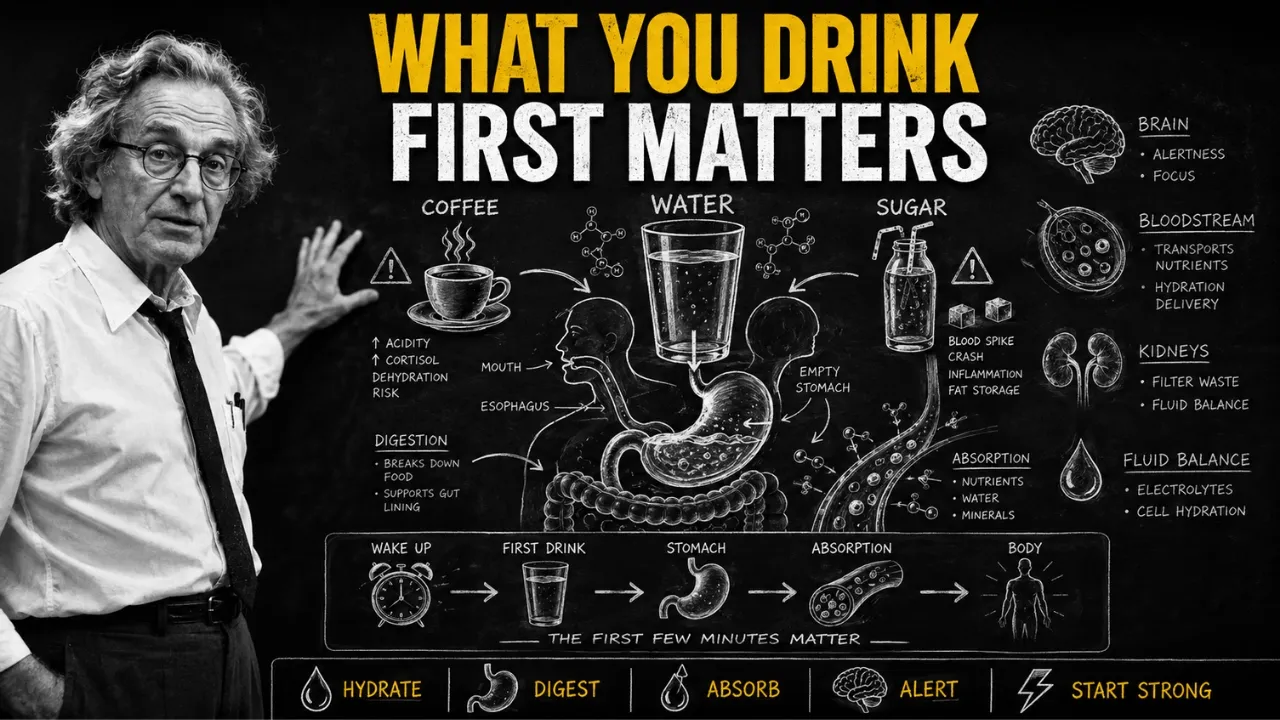
Feynman Cognitive Science · @FeynmanCognitiveScience
Words
4,248
Runtime
26:10
Speaking pace
162wpm
Reading time
18min
162 words per minute, between the 160 25th percentile and the 181 median of 349 measured videos. That distribution comes from the 349-video hook study.
Opening (first 30 seconds)
You wake up tomorrow morning. Let's say it's 6:52. The alarm goes off, you silence it, and for a second you just lie there. And in that half-conscious minute, before you've made a single decision, an organ sitting quietly under your right rib cage has already been working for hours. Not waking up, working. Your liver, roughly 4 lb of tissue running somewhere around 500 separate chemical jobs, has spent the entire night filtering your blood, storing and releasing sugar, and
81 words, the words spoken in the first 30 seconds at 162 words per minute.
Free, no signup. See how the first 30 seconds hold attention, with rewrites.
Sentence shape
| Measure | This transcript |
|---|---|
| Sentences | 229 |
| Average words per sentence | 18.6 |
| Longest sentence | 53 words |
| Questions asked | 2 |
| Sentences containing a number |
What this transcript is
Every word below is the caption track YouTube publishes for this video, pulled from the video itself and reproduced unchanged. It is not Prepublish's writing, not a summary, and not a re-transcription: it is the video's own published captions. English captions, generated automatically by YouTube, in the video’s original language. Source: the video on YouTube. A channel that would rather this page did not exist can ask for its removal through the contact page, and it is removed.
You wake up tomorrow morning. Let's say it's 6:52. The alarm goes off, you silence it, and for a second you just lie there. And in that half-conscious minute, before you've made a single decision, an organ sitting quietly under your right rib cage has already been working for hours. Not waking up, working. Your liver, roughly 4 lb of tissue running somewhere around 500 separate chemical jobs, has spent the entire night filtering your blood, storing and releasing sugar, and building a fluid called bile.
And right now, as your feet hit the floor, that organ is sitting there mildly dehydrated, its bile thickening by the minute, waiting to find out what you're going to hand it first. I want to be straight with you about something before we go further. This is not going to be one of those videos where someone holds up a mason jar of lemon water, says the word detox, and calls it a day. That kind of content bothers me, honestly, because the real biology sitting underneath this question is so much better than a lemon wedge.
What I actually want to do is take you inside your liver on a normal Tuesday morning. The bile chemistry, the blood vessel that connects your gut directly to this organ, the hormone spike that hits you within the first hour of waking, all of it. And once you've seen how those pieces fit together, the answer to whether you should drink water before your coffee is going to feel obvious. Not because I told you the rule, but because you'll understand the mechanism behind it.
And that's the kind of knowledge that actually sticks with you. So, let's start from the ground up. The first thing you need to understand is what your liver was doing while you were unconscious for the last 7 or 8 hours. Overnight, with no food or water coming in, your liver switches into a kind of maintenance mode. It breaks down stored sugar, called glycogen, in small steady amounts to keep your blood sugar level while you sleep.
At the same time, it keeps producing a fluid called bile, which most people only associate with digestion, but which is really the liver's drainage system. It's way of pushing waste products out of the body through the gut. Here's the detail almost nobody knows. Bile is about 95% water. It is structurally mostly a river, and overnight that river starts running dry. You lose somewhere between half a liter and a full liter of water every night just through breathing and through your skin, a process called insensible water loss, and it happens whether you're aware of it or not.
You don't wake up feeling thirsty, so it's easy to assume nothing happened, but your blood plasma is measurably more concentrated by morning, and that same concentration hits your bile. Instead of flowing like a river, it starts moving more like syrup, slow, sluggish, sitting in the ducts instead of draining through them. Now, here's where it gets interesting, and this is the part I really want you to hold on to. Within the first hour of waking, your body triggers something researchers call the cortisol awakening response, a sharp rise in cortisol that can climb between roughly 30 and 70% above your overnight baseline.
This has been documented for decades in work by researchers like Clemens Kirschbaum, and it's one of the most reliable hormonal shifts your body produces every single day. Cortisol gets branded as the stress hormone, which makes people assume it's something bad, but it isn't. It mobilizes energy. It sharpens focus. It's the reason you feel remotely functional before breakfast. But cortisol also does something specific to your gut.
It signals your gallbladder to start contracting, squeezing whatever bile is sitting there out through narrow ducts and into your intestine. So, picture the situation you're actually in most mornings. Your bile is already thick from a night of quiet dehydration. And now cortisol is telling your gallbladder to squeeze that thickened bile through ducts that were built for a thinner, faster-moving fluid. That's your baseline every single morning before anything touches your mouth.
And then a lot of people pick up a cup of coffee. I'm going to come back to coffee in detail in a minute because it's more complicated than good or bad. And I don't want to oversimplify it the way most videos do. But here's what you need to know for now. Coffee doesn't arrive into a neutral, empty system. It arrives into exactly the dehydrated, sludge bile, cortisol spiked system I just described. And what happens next in your liver depends entirely on one choice you make in the 90 seconds before you take that first sip.
To really understand what's happening in that 90-second window before your coffee touches your lips, you have to go back further than this morning. You have to go back to the moment you fell asleep last night because your liver did not clock out when you did. While the rest of you was unconscious, this organ was running one of the busiest shifts of its entire day. Think of your liver at night less like a factory that shuts its lights off and more like a factory that switches to the overnight crew.
With no food coming in through your gut, your body has to keep your blood sugar steady some other way. And that job falls almost entirely on your liver. It reaches into its own storage depots and starts releasing small, metered amounts of glycogen, a stored form of sugar, converting it back into glucose, and feeding it into your bloodstream in a slow, controlled drip. This is the only reason your brain, which burns through glucose all night long and can't store any of its own, keeps functioning while you sleep.
At the same time, your liver is still doing its other core job, filtering blood. Roughly a liter and a half of blood passes through your liver every single minute, day and night, and your liver is constantly pulling out metabolic byproducts, breaking down hormones that have finished their jobs, and neutralizing compounds your body doesn't want circulating. None of that pauses because you're horizontal. And on top of the sugar regulation and the blood filtering, your liver spends the night doing a third job that almost nobody thinks about.
It keeps manufacturing bile. Bile is often filed away in people's minds as just the digestion fluid, something that shows up when food arrives and otherwise doesn't matter. But your liver produces bile continuously, whether or not you're eating, and overnight it actually starts to build up and concentrate in your gallbladder, waiting to be used. So by the time your alarm goes off, your liver hasn't been resting. It's been running glucose logistics, blood filtration, and bile production simultaneously for 7 or 8 hours straight with zero new fluid or fuel coming in from the outside.
That last detail, zero new fluid coming in, is the hinge everything else swings on. Because for those same 7 or 8 hours, your body has been quietly losing water the entire time, and almost nobody accounts for it. Every breath you take at night pushes a small amount of water vapor out of your lungs. Your skin, even while you're lying still under a blanket, continuously releases moisture in a process that never fully stops.
Add those two sources together across a full night's sleep, and the average adult loses somewhere between roughly half a liter and a full liter of water, purely through breathing and through the skin, before they've had a single sip of anything. Physiologists call this insensible water loss. Insensible because you don't feel it happening the way you'd feel sweat on a hot day. There's no sensation attached to it. You simply wake up already down a measurable amount of fluid with no thirst cue to warn you.
This is why the idea, I don't feel thirsty so I must be fine, doesn't actually hold up. Thirst is a fairly late warning system triggered only once receptors detect that your blood concentration has already shifted. By the time you consciously feel it, your body has usually already made small adjustments elsewhere to compensate. One of which is thickening your blood plasma. With less total water available, the fluid portion of your blood becomes more concentrated and that concentration doesn't stay isolated in your bloodstream.
It ripples outward into every fluid system connected to it, including the one flowing out of your liver. And here's the part that makes this so easy to miss. None of it produces a symptom you'd actually notice. No headache, no dry mouth, nothing demanding your attention. You simply wake up already carrying the deficit, sitting there quietly waiting to interact with whatever you do in the next few minutes. Which brings you to bile itself.
Because this is where the overnight fluid loss actually becomes a mechanical problem instead of just a number on a chart. Bile is not primarily made of digestive enzymes or fat dissolving compounds, even though that's the role people usually associate with it. By volume, bile is about 95% water. The remaining 5% is where the functional ingredients live. Bile acids, cholesterol, and waste pigments. But water is the medium that carries all of it.
You can think of bile less like a specialized chemical and more like a river that happens to be carrying cargo. The river is what makes the delivery possible. Without enough water, the cargo doesn't move. It just piles up. So when you wake up mildly dehydrated from a night of insensible water loss. That dehydration doesn't just show up in your blood plasma, it shows up directly in your bile. Instead of flowing easily through the small ducts that carry it out of your liver and gallbladder, it thickens.
It becomes more like syrup than river water, moving slowly, sitting longer in narrow passageways than it's supposed to. And this matters because bile isn't just a fluid your body politely tucks away until lunch. It's the main exit route your liver has for waste it needs to get rid of, particularly the fat-soluble compounds that can't simply be filtered out through your kidneys and urine the way water-soluble waste can.
If bile is flowing well, that waste moves out efficiently. If bile is thick and sluggish, that same waste sits closer to liver tissue for longer than it should. This is the literal physical starting condition of your digestive system on most mornings, before coffee, before breakfast, before anything. A slightly dehydrated liver sitting on a supply of thickened sluggish bile waiting for the day's first instruction. And for a lot of people, that first instruction is caffeine delivered straight to an empty stomach.
Here's what actually happens when that hits. Caffeine is a stimulant, and one of the things it stimulates is your sympathetic nervous system, the branch of your nervous system responsible for the classic fight or flight response. Within minutes of drinking coffee, your body releases a burst of adrenaline and a corresponding rise in cortisol on top of the natural cortisol spike your body already produces just from waking up.
This combined hormonal surge does two specific things that matter enormously for the state your liver is already in. First, it triggers your gallbladder to contract, physically squeezing the bile that's stored there out through the bile ducts. Normally, this This a useful, well-timed reflex, Your body preparing to digest incoming food. But remember what that bile is like this morning. Thick, concentrated, low on water.
So, instead of a smooth release, you get something closer to trying to squeeze syrup through a straw. The contraction still happens. Cortisol doesn't wait around for optimal conditions, but it's working against a fluid that isn't ready to move easily. Second, caffeine causes vasoconstriction, a narrowing of blood vessels throughout your body, including the vessels that supply your liver. This is part of why coffee makes you feel alert.
Constricted vessels combined with a stimulated nervous system produce that sense of sharpened focus. But narrower blood vessels also mean reduced blood flow reaching your liver at the exact moment it's trying to process an incoming compound and push out already thickened bile. You've essentially asked an organ that's already running on a fluid deficit to squeeze sludge through narrow ducts, while also restricting its own blood supply.
To understand why your liver, specifically, ends up carrying the full weight of this, you need to know about one particular blood vessel most people have never heard of, the hepatic portal vein. Most of your organs receive blood from your heart directly, oxygen-rich, freshly pumped. Your liver is different. Instead of getting its main blood supply straight from the heart, your liver sits downstream of your entire digestive tract, connected to it by the hepatic portal vein, a vessel that collects blood leaving your stomach and intestines and routes it directly into your liver before it goes anywhere else in the body.
Think of it as a private highway that runs from your gut straight to your liver's front door, bypassing general circulation entirely. This is an elegant system most of the time. It means anything you absorb through your digestive tract gets processed and filtered by your liver first before it has a chance to circulate to your brain, your heart, or anywhere else. It's your body's built-in quality control checkpoint, and it's the same reason a medication taken as a pill often needs a higher dose than the same medication given by injection because so much of it gets processed and broken down by the liver on that very first pass.
But that same design means when you drink coffee on a completely empty dry stomach, there's nothing to dilute it. No food sitting in your stomach to slow absorption. No water in your system buffering the concentration. The caffeine gets absorbed quickly and travels down that private highway directly into your liver at close to its full undiluted strength. Compare that to drinking the same coffee after you've had food or water in your system, where the caffeine arrives gradually, diluted, spread out over a longer window instead of landing all at once.
On an empty dry morning, your liver doesn't get that gradual buffered introduction. It gets hit directly, at close range, in one concentrated dose, while it's already dealing with thickened bile and reduced blood flow from the vasoconstriction caffeine itself just caused. So by the time you finish that first cup, here's the actual physiological situation your liver is managing. A fluid deficit from a night of insensible water loss.
Bile that's moving like syrup instead of water. A gallbladder contracting under cortisol's orders and struggling to push that thickened bile through. Blood vessels narrowed by caffeine's vasoconstricting effect. And a concentrated dose of caffeine arriving directly through the portal vein with nothing to dilute it along the way. None of this happened because coffee is inherently harmful. It happened because of the order you did things in and and empty dry conditions your liver was sitting in when that first sip landed.
So, now you know exactly what's working against you in that first minute after you wake up. A liver running a fluid deficit it can't feel, bile thickening in ducts it doesn't control, and a hormonal spike waiting to squeeze that thickened bile through narrow passageways the moment caffeine shows up. The obvious question is, what happens if you change the order? What if, instead of reaching for the coffee first, you reach for a glass of water, something like 16 oz, and drink it before anything else touches your stomach?
Not as a ritual, not as a wellness habit you do because someone told you to, but because of what it actually mechanically sets in motion inside you. The sequence that follows happens faster than most people expect. Water doesn't need to be broken down the way food does, there's no digestion step required. So, it starts moving out of your stomach and into your small intestine almost immediately. A process called gastric emptying, that for plain water on an empty stomach can be substantially complete within 10 to 20 minutes.
And your small intestine is remarkably efficient at absorbing water, putting it through the intestinal wall and into your bloodstream within minutes rather than hours. Aided by the sheer surface area packed into that stretch of gut, folded and lined with finger-like projections called villi, that exist specifically to maximize contact between what you swallow and the bloodstream waiting just underneath. That absorbed water doesn't scatter randomly through your circulation either.
Remember the private highway from earlier, the hepatic portal vein, the vessel that roots blood from your gut directly to your liver before it goes anywhere else. Water absorbed in your intestine travels down that exact same route. Which means the first organ to feel the benefit of that glass of water isn't your brain, isn't your muscles, it's your liver, arriving through the same doorway that caffeine would have used if you'd gone the other order.
Once that water reaches your liver, it starts correcting the exact problem you spent the last several minutes learning about. Your blood plasma, concentrated overnight, begins to dilute back toward a normal ratio, easing the pressure inside the portal vein itself and improving the blood flow your liver has available to work with. The same blood flow that caffeine's vasoconstriction would otherwise have restricted. And that increased fluid volume flows directly into bile production.
Remember, bile is roughly 95% water. So, when your liver suddenly has more water available, the bile sitting in your ducts and gallbladder doesn't stay thick and syrupy for long. It starts thinning, moving from something closer to sludge back toward something closer to the fast-flowing river it's supposed to be. This isn't a slow, next-day process. Because absorption through the small intestine happens on the order of minutes, you're giving your liver a functioning drainage system again before your coffee maker has even finished brewing, well before that first cup ever reaches your lips.
A thinned, properly flowing bile supply matters for more than just comfortable digestion because it feeds directly into one of the liver's most important and least appreciated jobs. Something researchers refer to as biotransformation or more simply, detoxification. This process happens in two coordinated phases, and both of them depend heavily on water being available. In the first phase, a family of liver enzymes called cytochrome P450 enzymes take compounds that don't belong in your body, whether that's a medication, a metabolic byproduct, or a plant compound from your food, and chemically modify them, essentially tagging them for removal.
In the second phase, other enzymes attach those tagged compounds to water-soluble carriers, molecules that allow the waste to dissolve and travel safely out of your body through bile or urine, rather than lingering in fatty tissue, where it could otherwise accumulate over time. Both of these phases are fundamentally aqueous reactions. They require a watery environment to happen efficiently, the same way a chemical reaction in a lab often needs to happen in solution, rather than as a dry powder sitting on a countertop.
When you're dehydrated, both phases slow down, not because the enzymes disappear, but because the medium they're working in is too thick and too limited for the reactions to run smoothly. Hydrate first, and you're not adding some magical detox ingredient. You're simply giving enzymes your liver already has the working conditions they need to do the job efficiently, instead of struggling against a system running dry. There's a second benefit to hydrating first that has nothing to do with bile or detoxification directly, and it involves that cortisol and adrenaline spike from earlier.
Remember, caffeine on an empty dehydrated stomach triggers an exaggerated hormonal response, adrenaline and cortisol surging together. And one of the things that combination does is signal your liver to break down stored glycogen and release the resulting glucose into your bloodstream, on top of the natural cortisol awakening response your body already produces just from waking up. In a dehydrated state, this glucose release tends to run hotter than it needs to, partly because dehydration itself is interpreted by your body as a mild physiological stressor, which nudges those stress hormones even higher than caffeine alone would trigger.
Your body, in effect, reads low on fluid as a low-grade emergency signal and stacks that onto the emergency signal caffeine is already sending, and your liver responds the only way it knows how, by dumping more sugar into circulation than the moment actually calls for. This is part of why some people notice a sharp burst of jittery energy after their first cup, followed later by an equally sharp crash, their blood sugar spiking higher than necessary, and then dropping as insulin catches up to bring it back down.
When you hydrate first, you remove dehydration as an additional stress signal layered on top of caffeine's own stimulant effect. Your adrenaline and cortisol response to the coffee still happens. That's simply what caffeine does, and there's nothing wrong with that response existing. But it happens against a calmer physiological baseline instead of a compounded one. The glucose release that follows tends to be smoother, more proportional, less likely to produce that exaggerated spike and crash pattern that so many people just assume is a normal, unavoidable part of drinking coffee, when really it's a downstream consequence of the hydration state they started from.
Now, with all of this laid out, I want to circle back to something I mentioned earlier and address it directly, because I think it's the most misunderstood part of this entire topic. None of what you just learned means coffee is bad for your liver. If anything, the opposite is closer to true. Coffee contains a dense concentration of polyphenols, plant compounds with significant antioxidant activity, and one polyphenol in particular, chlorogenic acid, has been studied specifically for its relationship to liver health.
Research looking at regular coffee drinkers has repeatedly found associations with lower rates of liver fibrosis and reduced markers of liver enzyme elevation compared to non-coffee drinkers. And some of the larger population studies have even tracked a dose-dependent pattern, where drinking several cups a day correlates with a lower relative risk of chronic liver disease than drinking none at all. This is a genuinely well-supported area of nutrition science, not wellness industry speculation.
The problem was never the coffee itself. The problem was the conditions you were pouring it into. Chlorogenic acid and the other polyphenols in coffee still need a liver capable of processing them efficiently to deliver their benefit. An organ with adequate blood flow, thinned bile, and enzymes working in a properly hydrated environment. Drink that same cup of coffee into a system that's already dehydrated, thick biled, and vasoconstricted, and you're not getting the same outcome as drinking it into a liver you just gave a fair chance to work with you instead of against you.
Same compound, same cup, dramatically different result, depending entirely on the internal environment it lands in. Which brings you to the actual practical version of everything you've just learned. Because understanding the mechanism only matters if it changes what you do tomorrow morning, not just what you know about tomorrow morning. The protocol itself is almost disappointingly simple, and that's kind of the point.
When you wake up, before coffee, before anything else, drink somewhere around 400 to 500 ml of water, roughly 14 to 16 oz, at room temperature rather than ice cold. Since room temperature water clears your stomach and reaches your intestines slightly faster than water that's cold enough to cause mild, temporary stomach constriction and slow the whole process down. Then give it 15 to 30 minutes before your first cup of coffee.
That window is enough time for the water to move through your stomach, get absorbed in your small intestine, travel the portal vein, and start thinning your bile and easing your blood plasma concentration, all before caffeine enters the picture. You don't need to time it with a stopwatch. Brushing your teeth, getting dressed, checking your messages, any normal 15-to-30-minute stretch of your morning routine gives your liver exactly the window it needs.
After that, drink your coffee. You don't need to fear it, avoid it, or apologize for it. You're simply handing it to a liver that's already been given the resources it needs to make the most of what coffee actually has to offer, rather than one that's being asked to process a stimulant while it's still running on empty. Picture that same 7:00 a.m. scene from the very beginning of this. The kitchen, the coffee maker clicking on.
That first rich, dark pour. Except now, imagine there's a glass of water sitting there first. Already finished. Already absorbed. Already doing its quiet work in your bloodstream. Same morning. Same cup of coffee. Completely different liver receiving it. That's the entire idea. Not a detox, not a cleanse, not some dramatic overhaul of your routine. Just one glass of water in the right order. Giving a 4-lb organ running 500 jobs the one thing it actually needed before you asked it to take on one more.
The words are the caption track's own and nothing is reworded or re-transcribed. Paragraph breaks are placed between sentences so the text reads as prose.
Free tools for your own script. No signup, no login.
Paste your draft and see where viewers are likely to drop off, with a rewrite for each weak line.
Paste the first 30 seconds of your own draft for a hook score and rewrites.
Check your draft against YouTube's advertiser-friendly guidelines before you record it.
Read this channel's public videos and transcripts, and download a writing brief for it.
| 20 |
Most used terms
Filler phrases
30 in total: actually 12 · like 12 · kind of 4 · you know 2.
A literal whole-word count of the same phrase list the Prepublish browser extension uses, so a phrase inside another word is not counted and a phrase used in its ordinary sense still is. It is a count and not a judgement.