Getting the transcript
Reading the captions from YouTube. A video nobody has opened here before takes 10 to 30 seconds; this page fills in on its own.
Getting the transcript
Reading the captions from YouTube. A video nobody has opened here before takes 10 to 30 seconds; this page fills in on its own.
Extra History · @extrahistory
Where viewers went back to watch this video again, from YouTube's public Most replayed graph, lined up with what was said at that moment.
Most replayed moment #1
0:493.5x the video's typical replay level
but also, what their consequences may be. So, without further ado, Charlemagne spent the beginning of the 9th century kicking around basically everybody in western Europe. As a result, he ended up with an empire that spanned from what is now Spain, to Germany, to Italy.
Said at 0:44
Most replayed moment #2
3:551.7x the video's typical replay level
And even more, have been fought IN. Let's just look at the list. We've got; The Thirty Years War (1618-1648), The 9 Years War (1688-1697), The War of the Spanish Succession (1700-1714), Much of the pre-Napoleonic battles of the French Revolution (1789-1799), The Franco-Prussian War (1870-1871),
Said at 3:50
The graph counts replays. It does not show where viewers stopped watching.
Words
1,202
Runtime
6:52
Speaking pace
175wpm
Reading time
5min
175 words per minute, between the 160 25th percentile and the 181 median of 349 measured videos. That distribution comes from the 349-video hook study.
Opening (first 30 seconds)
Sometimes, an event echoes through history. Its reverberations being felt for hundreds of years. Today, we thought we would do something a little different, and explore one of those echoes. [music] Unlike most of our episodes, this one is going to be a LOT of conjecture. It's going to be James' take on a particular event in history, some speculation. And as such, it's not necessarily... ...correct. Rather, it's an idea to be explored and debated, to be examined, to help us think about why and how events
88 words, the words spoken in the first 30 seconds at 175 words per minute.
Free, no signup. See how the first 30 seconds hold attention, with rewrites.
Sentence shape
| Measure | This transcript |
|---|---|
| Sentences | 70 |
| Average words per sentence | 17.2 |
| Longest sentence | 60 words |
| Questions asked | 5 |
| Sentences containing a number | 4 |
Most used terms
Filler phrases
7 in total: basically 3 · I mean 1 · kind of 1 · sort of 1 · you know 1.
A literal whole-word count of the same phrase list the Prepublish browser extension uses, so a phrase inside another word is not counted and a phrase used in its ordinary sense still is. It is a count and not a judgement.
What this transcript is
Every word below is the caption track YouTube publishes for this video, pulled from the video itself and reproduced unchanged. It is not Prepublish's writing, not a summary, and not a re-transcription: it is the video's own published captions. English captions, published by the channel, in the video’s original language. Source: the video on YouTube. A channel that would rather this page did not exist can ask for its removal through the contact page, and it is removed.
Sometimes, an event echoes through history. Its reverberations being felt for hundreds of years. Today, we thought we would do something a little different, and explore one of those echoes. [music] Unlike most of our episodes, this one is going to be a LOT of conjecture. It's going to be James' take on a particular event in history, some speculation. And as such, it's not necessarily... ...correct. Rather, it's an idea to be explored and debated, to be examined, to help us think about why and how events unfold in our world today.
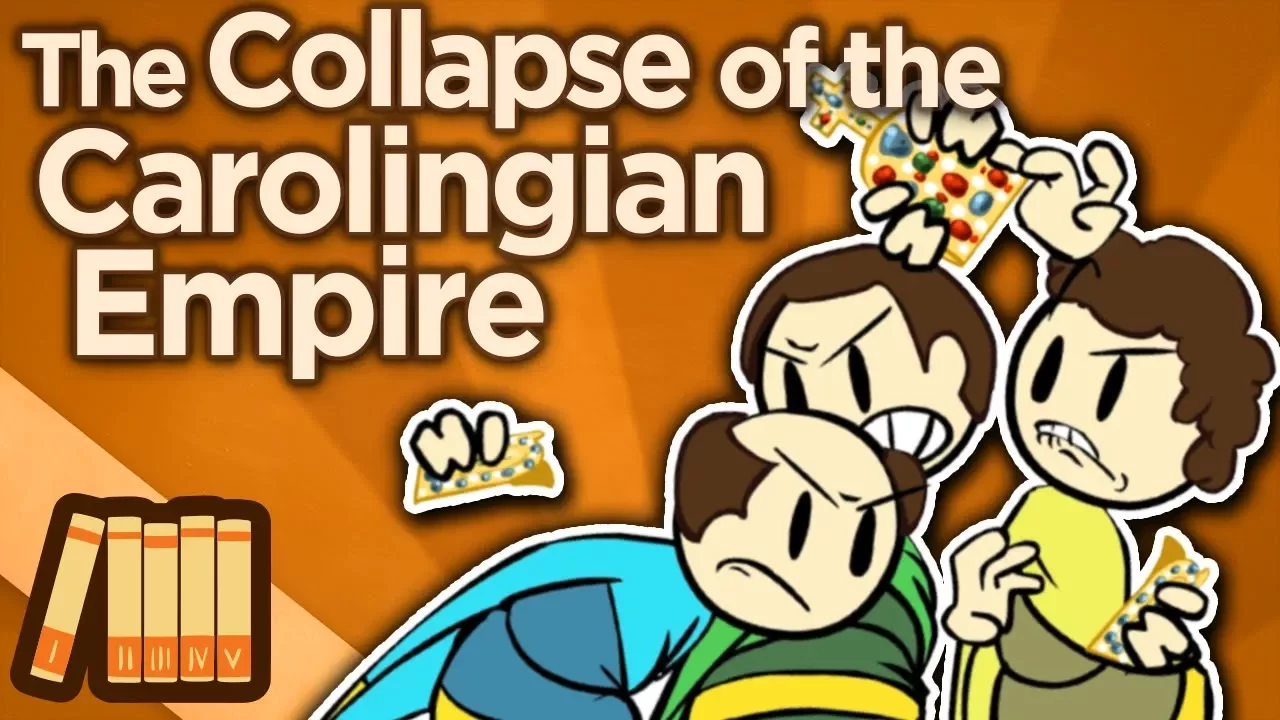
And it's important that we do such exercises from time to time. To practice not only thinking about what the facts of history are, but also, what their consequences may be. So, without further ado, Charlemagne spent the beginning of the 9th century kicking around basically everybody in western Europe. As a result, he ended up with an empire that spanned from what is now Spain, to Germany, to Italy. He got himself called "Emperor", and many thought that his conquests might be the beginning of a Roman Empire restored.
Then, he died. Tragically, but also, luckily, for his empire, by the time he kicked it, he had only one son left, so the empire passed from his hands to that of his son basically intact. But HIS son had 3 sons of his own. And Carolingian law had an interesting quirk to it. It wasn't ruled by primogeniture, (the idea that all inheritance goes to the first born son). Now, we often criticize primogeniture today, as it favours only one son, leaves women out entirely, and sometimes leads to rebellions led by younger sons with little to lose and everything to gain.
But, we are about to see why it became the dominant system. Because what happens when you can't leave your whole empire to one person? Well, that means that you've gotta carve it up and hand parts of it to, in this case, each son. So all of that work that you did to put together some great empire, just becomes a bunch of squabbling states again, as soon as you're out of the picture. "And how do states squabble, especially at this time?" Well, They go to war with each other.
So when Charlemagne son eventually legged it to the great beyond and left each of his sons with their own kingdoms, they immediately went at each others throats to try to take the pieces of the old empire back from the other ones. Which is where THIS map comes in (thanks, Verdun). Now, the first thing you will probably notice about that map, is that it is completely bonkers. Whether or not you know anything about Europe, you can probably tell that this middle country is COMPLETELY untenable.
It's got an enormous border to guard on both sides, and it's surrounded by larger, more cohesive states. And if you DO know anything about Europe, you're probably even more confused. Because this makes no sense geographically. I mean, it's filled with mountains and rivers, and yet, those features aren't being used to define much of its borders. But in terms of population, it's even weirder. The Western Frankish Kingdom is mostly Franks (or French), the Eastern Frankish Kingdom is almost entirely Germanic, but the middle, the middle is just a mix of everybody.
Germans, French, Italians, and people who consider themselves none of those three. That middle kingdom just feels kind of haphazard. And, sure enough, Its two bigger, more sensibly formed neighbours on either side, basically roll over it pretty quickly. The Italian part becomes its own thing, and the East and West Francia sort of split up the rest. But this one act, this one time haphazard split of an empire meant to provide kingdoms for sons, has had ENORMOUS historical consequences.
Because, take one more look at that territory. (Now, just ignore that Italian part for a moment,) and what do you see? What you're left with is a place that a surprising number of the major western European conflicts of the modern era have been fought over. And even more, have been fought IN. Let's just look at the list. We've got; The Thirty Years War (1618-1648), The 9 Years War (1688-1697), The War of the Spanish Succession (1700-1714), Much of the pre-Napoleonic battles of the French Revolution (1789-1799), The Franco-Prussian War (1870-1871), World War I (1914-1918), and, within the realm of argument, also World War II (1939-1945).
"Why is this the case?" "Why do so many conflicts erupt right here?" I would argue that it's because of the way that this one, haphazard decision, to carve out a kingdom for sons, made centuries before, interacted with a notion that came centuries later: national identity. Because West Francia would eventually become France, and East Francia would have eventually become Germany. But no clear line was ever established as to whom that middle bit belonged to.
And because the middle bit contained both French speakers and German speakers, people who both neighbouring nations would consider ethnically part of their nation and their "lost people". The two biggest powers in western Europe would continually get into conflict over the issue. And that part about national identity is key, Because, for a little over 700 years after Middle Francia fell apart, this wasn't really an issue.
Sure, there were some conflicts here and there, but, not of the severity or the frequency that we see thereafter. While Europe was simply a bunch of fragmented kingdoms where people had more allegiance to their local noble, or at best, their king, than some idea of a nation, any disputes were based on the desires of feudal lords. On questions of birth and rights by title, rather than some idea of the national boundaries of a state, or the unity of a people.
But as those ideas of national identity begin to take shape, that decision, made more than half a millennia before, begins to influence events in ways that no one could possibly anticipate when it was made. And we see this all over, mirrored in our world, even today. Even today, we see haphazardly drawn borders, slowly being redrawn to fit sensible geographic and demographic boundaries. To reunite peoples who were separated by a line on a map that wasn't greatly considered when it was drawn.
And, as with this region, we often see that boundary being redrawn in blood. So, while there is rarely any one cause for war, and while it is far too reductionist to blame all of those conflicts solely on one decision about how to draw a group of borders, without a thought given to the people living within those borders, it's certainly worth considering the ripples that might have spread from such a decision. And, how they might have added to the wave that became war.
And with that, I am going to leave you. But, I do hope that you keep this discussion going, agree, disagree, whatever. Offer your own theories. Any time we trace these echoes, that is the goal. Not to state an absolute, but to consider history, and how we might learn from it. [Music]
The words are the caption track's own and nothing is reworded or re-transcribed. Paragraph breaks are placed between sentences so the text reads as prose.
Free tools for your own script. No signup, no login.
Paste your draft and see where viewers are likely to drop off, with a rewrite for each weak line.
Paste the first 30 seconds of your own draft for a hook score and rewrites.
Check your draft against YouTube's advertiser-friendly guidelines before you record it.
Read this channel's public videos and transcripts, and download a writing brief for it.