Getting the transcript
Reading the captions from YouTube. A video nobody has opened here before takes 10 to 30 seconds; this page fills in on its own.
Getting the transcript
Reading the captions from YouTube. A video nobody has opened here before takes 10 to 30 seconds; this page fills in on its own.
Fredda · @FreddaYT
Where viewers went back to watch this video again, from YouTube's public Most replayed graph, lined up with what was said at that moment.
Most replayed moment #1
7:3310.3x the video's typical replay level
Before creating this video, I reacted to it live over on Twitch. I'll sprinkle in some clips for that when it's appropriate. Go ahead and hit follow if you want to see me in a more casual context. Anyways, here's the first clip. In the 19th century, a Dahomeyan king named Gezo described the slave trade as the ruling
Said at 7:25
Most replayed moment #2
35:138.1x the video's typical replay level
Webb, he has a a YouTube channel called History Debunked. This channel is for anybody who has ever questioned the stories which they learned during history lessons at school. Oh, that's a good start. Another video by him, "The King wishes Muslims Ramadan Mubarak, but cannot bring himself to say Happy Easter to
Said at 35:06
Most replayed moment #3
27:416.7x the video's typical replay level
I've never seen someone list their Bachelor of Science and their PhD in a citation. Here's how I reacted to this live. That's a very interesting way of doing a citation. What is he citing here? Cuz before he cited page numbers and now he's just cuz all the citations are very different. They're never the
Said at 27:33
The graph counts replays. It does not show where viewers stopped watching.
Words
12,242
Runtime
1:02:53
Speaking pace
195wpm
Reading time
51min
195 words per minute, between the 181 median and the 201 75th percentile of 349 measured videos. That distribution comes from the 349-video hook study.
Opening (first 30 seconds)
Conservative podcaster Matt Walsh has released a so-called history documentary called, and I quote, "Real History", which in his own words is meant to reveal the so-called lies told by the quote mainstream historians and academia. This is not the first time we've seen content creators adopt this angle when trying to pitch their idea of history which runs counter to the sort of consensus on the topic that exists in academia. Often times they engage in conspiratorial thinking, claiming academia has been infiltrated by and is being run by the left to advance a Marxist agenda or
98 words, the words spoken in the first 30 seconds at 195 words per minute.
Free, no signup. See how the first 30 seconds hold attention, with rewrites.
Sentence shape
| Measure | This transcript |
|---|---|
| Sentences | 707 |
| Average words per sentence | 17.3 |
| Longest sentence | 57 words |
| Questions asked | 29 |
| Sentences containing a number | 86 |
Most used terms
Filler phrases
84 in total: like 29 · actually 22 · sort of 10 · uh 6 · kind of 4 · literally 4 · basically 3 · um 3 · you know 3.
A literal whole-word count of the same phrase list the Prepublish browser extension uses, so a phrase inside another word is not counted and a phrase used in its ordinary sense still is. It is a count and not a judgement.
What this transcript is
Every word below is the caption track YouTube publishes for this video, pulled from the video itself and reproduced unchanged. It is not Prepublish's writing, not a summary, and not a re-transcription: it is the video's own published captions. English captions, generated automatically by YouTube, in the video’s original language. Source: the video on YouTube. A channel that would rather this page did not exist can ask for its removal through the contact page, and it is removed.
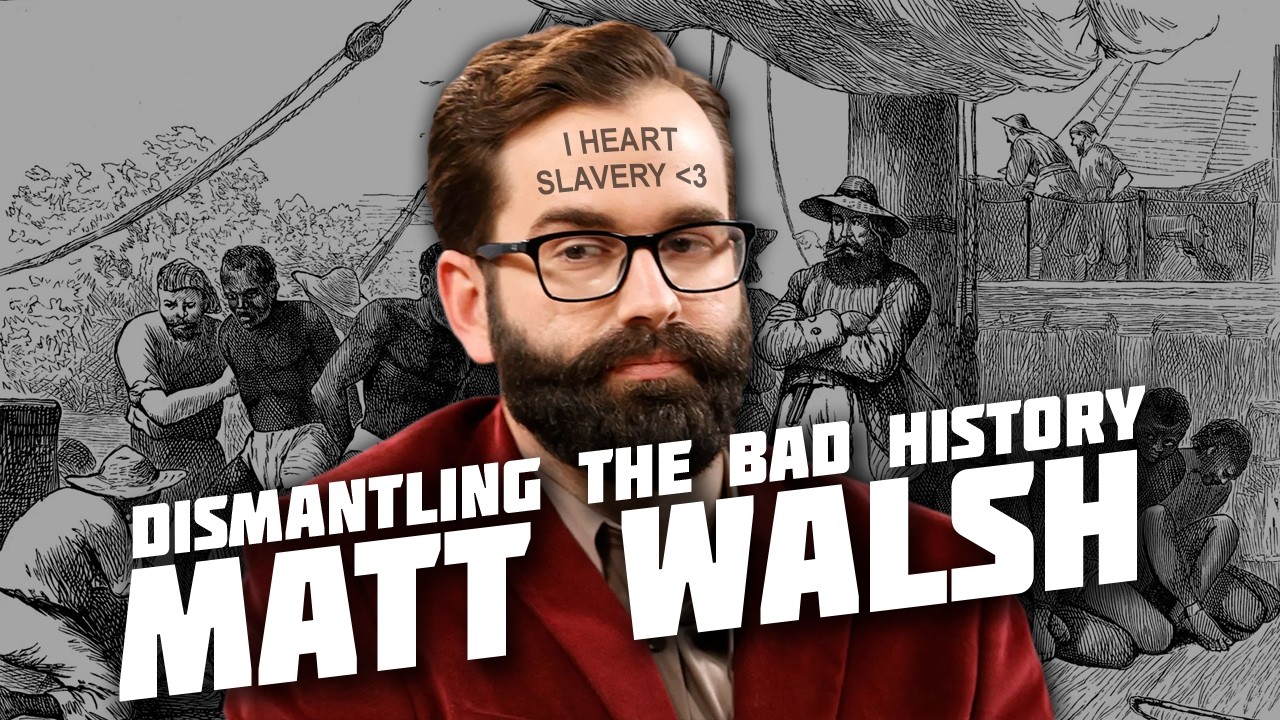
Conservative podcaster Matt Walsh has released a so-called history documentary called, and I quote, "Real History", which in his own words is meant to reveal the so-called lies told by the quote mainstream historians and academia. This is not the first time we've seen content creators adopt this angle when trying to pitch their idea of history which runs counter to the sort of consensus on the topic that exists in academia.
Often times they engage in conspiratorial thinking, claiming academia has been infiltrated by and is being run by the left to advance a Marxist agenda or something of that sort. It's tactic used to present yourself as the sole arbiter of truth. What you're seeing at the top of the screen is a citation. Historians work with, analyze, and interpret sources. Everything we write or say in a professional capacity has to be anchored in a source, their connection to the past.
They're also how we stay honest. We can't just lie about what may or may have happened in the past. We have to point to some sort of evidence, hence the citation above. When we do so, we also cite in such a way that you can actually find it as easily as possible, so as to not obfuscate our evidence. In this video, I'll be dismantling Matt Walsh's so-called Real History bit by bit. I'll investigate every single source and in some instances investigate the sources' sources.
I'll try to present a thorough and comprehensive review of Matt Walsh's aptitude as a historian at great personal cost to my own sanity. This isn't a fact check type video where I see what facts Matt Walsh got right or wrong. The goal of the video was to investigate whether this is history to begin with. To give a math analogy, imagine someone is tasked with adding 2 + 2. They might say five and you might go, well, that's not quite right.
Now, imagine you ask them to show their work and they seem to have arrived at five by doing 10 / 20, which is neither the correct answer four nor is it even addition to begin with. And it also doesn't result in an answer of five. That's how my investigation of Matt Walsh's work here made me feel. Let me quote the eminent historian E.H. Carr's analogy. Quote, "To praise a historian for his accuracy is like praising an architect for using well-seasoned timber or properly mixed concrete in his building.
It is a necessary condition of his work, but not his essential function." In this analogy, a house built by Matt Walsh cannot stand. Let's go to his very first source. One professor from the University of Wisconsin spent 11 years administering historical literacy tests to his students. He discovered that they overwhelmingly believed that slavery began in the US, was almost exclusively an American phenomenon. Let me present the facts that are left out here.
The College Fix is a conservative news site. The article says that the professor calls these cultural literacy tests, not historical literacy tests. The professor is not a professor of history and he's not teaching history students. He's an English professor by the name of Professor Duke Pesta, whose PhD was in Shakespeare and Renaissance literature. He runs a private online school called Freedom Project Academy. Here's their website with what appears to be AI-generated headshots of their staff.
He's also literally worked for the College Fix as the host of its Campus Roundup YouTube show. In the article, the professor actually says, quote, "They are convinced that slavery was an American problem that more or less ended with the Civil War and they are very fuzzy about the history of slavery prior to the colonial era. Their entire education about slavery was confined to America." Additionally, nowhere in said article is the professor quoted as saying, quote, "Most college students think America invented slavery." Professor Pesta doesn't present any data or numbers in the cited article.
He says this is the result of 11 years of testing. There is no way for us to verify the data or evaluate his methodology. In other words, if I'm working like a historian would, I would say that this man may as well be making this up. Following this, he sets up the straw man argument he will be confronting. We've been told that the history of slavery is straightforward and uncontroversial. We've been told that black slaves were mostly captured by whites, that white colonists in the Americas routinely enslaved free black men, and that more black people were enslaved than whites.
And we've been told that we're not allowed to question any of that. He's not actually quoting anyone who's making any of these arguments. He's just saying, quote, "We've been told this or that." Told by who, Matt? From this, we can extract Matt Walsh's thesis, the message or point that he wants to prove with this video. His thesis is this: The history of slavery is not straightforward and it is controversial. Black slaves were not mostly captured by white people.
White colonists in the Americas did not routinely enslave free black men. More white people were enslaved than black people. We should be questioning these facts. Once again, I want to point out that he's not presenting a counter narrative to any specific academic narrative. If he was, he would cite or point to that narrative. He's made up these claims that he's trying to debunk. He's fighting an evil Marxist academic in his own head.
Conservatives are really good at this thing where they make up a guy to be angry at. Let's get point number one out of the way. The history of slavery is obviously complicated and full of nuance as any actual academic would tell you. And it's obviously not uncontroversial as evidenced by the very existence of his video. If it wasn't controversial, there'd be no debate over the statues, reparations, long-term effects, and so on.
We would just be addressing these things and moving on with our lives. But we're having this debate because it is controversial. So, that's one out of the way. Let's move on to two. Historians and political pundits spend a lot of time talking about the transatlantic slave trade, the 350-year period in which an estimated 12.5 million slaves were brought to the Americas. A likely thing for historians to be talking about.
First, we start with a West African country you've likely never heard of, the Kingdom of Dahomey. Now, Dahomey was not a peripheral player in the Atlantic slave trade. It was central to it. The kingdom's wealth, its military power, and its cultural splendor were built entirely on the systematic capture, sale, and export of human beings. He's highlighting Dahomey because it was an African kingdom that became tremendously wealthy on the capture, sale, and export of human beings.
Export is the key word here. The rise of the slave trade, colonialism, early globalization, and capitalism were all interlinked. Slaves were captured to ensure supply in order to meet demand. That demand came from European colonizers. If Europeans had not shown up, there would still be slavery, but the scale would have been far lesser, the nature of it different, and there would have been no export. African slaves weren't capturing just to meet local demand.
They were capturing to meet the demand of several world-spanning colonial empires. Dahomey, according to Robin Law in an article on the historiography of Dahomey in the Journal of African History, was founded in 1625 and its militarism was a recent phenomenon. Quote, "Although the earliest accounts of the area do of course allude to wars, the sources offer a clear enough impression that by the 1690s the scale and frequency of wars on the Slave Coast was significantly greater than earlier.
Countries on the Slave Coast seem to have increasingly availed themselves of mercenary soldiers, a phenomenon that Europeans might have brought to the region. Quote, "The commercialization of warfare which it implies seems itself a significant new phenomenon. The rise of Dahomey in the interior was clearly only a part of a wider process of increasing warfare. Dahomey's military organization was geared towards the capture of slaves, with the king paying four times as much for a live captive in war as for a head.
Some of these slaves were taken to work on royal farms to feed the professional standing army, which allowed the Dahomey to continue waging war and continue capturing slaves. These slaves could be exported in exchange for European firearms, which allowed the further professionalization of the military and continued conquests. And so, the process repeats. Robin Law summarizes his article thusly. It examines the militaristic character of the Dahomeyan state and suggests that this is best understood as a consequence of increased warfare stimulated by the overseas market for war captives.
Before creating this video, I reacted to it live over on Twitch. I'll sprinkle in some clips for that when it's appropriate. Go ahead and hit follow if you want to see me in a more casual context. Anyways, here's the first clip. In the 19th century, a Dahomeyan king named Gezo described the slave trade as the ruling principle of my people. It is the source of their glory and health. Their songs celebrate their victories and the mother lulls the child to sleep with notes of triumph over an enemy reduced to slavery.
So, what he's not talking about here is that the people in Dahomey are not the people creating the demand for these slaves. Yeah, that's actually a source cited. Holy I'm Matt, you're actually doing better than most history YouTubers. God, was I wrong. This is where everything starts falling apart, fast. I looked at the page he referenced and found to my great surprise that the quote wasn't there and that page 147 was in chapter 14 titled Mamluks and Ottomans, not at all related to the topic at hand.
So, I went to the index in the back of the book to see where the book discusses Gezo and it occurs on pages 193 to 17 and 221. I went to page 193 and lo and behold, there's the quote. My first theory was that they had cited the page number that their PDF reader might have shown, but the PDF reader page the index points to is page 175. They might have thought to type page 175, but accidentally typed 174, but then messed that up and typed 147, but I have no idea.
If there are other editions, I couldn't possibly know which one he cited because he didn't list the year the book was published. I don't really know how this happened, but I might have a theory that I'll come back to later in the video. The citation is almost completely useless. I did of course find the text in the book after some searching. The context of the quote is that the British, having at this point abolished slavery, offered cash payments in exchange for the locals ending their slave exports.
The wider context of that, of course, is that the rise of the Dahomey and the emergence of the culture that this King Gezo speaks of could not have occurred had Europeans like the British not integrated them into an almost globe-spanning slave market to begin with. But I should point out that this quote, allegedly said by the King Gezo to quote a British naval officer, is not specific about when this was said, who this officer was, and there's no citation to a contemporary account writing down that this actually happened.
It perfectly well could have, but we can't follow the evidence back to where it was originally attested because the evidence ends here. Therefore, it's a bad citation. But there are worse ones coming. Next, he starts talking about an all-female military unit referred to by Europeans as the Dahomey Amazons. And he cites his source here, but this time for some reason there's no page number, which is strange because he did that on the last citation.
So, I got the book and found the quote. Turns out he's rewritten the quote for some reason, changing the wording and leaving out a very important sentence that precedes it. Here is Matt Walsh's quote alongside the original quote from the book. Here's the sentence that he left out, which makes it clear that these were just soldiers. These were the king's wives. I don't know why Matt Walsh would change the wording from ringing a bell to carrying a bell as well as other alterations to the sentence, but once again, I have a theory as to how and why it happened, which I'll get to later.
He cites an article about a study that proved traces of blood in the mortar of the palace and a scan of a 1994 UNESCO journal, both available online. Decent enough sources and he doesn't seem to be doing anything misleading with them. Or so I thought. When I read the study, I thought that their evidence doesn't really back up their sweeping claims about history, but I'm not a scientist, so I didn't feel comfortable making any definitive statements.
So, I sent the study to my girlfriend who is a scientist while she was in the lab. 2 hours later, she confirmed my suspicions. Using a limited sample size of six points on the inside of King Gezo's tomb, they established the trace presence of human and chicken peptides. There are numerous ways this could have ended up in the samples of this location. Also, there's no control. How can you prove that something definitively happened in one place unless you test using the same method in a place where you know for sure the mortar didn't use blood.
That aside, the data doesn't de- finitively prove anything about human activity. It's possible sacrificial blood was used in the mortar of the tomb, but the study doesn't prove that, only the trace presence of blood in six sampled points on the inside of the wall of the tomb. Matt Walsh himself brings up human sacrifices inside tombs to allow people to accompany a king into the afterlife. That could be a possible hypothesis for the findings, but so could virtually anything else.
You need more in order to make this conclusion. Also, they use the historical account of a man named William Snelgrave who isn't necessarily reliable. More on that in a moment. But then he introduces another element of his thesis. Assuming you survived the Dahomey raid, which wasn't likely, and were taken captive, it was far preferable to be sold to Europeans than to remain in Dahomey. The argument is that it was to the benefit of those captured by the Dahomey to be trafficked into the European-run Atlantic slave trade, which gives the slave trade an almost humanitarian character.
Let me let him finish before I delve into that. Slaves they couldn't sell or that they didn't want anymore were subjected to torture and public executions. That's because the Dahomeans believed that they could communicate with the gods through human sacrifice. Matt Walsh's argument here is actually a very old one, roughly 2 to 300 years old in fact. Quote, "The emergence of Dahomey into the European consciousness in the 1720s, it is important to note, coincided with the beginnings of a serious public debate about the morality of the slave trade.
It must be stressed that our principal accounts of 18th century Dahomey were all written by active participants in the slave trade. Further, all three were active polemicists in defense of the slave trade and their works were published explicitly as contributions to the debate on the slave trade. These people writing about the atrocities committed by the Dahomey were not shy to lie a little in order to emphasize the moral duty of Europeans to rescue Dahomey's war captives by trafficking them to their sugar plantations in the New World, like some form of humanitarian slave trade.
Quote, "It needs to be stressed how functional this view of the Dahomean society was for the anti-abolitionist case. Stress on the Dahomey's warlike character implied a situation of perpetual warfare, generating large numbers of war captives. Stress on the Dahomean brutality and the practice of human sacrifice on a large scale implied that such captives would normally be killed. The European demand for slaves, it could then be argued, provided incentive for the sale rather than the slaughter of these captives and so saved life." This is an argument that was formulated by the anti-abolitionist William Snelgrave in the 1730s.
Quote, "It is evident that abundance of captives taken in war would be inhumanly destroyed was there not an opportunity of disposing of them to the Europeans so that at least many lives are saved." The tyrannical nature of the Dahomey regime that Walsh seems to be emphasizing is also a recurring theme from the arguments of slavers at the time. Quoting historian Robin Law, "The stress on absolutism in Dahomey also served anti-abolitionist purposes by implying that Africans were effectively slaves already so that the Atlantic trade involved not the enslavement of free men, but merely the transfer of slaves from one continent to another." This was one of the things that Matt Walsh set out as part of his thesis in the beginning of the video, that Europeans weren't actually enslaving free men.
They were just transferring slaves from one place to another. This is an argument made by slavers in the 1700s that Matt Walsh is parroting. Quoting Robert Norris from the 1780s, "The general state of the African in Africa is that of slavery and oppression in every sense of the word. It is a lot of most of those that are brought to the colonies, who generally speaking were slaves in their own country, only to exchange a black master for a white one." A lot of what these anti-abolitionists said about Dahomey was exaggerated, but most of it, except maybe the allegations of cannibalism, was rooted in some reality.
Dahomey, for example, did carry out human sacrifice at an unusual scale compared to the rest of Africa, and Dahomey was particularly militaristic, having a professional standing army that eventually was equipped with European weapons. Even so, the picture that Matt Walsh paints is an exaggerated one that exclusively emphasizes barbarity and cruelty. The argument that Matt Walsh is making is a pro-slavery argument, one plucked straight out of the 1700s.
The blood of the murdered men was conducted by conduits into the trench until its quantity was sufficient to float the boat. This was the level of barbarism that defined the intra-African slave trade. The Dahomey literally sailed canoes in the blood of their slaves. First, I want to make it clear, as the authors that I've cited also do, Dahomey was an exception. The Dahomey's reputation for human sacrifice, slave taking, and militarism were not characteristic of the rest of the region.
It was a reputation that the Dahomey consciously cultivated as a means of control. And on the matter of the blood lake, he continues to heap on the stories of barbarity that sounds like it's straight out of a Warhammer Black Library book, dubiously sourced to a Sacramento Daily Union article about the Franco-Dahomey Wars, or in other words, the French conquest of Dahomey in the 1890s. Historian of Africa Edna G. Bay writes unambiguously in Wives of the Leopard that, quote, "There were no lakes of blood and cannibalism was never more than a rumor." The context of this being written in the middle of the French conquest is very important.
Quote, "Paralleling the political changes were changes in European perceptions of African peoples that ultimately provided rationale and justification for conquest and political subordination. Scholars have traced the growth of pseudo-scientific thinking about race and nationality during this period. In European and North American popular culture, Dahomey emerged from these debates as an archetype of depraved savagery, its name synonymous with barbarism.
By the time French soldiers arrived on the coast, the French press had prepared them to fight against the fameuses Amazons. The Dahomey who were confronted with aggressive European imperialism, unfortunately, also encouraged these exaggerated and inaccurate views of them as terrifying savages. Quote, "The Dahomean ruling elite expected European nations to respond as their African neighbors did, with terror." Of course, they didn't.
So, what was intended as scare propaganda instead became justification for European conquest to put an end to the supposed savagery. The fact that the newspaper printed a completely fabricated story about sailing a canoe on a lake of blood from human sacrifices and the fact that this newspaper is printed right before the peak of yellow journalism in America means we can't really take the article's content at face value.
The article doesn't cite an author, only citing another newspaper, the St. Louis Globe-Democrat. One element of the article that Walsh brings up is that the abolition of the slave trade led to an increase of human sacrifice in Dahomey. Such gruesome accounts were an ironic outcome of European powers ending the slave trade decades earlier. Unsellable slaves were only useful as human sacrifices. He is, of course, wrong.
But like all the lies about Dahomey, there's a grain of truth to it. The Dahomey state rose as a result of the slave trade. It had become reliant on its income to support itself. The wealth allowed gift giving and the purchase of loyalty, for example. Quote, "A reduction in the quantity of such sumptuous goods threatened a reduction in the numbers of followers and supporters of the king. In effect, participation in the slave trade had drawn Dahomey into an international commercial network for which it could withdraw only at the cost of the possible destruction of its social and political system." In essence, the slave trade had made Dahomey, and the Dahomey political elite were well aware that its abolition would similarly lead to its own making.
The Dahomey, seeing the writing on the wall, were eager to replace the income from the slave trade with other exports such as palm oil. Breakdowns in negotiations with the British over possible subsidies in exchange for no longer participating in the slave trade, and the death of King Gezo, who may have been a part of a reformist faction, led conservatives who argued for increased militarism and slavery to win through.
The result was an increase in human sacrifice, but not because the slaves had nowhere to go. If your state is struggling economically because you can't sell slaves, killing those slaves instead of putting them to work doesn't make much sense. To actually understand the rationale here, you need to understand it on Dahomean terms. Slaves were laborers, one of the most vital and important resources of the kingdom. A king who can afford to sacrifice a slave is a rich king.
A rich king is a successful king. If you sacrifice less than your predecessor, you make the decline of your kingdom's economic prospects very apparent to your subjects. So, in order to maintain their dwindling control over their dwindling kingdom, the Dahomean political elite used terror, military authority, and state religion. Quote, "The power and material success of the monarchy were attributable to the skillful use of both supernatural and human resources.
They had less money to spend, but if they stopped spending, their subjects and their divine ancestors would abandon them, which surely wouldn't lead them to getting any more money. Quote, 'Only one response offered relief, increased devotion as exemplified through more ritual and greater sacrifice." This story is far more fascinating and interesting when you try to understand it as a response to their material reality instead of trying to argue in favor of the slave trade.
They weren't big players in the trans-oceanic transportation of slaves. They also didn't participate in the raids on the coast of Europe that we'll address later in this episode. That's because, quite frankly, they just didn't have the technology to do that. But that's never addressed by mainstream historians. What do you mean? >> [laughter] >> Wait, wait. Mainstream historians never talk about how the people of Dahomey really wanted to raid Italy for slaves, but they just didn't have the technology to do that.
Like, what do you mean? Anyways, he then does an ad read and talks documentarian Ken Burns for something inconsequential in his American Revolution documentary. Here's a clip of me watching that section on stream. It would be inconvenient for propagandists like Burns to point out that the slaves were already enslaved by other Africans, mostly women, by the way. >> [laughter] >> Reality makes the white guilt narrative That What guilt again?
We already have that, but This year our sponsor PureTalk is celebrating President's Day by giving you great wireless service for only So, if if you want to celebrate President's Day, change your mobile service provider. The way he criticizes Ken Burns is very silly when you actually could be offering very valid criticisms of his Civil War documentary. In that documentary, Ken Burns chose to feature an author by the name of Shelby Foote who does 73.5% of all interview narration in the documentary.
According to Kevin M. Levin, out of 7,653 words spoken by Foote, quote, "He referenced slavery in one form or another only three times. Never once did Foote reference slavery as having anything to do with the cause of the war or as a motivating factor for Confederate soldiers at any point during the war." Side note, one of the upcoming videos that Matt Walsh is making is going to be on the American Civil War, so I might be watching that on stream.
Shelby Foote is noted as saying, quote, "What's more, I would fight for the Confederacy today if circumstances were similar." Sorry. And he kept a portrait of Nathan Bedford Forrest on his wall. Some of you might know Forrest as the former Confederate general who, among other things, served as the first grand wizard of the post-Civil War Ku Klux Klan. Matt Walsh probably didn't choose this particular angle of attack against Ken Burns because Matt Walsh had no idea this happened and probably wasn't because Matt Walsh is sympathetic to the KKK.
Though, maybe he is. I don't know the guy. Then, after he mistakenly implies the Aztec Empire was contemporaneous with the Roman Republic, two polities separated by over 1,000 years, he brings us to another citation. The historian Amanda Podany writes in her book Weavers, Scribes, and Kings, quote, "A woman named Kueia made what must have been a heartbreaking decision. She would sell her daughter." We've encountered this phenomenon before in the Ur III period when a family had to sell a child into slavery because that was the only way that the child would be able to be fed and to live and the parents could survive.
The price of the baby was 30 shekels. So, I looked at page 410 of the book and it's not there. And that's because it's on page 411. If you check my Twitter on April 12th, 2026, you'll see that I was crashing out over how he keeps messing this up and I have no idea why. But again, I do have a theory. Now, Walsh leaves out significant portions of this story that are on this very page. And so, his portrayal of this event is so misleading as to basically be lying.
What Matt Walsh does is contract several events and fold them into one. For one, everyone in Kueia's town of Emar was struggling. And part of the reason that Kueia was unable to support herself and her children was that the husband had left the family. What Matt Walsh leaves out on the end of that quote is the sentence, "But in Emar at this moment, almost everyone was suffering." Kueia offered her baby to a person named Anat-ummi.
The author says this was a risky proposition for the purchaser because 40% of children died in childhood. The contract also specified that Anat-ummi planned for the baby to be her daughter, not her slave. So, the section Matt Walsh is reading from is not, in fact, about a slave transaction. Quote, "Perhaps the payment represented a kindness to Kueia. Anat-ummi could have adopted the baby without paying for her. But in any case, Kueia never sold the baby to Anat-ummi." Quote, "Anat-ummi never came up with the money and so Kueia took Balmunamhe back." I don't know if I'm pronouncing it correctly.
Kueia was eventually pressed to sell her children a year later after her husband had returned to her. But again, this is a completely different section of the book, not the one he's quoting from. At this point, they had had another child, but were still just as poor. They were sold to a family of some import, rich people. But it's not clear if they were sold to be this man's children or to be treated as slaves. The contract doesn't specify.
Usually, contracts would specify that a child would be raised to some profession so they would have independence in adulthood. Matt Walsh brings this up in a section where he's trying to explain the normalcy of slavery in history, but he's using an extraordinary example. Quote, "The sale of children was hardly considered normal at Emar. It was, in fact, condemned and had to be justified as having been caused by extraordinarily difficult conditions.
The times were extremely hard at the end of the Bronze Age." Again, this is all in the same book that Matt Walsh has supposedly read. A more famous ancient reference to slavery comes from the Code of Hammurabi, which established slaves as property, set rules for interactions between slaves and their owners, included penalties for harboring fugitive slaves, and had class-based punishments for crimes based on whether the perpetrator was free or slave.
He portrays the Code of Hammurabi as something representative of the reality of life under Hammurabi's reign, but the code isn't actually a set of laws to be followed. Quote, "In the extensive documentation of court cases judged in Hammurabi's reign and afterwards, there is no reference to a collection of laws that was the basis for a decision." So, what was Hammurabi's code actually? King Hammurabi himself spelled it out.
Quote, "Let a wronged man who has a court case come to the statue of me as king of justice and let the words of my stela be read out to him. Let him see his verdict and set his mind at ease saying, 'Hammurabi brought about well-being for the people forever and may the land have just ways.'" It was a piece of royal propaganda made to emphasize his image as a just king who would protect your private property, even if that property was a human being.
But also one who would protect you against other rich and powerful people. It maybe reflects the culture and what would have made people view the state as just and legitimate at that time and place. But it doesn't reflect the legal proceedings of that time and place. Here is another unfortunately up citation. In Aristotle's Politics, he openly declared, quote, "Some men are by nature free and others slaves, and that for these latter slavery is both expedient and right." Walsh is citing Benjamin Jowett's translation, which is 141 years old and so it's in the public domain and available online.
However, the passage he's quoting once again doesn't appear on page 34. It's on page nine of Jowett's translation. I don't know why this keeps happening. Because the translation Matt Walsh is citing is actually 141 years old and it's been reprinted numerous times in various editions by various publishers, and since he doesn't list the year or edition, it's impossible to know which one he read. It could be he's using a different edition.
Who knows? But at this point, this is a consistent and reoccurring issue. Slaves who worked domestic jobs or skilled crafts had a decent shot at acquiring freedom, but there were also slaves who were sent to the mines. They were leg-ironed, routinely starved, savagely beaten, seldom saw daylight, and were worked to death with a typical life expectancy of about 4 years. When I was watching this for the first time, this citation puzzled me because I've never seen someone list their Bachelor of Science and their PhD in a citation.
Here's how I reacted to this live. That's a very interesting way of doing a citation. What is he citing here? Cuz before he cited page numbers and now he's just cuz all the citations are very different. They're never the same. They're not standardized. And here, "Silver production in city/state of ancient Athens." Um Maxwell K. Boots. What's smedega? smedega.org.au. Australian website. It's a PDF. It is a PDF. I just want to show you like the top of the PDF, the very top of the PDF.
How the do you put an image in in this I guess you can just use this one. Wait, what is this one? That's not really relevant. This is what's at the top of the PDF. That's why the citation looks like that cuz this is what's on top of the PDF. But that's not how you cite the PDF. [laughter] Wait, hold on. Wait, no, no. Sorry. I want to read the introduction. Can I read the introduction to you real quick? Introduction. "Much of what follows was sourced from the internet.
However, I remain responsible for the conclusions." What is that sentence? That's the first sentence in the whole document. "Genetic model here is centered around the presence of the large NS trending detachment fault in the" Is this a geology paper? Is he citing a geology paper? >> [laughter] >> What the is this? Read the red text. Wait, where's the red text? That's what the lecture was about. "I now put the silver mines in the historical context." So, this is these are lecture notes?
Oh my god. Yeah, this is just a guy talking. This is not at all like something you should cite unless you were at the lecture, maybe. You could. So, to give you the rundown of what just happened, Matt Walsh went looking for a quote and somehow ended up finding the personal lecture notes of a geologist, I think, who presented for the Sydney Mineral Exploration Discussion Group in 2020. He didn't cite the lecture and he didn't cite what was said at the lecture.
He cited the personal notes of the presenter. It's not like finding information about slavery in Greece is a hard thing to do, so I have genuinely no idea why he reached this hard to find a reference this obscure. And that's not the worst of it. The quote, once again, isn't even what's written in the notes. The actual quote is, "The slaves had a life expectancy of about 4 years. They were leg ironed, routinely starved, savagely beaten, seldom saw daylight, and were worked to death." He put the preceding sentence after for some reason, and changed the wording from "They were leg ironed" to "They wore leg irons." Just like the Ringing Bell quote from earlier.
It's as if there's some sort of computer program trying to optimize his wording. Slavery was widespread outside of Europe, too, of course. According to the anthropologist Pierre van den Berg, war captives and slaves were systematically humiliated and often tortured to death in some North American Indian societies. Among some South American groups of the Amazon rainforest, slaves were well fed, but only in preparation for a cannibalistic feast preceded by a mock battle in which the slave would be clubbed to death.
Here, for some reason, Matt Walsh chooses not to list the page number, but I managed to find the quote anyways. It's on page 117. Matt Walsh ironically citing an author who very much disagrees with the whole premise of his line of argument. Walsh frequently makes reference to how slavery was worse in other places than America. The author, in fact, makes it clear that he disagrees with this on the page right before the one that Walsh cites.
That is, on page 116. Quote, "The main ideological thrust of the slavery literature has been to document how horrible slavery was, and the comparative literature has mostly compared degrees of badness." Continuing further down the page, "This exercise of guilt expiation of Western, particularly Anglo-Saxon scholars, has not been fruitful. Degrees of evil are difficult to measure, and the outcome differs radically depending on the criteria chosen." Finally, let me read an illustrative quote from the very same page Matt Walsh cited.
"What distinguishes Western chattel slavery from domestic slavery is not greater moral depravity, but greater economic rationality born out of a capitalist mode of production oriented to a world market and consciously profit maximizing." This is an argument I've made many times. The difference is in scale, not in degrees of badness. In my mind, comparisons between these different forms of slavery, which emerged under very different conditions, aren't fruitful.
Irish marauders frequently raided the British coast for loot and slaves. Thousands of men, women, and children were taken. In one raid on the village of Bonnavent Taberniae near modern-day Wales, Irish raiders kidnapped a 16-year-old boy named Succat. Succat spent 6 years as a slave at a sheep farm in Northern Ireland. >> [music] >> He later escaped, returned home, became a priest, and came back to the land of his captivity as a missionary.
And we know him today as Saint Patrick, patron saint of Ireland. This is a hagiography, a tale constructed to idealize a saint after their death. We don't know for sure if Saint Patrick was actually trafficked by Irish marauders. Professor LeRoy Fleckner of University College Dublin posits an alternative theory. Saint Patrick was a tremendously wealthy man, possibly holding an imperial office in Roman Britain. And despite Walsh painting this as a story of Irishmen enslaving the British only to later have the tables turned on them, it's likely that Saint Patrick himself owned slaves in Britain.
And he may have done so even after he became a priest, because priests were not barred from owning slaves, and it's well documented that they did in the period in question. Quote, "There were at least two distinct contemporary narratives for the events that Patrick described and alluded to in the Confessio. One was Patrick's, and the other was a rival narrative that discredited Patrick. Saint Patrick was accused of having gone to Ireland out of financial gain, which is a strange accusation to make of a slave." Fleckner posits that when Patrick's father took holy orders, he would have been legally obliged to install his son as holder of his imperial office.
"This was a period characterized by social, economic, and political unrest." Quote, "At such times, curial obligations, such as collecting and underwriting taxes, would have been extremely difficult and even risky to discharge. Patrick might have then decided, perhaps with his father's consent and encouragement, that the best escape route open to him would be to set himself up in Ireland, and by so doing to ensure that the family wealth would not be depleted through the underwriting of taxes or malicious lawsuits.
This is a fairly well-established phenomenon at the time. Many others had done what Patrick may have done here." But we simply don't know. There's a lot of ambiguity here, and once again, there's a lot more to the story than Matt Walsh lets on. Islamic pirates, led by a commander named Morat the Younger, arrived banging war drums and screaming in Arabic. According to a book called The Stolen Village, quote, "None of these untraveled fisherfolk At this point, I'm not going to believe with the point.
It's not on page 130, it's on a different page. A brief note about Des Ekin's book. It's not written as an academic work of history. Seems to me overly sensationalized and relies heavily on two pages relating what happened in a report from the Council Book of Kinsale. I checked those pages as well as the author's other sources to find that most of what the author describes in vivid detail is actually just guesswork based on accounts about Barbary pirates in different locations about 200 years later.
It's basically just speculation that maybe they did some of these things because Barbary pirates were attested to have done them centuries later. What he writes is as if he was there, and he writes it as if it definitely happened. The two pages of actual contemporaneous account contain very little of this vivid detail that Matt Walsh is quoting here. This is just plain and simple. According to the book The Forgotten Slave Trade, historian Simon Webb described this shocking contemporaneous account.
Quote, I'm going to stop Matt Walsh right there, because I alluded to this guy in the beginning of the video. Here's my live reaction to discovering who Simon Webb is. Yeah, so so this guy, Simon Webb, he has a a YouTube channel called History Debunked. This channel is for anybody who has ever questioned the stories which they learned during history lessons at school. Oh, that's a good start. Another video by him, "The King wishes Muslims Ramadan Mubarak, but cannot bring himself to say Happy Easter to Christians." >> [laughter] >> Right.
So, source cited 11. Acceptable sources remains at eight. That's awesome. That's so good. That's sick. He has one um that says, "Homosexuality and Jews, two threads running through Keir Starmer's premiership." The myth of Jesse Owens being snubbed by Hitler at the 1936 Berlin Olympic Games. Why we all like to pretend that Hitler was beastly to poor Jesse Owens. I I don't know if I want to hear him say anything about Jewish people.
Uh test IQs in Nigeria and finds that the results are just as everybody expected. Is that the one you're talking about? Okay, so he's actually he's citing like an actual like hardcore racist here. That's awesome. That's so funny. The great thing is that I don't even know if Matt Walsh knows that this guy is this racist. To give you some extra background information on Simon Webb, according to Hope Not Hate, he's written a book on race science called The Equalitarian Dogma.
He received funding from Silicon Valley tech millionaire Andrew Conru, who's the founder of the swinger site AdultFriendFinder and a principal investor in the international race science network Human Diversity Foundation. Andrew Conru has also donated to Turning Point USA. Unlike the transatlantic slave trade, which was driven by pure profit, the Barbary raids on Europe were motivated by bloodlust and hatred. One historian described it as revenge, almost a jihad for the expulsion of Muslims from Spain in 1492.
There's an assertion here that the Barbary slave trade was not motivated by profit, but motivated by bloodlust. Note the three dots at the start of the quote. That indicates that they have removed a part of the sentence from the quote. Matt Walsh has done this previously without indicating that he did it with the three dots. I'm not sure why he chose to be honest here, because when you look into it, you realize this quote is not exactly what he makes it out to be.
Quote, "In Barbary, those who hunted and traded slaves certainly hoped to make a profit, but in their trafficking Christians, there was also always an element of revenge." So, not only was it entirely bloodlust and revenge, there was an element of it, at least claims the author here, and there was a desire for profit. This is also from the introduction, not the actual main body of the work, which is, generally speaking, not the best practice, because there's no footnotes and no sources in the introduction here.
Additionally, this author is also maybe not the best historian. Let me read you a review from the Journal of African History. "Readers of the Journal of African History and others who are used to consulting works about non-Western history will find this book quite odd. With the proliferation of cross-cultural studies of the past decade or two, few authors undertake to study any theme in a non-European context without even attempting to understand it within its own cultural context.
However, Professor Davis has somehow succeeded in writing an entire book that deals with an aspect of Ottoman enslavement without consulting a single Ottoman source, and without showing any understanding of Ottoman society, culture, political institutions, or economic structure. The result is, not surprisingly, akin to what books about Middle Eastern and African history looked like around the middle of the 20th century.
External, stereotypical, unconscious of otherness, and sorely uncritical of its own external sources and their limitations. If Davis' book was about constructing Christian enslavement, this could perhaps fly in certain discourses and bodies of knowledge. Unfortunately, however, it seeks almost naively to describe actual historical realities. Now, Davis does, later in the book, apparently claim that yes, there was a little bit about profit, but mostly about jihad and revenge against Europeans.
But how can he make that assertion if he doesn't use any Ottoman sources? How can he know anything about the Ottomans if he didn't read what the Ottomans actually thought this was all about? Let me finish by quoting the end of the review. "To conclude, Christian Slaves, Muslim Masters is a disappointment to people interested in non-European perspectives on African and Mediterranean history. Its saving grace is that it brings some interesting and neglected information that might be used to write another book with a broader and more comprehensive approach.
Professor Davis might also contribute to our understanding if his book provokes scholars in the field to write a corrective work on the topic of Ottoman enslavement of Europeans in North Africa during the early modern period." To sort of translate that from academic to normal, essentially, Professor Davis' work will only really be useful and make a contribution to the academic field if someone else makes a work to correct how bad his work is.
Boarded and the crews [music] taken to North Africa as slaves. We don't have to go much further on this one because that's once again Simon Webb, but the citation doesn't make it clear if it's Simon Webb's Substack or his YouTube channel, both having the same name. And it doesn't make it clear which of the 4,800 videos it is or where to find it on a Substack where he's published multiple articles a week for years. It's a citation.
When it comes to protecting yourself and your family, it's better to be prepared. That's why I'm a member of Ammo Squared. Ammo Squared lets you build an ammo reserve of your calibers steadily month by month. He's advertising what seems something like a cloud-based ammo storage solution here, probably designed to bypass regulation on how much ammo you can either own or store in their location. So, instead, you get an ammo IOU to redeem when you want your ammunition.
Be prepared for when you need it, and then just wait 3 to 5 business days for it to arrive. By some estimates, as many as 17 million East Africans were sold into slavery over 1,300 years, dwarfing the transatlantic slave trade. According to the American National Endowment for the Humanities, 12.5 million Africans specifically were trafficked in the transatlantic slave trade between 1525 and 1866. 17 million doesn't really dwarf 12.5 million, especially not when you consider the fact that Matt Walsh claims this 17 million number was reached over a period of almost a thousand years longer than the transatlantic slave trade even existed.
This is deeply stupid, but for illustrative purposes, if we use these numbers, then almost three times more were trafficked a year in the transatlantic slave trade. Again, none of this matters because these comparisons are stupid. We can acknowledge the cruelty and atrocity in both instances without minimizing either. And the practice wasn't abolished until 1909. Once again, because of colonizers, this time from Britain.
Also, ironically, the East African slave trade grew rapidly as a result of European colonizers abolishing the transatlantic slave trade. It's often brought up how the British abolished slavery around the world, and while that's true, Britain still, quote, effectively sided with the Confederacy during the Civil War. Cotton needed slaves, and the industrial mills of northern England needed cotton. Just like later industrial processes would need rubber, and rubber would need slaves.
This next part is actually quite interesting. On the morning of June 14th, 1786, Captain James Moore's family woke up on what seemed to be a normal day in Southwest Virginia. But as they left the family's cabin to attend to their farm animals, the fearful war whoop was heard. And a raiding party of Ohio Valley Shawnee Indians rode down a ridgeline and attacked them. Captain Moore was shot seven times before being tomahawked and scalped.
Matt Walsh is using a primary source account by Mary Moore, written down through her recollection by her son. We can excuse Walsh for citing it in the way that it did because the original author never actually penned his name to it, but we know his name. It's James Moore Brown. The book was originally published in 1854. I'm reading the 1942 reprint because it has a very interesting introduction by the editor Robert Bell Woodward, who gives us some more historical context as well as his opinions on the matter.
I hope at this point we can all agree that Matt Walsh is not exactly a trained historian. As such, it's a bit irresponsible for him to be uncritically utilizing a primary source in this way. What he should be doing is finding the interpretations and analysis done by experts on the topic and using those instead. But of course, he won't because he thinks they're woke Marxists or whatever, except for when he thinks they are agreeing with him.
In terms of the context that's left out by Walsh here, the location that these white settlers chose to settle was actually somewhat of a war zone long before a white person set foot near it, with several competing claims between the indigenous nations in the area. The editor of the book characterizes the acts of the Shawnee as a form of resistance to encroachment on their lands. This massacre, which occurred in 1786, was preceded by terrible atrocities committed by settlers, for which the Shawnee took terrible revenge.
Quote, the exasperated Shawnees took ample vengeance, and the blood of multitudes flowed along the frontiers. Careful historians find the white men chiefly to blame. This is in reference to a string of atrocities committed by white settlers in the preceding years. The editor implies some blame on the part of James Moore for the choice to settle or, at the very least, not leave his homestead founded in this conflict zone, in the middle of a period of intensifying conflict between the indigenous and the settlers.
The original author, the son, describes this as a site of conflict between the Shawnee and the Cherokee on page 14 of the original book. the duration and hereditability that historians increasingly regard slave as the more accurate term. There's no question that indentured servitude was slavery. Some indenture contracts literally use the term slave, and ads issued for runaway servants He literally doesn't cite anything here, but he makes it look like it's a quote from something.
He may as well be making this up. one designated undesirable by the British government. In the winter of 1650, 150 ragged Scottish prisoners of war arrived at Massachusetts Bay Colony, where they were sold as indentured laborers for 20 to 30 pounds each. Once again, there's no page number, but this time it's because none of this text appears in the book at all. I had to Google it to find that it presumably is the text printed on the back of the book.
I don't know because I've got an ebook copy. I'm genuinely impressed by how he just keeps finding new and innovative ways to piss me off. In colonial America, white and black slaves often bonded, according to NPR, which admits America's first slaves were white. According to some, uh, African-American uh, historians, they quote "There was no sign or little sign This isn't according to National Public Radio, you This isn't an editorial position of NPR.
It's the position of the two historians who wrote the book they're discussing in this interview. He also says, quote, "Okay, they saw themselves as suffering in common, and therefore they fought, as I say, against their oppressors together. In the end, their oppressors got terrified of black and white amity at this lowest level, and therefore a racial wedge was deliberately pushed between them, and the whites were made to feel superior." The book that the author here co-wrote is called White Cargo.
The authors introduce the book thusly, quote, "This book tells the story of these victims of empire." Matt Walsh opens his so-called documentary by alluding to a conspiracy to make you hate America and its founding fathers and national heroes, as well as the West and so on. But this book specifically actually seeks to rewrite history and charges Thomas Jefferson with propagandizing a creation myth of America, of a country founded by free men and women who, quote, created a democratic and egalitarian model society more or less from scratch.
A key thesis of the book is that slavery was inherent to the founding of America. It was alluded to in the interview, but when the authors were discussing Bacon's Rebellion from 1676 to 1677, the authors describe the terror of the planter class at the sight of a black and white underclass standing together. The authors describe the planter class as the early American capitalists. Virginia's rulers, in a stunning bout of class consciousness, understood that their numerically small ruling class standing in opposition to a uniform, numerically superior underclass was a precarious position.
Quote, they had no sizable yeoman class as a barrier to servile revolt. Quoting further, the task facing Virginia's rulers now was to fashion a class that gave them as many Virginians with a stake in suppressing servile insurrection as there were in fomenting it. They needed to create a middle class, a class to fight the battles of the planter elite. They pushed the front lines of the class struggle further down the ladder, and they drove a wedge between those whose class position had made them allies against the planters.
Quote, they played the race card. The status of the European servile class was upgraded, and a sense of racial superiority instilled. Meanwhile, the process of degrading non-whites was accelerated. In addition to this author that Matt Walsh cited to support his arguments, another author expressed a similar sentiment about how racism and racial slavery existed as a wedge dividing the working class. Quote, in the United States of America, every independent workers' movement was paralyzed as long as slavery disfigured a part of the Republic.
Labor in a white skin cannot emancipate itself where it is branded in a black skin. That's from chapter 10 of Capital, volume 1, authored by Karl Marx. 1671 report from Virginia Governor William Berkeley noted that the number of white slaves arriving vastly outnumbered black, quote, We suppose there come in of servants about 1,500, of which most are English, few Scotch, fewer Irish, and not above two or three ships of Negroes in 7 years.
These inquiries are just that, they're questions, which Matt Walsh chose to cut off for some reason, showing only the answer. Here's the question. What number of English, Scots, or Irish have for these 7 years last past come yearly to plant and inhabit within your government? As also, what blacks or slaves have been brought in within the said time? Two huge, glaring issues here. The smaller of which is that by cutting off the question, Walsh makes it seem as if this was the total amount in 7 years, and not, as the question makes it clear, the amount per year in a 7-year period.
Second, we don't know how many people said ships could fit. And I'm not about to speculate, nor could I find accurate information. So, in a sense, this quote tells us very little. In any case, in less than a decade from when this letter was posted, white people would be legally considered racially superior to black people, and a legally codified racial hierarchy would be put in place. was a planter and slaveholder named William Ellison.
Census records show that at the outset of the Civil War, he owned 63 slaves, making him one of the biggest slave owners in the region. During the Civil War, he and his sons made substantial donations to the Confederate government, but what makes Ellison remarkable >> [music] >> is that he was a black man. Yeah, I'm sure, but that's not William Ellison. That's Toussaint Louverture. Louverture was a anti-slavery revolutionary.
He killed slavers. American journalist and social critic Frederick Law Olmsted visited Mississippi in the early 1860s. He described meeting a black man who told him there were, quote, many free Negroes all about this region. Some were very rich. He pointed out to me three plantations within 20 miles owned by colored men. So, he's once again using a primary source here, and once again, he kind of mucks it up. This isn't in Mississippi.
The chapter he's quoting from is titled Louisiana. The term colored here likely refers to the term free person of color, which was a legal category indicating a racialized status. This is made pretty clear when they're referred to as French, because that's the language they spoke. Quote, "Within Louisiana slave society, free black people inhabited a middle stratum between enslaved people of African descent and free white people.
Their freedom was accompanied by a set of privileges denied to enslaved people, including property ownership. Slaves are, of course, considered property. Quote, "Yet white lawmakers denied free people of color political participation and subjected them to legal restrictions and discriminatory treatment based on their race." He keeps bringing up these exceptions, but the rule is that if your skin was not white, you were, on the whole, discriminated against in a way that you weren't if you were white.
In total, an estimated 3,000 blacks owned roughly 20,000 slaves in 1860. >> This figure seems to have its origins in a Facebook meme. I'm not kidding. Which Louis Jacobson of PolitiFact tried to fact-check in 2017, but couldn't because he couldn't trace it back to any sort of evidence. Even if the number was true, there's a couple of facts that are being left out, once again. Quote, "For starters, even if the number is accurate, it would still account for just a tiny percentage of all slaves held in the United States specifically 1/2 of 1%.
In addition, in the southern United States, if you were a black person who bought a family member from a slave owner, you were not legally allowed to free that person. Legally speaking, they would remain a slave, and their children would legally be slaves, too, and counted in these numbers. This is according to historian Woodson, who Matt Walsh also quotes. According to the black historian Carter Godwin Woodson, they often simply bought and sold slaves like white traders.
The reality is that a very small percentage of free blacks and American Indians owned slaves, but the same is true for white Americans. Yes, in order to own or buy a slave, you likely needed a certain amount of money, and the people who possess that amount of money or who possess the need for a slave to work something in order to make a profit are likely going to be in the minority of the population, not the majority.
Then he does something very funny and very transparently misleading. In the 1860 census, at the very height of slavery, there were 393,975 slave owners in the US out of a total population of over 31 million. That translates to about 1.2% of the population. The vast majority of American whites never owned any slaves. Because it was illegal for the vast majority of American whites at this point. He's using the 1860 census and the total population of the United States.
At this time, the United States was famously divided into states where slavery was legal and states where it was not. The majority of the population of the United States lived in free states, which skews the statistic quite a bit. If you only look at slave owners in slave-owning states, you get a much different percentage. According to professor of history Daina Ramey Berry, approximately 25% of all southern households owned slaves.
By 1900, Britain, France, United States, Denmark, the Netherlands, Spain, Portugal had all outlawed it. Every single abolition took place in societies under European control or heavy European pressure. In a perfect Orwellian twist of irony, it turns out white men are the heroes of the slavery story. What the does a perfect Orwellian twist of irony even mean? Like god, he's so stupid. It's like the most ChatGPT ass script I've ever heard in my life.
Speaking of, this video's left me with a profound hatred for Matt Walsh, and I think it has laid bare his profound hatred for history as a field and as an academic discipline. Let's return to the sort of thesis statement he laid out in the beginning of his video, and let's amend it. The history of slavery is complicated, and it is controversial according to academics, as is all history. The historian John Lewis Gaddis believes we must judge figures in history, whereas historians like E.H.
Carr notes Gaddis are reluctant to pass judgment on figures or institutions in history. It's a common right-wing talking point that we cannot judge peoples of the past on the basis of how we view things today, particularly when it comes to those we build statues to. But John Lewis Gaddis, who explicitly says we should judge slave owners, is a right-winger, and E.H. Carr, who says we have no right to do so, is a left-winger.
There is nothing simple, straightforward, or uncontroversial about history, and that's according to the historians themselves. Number two is once again not a narrative touted by historians, but one that Matt Walsh made up in his own head. Historians are well aware that black slaves were captured by local slave catchers, but they were captured based on an external demand. The Atlantic slave trade was imposed on them because the market did not originate in Africa.
On number three, yes and no. Africans who arrived in the Americas routinely arrived as slaves already, and so did not need to be enslaved, of course. However, in the United States, a freed slave could be kidnapped and brought to a slave state to be re-enslaved. In addition to this, I'd like to argue that if we consider a person to be born free, then every black person born into slavery is a black person enslaved through a routine process by a white colonist.
Number four is very unlikely to be true, but we don't have the numbers. If we're exclusively talking about the United States, then it's obviously false. Even if we consider indentured servants as slaves, as the book White Cargo that Walsh alludes to does, then the authors themselves say, quote, "How many of those whites who migrated from Britain were subject to the abuses we associate with slavery? 100,000? 200,000? 300,000?
It is impossible to know. No one did compile, nor could they have compiled such statistics. The Barbary slave trade did not enslave more Europeans than the Atlantic one did Africans, and the number of indentured servants in the United States, at the very least, was likely lower than the number of slaves because the slave population grew drastically. We are questioning the narrative. We are constantly re-examining history to construct more accurate renditions of the past.
Half the sources Matt Walsh cited are credible historians who are doing just that, and who, for the record, would disagree with his framing. Now, let's address the large language model in the room. I am firmly convinced Matt Walsh's script was written by or significantly influenced by a large language model like ChatGPT. Every single source Matt Walsh cited is digitized and available online. Certain sources, like the geologist's pre- senter's personal notes for his presentation, are the kind of thing a human wouldn't stumble upon naturally, but it's perfectly reasonable to assume a program searched its database to find that information indexed somewhere in there.
In one instance, Matt Walsh's source for a claim seems to be traced back to a Facebook meme from 2017, which is very odd as well, but it is possible that he had seen this figure on Facebook and just remembered it and put it in the script. Some page numbers are cited so wrong there's no natural explanation for it. No other editions and no typo could reasonably have produced that citation, leading me to believe the page number was hallucinated by the large language model.
Sometimes pages are cited and sometimes they're not, with no rhyme or reason as to why that is, possibly indicating that the citations aren't being done by an individual with a specific style or approach to citations. One citation cites the book summary, which appears on stores where you can buy the book, but doesn't appear inside the book itself. It's possible the large language model makes no distinction between the back of the book summary and the contents of the book.
Some quotes are optimized, moving text around for no discernable reason or changing words for no discernable reason, in the way a large language model sometimes does. One illustration meant to represent the black slave owner William Ellison is clearly an AI-generated image trained on or based on an illustration of the Haitian revolutionary Toussaint Louverture. I'd like to quote M. Naddaf and E. Quill in Nature magazine.
"An exclusive analysis conducted by Nature's news team in collaboration with Grounded AI suggests that at least tens of thousands of 2025 publications, including journal papers and books, as well as conference proceedings, probably contain invalid references generated by AI." In one study, researchers prompted OpenAI's GPT-4 LLM to generate six literature reviews on three mental health disorders and analyzed the 176 references in those synthetic reviews.
Under these experimental conditions, they found that nearly 20% were fabricated references and could not be linked to actual research, and 45% of the remaining references, which corresponded to genuine publications, contained errors, often incorrect or invalid DOIs. I believe Matt Walsh has availed himself of some sort of tool that's mucked up a lot of his citations, because the errors I'm seeing are too consistently weird to be created by a human being.
The alternative explanation, of course, is that Matt Walsh is a new and special kind of stupid. So, what was the point of the video that Matt Walsh made? It doesn't contribute any meaningful arguments we haven't heard a thousand times before, nor does it present new knowledge. A fellow history creator named Autumn Shea also analyzed Matt Walsh's video. This is how he starts his video on the topic. How about what sword shall I kill myself with?
African or European? Autumn Shea comes from a very different perspective than me, because he's an American in the deep south. He's done videos on these issues for years, and these issues are much closer to home for him than they are for me. As such, I encourage you to watch his video afterwards. There's not much left in this one, after all. But I got his permission to include a very important point that he made in my video that I want to then build on.
A special thank you to Emperor Tigerstar for reaching out for me, and also thank you to Autumn Shea for saying I'm great. That made me feel nice. Here is Autumn Shea again. Uh but let's be very clear here about what this is. This whole media operation, The Daily Wire, initially got going because of funding from the oil and gas industry. The fossil fuel industry pumps an enormous amount of money into conservative, kind of cultural war causes. >> [music] >> 80% of anti-trans media operations, I'm going to put up the article to, you know, to fact-check myself, cuz I'm at the sort of half-remembering here.
But 80% of anti-trans media operations take fossil fuel money. Matt Walsh is a stooge of the fossil fuel industry, and he is telling us a story uh that will distract us from the destruction of the biosphere of planet Earth by the companies that that own him. And so we will sort of talk about this and we'll argue back and forth about this that and the other thing. Oh, you know, who had it worse, the Irish or the blacks or whatever.
Meanwhile, uh fossil fuels set the planet on fire. And the executives to whom Matt Walsh is a lapdog can continue to make ungodly amounts of money while we die of preventable man-made famines. That's what's going on here. Um and if there were any justice in the world, all of these fossil fuel executives, basically anybody working above say a $60,000 pay grade at any fossil fuel company would be in prison. Matt Walsh would be rotting in prison if there was any justice in the world, but there isn't. >> Not only is it a distraction from real issues like climate change, systemic inequality, imperialism, racism, and so on.
It's an obvious and tacit admission that these are the politics of their side, so to say. Capitalists are eager to fund the sort of racist operation that Daily Wire is because they view it as an investment in pushing politics rightwards. Racism isn't just a distraction, it's also their issue. It's one lever by which they try to maintain the status quo. The ideological contribution that Matt Walsh is making with this video is to repackage old right-wing talking points and redistribute them to the right in order to shore up the walls of ignorance so these guys never actually learn any actual real history.
And as Atun-Shei mentions in his concluding remarks, Matt Walsh and the Daily Wire are raking in insane amounts of money off of this history denial and race-baiting. There's four sponsorships in that video. It's a product. It's made the Daily Wire guys millionaires. It's put them between us, the lower class, and the turbo rich, the capitalists who own the fossil fuel industries that are funding them. It reminds me of the quote I read from White Cargo, the book Matt Walsh himself pointed us to.
I'll read it again. The task facing Virginia's rulers now was to fashion a class that gave them as many Virginians with a stake in suppressing servile insurrection as there were in fomenting it. They played the race card. The status of the European servile class was upgraded and a sense of racial superiority instilled. Meanwhile, the process of degrading non-whites was accelerated. Now white servants, whose daily condition was little different from that of the Africans, were taught that they belonged to a superior people.
Matt Walsh is a white servant. Thank you for watching. I also want to give a special thank you to all the patrons who have supported me all this time. It gives me the stability I need to be able to work on these videos for a long time before releasing them. Patrons got to see this one early as I was seeing if I could get a sponsor, but it didn't work out time-wise this time. Sorry for the delay in getting it to YouTube.
Special thank you to the patrons at the $10 tier: Footnotes, Keyboard Keyboardson, Kraut, very funny by the way, DaKanan, Khalifa A, Leninade, Liquideo, Yan Fontan, Willoughby, Shimon, The History Enjoyer, Garion, Gilda Gilda Dragon, Young Genasi, Keen Enough, and Gamer, Ashira, Jordan M, and Monday/Brain Cell. I recognize several regulars from the Twitch chat in there. Thank you all so much for supporting me all this time.
Now I guess I'll see you in the next video. And thank you everyone else again for watching.
The words are the caption track's own and nothing is reworded or re-transcribed. Paragraph breaks are placed between sentences so the text reads as prose.
Free tools for your own script. No signup, no login.
Paste your draft and see where viewers are likely to drop off, with a rewrite for each weak line.
Paste the first 30 seconds of your own draft for a hook score and rewrites.
Check your draft against YouTube's advertiser-friendly guidelines before you record it.
Read this channel's public videos and transcripts, and download a writing brief for it.