Getting the transcript
Reading the captions from YouTube. A video nobody has opened here before takes 10 to 30 seconds; this page fills in on its own.
Getting the transcript
Reading the captions from YouTube. A video nobody has opened here before takes 10 to 30 seconds; this page fills in on its own.
Hidden History · @HiddenHistoryYT
This video has no Most replayed graph yet: YouTube shows one only once a video has enough views. These are the moments viewers replayed most in Hidden History's most watched videos.
Most replayed moment at 5:24
10.1x that video's typical replay level
over, began steaming in a wide, driverless circle. And that is when Gallery gave an order that had not been spoken aboard an American warship since the War of 1812. "Away all boarding parties." Here's what makes the next few minutes
Said at 5:16
The graph counts replays. It does not show where viewers stopped watching.
Words
2,169
Runtime
13:16
Speaking pace
163wpm
Reading time
9min
163 words per minute, between the 160 25th percentile and the 181 median of 349 measured videos. That distribution comes from the 349-video hook study.
Opening (first 30 seconds)
Thank you for watching to support my channel, and don't forget that you can now buy my book on Amazon. March, 1942. >> [music] >> A Japanese pilot flies over the islands north of Australia hunting for fleeing Allied ships. Below him, there is nothing but jungle. Small tropical islands, green and still, scattered across a glittering sea. He flies on. He finds nothing. But one of those islands is lying to him because one of them is not an island at
82 words, the words spoken in the first 30 seconds at 163 words per minute.
Free, no signup. See how the first 30 seconds hold attention, with rewrites.
Sentence shape
| Measure | This transcript |
|---|---|
| Sentences | 164 |
| Average words per sentence | 13.2 |
| Longest sentence | 39 words |
| Questions asked | 3 |
| Sentences containing a number | 15 |
Most used terms
Filler phrases
4 in total: like 3 · actually 1.
A literal whole-word count of the same phrase list the Prepublish browser extension uses, so a phrase inside another word is not counted and a phrase used in its ordinary sense still is. It is a count and not a judgement.
What this transcript is
Every word below is the caption track YouTube publishes for this video, pulled from the video itself and reproduced unchanged. It is not Prepublish's writing, not a summary, and not a re-transcription: it is the video's own published captions. English captions, generated automatically by YouTube, in the video’s original language. Source: the video on YouTube. A channel that would rather this page did not exist can ask for its removal through the contact page, and it is removed.
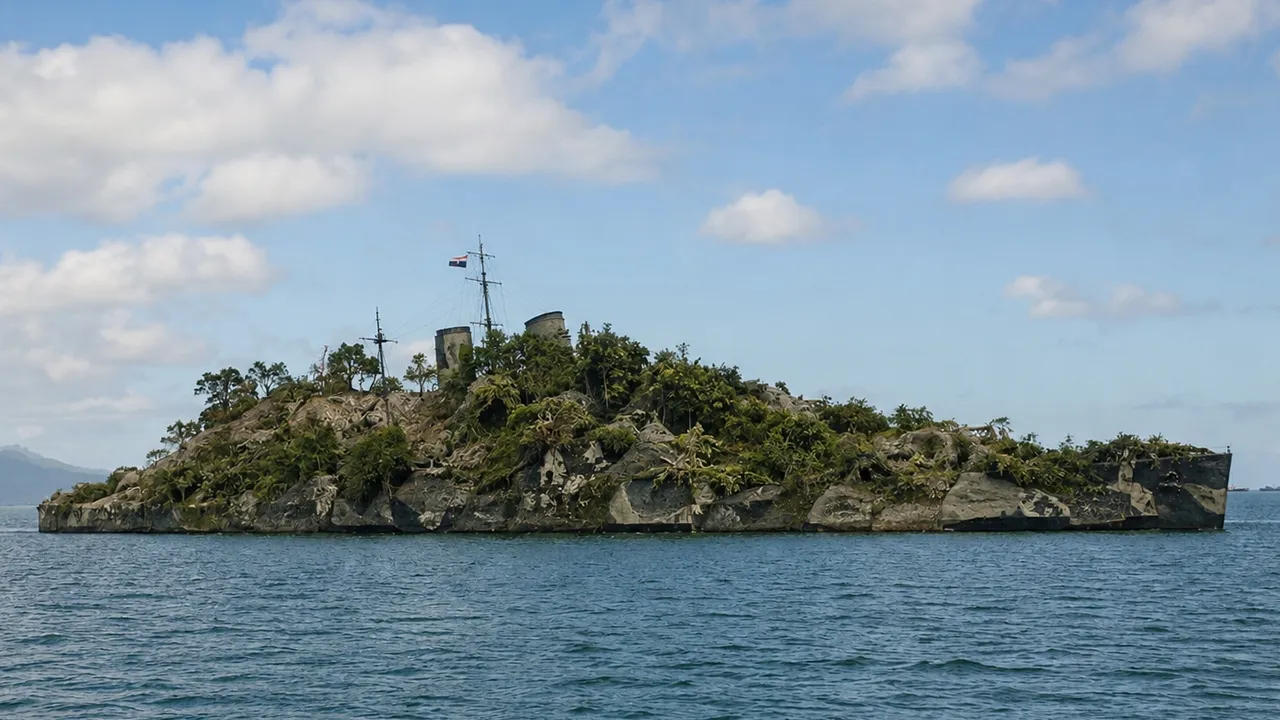
Thank you for watching to support my channel, and don't forget that you can now buy my book on Amazon. March, 1942. >> [music] >> A Japanese pilot flies over the islands north of Australia hunting for fleeing Allied ships. Below him, there is nothing but jungle. Small tropical islands, green and still, scattered across a glittering sea. He flies on. He finds nothing. But one of those islands is lying to him because one of them is not an island at all.
It is a warship full of terrified sailors holding their breath and praying he does not look twice. This is the true story of the little ship that survived a war by pretending to be a piece of land, and it is even stranger than it sounds. To understand how we got here, meet the ship. Her name is the Abraham Crijnssen, and she is nobody's idea of a hero. She is not a battleship, not a sleek destroyer. She is a minesweeper, a small, slow workhorse whose job is to clear deadly sea mines out of the water so bigger, more important ships can pass safely.
She was built in the Netherlands and launched in 1936, just 56 m long, only about 180 ft. She could barely make 15 knots. Her crew numbered around 45 men. Her weapons were modest, a single small deck gun, a couple of light anti-aircraft cannons, and some depth charges. Enough to do her job, nowhere near enough to survive a real fight. She was named after a bold Dutch naval commander from the 1600s. Nobody imagined this quiet little ship would ever need to be bold herself.
Her home was on the far side of the world in the Dutch East Indies, what we now call Indonesia. She She based at a port called Surabaya on the island of Java. For the Netherlands, these islands were a treasure. Warm seas, endless coastline, and above all, oil. Fields of it. And in a world sliding into war, oil was the most valuable thing on Earth. Therefore, this quiet corner of the world was about to become a target.
Because on the other side of the Pacific, an empire was on the march, and it was desperate for exactly what these islands had. In December 1941, Japan attacked. Within weeks, its forces swept south with terrifying speed. Island after island, taking everything in their path. A hastily thrown-together Allied force, Americans, British, Dutch, and Australians, tried to hold the line, but they were outnumbered, outgunned, and had no real air cover.
And the Japanese were coming straight for Java, the heart of the Dutch East Indies. For a little minesweeper like the Abraham Crijnssen, there was almost nothing she could do but wait and watch the sky. Then came the disaster that changed everything. On the 27th of February, 1942, the Allied fleet sailed out to stop the Japanese invasion convoys in a huge clash called the Battle of the Java Sea. It was a slaughter. The Allied ships were sunk one after another.
The Dutch admiral leading the fleet went down with his flagship. In a matter of days, Allied naval power in the region was simply wiped out. The door to Java was now wide open. The invasion was coming, and there was nothing left to stop it. So, the order went out to every remaining Allied ship. Run. Get to Australia however you can. Every vessel for itself. The Abraham Crijnssen received her orders in early March. She was supposed to escape together with three other warships.
Safety in numbers. But it did not happen. One by one, the others were gone, sunk, delayed, or lost in the chaos. And the little minesweeper found herself facing the most dangerous sea in the world completely alone. Think about what that meant. Between her and Australia lay hundreds of miles of open ocean, now ruled by the Japanese Navy and patrolled by their aircraft. She was slow. She was weakly armed. In a straight fight, or even a straight run, she had almost no chance.
The situation looked so hopeless that her captain, a Dutch officer named Van Meert, did something remarkable. >> [music] >> He told his crew the truth. He believed their odds were terrible. And he gave any man who wanted to leave the ship permission to go. They stayed. And now the crew had to answer an impossible question. How does a slow, tiny ship cross an ocean full of enemies who will spot it from the air in seconds?
You cannot outrun the planes. You cannot outgun them. You cannot outlast them. So, the crew of the Abraham Crijnssen came up with an answer so simple and so insane that it just might work. If they could not stop the enemy from looking at them, they would change what the enemy saw. They would stop being a ship at all. They would become an island. The plan was this. The region was dotted with thousands of tiny jungle-covered islands.
To a pilot flying high above, they all looked the same. One more little green island would attract no attention at all. So, the crew went to work like men possessed. They pulled the ship close to shore, and they cut down trees. Armfuls of branches, leaves, whole sections of jungle hauled aboard and lashed across the deck. They arranged it all into a canopy, layer upon layer, until the hard steel shapes of a warship vanished under a thick, living blanket of green.
The gun, the bridge, the funnel, all of it swallowed by the jungle. And for any part of the hull that still showed, they got out the paint. Grays and blacks and browns, brushed on to look like bare rock and steep cliffs rising out of the water. From above, the transformation was complete. The warship was gone. In its place sat a small, unremarkable tropical island. But a disguise is only half the trick. Because there is one thing every pilot knows, islands [music] do not move.
Therefore, the crew gave themselves one iron rule. In daylight, the Abraham Cringleson would not sail at all. She would find a shoreline, drop anchor, and sit perfectly still. Just another piece of scenery while enemy planes droned overhead. Only when the sun went down and the sky was dark and empty, would the engines quietly turn over. Then, under the cover of night, the island would slip its anchor and crawl south through the black water toward Australia.
Move by night, freeze by day. Night after night after night. Imagine being one of those sailors. By day, you sit trapped inside a sweltering camouflage ship in tropical heat under a roof of rotting leaves, forbidden to move, listening. Listening for the drone of an aircraft engine that could mean the end. Every plane that passed was a coin flip. One curious pilot, one second glance, one banking turn to look closer, and it would all be over.
The disguise could not survive a real inspection. It only had to survive a glance. At night came a different fear. Navigating a slow ship through unfamiliar, shallow, island-choked waters in near total darkness, unable to use bright lights that might give you away. For roughly 2 weeks, this tiny crew kept their nerve and kept their secret. Hiding in plain sight, right under the enemy's nose, on one of the most hunted stretches of ocean in the entire war.
And then on the 20th of March 1942, the impossible happened. The Abraham Crijnssen sailed into the harbor at Fremantle on the west coast of Australia safe. She had made it. Every man aboard had survived and she carried a distinction that still stands today. The Abraham Crijnssen was the very last Allied vessel to successfully escape from Java. Everything behind her had fallen. Of all the ships of her class in that region, she was the only one to survive the fall of the Dutch East Indies.
The slow little minesweeper that nobody expected anything from had outlived them all by refusing to be seen. Her captain and nine of his crew were later decorated for the courage of that escape. They had earned it. But the Abraham Crijnssen's war was far from over and here her story takes a turn that is almost as strange as the disguise. Australia was fighting for its life and desperately short of ships. So this Dutch minesweeper was taken in, refitted with brand new submarine detecting sonar, and in September 1942, she was commissioned into the Royal Australian Navy.
The Dutch ship now flew an Australian flag. Her crew became a floating melting pot. Her original Dutch sailors, joined by British survivors from a destroyer that had been sunk, and by Australians, all serving together under an Australian commander. That mix caused one wonderfully human problem. Navy tradition said you hung a portrait of your country's monarch in the officers' mess, but whose? The Dutch queen or the British king?
In the end, they compromised. The Dutch Queen Wilhelmina stayed proudly on the wall and the British King George the VI was given his own honored spot in the commander's cabin. Two monarchs, one very small ship. Her new job was to guard convoys, escorting vulnerable merchant ships, and hunting the submarines that preyed on them. She even served as a mother ship for Dutch submarines that had fled to Australia, just as she had.
And she did see action. In January 1943, while escorting ships through the waters south of the Australian mainland, her sonar suddenly pinged. A submarine contact lurking beneath the convoy. The Abraham Crijnssen and another Australian ship swung into the attack, rolling depth charges into the sea to destroy the intruder. But in the rushing chaos of that first attack, some of her own depth charges were released too hastily and too close.
The blasts hammered her own hull. Pipes burst, fittings broke, and the shock actually sprang the rivets running along the bottom of the ship. She had half wounded herself in her eagerness to fight. No wreckage of the submarine was ever found, so we will never know for certain what was down there. And the little minesweeper limped into dry dock for a week of repairs, her whole center line of rivets replaced. In 1943, she was formally handed back to the Dutch Navy, but she stayed on in Australian waters, quietly doing the unglamorous, essential work that keeps a war effort alive for years.
Near the end of the war, she was even given the odd job of towing a former submarine being used as a fuel barge up the coast. Though the tow cable snapped in heavy seas, and the barge ended up washed onto a beach. Not every mission was a triumph. And in a fitting final wartime act, she went back to doing what she was originally built for, clearing enemy sea mines out of a harbor, making the water safe again, just before the Japanese surrender was accepted nearby.
The ship that had once hidden from the war ended it doing honest, dangerous, ordinary work. When peace finally came, the Abraham Crijnssen did not get to rest. She spent years on patrol in the troubled post-war East Indies, then at last sailed home to the Netherlands, a country most of her wartime crew had not seen in a very long time. The Navy converted her for harbor defense work, and by the early 1960s, after nearly a quarter century of service, she was finally retired and struck from the fleet.
For a while, her story could have ended the way most old ships end. She was handed to a sea cadet group for training, then left to sit, used as little more than a floating storage shed. The famous island ship was slowly being forgotten. But this ship had cheated the odds once before, and she was about to do it again. In 1995, the Dutch Navy Museum recognized what she truly was. Not just an old minesweeper, but the survivor, the ship that became an island. >> [music] >> They took her in and lovingly restored her to look exactly as she had in her wartime days.
And that is where she rests today. At the Naval Museum in Den Helder in the Netherlands, you can walk her decks, stand where those sailors stood, and see with your own eyes the little ship that fooled an empire. She was too slow to run, too weak to fight. By every rule of war, she should have been lost with all the others in the spring of 1942. Instead, a handful of clever, stubborn sailors looked at a hopeless situation, cut down a forest, and turned their warship into the one thing no one would ever shoot at.
A quiet little island drifting home. Thank you to my Patreon members who helped make this video possible.
The words are the caption track's own and nothing is reworded or re-transcribed. Paragraph breaks are placed between sentences so the text reads as prose.
Free tools for your own script. No signup, no login.
Paste your draft and see where viewers are likely to drop off, with a rewrite for each weak line.
Paste the first 30 seconds of your own draft for a hook score and rewrites.
Check your draft against YouTube's advertiser-friendly guidelines before you record it.
Read this channel's public videos and transcripts, and download a writing brief for it.