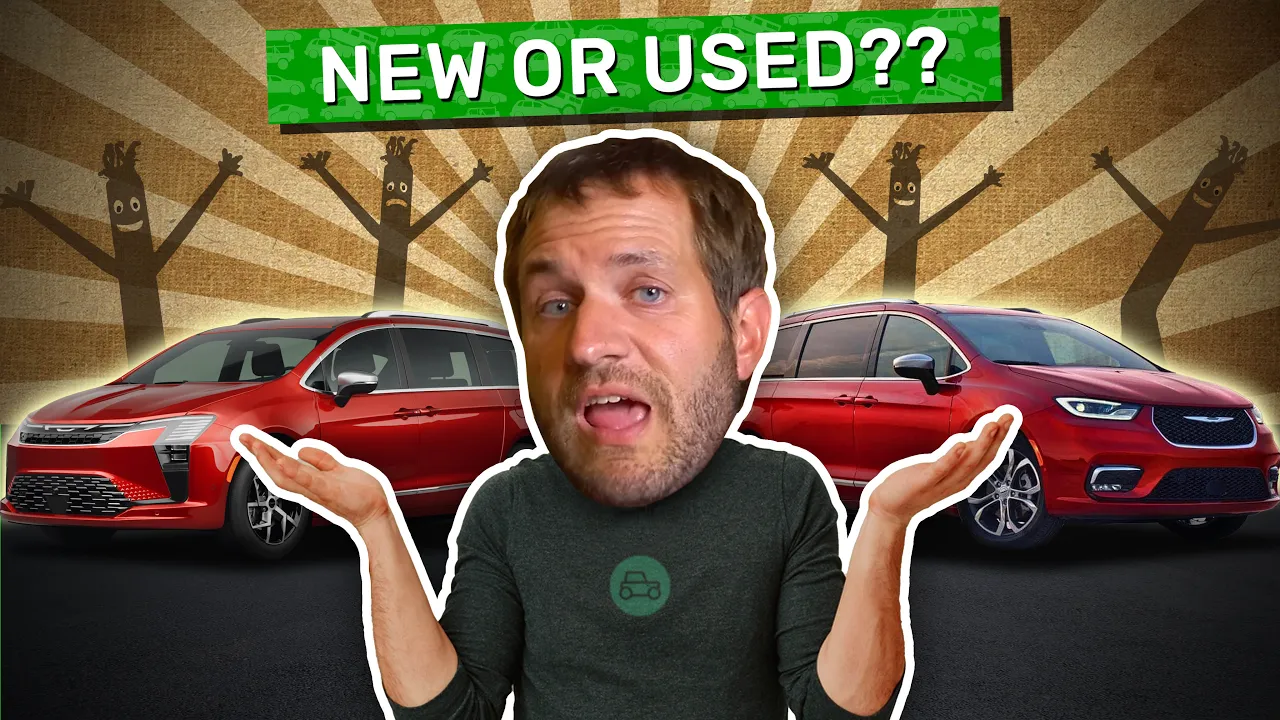
Should You Buy a New Car or a Used Car? transcript
Doug DeMuro · @DougDeMuro
Words
2,688
Runtime
12:47
Speaking pace
210wpm
Reading time
11min
210 words per minute, above the 201 75th percentile of 349 measured videos. That distribution comes from the 349-video hook study.
Opening (first 30 seconds)
This is Doug DeMuro, and today we're going to talk about should you buy a used car or a new car? This is a question I often get from a lot of people. I do a lot of car reviews, so I have a pretty good authority to answer it. Let's talk it through. New or used? Before we get started, are you ready for your next cool car? Sell your enthusiast car on Cars and Bids. Trading in your car to dealers means you aren't getting market value for your car, leaving you with less cash for your next fun car. Just look at
105 words, the words spoken in the first 30 seconds at 210 words per minute.
Sentence shape
| Measure | This transcript |
|---|---|
| Sentences | 140 |
| Average words per sentence | 19.2 |
| Longest sentence | 99 words |
| Questions asked | 20 |
| Sentences containing a number | 8 |
Most used terms
- car82
- cars54
- buying25
- buy18
- people16
- lot10
- pretty9
- years9
- better7
- driving7
- money7
- stuff7
Filler phrases
31 in total: like 6 · um 6 · kind of 5 · uh 5 · you know 5 · I mean 1 · actually 1 · basically 1 · sort of 1.
A literal whole-word count of the same phrase list the Prepublish browser extension uses, so a phrase inside another word is not counted and a phrase used in its ordinary sense still is. It is a count and not a judgement.
What this transcript is
Every word below is the caption track YouTube publishes for this video, pulled from the video itself and reproduced unchanged. It is not Prepublish's writing, not a summary, and not a re-transcription: it is the video's own published captions. English captions, generated automatically by YouTube, in the video’s original language. Source: the video on YouTube. A channel that would rather this page did not exist can ask for its removal through the contact page, and it is removed.
Transcript
This is Doug DeMuro, and today we're going to talk about should you buy a used car or a new car? This is a question I often get from a lot of people. I do a lot of car reviews, so I have a pretty good authority to answer it. Let's talk it through. New or used? Before we get started, are you ready for your next cool car? Sell your enthusiast car on Cars and Bids. Trading in your car to dealers means you aren't getting market value for your car, leaving you with less cash for your next fun car.
Just look at our recent sales of these cool cars compared to current trade-in value. This is a trade-in offer, and this was the Cars and Bids result. This is a trade-in offer, and this was the Cars and Bids result. This is the trade-in offer, and this is the Cars and Bids result. Get started now on carsandbids.com. Sell on Cars and Bids and join the best community to sell your enthusiast car. Okay, so should you buy a new car or a used car?
Um, again, get this question a lot, and uh I'll just start off by saying on a basic general level, I am typically a fan of used cars. Um, I own seven cars right now. It'll be more by the time you're watching this. They are all used with the exception of my Toyota Sequoia, my big family car, and that one is new only because used versions of that version didn't exist when I was buying the car. I would have bought it used.
I'm a big used car enthusiast. Uh, and the reason that I primarily gravitate towards used cars is, I guess there are two big reasons. Number one, in terms of my sports cars, they don't make new cars like these anymore. But in terms of even my daily driver cars, it's just cheaper. My wife drives a Mercedes-Benz station wagon that we bought certified pre-owned used, 2 years old at a $40,000 discount compared to the new sticker price.
I I've always felt that that initial depreciation hit being taken elsewhere is just really beneficial to to me and to my my car situation. And I generally find that reliability and ownership experience are pretty similar for the used cars that I'm buying even compared to a new car, which I'll cover in a little bit more depth in a second here. But with that said, I do not think that everyone should always buy used cars.
And I would say I break it down in this way. These are the primary reasons I think you should buy a new car. Number one, you should buy a new car if you can't find your car as a used car. If you want a certain type of electric car, for example, there's not a huge market out there right now of used electric cars. There will be, they're getting there, but like modern electric cars, sometimes you just have to buy new to get what you want.
Some of these cars simply are not out there on the used market just yet. And so that's a reason obviously to buy new. I would also say if if you want a new car and you can really, truly afford to buy a new car and afford to take the depreciation hit and not really have that significantly affect your financial situation, in that situation, I think you should consider buying a new car. Now, me personally, I got some money, I still think that I cannot afford to buy a new car.
So I don't know how much money you would have to have in order to reach the level that [laughter] I'm talking about, but um there are people out there who who certainly could afford to buy new cars, take the depreciation hit, and have it not matter all that much. And on that note, I think that you should really consider buying a new car if you are truly going to own it forever. My parents buy new cars. They are not car enthusiasts, they do not have a ton of money, but my dad's driving a car that he bought new in 2008, and my mom's driving a car that they bought new in or 13.
These people will be driving these cars forever. I would be shocked if in the next five or even eight years those cars are replaced. If you're going to get 20-plus years out of a car, the five or eight or 10 grand in depreciation initially doesn't matter quite as much as like you've had the car from the start, you know the whole experience, the whole history. Uh you're going to fully depreciate the car anyway. In that situation, I could definitely see you want to buy the car new so that you start fresh with it.
You're going to have that whole history with it and there's no questions. But, the other big reason you should consider buying a new car and the one I'm really going to focus on today cuz I think it speaks to the majority of people who are asking this question is you should probably buy a new car if the idea of buying used just stresses you out to a really, really high level. Maybe you've had terrible experiences in the past with used cars.
Maybe you're just really afraid, you don't know what to look for, etc. In that situation, I do think you should consider a new car. Now, I want to put a caveat on that, which is you don't have to be stressed out by it. It's easy for me to say as a car enthusiast because I have a great network of people who can fix cars. I know exactly what to look for when I'm driving a used car, how the suspension sounds, how the brakes sound, how the engine sounds, how it all feels.
I know exactly what to look for I'm driving a car to assess its quality. And a lot of people don't have either of those things. And they can't fix it themselves, that sort of thing. And and thus buying a used car could really be a ticket to bad financial hardship. And so buying a new car, even though it's more expensive and you lose in depreciation, you at least don't have to deal with the mechanical complications. And I totally get that.
But, what I would say to those people is there are ways to make your used car buying experience better. And there are some significant advantages to buying a used car. So, the biggest advantage is obviously price. Used cars are cheaper than new cars by virtue of having been used goods. As a result of that, that loan thing is the primary reason that people gravitate towards used cars over new cars. It is often thought of as a similar experience but cheaper.
And that is the primary reason why I do it when I'm buying daily driver cars or I go after used ones because they are less expensive. People wouldn't do it if they weren't. You wouldn't want something that someone else has already used unless it was cheaper, and so it is. But, if you're going to do it because it's cheaper, you're obviously trying to make a better financial decision, save some money, and so you got to go into it knowing what to look for in a used car.
And specifically, I would say how to read a Carfax report, knowing that it's not necessarily necessarily always accurate, but that it gives a really good picture of kind of the car's history. Was it ever somewhere where it might have been driven in the snow and ice in the winter where there might be rust? Was it at Was it Does it have unusual service histories? Does it have long gaps in the service history? If it does, might there be an explanation for that, like the dealership didn't report to Carfax?
Did it bounce around to a bunch of owners? Was it sold new in the United States? All that stuff. I would also want to know when I'm driving the car, I'm test driving the car, how does it sound? How does it smell? How does it feel? And again, those are things that can be difficult for someone who's not familiar with cars, and especially with used cars, to understand, um but they are pretty important. And I think that if you're if you're not able to really grasp that stuff, a cheaper used car could become a bad deal real quick.
So, what do you do to try to mitigate that? What do you do to try to put yourself in a more expert position? I think number one, you get educated. Before you go and buy a car, you try to read a lot of stuff online about what to look for, how to spot, you know, brake pad wear, how to spot an engine that's knocking or ticking that which could become a problem, suspension sounds, that kind of thing. I think all of that stuff is really important to really get yourself educated.
Try to bring along a friend who has some mechanical knowledge. If that fails, try to have the car checked out by a mechanic before you buy it. I know I'm not the biggest fan of automotive pre-purchase inspections. I think most problems with cars crop up when they're being driven and used, and you hear something or feel something or or something's leaking, but But still think that a pre-purchase inspection gives you a pretty good idea of what you might be going into if you're not exactly certain what to look out for.
I would caution you and say don't necessarily think that you have to be an expert in order to buy a used car well. I think there are a lot of people out there who try to scare you into thinking that that is true. Who try to make it seem like oh, if you don't know cars that you got you might buy something terrible, horrible, Gremlins, awful. I don't necessarily think that that's true. I think there are ways that you can avoid buying a used car with a lot of problems.
And I will say I think that one of the biggest ways to avoid buying a used car with a lot of problems do research on makes and models and years of cars that are generally pretty reliable. Are are Subaru Foresters or Honda CR-Vs or there certain years that are better than others? Are there certain years to avoid? If are there certain cars that are really especially reliable and desirable as used cars? Those are the ones you should pursue.
I think that buying a car that is relatively not that old. Uh three, four, five-year-old used car with relatively low miles cared for by someone who cares about the car. Those are all ways that you can avoid common pitfalls of used cars. When people are buying used cars, what I always educate them is you're buying the seller. You're not buying the car, you're buying the seller. Is it at some shady, sketchy used car dealer who's trying to hide stuff?
Is it some guy who, you know, maybe doesn't have the title but his brother had the car and all that stuff. Those are red flags. If you're buying car from just some family who's trying to sell it who who is, you know, kept it oil change receipts from day one and has done a perfect job of running the car. That's the type of car you're trying to look for. And buying the seller and getting a good feel from the seller and the way they live and the way they own a car, I think it's a great way to buy a used car.
And I think that buying from someone who takes bad Craigslist photos with their thumb over the license plate, you're taught that's someone lazy. That's someone who's not going to be a good car owner. That's someone who has skipped out on maintenance and their car probably has problems. And I think that that kind of stuff is is really points you in the right direction of finding a good car versus finding a not so good car.
I also think that more modern used cars tend to just generally be more reliable. If you can find a more modern car that has just not been used all that much, a 3-year-old car with 40,000 mi, modern-day cars are pretty reliable. And sometimes when I say this, people complain, "What do you mean? They have all these problems." It's not like it was. In the '60s and '70s, I mean, five-digit odometers were on cars up until the early '90s because cars weren't expected to last for 100,000 mi.
Yes, today's cars have more electronics that can cause problems and this and that, but there was a time back in the day when you threw away a car after 3 years pretty commonly um because they just weren't made to last at all. And that is not the case with cars today. And I think that a lot of people are doing themselves a disservice by spending a lot of money buying a new car when a used car that is cared for well, not that old, similar, you know, good low mileage, a similar car that they're looking for, a 3-year-old CRV instead of a new one, I think that they probably could save money and do a pretty good job of buying a pretty good car uh if they don't fall into this trap that oh my god, used cars are the worst and everything's going to be terrible.
To make used cars even more attractive, automakers offer this thing called certified pre-owned, which is basically a used car warranty that extends the new car warranty and gives you kind of automaker backed peace of mind. And certified pre-owned used cars are always more expensive than their just non-warrantied used car counterparts, but they're great. It's a great way to get into a used car, save some money on depreciation, um but still have the peace of mind of a manufacturer backed warranty.
And if you're really worried about dipping your toe into the used car pool, that is a way that to make the experience a little bit easier and a little bit more tenable. So, those are overall my thoughts. I I generally really do think that used cars are the way to go for most people most of the time in most circumstances, but I understand the fear behind it. And if you've been burned before, I get that. I would just caution you and say cars are better now, and if you do a good job buying a good car from a place with a good reputation with with good service history, etc., you are going to have a much better experience with a used car than you might think you will or than you probably did buying a some beater off of Craigslist 10 years ago.
And so, I highly suggest for most people do consider used cars with only a few exceptions, I think, where where new cars may potentially be the better play. So, there you go. My thoughts on new versus used cars and kind of how to avoid some of the potential pitfalls of used cars. That's just what I think, but it's also what I actually do in my normal life. And when it comes time to replace my daily driver cars again in a few years, I will absolutely be looking for used or certified pre-owned cars once again.
I just think it's a better way to do things for most people, including myself.
The words are the caption track's own and nothing is reworded or re-transcribed. Paragraph breaks are placed between sentences so the text reads as prose.
Use this transcript
Three free tools that work on the material around a video like this one. No signup, no login.
Hook Analyzer
Paste the first 30 seconds of your own draft for a hook score and rewrites.
Policy Pre-Flight
Check your draft against YouTube's advertiser-friendly guidelines before you record it.
Channel Skill Generator
Read this channel's public videos and transcripts, and download a writing brief for it.