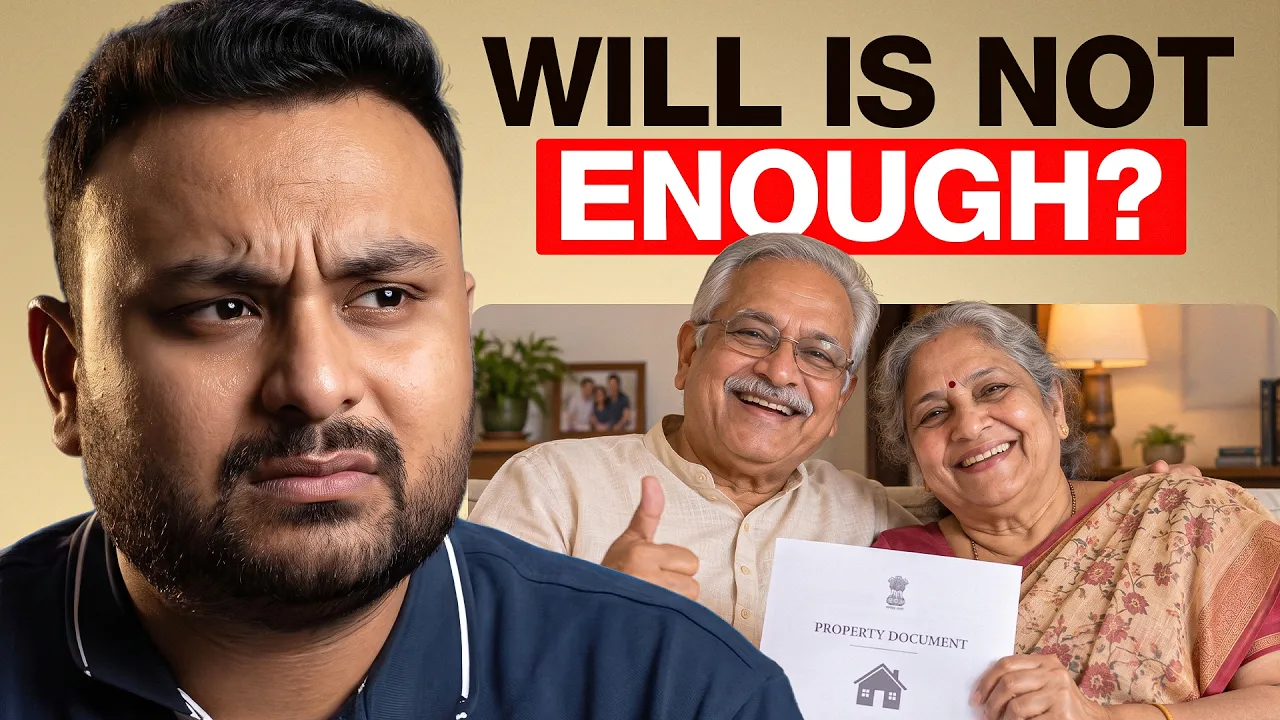
Your Parents Made a Will, But Here Is What NRIs Actually Need transcript
Alok Dubey, CFP® · @NRIMoneywithAlok
Words
2,001
Runtime
11:25
Speaking pace
175wpm
Reading time
8min
175 words per minute, between the 160 25th percentile and the 181 median of 349 measured videos. That distribution comes from the 349-video hook study.
Opening (first 30 seconds)
Imagine you are living in Dubai, London, Singapore, or US. Your parents are in India. They own a house, some fixed deposits, some mutual funds, or maybe some shares, or maybe some old investments like LIC policies that they don't even know about. And you are relaxed because your parents have already made a will and you know about their assets. But here is the problem. Having a will does not necessarily mean that one day all the assets will automatically come to your name. In fact, when
88 words, the words spoken in the first 30 seconds at 175 words per minute.
Sentence shape
| Measure | This transcript |
|---|---|
| Sentences | 110 |
| Average words per sentence | 18.2 |
| Longest sentence | 62 words |
| Questions asked | 11 |
| Sentences containing a number | 3 |
Most used terms
- family17
- certificate14
- assets11
- asset10
- parents10
- succession10
- bank9
- process9
- actually8
- succession certificate8
- court7
- documents7
Filler phrases
17 in total: actually 8 · like 4 · kind of 3 · you know 2.
A literal whole-word count of the same phrase list the Prepublish browser extension uses, so a phrase inside another word is not counted and a phrase used in its ordinary sense still is. It is a count and not a judgement.
What this transcript is
Every word below is the caption track YouTube publishes for this video, pulled from the video itself and reproduced unchanged. It is not Prepublish's writing, not a summary, and not a re-transcription: it is the video's own published captions. English captions, generated automatically by YouTube, in the video’s original language. Source: the video on YouTube. A channel that would rather this page did not exist can ask for its removal through the contact page, and it is removed.
Transcript
Imagine you are living in Dubai, London, Singapore, or US. Your parents are in India. They own a house, some fixed deposits, some mutual funds, or maybe some shares, or maybe some old investments like LIC policies that they don't even know about. And you are relaxed because your parents have already made a will and you know about their assets. But here is the problem. Having a will does not necessarily mean that one day all the assets will automatically come to your name.
In fact, when parents pass away, you may suddenly discover that transferring the house follows one process, transferring the bank account follows something other, mutual funds, shares, and all these things require completely different process. And somewhere in this process, you may hear a term like legal heir certificate, succession certificate, probate, NOC, mutation, and transmission. So in this video, I want to simplify the whole thing from an NRI's point of view.
I will show you what a will actually solves, where a succession certificate can become relevant, why different assets need different documentation, and most importantly, what you should organize while your parents are still around so that the family does not have to figure out everything during a time of emergency. And stay with me till the end because I will give you a very simple inheritance readiness test that you can run for your own family.
Now, let me tell you first why I wanted to make this video. We recently saw a case involving an NRI family where the parents passed away unexpectedly. The child was overseas and now you imagine the situation. Apart from dealing with the emotional side of losing your parent, you are suddenly trying to understand what assets they owned, where the documents are, who are the nominees, which relatives are qualified as legal heirs, what bank accounts want, or what local authorities want in local language.
And in that particular situation, the family also has to deal with court-related procedures, any notices, or any cooperation required from other family members. And this is the part that most NRIs don't plan for. When your parents are still alive, everything looks very simple. Father will handle the bank accounts, mother knows where the property papers are, and your father might know where the investments or funds are.
And somebody might remember the locker numbers or where the will is kept. But remove that one person from the system, and suddenly the family may realize that nobody has the complete picture. And that is where real estate planning becomes a risk. It is not simply do my parents have a will. The better question is if if something happens to them tomorrow, can the next person actually take control of every asset? And this brings me to the most important concept in this entire video.
Every asset has its own door. Think about five different buckets. Property, bank deposits, mutual funds, demat holding, and maybe family business on top of that. You cannot assume that one document opens every door. For example, your father owns a flat. After his death, the family may need a will, a death certificate, and other documents required to transfer the title, mutation on the society NOC with any concerned authority also.
Now, look at a bank fixed deposit. If there is a valid nomination or a survivor arrangement, the bank may have a very relatively simpler process. And there is no effective nomination or there are no multiple claimants, the bank may require stronger proofs before releasing any kind of money. Now, mutual funds have their own transmission process. Demat account and shares have a very different transmission process. And if there is a business involved, then the will is only one part of the story.
Partnership documents, shareholder agreements, or rules that the entity may also apply can matter. So, this is the first thing that I want every NRI watching this video to understand is that inheritance is not one transaction. It's a series-by-series, asset-by-asset transfer, and estate planning is really about making each of them easier in the future. So, now let's come to the term that created the most confusion when I was explaining this to my client, succession certificate.
Now, you may have seen videos that even if you have a will, you still need a succession certificate. That statement too is very broad. A succession certificate is not a universal document that every NRI needs for every asset. Under the Indian Succession Act, succession certificates are primarily connected with a specified debt or security of the disease. So, thing like a bank balance, you know, certain securities in situations where someone needs a court-backed authority to establish their right to collect or deal with those specified assets.
It is not simply a certificate that transfers every house, every plot, or every asset owned by the person who is no more. And this distinction is very important because otherwise family start collecting random legal documents without even first understanding what is actually needed. Somebody who died with a will might not require a succession certificate, but somebody who never made a will might require and I'll talk more about this.
So, when a succession certificate becomes relevant? One common situation is where there is effectively no nomination mentioned. Another is where there are multiple legal heirs involved and the institution wants a stronger clarity regarding who is entitled to claim the assets in case of no will. It can also arise when a bank or another institution requires a court-backed representative title. And obviously, if there is a disagreement between the claimants, the thing can become much more complicated.
So, instead first identify the asset, then identify how the ownership passes on, and then identify what document will actually be required, and the thing should be done in this exact sequence. Now, suppose a succession certificate is actually required. What happens then? Very simply, there is a court based process. A petition is prepared identifying the relevant debts or securities and the family details. It is filed before the contempt court.
The court considers the jurisdiction. Then a notice may be issued or published as required. Then interested parties can appear or raise objections. And after the court makes its determination, the certificate identifies the debt and the security covered under and the authority is being granted. For an NRI, one more practical issue becomes important here. Living in US or UAE doesn't mean that you can get this done whenever or whichever way you want.
Jurisdiction generally connects back to where the deceased ordinarily resided. So, in some circumstances where the relevant property is situated, you will have to go to that location. And that exact answer depends on your specific facts and the state involved. So, treat this as a general shape of it, not a ruling on your family's case. Which means that a process involving an Indian estate may still pull you back into Indian legal and administrative system.
And this is where poor planning becomes expensive. Not necessarily because one particular certificate itself cost some huge percentage of the estate, but because the time, the travel, the lawyers and the documentation and the hours that you have to put behind these things, in some cases weeks or months also, is to be considered into attention. So, for somebody living abroad with a job and family, this becomes a very real friction and a cost.
So, what should you actually do? This is where I want to shift the video away from what happens after death to how you can organize before the problem even starts existing. First, make sure that there is a properly executed and current will. Second, create an asset inventory. Your family should be able to answer a very simple basic question, where exactly are the things that my parents own. And this includes everything, not just the assets that I talk about, but post office deposits, LIC policies, anything that might be an asset to you needs to be reviewed correctly and put into records.
The third thing is to see nominations. People make nominations and forget about it for 10 20 years. Sometimes it is outdated, sometimes there's no nomination at all, sometimes it is one daughter or one son, or sometimes it is just wife spread across. I have seen 80-year-old person having his own father as a nominee in his investments, and the father actually passed 20 years back. So, don't just assume that nomination decide everything, which is a very oversimplification depending on the assets and the law applied.
In many cases, nomination does not guarantee that the assets will be of the nominee. It A nominee is just a custodian of the assets, and the job of the nominee is to transfer these assets in the right way by following the law. The fourth thing is is to organize all the original documents. Now, where is our will? Where are the property documents, investment statements, any insurance records? All of these things need to be made sure that they are collectively gathered because even missing a single document can create unnecessary problem for you in the future.
Now, there is another point that NRIs specifically need to think about, which is travel dependency. Ask yourself, if something happens tomorrow, would I have to fly to India every time somebody needed my signature? Would certain permitted procedures work? They can be Can that be handled by drafting a power of attorney for some specific case? If somebody dies outside of India, do you understand how the overseas death certificate and other documents will be accepted or authenticated for the use of India?
These are not questions which might cause trouble, but these are exact questions that makes the difference between inheritance taking a very reasonable and organized route, or a family spends months and years chasing the paperwork and the process. And this is also where our work with NRI family becomes broader than simply choosing any kind of investment or insurance. Because when somebody has spent 15, 20, 25 years outside of India, their financial life is rarely sitting neatly in one single place.
Some mutual funds, some shares, or some policies, something bought from NRE, something bought from NRO. All these things create unnecessary mess, and kids of NRIs end up becoming NRIs where they now care less about getting these things organized in the future. So, for good financial planning, eventually you have to answer one very uncomfortable question, that if you're not around, does your family know what happens next?
If you're an NRI who is planning to return back to India, or wants to make investments, wants to get advice on taxes, then feel free to reach out to my team, for which the link is in the description below. But even if you never work with us, please do this exercise that I'm about to give you. In the description, you will find an Excel sheet, which you can fill every year and keep it in records with your family members.
This will include all kind of information that is required in terms of asset holdings, whether there is a will or not, and a whole a whole lot of checklist that you can keep in mind, and make it an annual practice that every year you record these things, and keep one copy with your parents, and one copy with your children. And repeat the same thing for your parents also when you are physically present in India, because this one simple exercise can actually save a lot of time for you someday in the future.
If you like this video, share it with other NRIs who might be in this same need. Join my WhatsApp community for NRIs only, for which the link is in the description below. Thank you, and I'll see you in the next.
The words are the caption track's own and nothing is reworded or re-transcribed. Paragraph breaks are placed between sentences so the text reads as prose.
Use this transcript
Three free tools that work on the material around a video like this one. No signup, no login.
Hook Analyzer
Paste the first 30 seconds of your own draft for a hook score and rewrites.
Policy Pre-Flight
Check your draft against YouTube's advertiser-friendly guidelines before you record it.
Channel Skill Generator
Read this channel's public videos and transcripts, and download a writing brief for it.