Getting the transcript
Reading the captions from YouTube. A video nobody has opened here before takes 10 to 30 seconds; this page fills in on its own.
Getting the transcript
Reading the captions from YouTube. A video nobody has opened here before takes 10 to 30 seconds; this page fills in on its own.
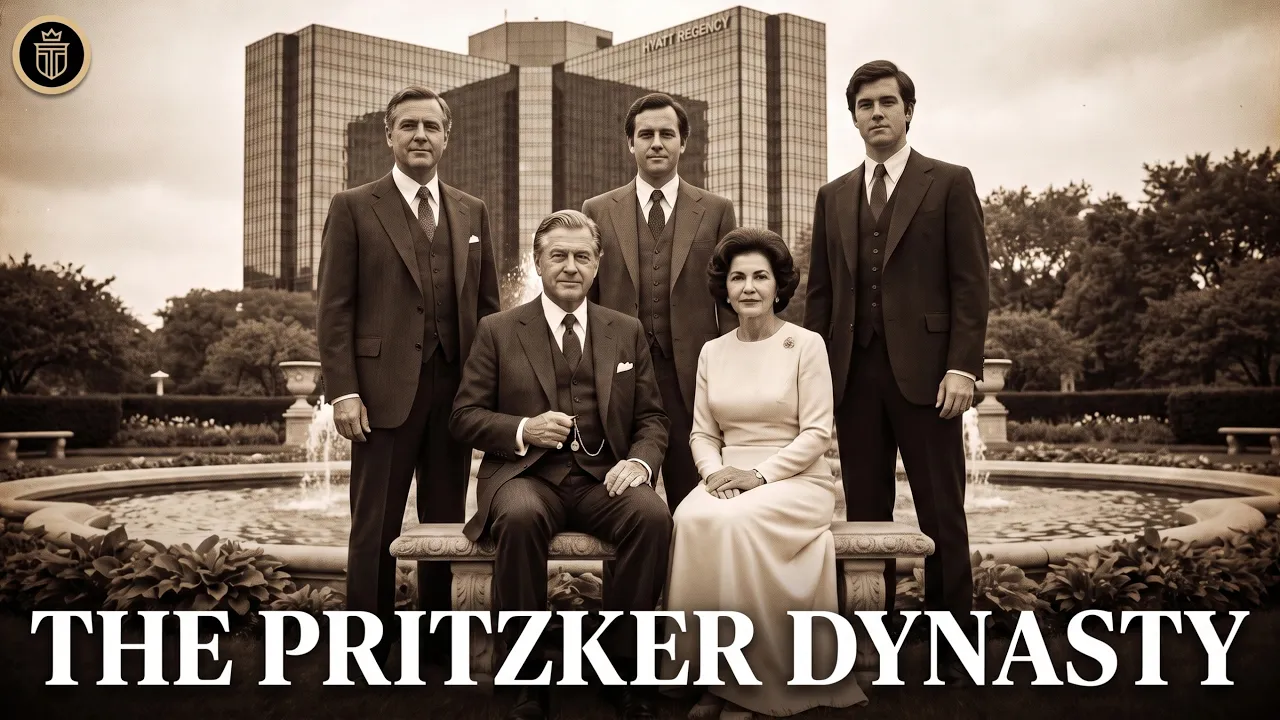
Old Money Documentaries · @OldMoneyDocumentaries
Where viewers went back to watch this video again, from YouTube's public Most replayed graph, lined up with what was said at that moment.
Most replayed moment #1
11:598.3x the video's typical replay level
across Century Boulevard to a motel called the Hyatt House. It was a 149 room establishment owned by a Los Angeles socialite named Hyatt R. Vondern. Vondane was famous in his city as much for his string of high-profile marriages as for his business acumen.
Said at 11:51
Most replayed moment #2
53:558.2x the video's typical replay level
both sides knew it before the appellet court's ruling had even been fully digested by their lawyers. Cook County Circuit Court Judge Patrick Quinn dismissed claims against the 11
Said at 53:48
Most replayed moment #3
23:586.5x the video's typical replay level
public view requires an understanding of what a had actually built inside the walls of the family's fortress. The fortress was not made of hotels or copper tubing or credit reporting bureaus. It was made of trusts. The full
Said at 23:51
The graph counts replays. It does not show where viewers stopped watching.
Words
9,157
Runtime
59:53
Speaking pace
153wpm
Reading time
38min
153 words per minute, below the 160 25th percentile of 349 measured videos. That distribution comes from the 349-video hook study.
Opening (first 30 seconds)
In November of 2002, at Cook County Circuit Court in Chicago, an 18-year-old college freshman filed a $6 billion lawsuit against her own father. The plaintiff was Leisel Pritsker. The defendants were her father, Robert Pritsker, and 11 of her older cousins. The Pritsker family, at the time of the filing, ran Hyatt Hotels, the Marman industrial conglomerate, a substantial stake in Royal Caribbean Cruises, and roughly 200 other operating companies. The empire was held inside a
77 words, the words spoken in the first 30 seconds at 153 words per minute.
Free, no signup. See how the first 30 seconds hold attention, with rewrites.
Sentence shape
| Measure | This transcript |
|---|---|
| Sentences | 502 |
| Average words per sentence | 18.2 |
| Longest sentence | 61 words |
| Questions asked | 0 |
| Sentences containing a number | 142 |
Most used terms
Filler phrases
9 in total: like 5 · actually 3 · kind of 1.
A literal whole-word count of the same phrase list the Prepublish browser extension uses, so a phrase inside another word is not counted and a phrase used in its ordinary sense still is. It is a count and not a judgement.
What this transcript is
Every word below is the caption track YouTube publishes for this video, pulled from the video itself and reproduced unchanged. It is not Prepublish's writing, not a summary, and not a re-transcription: it is the video's own published captions. English captions, generated automatically by YouTube, in the video’s original language. Source: the video on YouTube. A channel that would rather this page did not exist can ask for its removal through the contact page, and it is removed.
In November of 2002, at Cook County Circuit Court in Chicago, an 18-year-old college freshman filed a $6 billion lawsuit against her own father. The plaintiff was Leisel Pritsker. The defendants were her father, Robert Pritsker, and 11 of her older cousins. The Pritsker family, at the time of the filing, ran Hyatt Hotels, the Marman industrial conglomerate, a substantial stake in Royal Caribbean Cruises, and roughly 200 other operating companies.
The empire was held inside a network of more than 950 separate interlocking trusts, so elaborately layered that no single document could map it. The 18-year-old plaintiff was, at the time she signed the complaint, a Columbia University freshman who wore fleece to class and watched her spending on Broadway tickets. Two years later, that empire would be dismantled, its architecture exposed, and the family scattered. This is the story of the Pritskars.
In 1871, in a Jewish community near Kiev, in what was then a distant western province of the Russian Empire, a boy named Nicholas [music] Jacob Pritska was born. The Jews of the Russian Empire were not citizens in any meaningful sense of the word. They were confined to a strip of territory called the Pale [music] of Settlement, barred from most professions and from land ownership, subjected to state sanctioned violence, and periodically hunted through waves of organized massacre known as pgrams.
For the Jewish communities of Ukraine, immigration was not aspiration, but survival. In 1881, at the age of 10, Nicholas Pritska chose America. He joined the flood of Eastern European Jews fleeing westward that year, assisted by the Hebrew Immigrant Aid Society, which had been founded that same year specifically to help Jewish refugees. His assigned destination was Clinton, Iowa, where a sponsoring family had agreed to take him in.
When he arrived in Clinton, there were no jobs. According to a family story later recounted by his greatgrandson, JB Pritsker, Nicholas asked which way the nearest big city was. He got back on a train and rode to Chicago. His first night in that city, Nicholas Pritsker slept in the train station. He spoke no English. He had no money, no family, and no connections. He found work the only way an immigrant child could find work in 1881 Chicago, which was to say by selling newspapers on street corners.
The newspaper he sold was the Chicago Tribune. The name of that paper would matter later in ways that a 10-year-old boy sleeping in a Chicago train station could not possibly have foreseen. The Chicago Tribune would eventually chronicle the spectacular collapse of the dynasty Nicholas Pritsker was about to build. It would also spend more than a century as the newspaper of record for the family's rise, its acquisitions, its philanthropies, and its [music] scandals.
From the pages of the Tribune, Nicholas taught himself the English language, sounding out headlines and stock prices in the freezing dawn hours before he started his day's deliveries. He rose from newsboy to pharmacist to lawyer through a slow and grinding process of self-fabrication. He put himself through Depal University College of Law. He graduated as an attorney. He established a firm called Pritsker and Pritsker which would serve as the family's legal and financial nerve center for the next century.
The surname itself carried an origin story. Pritsker is a Jewish habitational name derived from Pritsky, a town in Ukraine, an inheritance permanently embedded in an American dynasty. Nicholas Pritsker also carried a distant connection to the world of ideas [music] as a cousin of the existentialist philosopher Lev Schesto, one of the major religious existentialist thinkers of early 20th century Europe. That connection would go unremarked in most accounts of the family's business rise, but it hints at something essential in Nicholas himself.
He was a builder, but he was also a man who read. Nicholas had three sons and all three joined him at Pritsker and Pritska. Harry was born in 1892. Abram Nicholas Pritsker who came to be known simply as Aen was born in 1896. Jack was born in 1904. The three brothers divided the work of the firm along complimentary lines that would define the family's professional character for the rest of the [music] century. Harry specialized in criminal law and spent his entire career at the firm. eventually reshaping it into an in-house legal operation that served only the Pritsker family's private needs.
Jack specialized in real estate law. Aen, who became the central architect of the Pritska fortune, specialized in business law. Business law gave him the legal tools to do what he would [music] spend the rest of his life doing, which was structuring deals, protecting assets, and building a financial architecture that would outlast himself. and Pritsker graduated from Harvard Law School in 1920. He returned to Chicago and worked at his father's firm for 16 years.
Then in 1936, Aen and his younger brother Jack made a decision that redirected the family's future. They left the law firm. The timing was not accidental. The Great Depression had collapsed the Chicago real estate market into chaos with banks foreclosing on properties they had no capacity to manage and no interest in holding. Anne and Jack moved in where institutional capital had retreated, buying Chicago real estate at severe discounts, holding it as the economy slowly recovered.
It was a philosophy of patient opportunism. It would define the Pritskar approach to acquisition for the next 70 years. Their father Nicholas had written a small book that was passed down through the family. Its central theme distilled into a single sentence. Your only immortality is the impact you have on your successes. Aan took that sentence seriously in the most structural sense possible. He began placing family assets into a network of trusts.
Initially modest, then expanding across decades into a sprawling web of hundreds and eventually more than 950 separate entities. The trusts were designed to minimize taxation and to concentrate ownership within the family across generations. According to the Wikipedia entry that would eventually be written for Harry, the Pritsker brothers used their firm to shield family earnings through a series of trusts and tax code loopholes that let them distribute their earnings as they chose.
That trust architecture would define the Pritska family for the rest of the 20th century. It became in time the very battleground on which the family fought its greatest internal war. And Pritsker had three sons spanning a generation of American history. Jay Pritsker was born on August 26th of 1922, Robert on June 30th of 1926, and Donald the youngest by a considerable margin in 1933. The family they grew into was deeply shaped by loss.
And by the time the fourth generation would come of age, that shape had already hardened. Jay and his wife, Marian, lost their eldest daughter, Nancy, in 1972 when she took her own life at the age of 24. The grief Jay carried from NY's death surfaced years later as among the most durable pieces of the family's civic legacy in the form of an endowment that gave the University of Chicago Medical School her name. Donald himself died that same year of a heart attack at 39.
For a family that cultivated an image of impenetrable prosperity, tragedy was always close beneath the surface. Jay Pritsker was a prodigy of a kind that Chicago had rarely seen. At the age of 14, he was admitted to the University of Chicago, then as now among the most intellectually demanding universities in America. He earned a bachelor of science degree from Northwestern University in 1941. He then served as a naval aviator in the Second World War, flying missions in the Pacific Theater during the years the American war economy was reshaping the industrial map of the country.
What he saw from a cockpit as a young officer during those years [music] and how it shaped his sense of what American manufacturing and services could scale to would inform every business decision he made for the next 50 years. He returned to Northwestern's law school in 1947 to earn his jurist doctorate. By the time he entered the family business in his mid20s, he had accumulated a warrior's instinct for decisive action, a lawyer's precision, and an accountant's feel for numbers.
J Pritsker was, by all accounts, the most formidable dealmaker of his generation. The reason had less to do with outsmarting other people than with the way he moved. He arrived at meetings knowing what he wanted, proposed it directly, and closed the transaction before his counterparties had finished weighing whether to negotiate. Jay was also famously private, a trait the entire family shared to something close to a pathological degree.
The Pritskars held no press conferences. They gave almost no interviews. They spent decades accumulating billions of dollars while remaining nearly invisible to the general public. Jay's few public appearances were measured and deliberate. And he cultivated relationships with politicians, architects, and civic leaders rather than with journalists. The strategy was effective. For most of his life, Jay Pritsker was one of the wealthiest men in America and also one of the least known.
While Jay was learning to move quietly through the boardrooms of Chicago, his brother Robert, was learning something entirely different. Robert Pritsker, the middle son, had never wanted to be a lawyer. He had graduated from the Illinois Institute of Technology in 1946 at the age of 19 with a degree in industrial engineering. Before the family had even begun to think seriously about manufacturing, Robert had already become the general manager of a small Chicago company that made paint rollers.
He had taken the position not because the family needed the money, but because he wanted to understand a factory from the inside, and had insisted, against the wishes of his father, on starting at the level of a floor manager, rather than in the executive suite that his surname could have easily secured for him. His passion was distinctive, almost eccentric in the context of his family's world of dealmaking and law. It was the factory floor.
Robert wanted to know how raw materials and labor entered a building and something valuable came out the other side. By the middle of the 1950s, the Pritskars [music] had spent two decades quietly assembling their base. They owned discounted Chicago real estate accumulated through the depression years. They held stakes in a range of small operating businesses from paint rollers to caster wheels to fabricated metal parts.
They were by conventional measures already wealthy. But the family had no signature company, no defining brand and no venture that had captured any part of the American imagination. That fact changed on a single morning in August of 1957 in the coffee shop of a motel across the street from Los Angeles International Airport. J Pritsker had flown to Los Angeles on a business trip. He arrived early at the old airport terminal with time to kill before a meeting.
Too early to do anything, he later told the Los Angeles Times, and too late to go back to bed. He walked across Century Boulevard to a motel called the Hyatt House. It was a 149 room establishment owned by a Los Angeles socialite named Hyatt R. Vondern. Vondane was famous in his city as much for his string of high-profile marriages as for his business acumen. Jay had been told the night before at a dinner in Chicago that Von Durn wanted to sell.
He walked into the motel's coffee shop, sat down at the counter, and ordered breakfast. At the grill, the cook cracked four eggs in a row without breaking a single yolk. The precision made an impression that Jay Pritsker carried with him for the rest of his life. Within hours of watching the cook break four eggs, Jay [music] Pritsker was sitting across from Hyatt Aron Durn in a Bair home so extravagantly designed that it looked more like a stage set than a residence.
A breakfast meeting had turned into a negotiation. Jay wrote out a proposal, left, and [music] within days received an acceptance. He paid 2 and 2/10 million for the Hyatt House Motel. According to the most famous version of the story, he wrote the check on a napkin because he had not brought his checkbook with him to Los Angeles. The date was September 27th of 1957. The Hyatt Corporation was born. Jay and his younger brother Donald began expanding the chain methodically.
Donald proved to be the operational genius behind the early growth of the chain. He opened the second Hyatt House near San Francisco International Airport, then added a third in Seattle, a fourth in San Jose, and a fifth in Chicago. The strategy was straightforward, and looking backward, it seems almost obvious. Every new hotel sat next to a major airport. Every new hotel served the same customer, which was the business traveler who wanted reliability rather than glamour, a decent bed rather than a decorative one, and a location he could reach without a taxi ride into the city.
Hyatt was building itself out on a bet that American commerce in the late 20th century would run on planes rather than trains and that the men and women running that commerce [music] would prefer to sleep near the runway rather than in a downtown hotel that required an hour of travel at the beginning and end of each business day. The chain was building itself out on the two things Americans in the late 1950s were doing more of than ever before, which were flying commercial airliners and going on business trips.
A turning point arrived in 1967 when Hyatt was invited to finance an unfinished hotel in Atlanta that every major hotel chain had already refused. The design of the building by an architect named John Portman was the source of the trouble. Portman had proposed something that no American commercial hotel had ever attempted. He wanted an interior atrium lobby that soared through multiple stories of the building. The atrium was open at every floor, [music] ringed by balconies and lit from a distant skylight above.
Conrad Hilton, the founder of Hilton Hotels, reportedly took one look at the plans and called it a concrete monster that would never be successful. Every major hotel chain in America had refused to touch it. J Pritsker took the gamble that the industry's established players had walked away from. The Hyatt Regency Atlanta opened to extraordinary acclaim. The atrium became the architectural signature of Hyatt Hotels and one of the defining design innovations of the 20th century American hotel industry.
By 1968, Hyatt had gone public [music] and by the early 1970s, it was a dominant force in global hospitality. While Jay was building Hyatt into an icon, his brother Robert was doing something quieter and in dollar terms considerably larger. The phone call that launched what would become the Marmon Group [music] came in the spring of 1953. Jay, who had been on the lookout for a manufacturing acquisition, called Robert with characteristic directness.
"Bob," he said, "I think I have finally found one for you." Jay had learned from a broker that the Coulson Corporation, a Northern Ohio manufacturer of bicycles, wheelchairs, casters, and hand trucks, was available for sale. Robert went to look, saw the potential, [music] and the brothers acquired it for a business generating approximately $3 million in annual revenues. It was a working partnership that would define the relationship between the two brothers for the next five decades.
Jay sourced the deals with the dealmaking instinct and legal training that had built Hyatt. Robert ran the acquired companies with his engineering judgment [music] and his particular management philosophy, which was a philosophy Chicago industry had rarely seen applied on the scale he applied it. That philosophy was unusual in the American corporate culture of the 1950s and60s. Rather than consolidating acquired companies into a rigid corporate hierarchy, Robert left their managers in place.
He trusted them with operational autonomy. He provided capital and strategic guidance from the center and otherwise stayed out of their way. He wanted, as his friend and fellow National Academy of Engineering member Bob Galvin [music] later wrote in the forward to Robert's 2006 book, Thoughts on Management, to make things [music] rather than to make money. By the time the Coulson acquisition was formalized and subsequent purchases organized into the Marmon Group in 1964, Robert had acquired dozens of manufacturing companies across the country.
By the year 2001, the Marmon Group comprised more than 125 separate companies from railroad tank cars, copper tubing, and wire cables to water treatment systems and medical devices. The group generated between 6 and 1 half and 7 billion in annual revenues. It was the 19th largest private company in the United States. Together, Jay and Robert had turned a Chicago real estate portfolio and a small paint roller manufacturer into two of the most substantial industrial enterprises in North America.
They were not close to finished. Beyond Hyatt Hotels and the Marmon Group, the Pritsker brothers assembled an empire whose breadth was difficult even for their own accountants to catalog. They held a significant equity stake in Royal Caribbean cruises during the years the cruise line was becoming one of the largest passenger fleets on Earth. Robert's Marmon Group acquired the TransUnion Corporation in 1980. TransUnion was one of the country's three major credit reporting bureaus and its files carried the credit histories of a substantial share of American consumers.
At the time of its purchase, it was among the most respected companies on the New York Stock Exchange. Jay acquired Braniff Airlines in 1983 at a moment when the airline industry was reeling from deregulation and the strongest carriers were consolidating market share against the weakest. He flew Branif for 5 years and pulled out only when the airline entered its second bankruptcy in 1988. An outcome that revealed the limits of even Pritska discipline against the structural forces of a deregulated market.
In 1982, he bought a small ticketing company called Ticketmaster. The company at the time of the purchase served a handful of arenas and theaters and could plausibly have been dismissed as a curiosity. Jay expanded it aggressively across the entertainment industry, buying up competitors and locking arenas into exclusive contracts until Ticket Master controlled the ticketing infrastructure of live entertainment across the United States.
He sold 80% of it to Microsoft co-founder Paul Allen in 1993 for more than $325 million. The family also backed the Conwood Company, a manufacturer of smokeless tobacco. They owned Presidential Towers, which was then the largest apartment complex in downtown Chicago. They held interests in industrial chemicals, in container leasing, in copper mining, and in dozens of other lines of business whose names never entered public consciousness at all.
Most Americans in the late 1980s, if asked whether they had ever done business with a Pritsker company, would have said no. Most of those Americans would have been wrong because a Pritsker owned entity had almost certainly touched something in their daily lives. Whether it was the credit report a bank had pulled on them, the caster wheels on their office chair, the concert ticket in their pocket, or the hotel room they had booked for a work trip.
At its peak, the Pritska Empire comprised more than 200 operating companies held across more than 1,000 family trusts. The financial architecture was so complicated that even the family's own lawyers struggled to map it. Jay Pritska also spent decades building the family's philanthropic and cultural identity. He wo the Pritsker name into the institutional fabric of Chicago so deeply that it seemed likely to outlast any one business venture.
In 1979, drawing on the family's genuine passion for architecture, he endowed the Pritsker Architecture Prize. The award, $100,000 annually, was modeled consciously on the Nobel Prize. It recognized the living architect whose built work had contributed most significantly to humanity. Within a decade of its founding, the Pritska architecture prize had become the most prestigious award in its field, equivalent within architecture to what the Puliter prize is within journalism.
Laurates included Philip Johnson, impe Frank Garry and Zaha Hadid whose recognition through the prize would shape the way their work was received by governments, developers and museums for the rest of their careers. Jay gave the University of Chicago's medical school the Pritska name in memory of his daughter Nancy. He endowed research centers at Northwestern University's law school. He underwrote galleries at the Art Institute of Chicago.
In Chicago's Millennium Park, the centerpiece outdoor performance venue designed by the architect Frank Gary would be named the J. Pritska Pavilion. The pavilion was a B-shaped stage crowned with a sweeping stainless steel bandshell whose ribbons curled outward as if the metal itself had been caught mid-motion. A trellis of steel tubing extended over the sloping lawn beyond the seating area, threaded with speakers that reproduced concert hall acoustics in the open air.
The pavilion was completed in 2004, 5 years after Jay's death. By the time Jay Pritsker died on January 23rd of 1999, the family he had built was no longer merely wealthy. It was civic infrastructure. Jay had spent much of his final decade in declining health. Contemporaneous accounts describe him as suffering from serious heart disease by the time he called what would prove to be the most important family meeting of his life in the spring of 1995.
He knew by then that his moral authority over the family would not survive him indefinitely. He was already preparing his successors and preparing them urgently. He left behind a sprawling empire of more than 200 companies held across more than 1,000 family trusts valued at approximately 15 billion. He left behind no genuinely binding succession mechanism beyond his own moral authority. That authority he had spent decades building.
It evaporated almost the moment he was gone. To understand what happened next and why the family that had cultivated impenetrable privacy for three generations was suddenly exposed to public view requires an understanding of what a had actually built inside the walls of the family's fortress. The fortress was not made of hotels or copper tubing or credit reporting bureaus. It was made of trusts. The full extent of that architecture was within 3 years of Jay's funeral forced into the open by a college freshman.
By any measure of the private wealth preservation systems assembled in the United States during the 20th century, the Pritska trust architecture stood as among the most sophisticated ever built. Rather than accumulating wealth under a simple corporate holding structure, a had deliberately fragmented the family's assets across hundreds of interlocking trusts and eventually more than 950 separate entities. The number would later stun legal observers when it was finally disclosed in court proceedings.
The trusts were organized in cascading [music] layers with some entities holding operating businesses directly, others holding interests in the operating trusts and still others existing purely to hold economic interests in the intermediate trusts. The result was a pyramidal structure so complex that no single document could map it. When Leisel Pritskar's attorneys eventually compelled the family to produce an exhibit cataloging the trust network, the exhibit ran to 400 pages, and even that document was almost entirely redacted before it was released to the public.
The architecture had a crucial legal foundation, which was the foreign trust. Beginning in the late 1960s, the Pritskers, working with a Chicago tax attorney named Burton Caner of the firm that would eventually become Neil Gerber and Eisenberg, placed significant portions of the family fortune into offshore trusts. The initial jurisdiction was the Cayman Islands, a British overseas territory whose tax code had been carefully engineered during the 1960s to attract exactly this kind of international wealth structure.
Later structures reached into the Bahamas and other Caribbean territories, each chosen because its combination of banking secrecy, corporate flexibility, and tax exemption made it in the language of international tax planning a friendly jurisdiction [music] for a family that wished to keep its wealth quiet. When a died in February of 1986 at the age of 90, he left a fortune Forbes estimated at 2 and 3/10 billion. The Internal Revenue Service claimed no estate taxes had been paid on most of that fortune because the foreign trust arrangement had been specifically designed to mask A's ownership of the assets during his lifetime and to shift formal title to entities beyond the reach of American tax authorities.
The Internal Revenue Service characterized the entire arrangement as a sham. Its investigators alleged that AN had transferred more than 94 and 7/10 million in property to several foreign trusts through a series of bargain sales and other means in ways calculated to avoid both income and estate taxation and to shield the transferred assets permanently from American tax jurisdiction. [music] The result was a landmark legal showdown.
By 1992, the IRS had waged a decadel long battle against the family with more than $150 million in income and estate taxes at stake across 13 separate cases involving A's estate, J Pritska, and other heirs. The IRS alleged that income from the family's holding company, Great Lakes Corporation, had been improperly routed through foreign trusts rather than taxed as personal income. The family's tax lawyers argued the arrangement was fully legal.
Through a combination of settlements and legal victories, the Pritskars largely prevailed. The episode demonstrated the sophistication of the architecture and its willingness to test the outer edge of what tax law permitted. Decades later, during her 2013 commerce secretary confirmation hearings, Penny Pritsker would disclose that she had received $54 million in consulting fees over a single decade for overseeing her family's offshore trusts.
Senate Finance Committee members, led by Iowa Republican Chuck Grassley, publicly criticized the arrangement as an emblem of how the ultra-wealthy used offshore structures inaccessible to ordinary Americans. The design of the domestic trust structure had several interlocking intentions beyond tax avoidance. The first was wealth concentration. By holding everything inside a unified pool, no individual heir could demand a cash out or force a liquidation.
The fortune was designed to be indivisible by any single member's will. The second intention was dynastic control by merit. J Pritsker believed ferociously that inherited wealth without accountability produced ruin. His credo articulated in a rare 1988 Fortune magazine interview [music] was blunt. "If we are going to have a problem," he said, "it is probably going to be a n do well. No one in the family," he added, has a right to anything until he has made a contribution doing something and doing it well.
The trust structure operationalized that philosophy. Trustees held broad discretionary authority over how assets were managed, invested, [music] transferred, and distributed. The authority was so sweeping that even transfers that enriched some beneficiaries at others expense could be technically justified under the rules an had himself written. That concentration of discretionary authority was the trap hidden inside the fortress.
What looked on paper like a shield against outside predators was also on paper a blank check for whoever sat in the trustee chair. Aen had drafted the trusts assuming that the trustees would always be principled pritskers chosen by the family and answerable to it. He had not accounted for what happened when principled pritskers turned out to have interests of their own. In theory, the design ensured the family's wealth would be managed by its most capable [music] members.
In practice, it meant that whoever controlled the trustee positions controlled the entire fortune. There was little meaningful accountability to the very beneficiaries the trusts were supposed to protect. When J Pritsker died in 1999 and the family's internal consensus fractured, the trustee positions became weapons. A structure A had designed to preserve the dynasty became the instrument of its destruction. In June of 1995, Jay Pritsker called the family together.
He was at that point 72 years old and battling the heart disease that would ultimately kill him. The meeting took place at the apartment of his eldest son, Tom Pritsker, on Chicago's Northshore. Jay's purpose was to formalize the leadership transition he had long been preparing. He wanted to reinforce one more time the principle that had governed the family for three generations. The fortune belonged to all of them collectively and its preservation required collective discipline.
He designated a governing triumpvirate to lead the family enterprise going forward. The three were Tom Pritsker who was Jay's eldest son, Nicholas Pritsker, who was A's nephew through his brother Jack, and Penny Pritsker who was the daughter of Donald. The 11 adult fourth generation cousins gathered before Jay that day were expected to affirm their commitment to the system. What they agreed to in that living room was at its core a buyout of the dissenters.
Cousins who had no interest in running the businesses would be paid up to $25 million each in cash. They would remain cooperative, accept their role as passive beneficiaries, and leave the active management to Tom, Nick, and Penny. It was a pragmatic compromise. It carried a latent flaw that would prove catastrophic four years later. Leisel and Matthew Pritsker were not at the meeting. Robert's children, by his second marriage, were then only 11 and 13 years old, children rather than heirs to be consulted.
The family treated them implicitly as members of a fifth generation cohort decades younger than the other cousins with a completely separate timeline for receiving their inheritances. It seemed at the time like a reasonable administrative distinction. It became one of the most consequential exclusions in American legal history. After Jay's death in January of 1999, the centrifugal forces he had spent a lifetime suppressing erupted almost immediately.
The 1995 arrangement collapsed under the weight of conflicting ambitions and grievances. The non-business cousins resented being paper billionaires with no real access to their wealth since everything was locked inside operating companies controlled by the triumvirate alone. Several cousins harbored [music] specific grievances. The triumvirate was alleged to have received disproportionate compensation and disproportionate investment opportunities, effectively profiting from their control over the family trusts at other beneficiaries expense.
There were accusations of self-deing [music] and of undisclosed conflicts of interest, of insider access to information about family investments, and of the triumvirate having positioned itself at the center of a system in which they held all the levers and their cousins held none. An internal email dispute erupted over the family's Falcon 900 private jet. The immediate subject of the dispute [music] was scheduling priority.
The actual subject of the dispute was a much more fundamental question about who mattered and who did not in the new Pritska order. By the time the court documents were eventually unsealed, it emerged that as many as six of the 11 adult fourth generation heirs had been preparing their own lawsuits against Tom Pritska before Leisel ever filed hers. The family fragmentation had not been caused by any lawsuit. The lawsuit merely exposed a fragmentation that had already been widening from the inside.
The Cudigrass arrived in 2001. Exhausted by internal conflict [music] and with no patriarch to hold the center, the 11 adult fourth generation cousins reached a secret agreement to [music] do what Jay Pritsker had called unthinkable. They agreed to break up the family fortune entirely. The family settlement agreement filed in Cook County Circuit Court in Chicago in 2002 was immediately sealed by a judge at the family's request.
The document known within the family and later within the courts as the FSA would take four years to force into public view. Under its terms, the empire would be liquidated over a 10-year period. Each of the 11 heirs would receive approximately 1 and 3/10 billion in assets along with an additional $30 million in cash. Initial distributions had already been made. Each of the 11 cousins had received $25 million at the time the agreement was ratified. each had received another $25 million in January of 2002.
The dismantling of a $15 billion dynasty [music] was already well underway before the public knew any part of it existed. The operation had been designed to complete itself quietly over the course of a decade, with each cousin quietly cashing out into a personal portfolio. By the time the last transaction was recorded, the family whose privacy J Pritsker had cultivated for half a century [music] would be dispersed into 11 separate financial universes.
That was at least the plan the cousins had signed in 2001. What the FSA did not provide for was Leisel and Matthew Pritska. The agreement explicitly included Robert Pritskar's three children from his first marriage [music] as fourth generation heirs. It excluded only Lisel and Matthew on the grounds that their birth years placed them in a different generational category, leaving them with depleted trusts and no share in the $15 billion distribution their family had secretly engineered without them.
While each of the 11 cousins was set to receive approximately $1 and 3/10 billion, Leisel and Matthew were [music] left with trust funds that had been, according to their subsequent lawsuits, systematically drained of the very assets that would have given them comparable wealth. The draining had been going on for years. The depletion of Leisel and Matthews trusts was not, the lawsuit alleged, an accident of generational timing.
[music] It was a deliberate operation conducted over nearly a decade by the one person the law had empowered to protect them. That person was their own father. The origins of the scheme lay in the wreckage of Robert Pritskar's second marriage. Robert had met his second wife, an Australian woman named Irene Dryberg, while she was working at a Pritsker owned Hyatt Hotel in Australia. They married in 1980. They divorced in 1989 when Leisel was 5 years old.
The divorce, by all accounts, was savage. Robert and Irene fought over custody, over the children's schooling, over the family maid, over the pets. They fought most bitterly over the children's very name, a dispute that would eventually force an 11-year-old girl to invent a pseudonym to appear in a major Hollywood film. The depth of Robert's fury at his ex-wife can be measured by what allegedly happened to his children's trust funds in the years immediately after the divorce was finalized.
In October of 1994, in the aftermath of the divorce settlement, Robert was formally appointed as sole trustee over the trusts that A had established in the 1960s for each of his grandchildren, including Leisel and Matthew. The previous trustees, Tom Pritsker and the family attorney, Marshall Eisenberg, stepped back. Robert Pritsker [music] now controlled the assets. The lawsuit alleged that the transfers had actually begun in 1993 before his formal appointment as sole trustee and had continued systematically thereafter.
According to Leisel's complaint, the specific acts of alleged looting were methodical and multifaceted. Robert had transferred Leisels and Matthews beneficial interests in at least one major trust directly to other Pritskar relatives, simply redirecting the economic entitlement without compensation. He had donated Leisel's 5% stake in Hgroup, the parent company of the Hyatt Corporation, to the Pritska Foundation, the family charity.
That stake had been at the time of the donation one of the most lucrative equity positions in the entire Pritska Empire. The gift eliminated a valuable ownership interest from Leisel's trust and transferred it to a philanthropic entity controlled by other family members. He had sold trust assets to other family members at prices substantially below fair market value. The sales were often structured so that the buyer paid only 5% of the price in cash upfront with the remaining 95% payable over 25 years at low or negligible interest rates.
The structure made those transactions functionally indistinguishable from gifts. He had made investment decisions that systematically benefited other family members trusts while eroding Leisel's and Matthews accounts, directing capital appreciation and yield generating assets away from his children's trusts and toward trusts benefiting his cousins and half siblings. The defense that Tom Pritsker's attorneys offered was legally creative and morally devastating.
They acknowledged that many of the transactions had occurred. They argued that the transactions were permissible under the extraordinarily broad discretionary authority that Aen Pritska had written into the original trust documents. The argument in essence was that A's own legal draftsmanship had created a structure within which a trustee could legally enrich some beneficiaries at others expense without technical violation.
It was an admission of fact and a defense of principle simultaneously. It illustrated with brutal clarity the lethal design flaw at the heart of the entire Pritska trust system. The system was built on absolute discretion with no meaningful accountability mechanism and it had been built that way on purpose. Anne had believed that any accountability mechanism would eventually be exploited by an ambitious beneficiary as a lever against the trustees and had therefore drafted the trusts to place the trustees beyond the reach of any beneficiary's complaint.
What he had not anticipated was a beneficiary willing to bring the complaint anyway in open court before 18 years old. The transactions, the lawsuit alleged, had been deliberately obscured behind the complexity of the trust network itself. The defendants had operated with the assurance, as the complaint put it, that the complex web of trusts and entities managing the family's wealth made it improbable that their scheme would ever be uncovered.
The compounding injury was the 2001 settlement among her older cousins. When the 11 cousins divided the $15 billion empire, each received a proportional share of assets that had been fattened in part by what Leisel alleged was wealth systematically redirected out of her own trusts and into pools that the cousins now inherited outright. It was a double dispossession. first the systematic transfer of assets out of her trusts and then the secret redistribution of the enlarged family fortune from which she and Matthew had been deliberately excluded.
Robert Pritsker had however taken one precaution. Some years before any lawsuit was ever filed, he had established a special $200 million trust fund specifically to address any liabilities that might arise from future litigation over his conduct as trustee. The act could be read either as responsible contingency planning or as a tacit acknowledgement of exposure. The girl whose trusts had been systematically drained across those years was unbeknownst to almost anyone outside her family one of the most recognizable child actresses in America.
Leisel Anne Pritska was born on March 14th of 1984 in Chicago. Her mother, Irene Dryberg, was the Australian woman Robert Pritsker had met at a Pritskar owned Hyatt Hotel. Their marriage lasted 9 years. The custody battles that followed the 1989 divorce were, by multiple accounts, [music] extraordinarily bitter, and Leisel and her younger brother Matthew were deposited squarely in the middle of them. Every shared possession became contested ground.
The family made the pets, the children's schooling, and the children's very names. When the filmmaker Alonso Quaron, who would go on to direct Children of Men, Gravity, and Roma, cast the 11-year-old Leisel in his 1994 film A Little Princess. It should have been a straightforward professional triumph. Instead, [music] it became another front in the parental war. Robert Pritsker threatened to prevent his daughter from taking the role unless she was credited using a name he controlled.
The name he refused to allow was Leisel Pritsker Dryberg, her mother's remarried surname, or any variation that could be taken as a victory for Irene's side of the dispute. The compromise Leisel arrived at with a personal grace that would characterize her for the rest of her adolescence was to adopt the stage name Leisel Matthews. The surname was a direct tribute to her brother Matthew. The gesture was quietly telling. a child caught inside adult warfare had chosen as her public identity, the one relationship in her life she held most dear.
The film itself and the biographical irony of Leisel's participation in it deserves attention. In A Little Princess, Leisel played Sarah Crew, the beloved daughter of a wealthy English captain who is suddenly impoverished when her father is reported dead in the Bore War. Sarah is stripped of everything. Her room, her clothes, her status. She is reduced to working as a scalery maid in the frigid attic of the boarding school that had once treated her as royalty.
She survives through imagination, inner strength, and an unshakable conviction in her own worth. Sarah's father, of course, turns out to be alive. In the film's climax, the father and daughter are reunited. The layers of biographical irony viewed with hindsight are almost unbearable. The billionaire's daughter played a girl stripped of wealth. The girl fighting for her inheritance played a girl whose inheritance had been stolen.
The aranged daughter of a father with whom she was locked in a custody war played a story about a father lost and found again. Life had already written the script and Leisel was living it simultaneously on both stages. Two years later, she appeared in Air Force 1, the 1997 Wolf Gang Peterson thriller playing Alice Marshall, the daughter of the United States president played by Harrison Ford. Ford, among the most respected figures in Hollywood, was reportedly so impressed by Leisel's naturalistic performance that he compared her to a young Jodie Foster.
He praised her acting as so real. He told an interviewer that it was like a breath of fresh air. Leisel was 13 years old. She was critically acclaimed, personally beloved on the set of Air Force One, and completely unknown outside the film community as the daughter of a billionaire. By all outward appearances, Leisel Matthews was on a trajectory toward a significant acting career. She chose instead to walk away from Hollywood and enroll at Colombia University in New York in the fall of 2002.
The decision to leave acting behind was, by her own later description, a matter of wanting something more ordinary than a life in front of cameras. By the fall of 2002, Leisel was a Columbia University freshman. She was living in a dormatory in Manhattan, wearing fleece to class, watching her spending on Broadway plays and enrolled in a demanding liberal arts program. A fellow Colombia freshman named Mike Fasiano, who lived on her dormatory floor, would later tell journalists that he would [music] not describe her as merely down to earth.
Insightful, he said, was the more accurate word. She was in demeanor and in self-presentation no version of the person the public image of a Pritskar implied. What catalyzed the lawsuit [music] was a process of gradual discovery. Leisel had been piecing together what had happened to her trust funds through a combination of family conversations, legal documents she had begun to access as an adult, and the growing awareness that a massive wealth redistribution had occurred without her knowledge.
She had heard rumors about the family settlement agreement earlier that year from cousins who had assumed she already knew what her siblings and half siblings had signed. She had not been shown an official copy, and no one in the governing triumvirate had thought it necessary to sit down with [music] her and explain what had been decided about her share of the family fortune before she had been old enough to have a share of her own.
The approximate trigger for the lawsuit came at a private dinner in Chicago in the fall of 2002 in the middle of her freshman year at Colombia. Her dinner companion was her [music] cousin Tom Pritska, chairman of Hyatt Hotels, the eldest member of the family's governing triumvirate, and the person most directly answerable for what had happened to her trust funds while she had been a child. The details of what was said between them remain private.
Leisel's own account of the dinner in her subsequent characterization of it has become among the most tur quotations in American dynasty law. He said some things. She filed suit. The complaint Leisel Pritska filed at Cook County Circuit Court in November of 2002 was a document of striking directness. She demanded 1 and 1/10enth billion per plaintiff in compensatory damages plus $5 billion in punitive damages. The total figure, $6 billion, had been calculated by her legal team based on the estimated value of assets that had been transferred out of her trusts compounded over the years during which they had been held by other family members.
Her attorney, a Chicago litigator named Lazar P. Real framed the filing in terms of information rather than of money. They had filed Leisel's lawsuit, he explained, to find out exactly what had happened to her trusts when she was a young girl. Once that had been accomplished, he added, they would be in a position to resolve all financial issues. Her brother, Matthew, then 20 years old and studying at American University in Washington, filed his own separate suit in April of 2003.
Matthew alleged that his trusts had been looted of a comparable amount to Leisel's. He joined what had become a two-front legal assault on the family. The family publicly presented itself as blindsided. A spokesman called the filing an absolute shock, insisting that negotiations had been ongoing for a year to reach a private resolution. Robert Pritsker issued a statement that read, as a study in performing wounded paternal love.
It is sad, he said, when a daughter who is a beneficiary of great family wealth and tremendous advantage sues her father and other members of her family. The statement was designed to position Leisel as an ingrate, a girl who had received enormous privilege and was turning it into a weapon against the very people who had provided it. Friends of Robert, including the longtime ABC news anchor Hal Bruno, genuinely believed he was a generous man who had been deeply hurt and was incapable of the behavior alleged in the complaint.
Leisel's counterstatement to Forbes cut through the performative hurt with the same directness she had shown in every prior encounter with the press. This is not about cash, she said. It is not like I think if we win it will be by the Bentley bling bling. I filed, she added, because I wanted to know what happened. It is going to be tricky, she said, and it will take a long time, but I just need to know what happened.
The statement shifted the moral frame of the entire dispute. It moved the argument from a greedy suing a generous father to a young woman demanding an accounting from the people who had controlled her inheritance while she was a child. The family's response strategy was at first extraordinarily effective at one specific task, which was keeping the details of the litigation out of public view. Within weeks of Leisel filing her complaint, the family's lawyers persuaded the Cook County judge to seal the case file entirely.
The rationale offered was a combination of commercial sensitivity and personal safety. Making the financial details of the family's empire public, they argued, would harm the operating businesses and potentially endanger the youngest heirs. The Chicago Tribune, founded by the same institution from which Nicholas Pritsker had taught himself English 120 years earlier, challenged the ceiling in court. The symbolic weight of that challenge was inescapable.
The newspaper that had given a 10-year-old immigrant his first wages and his first language was now the newspaper demanding accountability [music] from the dynasty he had founded. Its lawyers argued that legal proceedings conducted in publicly funded courtrooms should be accessible to the public. The case ultimately reached the Illinois First District Appallet Court. In late 2004, the appellet court ruled decisively that the public's interest in open judicial proceedings outweighed the Pritskar's interest in secrecy.
The partial unsealing was a watershed for the case and for public understanding of how the family's wealth had actually functioned. For the first time, the mechanics of the Pritska machine became visible, if only partially. The public learned about the 950 trusts cataloged in a 400page exhibit that remained otherwise redacted. The public learned about the FSA and its 1 and 3/10 billion per heir structure. The public saw the internal email conflicts among cousins threatening to sue Tom Pritska and learned that as many as six Pritska heirs had been building their own legal complaints before Leisel's filing.
The public learned that the FSA contained a provision allowing Tom Pritska as the dominant trustee to nullify the entire agreement unilaterally before December 17th of 2006. What remained hidden was in many respects the most significant material. The full text of the family settlement agreement was kept sealed. The document specifying compensation limits and investment terms for Tom, Nick, and Penny, the three individuals who had managed the trusts and controlled the empire, remained confidential.
The complete 950 trust inventory was redacted. The Pritskars had lost the transparency battle in principle, but won it in practice. Enough was revealed to confirm the outlines of what had happened. Not enough was revealed to allow a complete accounting. The pressure towards settlement was by the fall of 2004 becoming irresistible and both sides knew it before the appellet court's ruling had even been fully digested by their lawyers.
Cook County Circuit Court Judge Patrick Quinn dismissed claims against the 11 cousins and the Pritska Foundation in September of 2004. He ruled that their involvement in the trust transfers had been too indirect to support liability. He also ruled that Leisel and Matthew could not seek punitive damages against the remaining defendants. What survived was the core claim. That claim was that Robert Pritsker, Tom Pritsker, and Marshall Eisenberg as trustees had breached their fiduciary duties.
A second judge, David Donnersburgger, who was handling the parallel FSA court approval proceedings, ordered general features of the family division plan made [music] public while protecting the names, addresses, and specific financial details of the youngest heirs. The Pritskars ultimately withdrew their petition for judicial endorsement of the plan. The tactical retreat allowed them to proceed outside of formal court supervision.
Negotiations resumed after the summer recess and accelerated through the fall. In January of 2005, after slightly more than 2 years of litigation, the parties settled. The final resolution was completed on January 6th of 2005 when the last funds were transferred and attorneys moved to dismiss the lawsuit in Cook County Circuit Court. Leisel and Matthew each received between $280 and $300 million in cash. each retained control over approximately $170 million in assets still held in their trust funds, primarily long-term promisory notes from the transfers their cousins had made out of those trusts over the years.
The total value per sibling was approximately $450 to $500 million. At ages 20 and 22, the siblings were in a single afternoon among the wealthiest young people in the United States. The settlement was equally financed across Robert Pritskar's liability exposure and the 11 cousins [music] trusts. The cousins contributed proportionally. Robert had separately established a $200 million special trust fund to cover litigation liabilities.
That fund was drawn upon to fund part of the settlement. In exchange, both Leisel and Matthew relinquished all further claims to the Pritsker family fortune. The Chicago Tribune reported that Leisel and Matthew, despite the size of their settlement, had received only about onethird of what each of their older cousins stood to receive under the settlement. Thomas Pritsker was estimated at 1 and 7/10 billion. Penny Pritsker at 160/10 billion.
JB Xi and Anthony Pritsker at approximately 1.5 billion each. The settlement was a vindication. It was a partial one. The argument that Leisel and Matthew had been wrongfully excluded had held enough legal merit to force a resolution valued at approximately $900 million. The system, however, still protected its primary beneficiaries. Robert Pritsker was by then 78 years old and increasingly ravaged by Parkinson's disease.
He would die in October of 2011 at the age of 85. He issued a brief statement upon the settlement's completion. I love them dearly, he said, and it is unfortunate they feel wronged. I did not personally gain from the asset transfers I managed as trustee. The formulation was careful. He did not claim the transfers had not occurred, nor that they had been in Leisel's or Matthews interest. He claimed only that he personally had not profited.
Whether that was legally meaningful or morally sufficient, each reader was left to decide. Leisel and Matthews joint statement upon the settlement was brief, measured, and telling in what it did not say. We are very pleased to have resolved this matter, they said, [music] and to bring an end to this litigation. We wish nothing but the best for our cousins and their families. There was no expression of reconciliation with their father.
There was no declaration of family healing. There was the formal language of legal conclusion and nothing more. The settlement achieved one further thing beyond the money. It cleared the last legal obstacle to the broader Pritsker family dissolution. The 11 cousins plan to liquidate $15 billion in assets over a decade and distribute the proceeds could now proceed without the cloud of Leisels and Matthews claims hanging over every transaction.
The lawsuit that had been intended to expose the family's secret plan had ironically cleared the way for that plan to proceed to its completion. The Pritskar Architecture Prize, endowed by Jay in 1979, remains the most prestigious award in its field. The J Pritsker Pavilion in Millennium Park continues to host free summer concerts on Chicago's lakefront. The University of Chicago Medical School still carries the Pritska name in memory of Nancy.
The name that Nicholas Pritska had carried out of a Ukrainian village in 1881 remains stitched into the civic fabric of the city where he had once slept in a train station. The empire he founded is gone. [music] The trusts have been unwound. The daughter who took her own father to court is now [music] in her adult career as a philanthropist and impact investor among the most publicly visible members of a family that spent a century avoiding attention.
She has co-founded an investment firm devoted to companies serving low-income communities, spoken publicly about wealth and responsibility in ways her forebears never would have, and married Ian Simmons, another heir to a significant American fortune in a partnership built around shared philanthropy. The woman who once played a girl stripped of her inheritance, grew up to redefine what it meant to keep one.
The words are the caption track's own and nothing is reworded or re-transcribed. Paragraph breaks are placed between sentences so the text reads as prose.
Free tools for your own script. No signup, no login.
Paste your draft and see where viewers are likely to drop off, with a rewrite for each weak line.
Paste the first 30 seconds of your own draft for a hook score and rewrites.
Check your draft against YouTube's advertiser-friendly guidelines before you record it.
Read this channel's public videos and transcripts, and download a writing brief for it.