Getting the transcript
Reading the captions from YouTube. A video nobody has opened here before takes 10 to 30 seconds; this page fills in on its own.
Getting the transcript
Reading the captions from YouTube. A video nobody has opened here before takes 10 to 30 seconds; this page fills in on its own.
Danny Maude · @DanielMaude
Where viewers went back to watch this video again, from YouTube's public Most replayed graph, lined up with what was said at that moment.
Most replayed moment #1
6:354.4x the video's typical replay level
more neutral. This would give me now a much much straighter drive. And we can see there. Look at this. Now,
Said at 6:30
Most replayed moment #2
4:282.0x the video's typical replay level
underneath. Right. Then we're going to hold the golf club. One. Two. We reversed it. This would be probably too much, but we're going to do that first. So, you can feel the difference between
Said at 4:23
Most replayed moment #3
4:592.0x the video's typical replay level
want you to create. So again, I'm going to do exactly the same swing I've just done on the previous one, but because of my first path is already close at setup, we will see a ball that turns from right to left.
Said at 4:54
The graph counts replays. It does not show where viewers stopped watching.
Words
1,947
Runtime
10:36
Speaking pace
184wpm
Reading time
8min
184 words per minute, just over the 181 median of 349 measured videos. That distribution comes from the 349-video hook study.
Opening (first 30 seconds)
How often do you grab your driver, you stood on the tea, and every so often you hit a nice one down the middle of the fairway, but sometimes you just hit it left or you hit it right and you feel like you've done exactly the same swing, but you just don't know what's going on. How do you learn to hit driver straight consistently? Well, I want to stop you doing what a lot of my students come to me with with drowning in lots of different swing tips that
92 words, the words spoken in the first 30 seconds at 184 words per minute.
Free, no signup. See how the first 30 seconds hold attention, with rewrites.
Sentence shape
| Measure | This transcript |
|---|---|
| Sentences | 176 |
| Average words per sentence | 11.1 |
| Longest sentence | 57 words |
| Questions asked | 15 |
| Sentences containing a number | 2 |
Most used terms
Filler phrases
17 in total: like 11 · uh 2 · actually 1 · kind of 1 · right? 1 · you know 1.
A literal whole-word count of the same phrase list the Prepublish browser extension uses, so a phrase inside another word is not counted and a phrase used in its ordinary sense still is. It is a count and not a judgement.
What this transcript is
Every word below is the caption track YouTube publishes for this video, pulled from the video itself and reproduced unchanged. It is not Prepublish's writing, not a summary, and not a re-transcription: it is the video's own published captions. English captions, generated automatically by YouTube, in the video’s original language. Source: the video on YouTube. A channel that would rather this page did not exist can ask for its removal through the contact page, and it is removed.
How often do you grab your driver, you stood on the tea, and every so often you hit a nice one down the middle of the fairway, but sometimes you just hit it left or you hit it right and you feel like you've done exactly the same swing, but you just don't know what's going on. How do you learn to hit driver straight consistently? Well, I want to stop you doing what a lot of my students come to me with with drowning in lots of different swing tips that may or may not work >> because there's one principle that works every single time.
And if you learn this principle, I absolutely promise you, you will have the tool, the tool, one tool to help you hit driver straight on a more consistent basis. Let's get into the video now. Let me show you what that is and how you can go about putting it into every single club. Not just your drive, but every single shot you hit. And that principle is face to path. What is face to path? Well, if you slice a golf ball, what's actually happening is your face is aiming in one direction and your path is aiming in another direction.
So if you slice it, for instance, the face will be aiming for me as a righthander to the right and my path will be heading to the left. If I do this for instance, okay, this is what tends to happen. And what you'll start to see is a ball that slices off to the right of the target. Now, if you hook the golf ball, the opposite's true. The face is aiming to the left of the path. So, the path is aiming going in one direction and the face is aiming left of where that's going.
And if we do that, this is what tends to happen. and you'll start to see a different ship. So, if you'd like to learn how to hit drivers straight up more consistently, you'll need to learn how to feel how to control that face the path. And the great thing for you is is it can mostly be done before you've even taken the club back just at setup. So, I had a student of mine uh this week, Tina, and she sliced it really badly.
We fixed the first a path very very quickly just in setup and she started hitting going from these kind of sky shots shots pulling left shots slicing right to these laser straight drives more importantly. >> What a drive. >> She felt it. She felt the difference and that's what you're going to get today. So let's do this together. I'm going to show you a slice setup, a hook setup and then the setup which is perfect so you can feel it.
So most people that slice are completely unaware of this. So, put your arms out like this for a second. Okay. Now, our arms can the palms can turn down and everything can turn this way. So, you see my elbows, my elbows can point down to the ground or they can point out to the side. When a slicer setup setup, I'll spit it out in a second. When a slicer sets up to the golf ball, this is what I see 99% of the time. The elbow at setup is pointing down to the ground and they grip the golf club like this.
Then they put their trail hand on and the elbow is pointing out to the side. They look at the face and you go, "Well, Danny, that's straight." It is, but the problem is my trail arm is higher than my lead arm. If I put this club down to the ground now, and I see this all of the time. You should be able to see my left arm, my lead arm underneath my left. What you're seeing now is my forearms misaligned. My forearms are aiming in this direction where the face is aiming in this direction.
So, where's the face? It's pointing right of my path. Watch this. I'm going to make a shot. Now, if just do a normal golf swing, watch what happens. Watch this. What is my face to path? My face to path is 13.3 degrees open. And I've just hit a massive slice. Massive slice. All because of my setup. So, how do we correct this? You simply reverse it. So, what we're going to do for a second now is this. We'll find a balance.
What I did with Tina was this. Take your arms out. Tina, we're going to swap these around. You had this and this. What we're going to do now is reverse this. We're going to turn this on top and this underneath. Right. Then we're going to hold the golf club. One. Two. We reversed it. This would be probably too much, but we're going to do that first. So, you can feel the difference between these two. So, now look at this.
You can see a face that's square, but now if you look down the line, what do you notice? You now see my left hand, my lead hand above my trail hand. So, now I have a path that is working what direction? Out to the right. This is a feeling that I want you to create. So again, I'm going to do exactly the same swing I've just done on the previous one, but because of my first path is already close at setup, we will see a ball that turns from right to left.
And you can see here, look, my first path is closed and we get the movement right to left. So we don't want either, do we? We don't want to slice and we don't want a hook. But now you know what you need to do in a really extreme cases to start to create both shapes. Now you can do that. And this is what I would definitely practice first. If you're a hooker, go towards more the slice feeling. If you're a slicer, move towards more the hooker feeling.
So it's really important that your body can feel those two movements because once it feels it, then what we can do, it's like almost like an old radio. We can start to tune it. So how do you then learn to find something in between of that? Well, let's again let's imagine we're slicing it. We're going to turn that elbow feeling like it's pointing outwards. But rather than have the whole hand now like this, which would be we call very short, that would be hook.
All I'm going to do now is just turn my hand more this way. But my elbow has stayed the same. It make sense? My elbow's still pointing there, but my hand is on the golf club. Slightly different. More turn this way. With my trail hand, I turn it flat. I don't want to hold the club like this. So, I'm just going to bring the palm so it faces more the target. But where's my elbow? Still still pointed to the ground. Now, what we've done, we've neutralized that forearm.
So, it's not nowhere near as much as this, but it is more neutral. This would give me now a much much straighter drive. And we can see there. Look at this. Now, suddenly my face to path is almost perfect. and we hit a lovely lovely straight drive. So that's what you start with. Get really good first of all at this. There's another step to come in a second so bear with me. But get good at the face to path. If you can control this, I I cannot tell you what it will do with your golf swing.
If your face is open, for instance, if your face is open coming down, your face to path, you are going to have to do all kinds of weird stuff to try and square it. It destroys your swing. If your face path is good, it creates great looking golf swings. So that is stage number one. Just doing that, just that alone, I you will be amazed at what it does to your ball striking and your overall game. But one other thing, you've got your hands and arms.
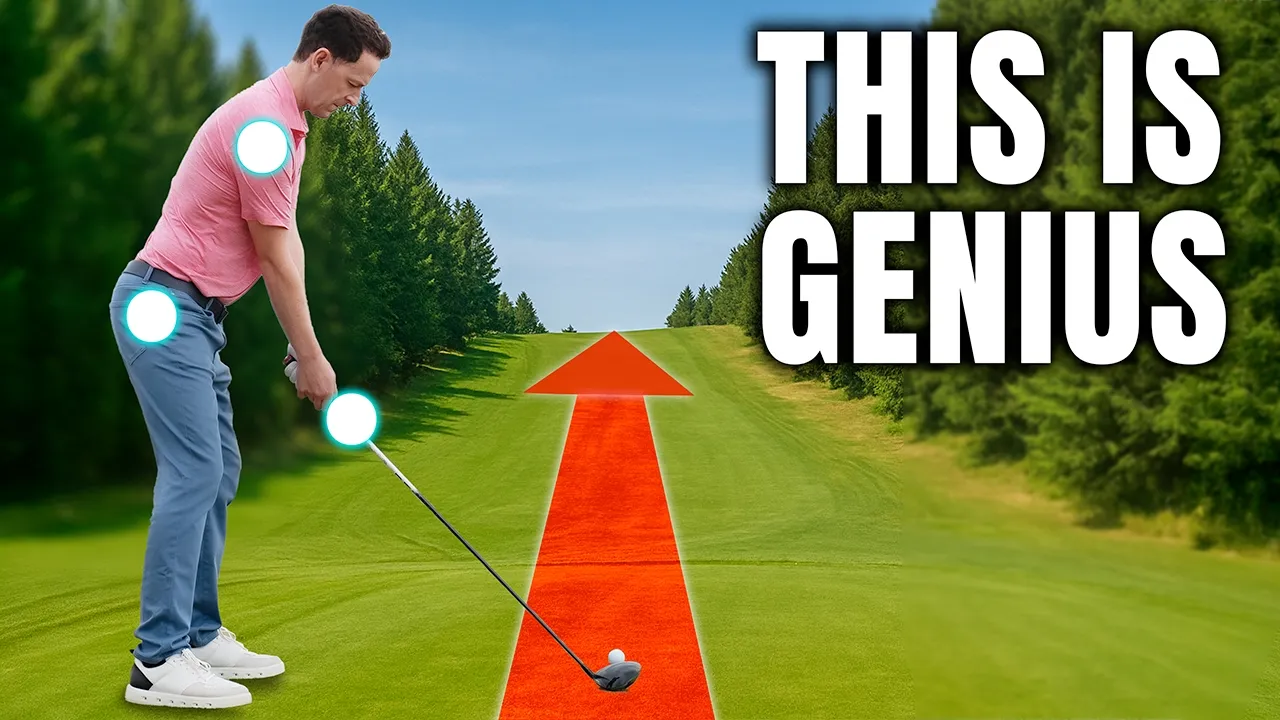
What about the body? Again, let's keep this incredibly simple. How do we control the face to path? Not just with our hands and arms, but also your body, too. Super simple. Just imagine a dot here and a dot here. The more this upper dot here gets ahead of the lower dot, i.e. the middle of your uh pelvis, the more we're into slice territory. Watch this. This would be now moving bit by bit to more hook territory like this.
Look at this. Slice hook. Look at this from this angle. From here, look. Slice. You can see here. Look, that's going to get me coming down and across to the left. Add the open face so that we hit a slice. Where's the path going to go now? Well, if we line up the face here, look, and we start to get back here, that's now moving towards hook territory. So, again, feel that. Hit some shots. By the way, don't be shy of it.
So for instance, if somebody slices the golf ball, I'm going to get them to imagine imagine that this upper center is always behind their lower center as they are swinging through the shot. So I almost imagine their head stays very much feels like almost behind the golf ball. Yeah. As they're coming through the shot. Most slicers, they tend to move this way. So controlling that. So let's look at this in action. So, if I get, for instance, my upper center head of my lower center, watch what happens.
Yeah. So, watch this. We're going to see a big slice face the path massively open because I've just done that. So, same principle. Let's grab a tea. If I wanted to get reduce that with my body alone, all I would do is get the sensation. Feel it. This is where I want to be. Okay. Feel it, right? Okay. So, this is going to be if I slice the ball, feeling this exaggerated motion here. Combine that with this. And suddenly, now we're going to quite struck that one, but it's just me exaggerating.
Suddenly, we're going to be creating more of a hook style shot. But you can see here how to maneuver that and learn to feel the difference between those two is how you learn to control the face to path. Learn to control the face to path and you will be amazed at what it does to every single part of your game. More importantly, it's going to save you thousands of hours practicing on random golf tips that probably won't improve anything whatsoever.
Look, I really, really hope you enjoyed this video. If you did, give a thumbs up, maybe share it with your friends, and of course, love. Subscribe to the channel if you haven't already done so. I'll put a free downloadable practical plan in that description box below. Once you've started to hit driver straighter, you're going to want to probably want to know how to add more distance to your driver. Once you've done this video and you've learned some of this, check this video out right here.
But until next week, have a wonderful golfing
The words are the caption track's own and nothing is reworded or re-transcribed. Paragraph breaks are placed between sentences so the text reads as prose.
Free tools for your own script. No signup, no login.
Paste your draft and see where viewers are likely to drop off, with a rewrite for each weak line.
Paste the first 30 seconds of your own draft for a hook score and rewrites.
Check your draft against YouTube's advertiser-friendly guidelines before you record it.
Read this channel's public videos and transcripts, and download a writing brief for it.