Getting the transcript
Reading the captions from YouTube. A video nobody has opened here before takes 10 to 30 seconds; this page fills in on its own.
Getting the transcript
Reading the captions from YouTube. A video nobody has opened here before takes 10 to 30 seconds; this page fills in on its own.
Dara Denney · @DaraDenney
This video has no Most replayed graph yet: YouTube shows one only once a video has enough views. These are the moments viewers replayed most in Dara Denney's most watched videos.
Most replayed moment at 1:55
4.1x that video's typical replay level
different parts of your computer and different apps, you're going to have to give it access through connectors. And for everything that we're going to go through today, make sure that you at least have Chrome connected as well as Slack. Now, let's dive into this first one, analyzing ad libraries. Now,
Said at 1:49
Most replayed moment at 14:54
4.4x that video's typical replay level
like to use it in addition to this is right here. First, what you're going to do is go to Claude, and you're going to export your brand brain, and any other context documents that you have. If you don't have that yet, here's a really great prompt that I use for all of my
Said at 14:46
The graph counts replays. It does not show where viewers stopped watching.
Words
3,871
Runtime
20:00
Speaking pace
194wpm
Reading time
16min
194 words per minute, between the 181 median and the 201 75th percentile of 349 measured videos. That distribution comes from the 349-video hook study.
Opening (first 30 seconds)
Media buying is dead. Creative strategy is dead. Influencing is dead. Meta ads are dead. And so have we all died. I know this seems like the big bold truth. I see it every single day on LinkedIn and Twitter. And nothing infuriates me more because I think it is the furthest thing away from the truth. But AI is having a massive impact on our industry and there are big ramifications of it and also big opportunities. I like never sit down and do true heart-to-he heart videos with you guys and I want to try
97 words, the words spoken in the first 30 seconds at 194 words per minute.
Free, no signup. See how the first 30 seconds hold attention, with rewrites.
Sentence shape
| Measure | This transcript |
|---|---|
| Sentences | 186 |
| Average words per sentence | 20.8 |
| Longest sentence | 86 words |
| Questions asked | 16 |
| Sentences containing a number | 8 |
Most used terms
Filler phrases
103 in total: like 59 · actually 33 · kind of 5 · right? 2 · literally 1 · sort of 1 · um 1 · you know 1.
A literal whole-word count of the same phrase list the Prepublish browser extension uses, so a phrase inside another word is not counted and a phrase used in its ordinary sense still is. It is a count and not a judgement.
What this transcript is
Every word below is the caption track YouTube publishes for this video, pulled from the video itself and reproduced unchanged. It is not Prepublish's writing, not a summary, and not a re-transcription: it is the video's own published captions. English captions, generated automatically by YouTube, in the video’s original language. Source: the video on YouTube. A channel that would rather this page did not exist can ask for its removal through the contact page, and it is removed.
Media buying is dead. Creative strategy is dead. Influencing is dead. Meta ads are dead. And so have we all died. I know this seems like the big bold truth. I see it every single day on LinkedIn and Twitter. And nothing infuriates me more because I think it is the furthest thing away from the truth. But AI is having a massive impact on our industry and there are big ramifications of it and also big opportunities. I like never sit down and do true heart-to-he heart videos with you guys and I want to try it this once, right?
Like I feel like I'm in this position with the channel where recently I try to overd deliver on value and try to make sure oh my god if like they're not getting something where they could implement and it would immediately make them 20k then I'm not going to make a video about it. I actually kind of want to just jam with you guys for once about the way that I see the next few months of creative strategy work and meta ads and [music] how crazy of a ride I think it's going to be.
And listen, I'm not saying this to like fear-monger you into watching this video. I actually just want to jam one-on-one with my core audience here because for the right people, I do think you are going to thrive having this information. So, what I want to talk about is what I think the next 6 months to a year is going to look like for the performance marketing industry. And this is from real conversations that I've had with some of the top AI companies, their CEOs and leadership.
And I also want to pull back the curtain how I'm thinking about my own creative strategy work, my own work as a creator/influencer, and how I'm gauging some of AI's toughest moral questions. My god. So, the first thing that I want to talk about is actually something that I think I got wrong. a prediction that I made a number of months ago about AI where I thought that a lot of junior roles were going to start to disappear.
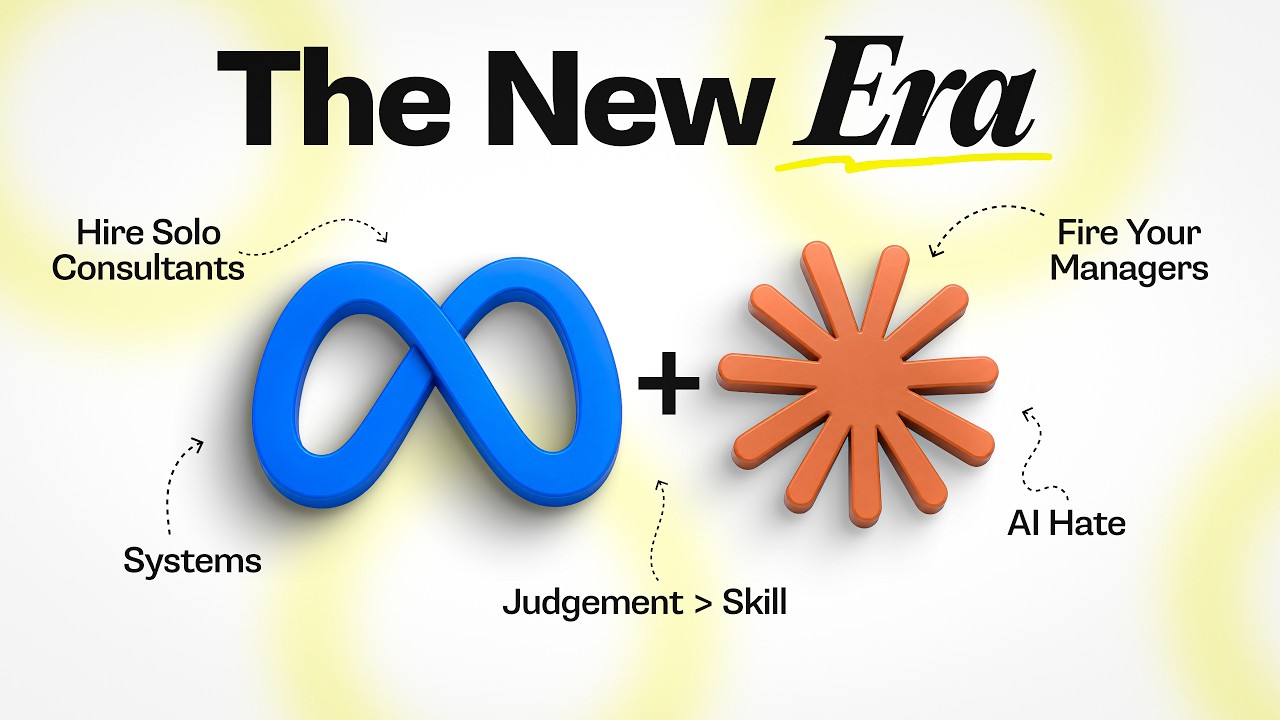
And this was a big concern for me because I was like, "Wow, like how are we going to train the next era of creative strategists if we're not giving them entrylevel junior positions to actually learn and curate this craft. What I am actually seeing and based on conversations that I've had with CEOs at some of the top AI companies recently is they're actually predicting and seeing that the management roles are what are starting to dissolve in favor of the independent contributor who can actually get done.
This is how law firms are run but this is not how agencies traditionally are run. When we look at an org chart of an agency, there are going to be a lot of people managers. And actually, like something that I ended up doing when I was moving up in my career is like I very quickly became a people manager and wasn't the one day in and day out doing a lot of the work. I was managing the workflow. I was overseeing that work.
I was potentially doing and spearheading the strategy, but I wasn't like fingers on keyboard. What I'm seeing based on these conversations is the industry is moving towards people who can do the strategy and execute the work with AI. Those are going to be the most lethal hires over the next 6 months to a year and priority and highest salaries are going to be given to these individuals that in theory are going to be able to do the work of two to three people.
Now, what's really interesting about this is this is something that actually happened recently at my agency with me and Miguel. We decided a number of months ago, oh, we want to hire a creative strategy leader, someone who can really help manage the workflow of the creative strategist, set some of that initial strategy, and really QA briefs and content before going to clients. And we actually decided to reverse that decision and hire more junior mid-career creative strategists that could be more closely mentored by him and I.
And the reason why we've done that is because a number of our automations have actually enabled us to review more briefs, get more quality work out the door, and the work of being a middle manager was starting to fall by the wayside. So we thought, okay, if we can get more people to execute on the work that we are doing because we're not putting as much man-hour into reporting, into client comms, into project management, we are actually able to get more quality creative out the door because of that.
Now, I think for creative strategists particularly here, the biggest change that's going to happen is they're going to be owning the entire acquisition funnel. And I'm seeing this with the top creative strategist at the top brands. They're not just setting the strategy, writing the briefs, and QAing the creative as it gets out the door. They are also creating that entire experience from the funnel and product selection on what they think is actually going to be the most scalable acquisition offer. and they are also creating that back-end landing pages because they're able to move so quickly with AI.
And I really think this creative strategy leadership IC role is going to be the hottest job. And I actually think a great opportunity for creative strategists who are super talented that want to offer their own services as a consultant or as a freelancer because if you can learn to do actual business strategy and also facilitate the landing page in addition to making the creatives like you are a plugandplay vital person that any business in this new era is going to need.
Now one of the other biggest changes that I'm noticing is that the biggest skill to acquire right now isn't necessarily AI. And I think that's because AI is no longer a promptbased experience. It's much more conversational and nuanced. What I found that I've personally done over the last few weeks and months is I've pretty much abandoned my prompt library in favor of having actual sideby-side workflows in conversations with LLMs and with specific agents. which means that you no longer need to be really good at AI or have the best prompt or like be like a prompting engineer.
What you actually really need to be good at are these five things. Number one, creating or being creative. If you're able to say, "Oh, having this specific visual in this hook would really increase performance." And that's not something that an AI is telling you, but you're able to easily implement because of AI. This is something that is a major perk for how you are actually working with this technology because you are driving it.
You are making the decision, but you are able to move a lot more quickly as a result of having the tech. And number two, curating and editing. I think everyone loves to talk about taste. It's like the taste wars of 2026. All of a sudden, having taste is so sexy. Like even when I talk to my friends about the type of guys they're interested in dating, like almost all of them will say, "Oh, he has like a certain type of taste or style." Like being able to be someone who can curate not only yourself but the content and the elevation of work that you want to be associated with.
This is a new skill set. And number three, articulation and communication. Again, working with AI is no longer a prompt-based experience. It is a articulation and a communicative one. And number four, your decision making and judgment process. When AI gives you something back, are you able to make a decision? Either this is good, this is bad. So having that judgment call or are you able to actually take action from the information that it gives you ultimately the person who's going to succeed the most in the room is the person who can make the most decisions.
And as someone who in the past has like hemmed and hawed over certain decisions, like I cannot emphasize how true this is. In fact, one of the conversations that I've had with a CEO friend of mine, the number one word that he used in relation to AI in this next new era, which I was able to pull out from my granola, was the word judgment. Do you have the right judgment when it comes to approving the work that a lot of these LLMs and strategists and people are going to put out?
Are you able to really differentiate between the 8020 of slop and and actual good asset that you could curate and edit to then actually become great? And then the final one is systems thinking. When I was at the WhatsApp conference in London earlier this year, this was the number one thing that was flagged by Meta's CMO about the skills that are really going to be needed to thrive in this next era. And it's this idea around being a systems thinker.
And this is the way that I like to think about systems thinking. Are you able to look at a process in your overall business and see outside of that initial process? Are you able to see the impacts of when something would change within that specific process? Are you able to look at your workflow, think of it in a systematized A, B, C, D, split off and B and split off and D and F and how changing one of those things could impact the overall system.
Because systems thinkers aren't just thinking about how to solve their immediate problem. They're thinking about how that solve could potentially impact other people's workflows, aka the impact of the entire system. And this is one that I think I need to work and curate more of my skill set on because I am a little bit more creative as opposed to processoriented, which is why I feel like my partnership with Miguel and why the agency has been so successful in a short amount of time is because we really do have the right and left brain combination.
Now, in spite of all this, I want to keep it 100 with you that I still feel like I have an AI spiral like once every two months. This absolutely started happening when Claude Co launched earlier this year. And like candidly, one of my favorite AI tools to date has had a massive impact on my work as a creative strategist. And that's because the things that I really sucked at like actually did not matter anymore. Like for instance, I did not get an agency job that I desperately wanted 12 years ago because I was bad at Excel and I could not make a pivot table.
Now I can literally just yap to AI and make the Google spreadsheet of my dreams. And thinking back to my first agency job when I was an account manager living in Cairo, Egypt at the time, they actually had to hire me an assistant because the reporting actually took so long for me personally to do on the accounts that I was executing. the reporting aspect of what I did annihilated so much of my workflow. And like great on the team for recognizing that, but like they knew I was such a creative thinker that like every single month it would blow up an entire week.
That's how big of an impact it had and why they needed to make this higher. Again, I feel like I'm a much more well-rounded individual just cuz I can do XL now. And it's so cool to be able to create these type of documents and artifacts with Claude and with Runith. And because I'm able to ask the right questions, I feel like I am one of those people that's kind of secretly getting the most out of AI. It was just like some of the technical that I was never good at that like now I don't ever have to be good at and like no one else has to ever be good at ever again.
It's kind of a relief. Okay. And now here's the thing I'm candidly most nervous to talk about and I'm like so curious how this conversation with you guys is going to go. It's like the selective moral outrage of AI and implementing AI into businesses and into our world, right? I think this is incredibly topical right now considering the recent chat GBT influencer trip. I actually got asked if I was free to go on this trip and I wasn't.
I was in Europe for the next month so I wasn't able to go on it. And it was so funny cuz I was totally split between whether or not I wish I could have gone or it was a blessing in disguise cuz I don't know that I could have handled the like public fallout even though I don't agree with a lot of it. So, let me explain. Right. Recently, OpenAI hosted a bunch of influencers on Wildflower Farms in upstate New York, and people had a lot of thoughts about it.
Probably one of my hottest takes is that I think the outrage over AI is actually more damaging to our culture and our society than the impact that AI is actually going to have on our environment. And I know that's a hot take. And the reason why is because I don't think people actually hate AI because of the environmental concerns. If people really hate AI because of the environmental concerns, we would have more vegetarians and vegans.
We would have less people using fast fashion. We would have less people watching Netflix and YouTube and there would be similar outrage amongst all of these big pillars. And don't get me wrong, the data centers and our energy consumption, it's going to go up a lot. They predict it's going to be about a quarter for what we're currently generating in the US. What I think the narrative of it is that is so dangerous is, oh, you shouldn't use AI, you shouldn't support AI technology because it's bad for the environment.
When I think perpetuating that narrative, it gives people permission to opt out of learning a skill that they're really going to need. And I think there's a lot of intimidation with AI. There's a lot of concerns with people losing their jobs. And I'm just not one to think, okay, like let's complain about it. I'm one to think, what can people do? And that's why I think my position in this is realistically I want to make AI approachable for people particularly women.
I want to show them an easy onramp for how they can incorporate this technology into their everyday workflow and lives. I think saying oh AI is really bad for the environment and we just shouldn't use it is actually allowing the K-shaped economy to really come to fruition. And I already think that it's happening. And for those of you that don't know, the K-shaped economy is essentially the theory that the rich are going to get richer, the poor are going to get poorer, and it's going to be the fallout of the middle class.
And I do think that this technology, particularly that narrative, is perpetuating and accelerating the K-shaped economy. And this is actually the thing that I am most concerned about when talking with the CEOs from these large AI companies is there's so much awe and wonder and opportunity for people who are taking advantage of the tech, but for the average individual who maybe has some concerns, isn't an early adopter, what is going to happen for them?
So, I think about the hundreds of people that I've managed over the last decade of my career, designers, video editors, junior creative strategists, and I really wonder like what is the future of their work going to look like if they are not people who are taking it on themselves to really adopt this new tech and adopt it into their workflow and really change with the times. And I think part of it is this narrative that gives them permission to not adopt and not lean in.
I want to emphasize that I think the environmental concerns are really real, but I also believe that there's selective outrage and people are looking for a reason to hate AI and the environmental concern is the biggest scientific objection that people hang their hat on when really they don't think that the big corporations are actually going to help them. And they'd be right. Which is why also my biggest prediction moving forward is that the rate of entrepreneurs and founders and freelance economy is going to be the thing that's going to really spiral and snowball.
Not because people want it, but because people are going to need it in order to survive in this next era. And to like wrap it all up, here's really how I would think about moving forward as a creative strategist or someone who works in performance marketing. And number one is actually like a really distinct action item and it's an exercise that I recently went through that I found to be really fun and really helped me feel like wow I'm like doing the thing which is sit down and I want you to create an or chart for yourself um or a board of directors chart right and I want you to ideulate hey if I could hire anyone for myself or any role for myself personally what would it be?
Would you hire an interior designer? Would you hire a financial advisor? Would you hire a fashion stylist? Like these are all things that are on my org. I shared this org with Claude and I helped it build out workflows and agents so that I could actually curate those type of skills into more of my day-to-day life. Begin to build automations for yourself so that you can become the best version of yourself. And I also think that sometimes the on-ramp of AI is best done when there is a personal use case instead of a professional one because a lot of times the professional ones are kind of boring.
The second thing is to take seriously your curation and your creativity skills. If you've met me in person at all over the last year, then you know that I had a major major life change towards the end of November. And it was sort of like a bit of a soul awakening for me. And one thing that really helped me so much was going through the artist's way. Listen, none of you are going to actually read this. Maybe two or three of you will, but I cannot emphasize how much this daily practice impacted me as a person and as a creative and candidly as a creative strategist.
Like the business ramifications have been vast. Number three, another action item for the way that you're going to be using AI is to build out your own systems and approach and workflow for how you are approaching your day-to-day work, regardless of what your profession is. And again, the amazing thing is is now all you have to do is yap to your platforms about the way that you want to approach this work and it will build out the workflows and the Google Sheets and the notion boards for you.
Thank god because I was always so bad at that. And I can't tell you like even now I've been doing this work for over 12 years and every time I sit down getting ready to work with a client, I haven't done my research. I'm like I don't know kind of shooting in the dark here. But I go through my research process at the end I'm like yeah I have some big opinions now. And it's because I've systemized that approach to research and my own internal processes for how I approach what I do, my craft.
I have a craft. Develop your craft and verbalize it and visualize it using AI. And number four, aim for excellence. Know what excellent looks like. If you can be associated with creating excellent work, this is going to be a defining characteristic for you for the next decade. If you can be associated with not AI slot, consider taking a look at your own creative workflow and what are the things you want to use AI for?
What are the things that you don't? When I think about this, right, like I think part of the reason why I'm so successful on LinkedIn is because I don't use AI for it. I don't I write it from the rip. Another thing that I actually think has helped me aim for excellence and push me to know what excellence looks like is by looking at content in media and defining whether or not it is good or bad. This is actually something that I learned from Orange John.
He posted this on a tweet like a year ago and it's probably like one of the biggest things that I've taken from him in his content which is you will learn to develop your own taste and your own barometer for what is good and bad. If you are forced to look at content and media and creative through the lens of is it good or bad and can you articulate why or why not? And finally, if you are a creative strategist, if you are a performance marketer, I implore you to begin to take on freelance and consulting work.
You can offer hourly consultations. You can offer projectbased work. You can offer monthly retainers. You can offer audits. You can offer static bundles. But as businesses are starting to dissolve management positions, I think that that means that there's also going to be a big chunk of people who are unable to get work at agencies or brands in the near future. Which is why I encourage every single creative strategist out there to really start looking at themselves like they are their own business.
It's not only the safest path forward, but I also think it's the path where people are going to thrive more. So, in my opinion, it's a win-win. Let me know what you think about this YAP session. Very, very different from what I normally do. Tell me if you loved it or hate it. I got thick skin. And I'll see you next week. Love you. Bye.
The words are the caption track's own and nothing is reworded or re-transcribed. Paragraph breaks are placed between sentences so the text reads as prose.
Free tools for your own script. No signup, no login.
Paste your draft and see where viewers are likely to drop off, with a rewrite for each weak line.
Paste the first 30 seconds of your own draft for a hook score and rewrites.
Check your draft against YouTube's advertiser-friendly guidelines before you record it.
Read this channel's public videos and transcripts, and download a writing brief for it.