Getting the transcript
Reading the captions from YouTube. A video nobody has opened here before takes 10 to 30 seconds; this page fills in on its own.
Getting the transcript
Reading the captions from YouTube. A video nobody has opened here before takes 10 to 30 seconds; this page fills in on its own.
The Escalist · @the.escalist
Where viewers went back to watch this video again, from YouTube's public Most replayed graph, lined up with what was said at that moment.
Most replayed moment #1
5:5613.5x the video's typical replay level
sight, the real question stops being how big whirlpools get on Earth and starts being whether Earth is even where this pattern ends. Level eight. Earth's oceans aren't the only place nature builds giant vortices, and from here, the danger stops being something you
Said at 5:49
Most replayed moment #2
0:594.9x the video's typical replay level
stay small on purpose. Give that same rule more water, more current, more depth, and it stops being something you rinse off your feet. Level one. Engineers have a nickname for what forms behind certain low, unassuming dams. So ordinary that people drive past hundreds of them without a glance. The drowning
Said at 0:52
Most replayed moment #3
2:584.8x the video's typical replay level
the country. Yet, despite holding the world record, Saltstraumen is rarely the whirlpool people remember. That honor belongs to something sailors feared long before anyone understood why. Level four. That title belongs to a stretch of sea near Norway's Lofoten Islands that ships avoided for centuries, a name that
Said at 2:51
The graph counts replays. It does not show where viewers stopped watching.
Words
1,439
Runtime
8:14
Speaking pace
175wpm
Reading time
6min
175 words per minute, between the 160 25th percentile and the 181 median of 349 measured videos. That distribution comes from the 349-video hook study.
Opening (first 30 seconds)
Level zero. A drop of water spirals down your bathtub drain and something older than civilization quietly switches on. You've probably heard the myth, which way it spins depends on which hemisphere you're in. It's a satisfying story. It's also almost entirely wrong at this scale. The Coriolis effect only reliably shapes rotation across distances of hundreds of kilometers, not a few liters of bathwater. What's actually spinning your drain is leftover motion already in the water. Tiny currents from how you filled the tub, how you moved
88 words, the words spoken in the first 30 seconds at 175 words per minute.
Free, no signup. See how the first 30 seconds hold attention, with rewrites.
Sentence shape
| Measure | This transcript |
|---|---|
| Sentences | 93 |
| Average words per sentence | 15.5 |
| Longest sentence | 41 words |
| Questions asked | 3 |
| Sentences containing a number | 14 |
Most used terms
Filler phrases
7 in total: like 5 · actually 2.
A literal whole-word count of the same phrase list the Prepublish browser extension uses, so a phrase inside another word is not counted and a phrase used in its ordinary sense still is. It is a count and not a judgement.
What this transcript is
Every word below is the caption track YouTube publishes for this video, pulled from the video itself and reproduced unchanged. It is not Prepublish's writing, not a summary, and not a re-transcription: it is the video's own published captions. English captions, generated automatically by YouTube, in the video’s original language. Source: the video on YouTube. A channel that would rather this page did not exist can ask for its removal through the contact page, and it is removed.
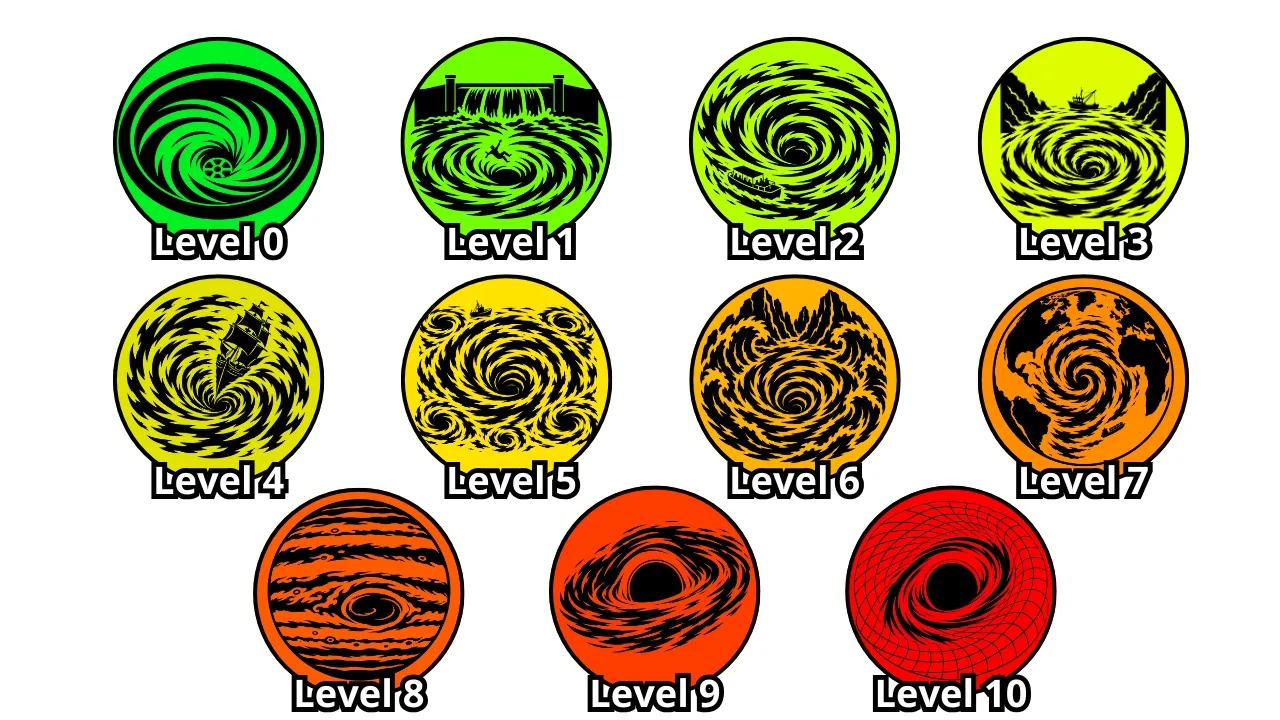
Level zero. A drop of water spirals down your bathtub drain and something older than civilization quietly switches on. You've probably heard the myth, which way it spins depends on which hemisphere you're in. It's a satisfying story. It's also almost entirely wrong at this scale. The Coriolis effect only reliably shapes rotation across distances of hundreds of kilometers, not a few liters of bathwater. What's actually spinning your drain is leftover motion already in the water.
Tiny currents from how you filled the tub, how you moved through it, the exact shape of the hole. Basic, predictable, forgettable. Scientists have actually tested this in labs, letting bathtubs sit undisturbed for a full day before draining them. And only then does the Coriolis effect win out consistently. A rotation too faint for any human hand to notice happening. But the rule running underneath the whole thing, water conserving its rotation as it loses space to move through, doesn't stay small on purpose.
Give that same rule more water, more current, more depth, and it stops being something you rinse off your feet. Level one. Engineers have a nickname for what forms behind certain low, unassuming dams. So ordinary that people drive past hundreds of them without a glance. The drowning machine. Water pours over the edge, curls underneath, and recirculates in a closed loop that will not release what falls in. Lifejackets don't help.
Strength doesn't help. Rescuers have watched swimmers pulled under, pushed to the surface, then pulled under again over and over by a hydraulic that looks like nothing more than a ripple from the road. No coastline required. No storm required. Just water refusing to let go. In the United States alone, low-head dams have been linked to hundreds of drownings. So many that some states have begun tearing structures down purely because the recirculating current beneath them is more dangerous than the flood control they were built to provide.
If a structure this small can hide something this merciless, what happens when the ocean builds the same trap across an entire strait? Level two. Twice a day the tide answers that question in Japan's Naruto Strait, where the Pacific and the Seto Inland Sea are forced through a gap barely 1 km wide. The squeeze produces whirlpools up to 20 m across with currents reaching 20 km/h, fast enough that tour boats are purpose-built to survive the ride through them.
These whirlpools aren't chaos, they're clockwork, timed so precisely to the moon that locals can name the hour before it's arrived. Predictable violence on a schedule. So, what happens when that same tidal squeeze gets forced through a gap even narrower? Level three. Every 6 hours roughly 400 million cubic meters of seawater get compressed through a Norwegian channel just 3 km, a strait called Saltstraumen. That's the official record holder for strongest tidal current on Earth, producing whirlpools up to 10 m and surface speeds near 40 km/h.
Fisherman still stand on the bridge above it because the same violence that terrifies tourists also drags up some of the best cod fishing in the country. Yet, despite holding the world record, Saltstraumen is rarely the whirlpool people remember. That honor belongs to something sailors feared long before anyone understood why. Level four. That title belongs to a stretch of sea near Norway's Lofoten Islands that ships avoided for centuries, a name that traveled faster than any warning could.
Moskstraumen, the original maelstrom. Edgar Allan Poe sent a sailor into it. Jules Verne sent a submarine through it. For generations, something about this water felt unfinished, too violent to have a simple explanation, and every era tried to resolve it with a bigger story. Sea monsters, sinkholes, portals. Modern instruments finally measured the truth, currents over 30 km/h producing standing waves and turbulence rather than one bottomless funnel.
The legend exaggerated the shape. It did not exaggerate the danger, and astonishingly, it still isn't the largest whirlpool on Earth. Level five. The largest whirlpool in the entire Western Hemisphere doesn't need a legend, just an underwater seamount off New Brunswick, Canada, and the biggest tidal range on the planet, up to 16 m, about 52 ft, between high and low tide. Locals call it the Old Sow. Twice daily, that much water forced around that much rock erupts into a spiral roughly 76 m, about 250 ft across, trailing smaller satellite whirlpools nicknamed piglets.
You hear it before you see it, a low grinding roar fishermen have used as a warning for generations. One whirlpool on this list is smaller than the Old Sow and still considered more dangerous. It has a goddess attached to its origin story, level six. Scottish folklore says the sea hag Cailleach uses the Gulf of Corryvreckan to wash her plaid, stirring it for 3 days until the water turns white. Science credits a submerged pinnacle instead, one that forces tidal water into standing waves up to 9 m, about 30 ft, high loud enough to be heard from 16 km, about 10 mi away.
Currents here move a modest 18 km/h, roughly 11 mph, slower than several whirlpools already on this list. Yet, the jagged terrain beneath it makes Corryvreckan one of the most dangerous navigable waters on Earth. Every whirlpool so far has had a coastline you could point to. The next one doesn't. Level seven. Satellites have caught something rotating far from any shore that dwarfs everything above it combined. Mesoscale ocean eddies, some stretching over 300 km, roughly 190 mi, across.
No funnel, no roar, nothing a sailor on deck would ever notice. Just a slow, months-long rotation that drags warm water and entire ecosystems thousands of kilometers off course. Only satellite altimetry, tracking tiny bulges in sea surface height, can confirm they're there at all. Oceanographers have found some eddies that survive for over a year, drifting across entire ocean basins while carrying their own self-contained climate of warm water and marine life along for the ride.
And if the ocean can hide a whirlpool this size in plain sight, the real question stops being how big whirlpools get on Earth and starts being whether Earth is even where this pattern ends. Level eight. Earth's oceans aren't the only place nature builds giant vortices, and from here, the danger stops being something you could survive and starts being something the universe simply does. It isn't. Jupiter carries a storm larger than our entire planet, spinning continuously for at least the last 190 years that telescopes have been watching it.
The Great Red Spot. Wind speeds inside its outer bands reach roughly 430 km/h, and the storm has no ocean floor, no coastline, no friction to slow it down, just gas, gravity, and the same conserved rotation that emptied your bathtub. A whirlpool the width of Earth, held together by nothing but physics that doesn't care what planet it's on. So, if a gas giant can spin a whirlpool this large, what does the universe do when it runs out of gas to spin?
Level nine. It builds a drain that nothing escapes. Around a black hole, infalling matter doesn't fall straight in. It spirals, forming an accretion disk that can reach temperatures of millions of degrees before crossing the event horizon. It is the same conservation of angular momentum from every level before this one, just given a gravitational well steep enough that the spiral becomes the last thing light itself will ever do.
Near the inner edge of the disk, matter can complete an orbit in a matter of minutes, moving at a meaningful fraction of the speed of light before it crosses a boundary nothing has ever been observed to cross back over. Scientists don't describe black holes as literal whirlpools, but the same physics of conserved angular momentum builds a spiral that behaves remarkably like one. They're speculating about something stranger happening just beneath it.
Level 10. A spinning black hole doesn't only pull matter into a spiral. According to Einstein's general relativity, confirmed by satellite experiments like Gravity Probe B, a rotating mass drags the fabric of space-time itself around with it, an effect called frame-dragging. Near a black hole, that drag becomes extreme enough that space and time stop behaving like a stage the universe performs on, and start behaving like water caught in the current.
Not a whirlpool in space, a whirlpool made of space itself. Physicists still don't agree on what happens at the exact center of that spiral, only that something is being pulled toward it right now, in real time, and it hasn't finished arriving yet.
The words are the caption track's own and nothing is reworded or re-transcribed. Paragraph breaks are placed between sentences so the text reads as prose.
Free tools for your own script. No signup, no login.
Paste your draft and see where viewers are likely to drop off, with a rewrite for each weak line.
Paste the first 30 seconds of your own draft for a hook score and rewrites.
Check your draft against YouTube's advertiser-friendly guidelines before you record it.
Read this channel's public videos and transcripts, and download a writing brief for it.