Getting the transcript
Reading the captions from YouTube. A video nobody has opened here before takes 10 to 30 seconds; this page fills in on its own.
Getting the transcript
Reading the captions from YouTube. A video nobody has opened here before takes 10 to 30 seconds; this page fills in on its own.
Phil Mosley - MyProCoach Triathlon Training · @myprocoach123
Where viewers went back to watch this video again, from YouTube's public Most replayed graph, lined up with what was said at that moment.
Most replayed moment #1
2:032.7x the video's typical replay level
to keep things interesting and to stop my mind wandering too much. This workout develops sustainable race power without frying your. During these sessions, you would write efforts around 80 to 85% of FTP or
Said at 1:57
Most replayed moment #2
6:172.3x the video's typical replay level
one quality bike, one quality run, and two swims depending on your schedule. The R is spacing them sensibly so that you are fresh for the key workouts rather than tired all the time. This is where having a structured plan can make life easier.
Said at 6:12
Most replayed moment #3
4:271.8x the video's typical replay level
of 15 minutes at tempo thrown in. And then you hop off your bike and you run for 20 minutes, and the first five or 10 minutes of that 20 minutes you would try and do at your target race pace. The aim of these sessions isn't to punish yourself, it's just to rehearse pacing and
Said at 4:20
The graph counts replays. It does not show where viewers stopped watching.
Words
1,301
Runtime
7:17
Speaking pace
179wpm
Reading time
5min
179 words per minute, just under the 181 median of 349 measured videos. That distribution comes from the 349-video hook study.
Opening (first 30 seconds)
You don't need to train for endless hours to race a strong IRONMAN 70.3 triathlon. You just need the right key sessions used consistently, and for the right reasons. Over the years, I've coached thousands of athletes and I've made plenty of mistakes myself. So what you'll hear today comes from a lot of trial and error. One thing I've learned is that IRONMAN 70.3 success isn't about piling on endless hours. It's about choosing the right sessions at the right time. So in this video, I'll share the five
90 words, the words spoken in the first 30 seconds at 179 words per minute.
Free, no signup. See how the first 30 seconds hold attention, with rewrites.
Sentence shape
| Measure | This transcript |
|---|---|
| Sentences | 75 |
| Average words per sentence | 17.3 |
| Longest sentence | 40 words |
| Questions asked | 0 |
| Sentences containing a number | 24 |
Most used terms
Filler phrases
10 in total: like 8 · actually 1 · uh 1.
A literal whole-word count of the same phrase list the Prepublish browser extension uses, so a phrase inside another word is not counted and a phrase used in its ordinary sense still is. It is a count and not a judgement.
What this transcript is
Every word below is the caption track YouTube publishes for this video, pulled from the video itself and reproduced unchanged. It is not Prepublish's writing, not a summary, and not a re-transcription: it is the video's own published captions. English captions, published by the channel, in the video’s original language. Source: the video on YouTube. A channel that would rather this page did not exist can ask for its removal through the contact page, and it is removed.
You don't need to train for endless hours to race a strong IRONMAN 70.3 triathlon. You just need the right key sessions used consistently, and for the right reasons. Over the years, I've coached thousands of athletes and I've made plenty of mistakes myself. So what you'll hear today comes from a lot of trial and error. One thing I've learned is that IRONMAN 70.3 success isn't about piling on endless hours. It's about choosing the right sessions at the right time.
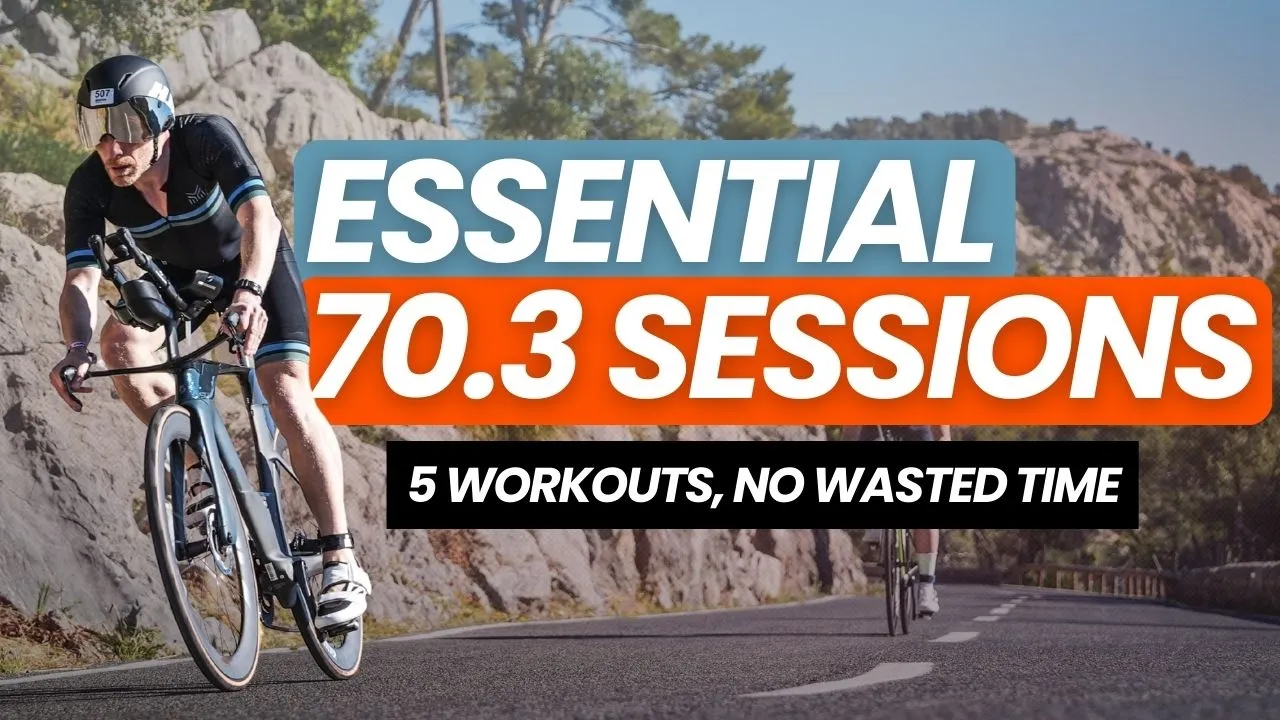
So in this video, I'll share the five workouts I consider absolutely essential for IRONMAN 70.3 athletes. They're simple, repeatable, and incredibly effective when done consistently. Let's get started. So your long ride is the foundation of your IRONMAN 70.3 bike fitness. Nothing clever here, just steady time in the saddle. A around zone two or roughly 65 to 75% of your FTP or put more simply riding at a conversational pace.
The key is keeping it genuinely steady. Most athletes drift too hard on climbs and then soft pedal a flat If you can keep it controlled, the long ride quietly builds the aerobic base that allows you to hold race pace for more than two hours. It is not glamorous, but it works every single time. Aim for somewhere between 90 minutes and up to four hours or even five hours if you're training for an IRONMAN. Depending on your experience and where you are at in your journey, gradually increase the ride duration of the weeks go by rather than making big jumps in one go.
Keep your fueling simple and use these rides to practice your nutrition and hydration that you plan to rely on for race day. I like to do these sessions with friends personally because the time passes much more quickly. Whereas if I'm riding on my own, I'll often plan a stop at a coffee shop halfway through. Just because it breaks the ride into two manageable chunks and makes it feel less daunting. And if I'm indoors on the indoor trainer, I usually put on a film to keep things interesting and to stop my mind wandering too much.
This workout develops sustainable race power without frying your. During these sessions, you would write efforts around 80 to 85% of FTP or zone three if you prefer heart rate. The aim is to build your muscular endurance while still recovering well enough afterwards. For your key run sessions, a simple starting point would be three lots of 15 minutes at tempo with five minutes easy between them. If you are more experienced, you can progress to two lots of 25 minutes or three lots of 20 minutes even.
The efforts that you do should feel firm, but controlled, like you can manage short sentences, but a proper conversation would probably be out of the question. I used to find these sessions tough mentally until I started using a power meter that seemed to make the whole thing feel more manageable because you can smooth out the spikes and keep things even. When you ride at 80 to 85% of your FDP, it doesn't feel that bad at first, but it does gradually creep up on you and by the final interval, you really have to focus to hold that effort Level.
Sessions like this teach you what your race pace genuinely feels like, and more importantly, how to sustain it. The long run is about durability, not speed. Keep this run entirely aerobic zone two or even easier. You want to finish it feeling like you could have carried on because that's exactly how a good 70.3 run feels until the final few kilometers. The biggest mistake people make with their long, steady runs is going too hard often because they want the uploaded workout to look impressive.
On Strava. If you can't comfortably hold an easy conversation, you are running too fast. Keep it genuinely gentle, and that's where the real endurance is built. Aim for 75 to 100 minutes for most athletes and up to two hours if you're more experienced. Anything much longer tends to create more fatigue than fitness. Focus on relaxed form, light feet, and consistent pacing and practice your nutrition and hydration strategy throughout these longer runs.
Bike to run brick sessions don't need to be dramatic to be effective. In fact, most people overdo them. I prefer to keep bricks relatively short and simple. One session I really like is where you cycle for an hour with two lots of 15 minutes at tempo thrown in. And then you hop off your bike and you run for 20 minutes, and the first five or 10 minutes of that 20 minutes you would try and do at your target race pace. The aim of these sessions isn't to punish yourself, it's just to rehearse pacing and nutrition and to get used to that slightly awkward feeling of running off the bike.
If you make these sessions too long or too hard, they'll just become a slog and you'll spend several days recovering from them afterwards. This simple session delivers a huge return on investment 'cause it teaches control. Race day rewards athletes who can pace well in the first 20 minutes of the run. If you nail that part, you're halfway to a strong finish. IRONMAN, 70.3 swims. Reward strong, steady engines not flat out sprinting.
A classic swim workout is 10, lots of 200 at or just above your target. IRONMAN 70.3 Race pace. With, uh, 20 or 32nd rests. If you are newer to swimming, you can adjust that distance to eight lots of 150 or 12 lots of 100. The goal is sustainable discomfort, swimming just hard enough to develop technique under fatigue while improving aerobic capacity. If you can do this, swim in a safe, open water environment, that's even better than doing it in a pool.
Personally, I do all my swim training in a pool due to necessity, but I always think I'd swim better on race day if I could practice outside more often. Either way, this swim session teaches good pacing discipline, most IRONMAN 70.3 athletes, start the swim too fast, fade halfway, and then battle their way to the finish. Sets like these help you find that sweet spot where you are quick, smooth, and control. A good 70.3 training week normally includes one long ride, one long run, one quality bike, one quality run, and two swims depending on your schedule.
The R is spacing them sensibly so that you are fresh for the key workouts rather than tired all the time. This is where having a structured plan can make life easier. I actually build all my athletes training around these kinds of sessions. Nothing fancy, just proven fundamentals. And if you ever want a low-cost way to follow a well-designed plan with quick coach support when you need it, mine start from around $30 and you'll find the link in the description, or you can head to myprocoach.net.
The key message here is that IRONMAN 70.3 training doesn't need to be complicated. If you consistently hit these five workouts, the long steady ride, the tempo bike, the long run, the race pace brick, and the threshold swim. You'll build the exact fitness you need to race well without burning yourself out. Let me know in the comments which of these sessions you already do or which ones you like best. And if you found it helpful, do hit the subscribe button because it helps the channel grow.
And on screen right now, you'll see another video you might enjoy along with a playlist full of IRONMAN Tips for Athletes. So thanks for watching and hopefully I'll see you in the next one.
The words are the caption track's own and nothing is reworded or re-transcribed. Paragraph breaks are placed between sentences so the text reads as prose.
Free tools for your own script. No signup, no login.
Paste your draft and see where viewers are likely to drop off, with a rewrite for each weak line.
Paste the first 30 seconds of your own draft for a hook score and rewrites.
Check your draft against YouTube's advertiser-friendly guidelines before you record it.
Read this channel's public videos and transcripts, and download a writing brief for it.