Getting the transcript
Reading the captions from YouTube. A video nobody has opened here before takes 10 to 30 seconds; this page fills in on its own.
Reading the captions from YouTube. A video nobody has opened here before takes 10 to 30 seconds; this page fills in on its own.
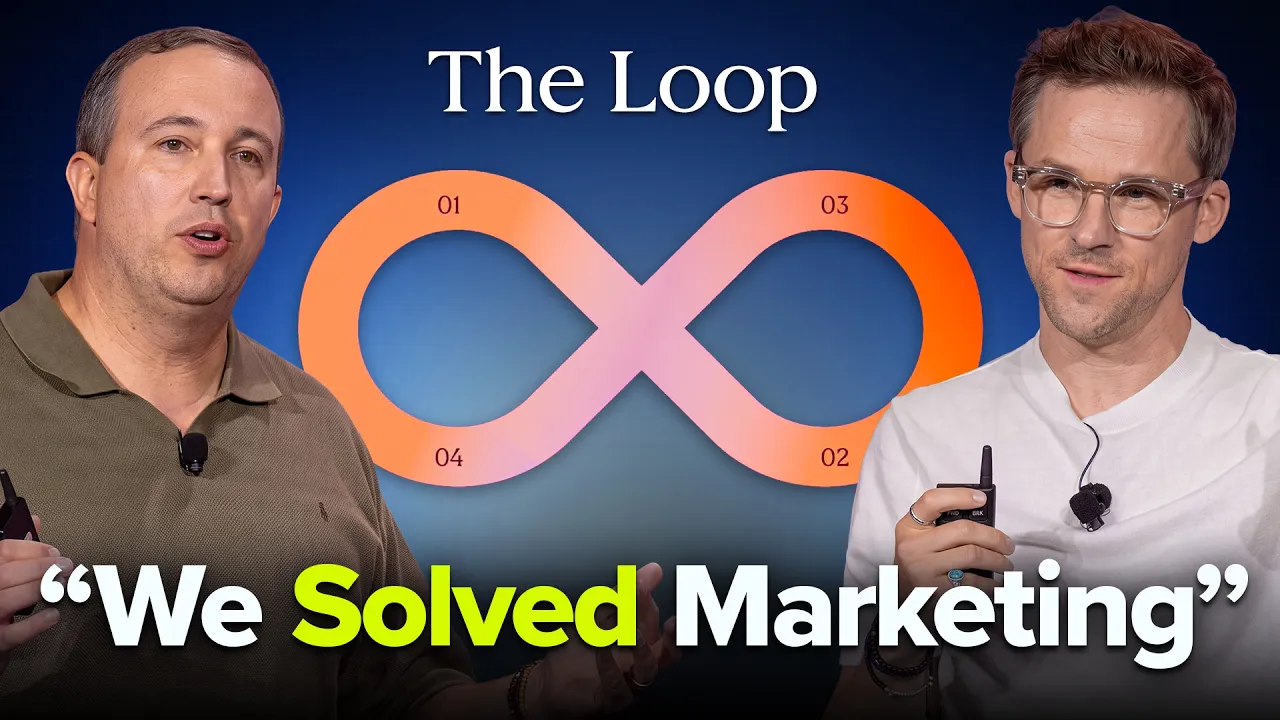
Marketing Against the Grain · @MATGpod
Words
4,654
Runtime
27:23
Speaking pace
170wpm
Reading time
19min
170 words per minute, between the 160 25th percentile and the 181 median of 349 measured videos. That distribution comes from the 349-video hook study.
Opening (first 30 seconds)
AI has been out there and it's been killing everybody's marketing strategy. I know it happened to me firsthand at HubSpot. We lost 140 million visits in one year. That was super painful and it forced us to rethink how we did everything in our marketing. We found that to be so transformative and so important that we spent hundreds of hours of our own time putting together our brand new book, Loop Outarn, Out Market, OutGrow. Today is the first day anybody in the
85 words, the words spoken in the first 30 seconds at 170 words per minute.
Free, no signup. See how the first 30 seconds hold attention, with rewrites.
Sentence shape
| Measure | This transcript |
|---|---|
| Sentences | 364 |
| Average words per sentence | 12.8 |
| Longest sentence | 61 words |
| Questions asked | 19 |
| Sentences containing a number |
What this transcript is
Every word below is the caption track YouTube publishes for this video, pulled from the video itself and reproduced unchanged. It is not Prepublish's writing, not a summary, and not a re-transcription: it is the video's own published captions. English captions, generated automatically by YouTube, in the video’s original language. Source: the video on YouTube. A channel that would rather this page did not exist can ask for its removal through the contact page, and it is removed.
AI has been out there and it's been killing everybody's marketing strategy. I know it happened to me firsthand at HubSpot. We lost 140 million visits in one year. That was super painful and it forced us to rethink how we did everything in our marketing. We found that to be so transformative and so important that we spent hundreds of hours of our own time putting together our brand new book, Loop Outarn, Out Market, OutGrow.
Today is the first day anybody in the world gets to read or listen to this book. And Loop is a playbook for the next era of marketing. And we were live at HubSpot's Unbound event. And we had thousands of people in the room to hear Loop in person for the first time. And we are giving you an exclusive version of that talk for the show today. You're going to want to stick around cuz we are giving you one of the most important tools from Loop.
I highly highly recommend today's episode because we are not only going to break down this new playbook, but we're going to give you a free tool that you can use that is going to supercharge how you play in this new era of marketing. Let's get to today's show. [music] >> [music] >> super excited to be here to talk about why your marketing is broken, but better yet, how we can all fix it. All of the things that used to work are really drastically changing.
And it's not that we're doing something wrong. It's really that the rules of Martin have changed and we have to change with them. They changed pretty drastically for HubSpot in May of 2024. And I want to bring out my great friend Kip Bodner, the CMO at HubSpot to go through this story because he is the one that had to explain this to our CEO Yaman. Kip, why don't you come out at the stage? So Kieran set up a little bit of what we're here to talk with you all about today.
And this is not a pretty chart that anybody wants to explain to anybody. Correct. And so what happened for a long time? More visits met more customers. And that equation is now broken. And what that means for all of us in the world of marketing is that we've moved to a world where volume of visits matter to the a world where value of visits matter. Because what happened in this same period of time is very fascinating.
We saw an 80% drop in our traffic. We lost 140 million visits in a year. But we managed to increase our leads, our demand generation by 20%. Which seems exceptionally counterintuitive, but it's not when you realize that that core shift is in the value of the traffic we maintained and grew versus the lack of value in the traffic we lost. So this is the setup. This is the opportunity we all have. It used to be a buyer would land on a blog post, read all your blog posts, download your ebook, and spend a ton of time on your website.
Now they're having those conversations with chat GPT with Claude and the entire buying motion has changed. The best way for me to explain this to you might be a model we're all very very familiar with. The old funnel. The old funnel was very effective. It was very linear. You put more visits in. It was easy to get a lot of visits. You got customers out of the bottom. The new funnel, the AI era funnel is exceptionally different.
Up top awareness has really broadened. It's scattered out completely because you have a ton of new channels. You have creators. You have AI search. You have endless new platforms being built. But what's happened is all those platforms want to keep people on their platform. So, it's gotten way harder to get people to actually come from them to your website. So, getting visits has never been harder. But AI has made personalization, tailoring your content, finding and messaging the relevant buyers easier than ever.
And because of that, the conversion rates are actually getting a lot better. And it's easier to increase your conversion rates, which brings this hourglass funnel to life. So we are in this new era of marketing with a very new shaped funnel. And for this new era, we are going to pause it that you need a new framework and playbook for doing marketing. Kieran and I, when we lost all that traffic, set out to build a new playbook.
We call that playbook the loop. We have a book coming out on Tuesday. We're very excited about it. Thank you for being here. And the loop has four very simple but important steps that any marketer can follow. The first is all about expressing your taste and judgment with AI. The second is tailoring your content to your audience and the channels they live in. The third is amplifying your message across the new modern buying channels where your buyers are hanging out and spending their time.
And then the fourth and maybe one of the most important ones is all about evolving. Taking the lessons you learned in real time and applying them so that the next loop you run gets smarter and gets better result. You run one loop for a campaign, for a tactic, and it compounds over time. Your results get better and better. That is the plan. We're going to take you today through the entire loop in detail. Not everything, but we're going to give you some of the highlights we think are the most important.
All right. So, I want to talk to you a little bit about the first stage of the loop, the express stage. And I'll let you in to a little secret. This is Kip and I's favorite stage of the loop. We are seeing a lot of things generated by AI and that's the world we live in today. You look around the room, everybody here has access to the same tools, the same prompts, the same models. And it's not that the output AI has given us is bad.
It's just that we see it everywhere. It is the sea of sameness. Now, why does that even matter? Well, for a hundred years, the last h 100red years, the hardest part of marketing has actually been making things. Marketers have had to figure out how do I spend the amount of time I have to make things for my customers. And that took a lot of time, a lot of resources, and a lot of effort. That's just no longer the case. AI can generate an infinite amount of stuff about anything.
And so the hard part has actually drastically changed. Making is no longer the problem. Choosing is the problem. Choosing what to make. When the cost of production is free, judgment is the only thing that has a price. And I want to really emphasize that when the cost of production is free, judgment is the only thing that has a price. And so that's why you will hear a lot about taste. You have to have taste. Taste is the foundational part of how you be an incredible marketer today.
And Kip and I truly believe that taste and judgment. But what do we mean by taste? What does that even mean? Taste is when a man creates a beverage drink that tastes horrible. The flavor tastes horrible. And he refuses to change it because he knows people consume his beverage not because of the taste of the drink, but because of what it says about how they want to express themselves. That's Red Bull, a 10 billion dollar company.
Taste is putting water into a beer can, calling it liquid death, and marketing it to the punk kids who are embarrassed by the drink that they're holding. That company is now worth over $1.4 4 billion. Taste is put in a 50 cent eye patch on a perfectly sided model with the strap line that says the man in the Hathaway shirt. Olga sold out Haway shirts for years based upon that single ad. And the absence of taste is Jaguar ignoring 70 years of heritage creating an ad without a single car in it. an ad created for award shows, not for people who buy Jaguar cars, and seeing their sales decline 97% over a 6-month period.
Taste is such an important part of marketing today. It is being able to understand what will resonate with your customers long before it ever does. And here's the exciting thing for all us marketers. AI does not have taste. AI will give you the medium of everything it was trained on and that's where all of your competitors live. It means you have two choices. You can either outsource your taste to AI or you can actually describe your taste to AI and teach it what it is.
And this is the most important lesson from this section. You never outsource your taste to AI. You instill your taste to the AI so it creates things that are uniquely you. But how do you do that? Well, we have something in the book called the taste profile. You basically write your taste down. Now, it sounds simple, but there's some complexity in there. You have to understand three core things. You have to understand who your customer is.
How do I garner trust with them? How do they talk? You have to understand your stories, your brand stories, your product stories, the why you story and why now story. And most importantly, you have to understand what resonates with my customers. Why will they stop scrolling for me? Why will they spend a little part of their precious time during that day with the things that I create? Now, in marketing, we've called these things brand style guides or writing style guides or positioning docs that live in folders that no one ever reads.
The taste profile is a living, breathing artifact. It updates each and every time when you're doing marketing. And the more you learn about your customer, the better it gets. And every time AI creates something for you, it reads it before it creates that thing. Let me give you a quick example. The left hand side is a web page created without a taste profile. You could package this up and sell it to any SAS company. Insert their logo and strap line and it looks like 80% of SAS companies today.
The web page on the right has been instilled with our taste profile. It's uniquely us differentiated and that's the value of doing this. So the taste profile has two core building blocks. It has your customer taste. It understands all of the context about your customer and your brand taste. Understands all of the context about your brand and brings them things together in everything it creates. Now, you don't have to worry about taking notes.
You don't have to worry about trying to replicate this because Kip and I I have made everything in the book and the presentation actionable. Take the QR code, build your taste profile. If it doesn't work, the QR code, you can go to our marketing degree YouTube channel. This show will be on there next week. You can get the transcript. AI will do all the things you want to do. Please subscribe to our YouTube channel. We are near 100,000 subscribers.
Kip and I won our first YouTube plaque. Please, please, please, please, please. [laughter] As express, now that I've actually created my taste profile, I want to craft marketing for my customer. I'm going to hand back to Kip to take me through the tailor stage. Okay, so the tailor stage is the second step of the loop. and raise your hand if you're like me and you open Netflix and you scroll around for 15 minutes and don't end up watching anything cuz you're completely overwhelmed.
Uh, normally about 10 minutes in, my wife yells at me and then it's like, "What are we watching?" I was like, "I don't know. We I'm too overwhelmed." That is the perfect example of the world we are living in today. We are in the midst of a content delouch. This is to me one of the most alarming trends that's happening. In the last 2 years, we've seen a 4x increase in AI assisted content. I don't think all of you all have seen a 4x increase in attention or views on your content.
No, but that is what's happening and it's drowning out so much of the work everyone in this room is doing. So, what are we going to actually do about it? The first thing you need to understand is that the halflife of your content is far less than it ever used to be. I'm old enough to remember when the Titanic was in movie theaters. It was there for 287 days. The average movie is now in a movie theater for 5 weeks. A drastic change.
The halflife of your post on LinkedIn less than 24 hours. that email you worked so hard to send out, you're going to get half of the audience in the first two hours. We live in a very different time. Everyone is bombarded by information and you have to tailor your information to actually break through. The way I like to think about this world of content that we live in is in the simple 2x two matrix. And there's a few parts of this matrix.
I think there are a lot of people in the dead zone. Those companies are in the slot factory. They're creating a lot of stuff, but the quality of that content is very low. There are some brilliant brands making amazing amazing campaigns, but they're just doing it at very small interval. They're in that invisible excellence. They get a little attention when they do that remarkable thing, but they're not doing enough. What we all have to work on moving towards is that top right which is remarkable and relentless.
It's not enough to just create great content. It has to be great content at scale. That's now possible because of AI. Remarkable content means unique unique data, unique customer stories, unique examples, things that you couldn't go and just make asking a traditional AI model like chat GPT or claude. In the tailor phase, we want to move to the remarkable and relentless quadrant. How do we do that? Because that seems overwhelming.
I want to tell you a very interesting story. It's about a woman named Sabrina Romanov. Kieran and I have been lucky enough to become friends with Sabrina over the last couple years. And she's a remarkable woman, but she's one person just herself. And over the last 28 months, she's built a following of 3.4 million followers. not a big team, not millions of dollars, one person and some time and a very thoughtful strategy.
And I want to give you her secrets today. The first secret is that she has two ways of trying to be remarkable and relentless. The first is in getting remarkable, how does she know what content actually is going to resonate with her audience and in what channels it's going to resonate in? She has two processes. The first is she starts long. She makes a long- form YouTube video or a long form email newsletter and then cuts it into small pieces and multiplies it across all of her channels.
The second strategy she uses is starting short. She'll take very quick 30-se secondond videos, couple paragraph LinkedIn posts, and she will test 20, 30 ideas over the course of a week or two and figure out which couple of those really take off. they really resonate with her audience so much that she needs to double down and create deeper, richer, long- form content. This is the formula for content strategy and tailoring your content in the new AI era.
The second part is being relentless. And it might seem crazy, but this is Sabrina's system. It is her actual system that she uses to run all of her content. But it's actually very straightforward. She has one piece of content, either that long form or one of the hits from that short form and then she has built an AI system that actually takes that and rewrites the scripts for video, actually reformats that for LinkedIn with a hook that's more important for LinkedIn because she knows what her LinkedIn audience cares about, for example.
This system is what allows you to not be spending 24 hours a day building and making content. Kieran, that's how you tailor some content. One of our really critical stages about getting that content out into the world and it's all about amplifying it. Can you take everybody through it? Okay. Everyone wants the new marketing distribution playbooks. That's what we tried to cover in the book. But I wanted to give you a snippet in one channel, something that you can action take away and apply on a Monday.
We want to do paid advertising. Paid advertising is going through a renaissance because of AI. And I want to give you a quick example of how that's happening. The NBA finals, it's June 2025, and there's a creator called PJ Assetero who came on the marketing against screen show and told us about an ad he created for the NBA finals that competed with all other brands. Now, these brands were spending hundreds of thousands of dollars, if not millions of dollars, to create these ads.
PJ used AI and a couple of thousand dollars to create an ad for a platform called Kouchi, and his ad outperformed everyone else's. And that's a consistent theme across this presentation. The ad used to be the most expensive part of doing paid advertising. It no longer is. AI can do that for you. The question is, are you creating enough of them? And this is a really important data point. ROAZ is a northstar for any paid advertising team.
Return on ad spend, whether that's direct or incremental. And what this data point is telling us is the same brand, same budget, spend it in the same platforms, if you do 10 creative ads, you get a certain amount of return on ad spend. But if you increase that to 20 creative ads each and every month, you increase your rorowaz by 65%. 65% by doubling the amount of creative ads you do. And this number is pretty exponential.
So if you are the one creating 10 ads and you get $3 back for every $1 you spend. If you go to 20, that's $6. If you go to 100, that's $30. Why is this even happening? It's because creative is the new targeting in paid advertising. Creative is the new targeting. For years, paid marketers used to optimize their audience. The right job profile, the right job description, the right likes, the right interest, building our lookalike audiences.
You would spend hours perfecting that audience. It's no longer the case. Meta and Google understand your audience much better than you. And we've tested this in HubSpot. When we do manual campaigns versus using Meta's advantage tool, we see a better return on ad spend by 22%. And when we use Google's performant max, we see a reduction in cost to acquire companies by 33%. They understand the audience much better than you can.
So your job is to create enough creative ads around different jobs around different jobs to be done to allow the algorithms to pick who your audience is. The new benchmark for paid advertising is 20 creatives a month. But actually that number can keep going up and your return on investment can keep getting much much better. The second thing is you want to optimize for quality not quantity. You want to tell the platforms the type of demand you want to acquire.
If you ask it for form fills, it will give you a bunch of low intent demand. If you ask it for qualified leads, it will do a little bit better. If you ask it for booked meetings, a little bit better. But what we want is closed $1. That is actually what we're looking for. How do we even do this? Well, we enrich the paid advertising platforms with our first party data and they do a much better job of acquiring the right intent for your company.
And that's what we mean by the distribution playbooks are changing. There's a bunch of new tactics. Two very simple ones that you could start with on Monday is to increase the number of creative ads you're putting out in each and every month and allow the algorithms to pick your audience and tell them what good looks like. Enrich the paid advertising platforms with your first party data. Connect your CRM and tell them exactly what you want.
Now, in the book, we give you a bunch of these tactics and a bunch of experiments. Some will work, some won't. The real skill in a marketing team in the future is how quickly you learn that. And I want to pass back to Kip to go through the last stage of evolve to tell you how quickly marketing teams can learn today. So Kieran just told you you're going to run some experiments. We all run experiments. Some work, some don't work.
It's the marketers that learn that make all the difference. And Loop is all about learning. And to really emphasize this, I think the whole lesson comes from an important story from 1903. In 1903, there were two teams of people they were trying to fly. One had $1.5 million, the backing of the US government. His name was Samuel Langley. He spent years perfecting the perfect airplane. It crashed into the battoic. He took one more shot.
It crashed again. Then you had the Wright brothers. They had $1,000, no government backing, but they had a very different approach. They built very cheap gliders and they would fly the glider, it would fail, they would fix based on what didn't work and they would build a new one and they try again. And they iterated really quickly. 9 days after Samuel Langley crashed the second time, the Wright brothers flew at Kittyhawk.
That is the power of learning. And that is the power that we all now have thanks to the new tools at our disposal. When I think about how you build and run a modern team in marketing, one of the most important switches that I think everyone needs to make is moving from quarterly campaigns and calendars to a sprint model. For example, we've moved to running two and six week sprints. If you run a twoe sprint, that gives you 26 opportunities to learn in one year.
If you run a quarterly campaign, you have four. The quarterly campaign is the equivalent of Samuel Langley. The 26 sprints, that's the equivalent of the Wright brothers. And that is the opportunity. It used to be really hard to do these things cuz you had a bunch of manual work to pull the data, look at the data. You'd forget to look at the data. You didn't want to have to create a deck and you'd spend more time doing admin than regular marketing. and the important parts of marketing.
Now, AI has made it very easy to automate all of that data gathering, all of that deck creation, all of the administration around running sprints. And what I have here is our actual format that we use to run sprints. And anybody who wants can take a picture of this. This is something you can do today or when you get back into the office. You can literally take a picture of this, put it in your AI tool of choice with campaign data from your most recent campaign and it will populate and create a first version for you and give you a potential next sprint that you might want to go and run.
This is the power of loop and the power of learning. That is the entire loop. We started with expressing our taste and judgment with AI. Then we learned all about how Sabrina tailors her content with AI. Kierum gave us a master class in advertising and Amplify. There's other important channels there. AI search creators, they're all in the book. We just didn't have time to share them with you today. And then I talked to you a little bit about evolving and how you should think about running yourself or your team differently in the future.
The most important thing that I think we want to leave you with today is a story that happened on May 6th, 1954. There was a very interesting thing that happened in the first part of the 20th century. Everybody who ran and liked to ran thought it was impossible to run a mile in less than four minutes. Just just not possible. You your human the body was going to break. It was going to do damage to you. It just was physically not something that could happen.
Well, that's not true cuz then Roger Banister ran a 3minut 59.4 second mile. The interesting thing about that though is that within the next 12 months over a dozen people also ran a mile in under 4 minutes. And what that really tells you is that it is a mental breakdown, a mental gap that stops you from making this progress. And that is probably how Luke feels to a lot of people today. It might feel daunting. Being remarkable and relentless or figuring out what your taste profile is, that might feel hard, but it's a mindset shift that we had to go through.
Our traffic dropped 80%. We had no choice. I would strongly encourage you if you if you have an option, those things haven't happened to you yet, that you take the action, you break through, and you run your first loop. It can be a simple tactic. It can be a simple campaign. Kieran, close us out. Tell everybody about the book. Okay, so this was our very first time doing a presentation about the loop. We really appreciate you being our our first audience.
Kip and I have poured everything into this book, but it's the combination of our learnings and then 897 YouTube videos that we have recorded with the best brains in the industry and we've put the best prompts, templates, and tools to make it actionable. We hope anyone who reads it enjoys it. If you want to connect with us, you can go to marketing against the grain, get us our first YouTube plaque. Please, please, please.
I know I'm desperate, but hey, and uh we really appreciate you sticking around and actually listening to the loop. And we hope you enjoy it. We hope you find it helpful. Thanks everyone. >> Thanks everyone. We appreciate your time today. Thank you. [music] >> This data is wrong every freaking time. >> Have you heard of HubSpot? HubSpot is a CRM [music] platform where everything is fully integrated. >> Well, I can see the client's hold history, calls, support tickets, emails, and here's a test from 3 days ago I totally missed.
[music] >> HubSpot. Grow better.
The words are the caption track's own and nothing is reworded or re-transcribed. Paragraph breaks are placed between sentences so the text reads as prose.
Free tools for your own script. No signup, no login.
Paste your draft and see where viewers are likely to drop off, with a rewrite for each weak line.
Paste the first 30 seconds of your own draft for a hook score and rewrites.
Check your draft against YouTube's advertiser-friendly guidelines before you record it.
Read this channel's public videos and transcripts, and download a writing brief for it.
| 49 |
Most used terms
Filler phrases
26 in total: actually 15 · like 7 · uh 2 · basically 1 · literally 1.
A literal whole-word count of the same phrase list the Prepublish browser extension uses, so a phrase inside another word is not counted and a phrase used in its ordinary sense still is. It is a count and not a judgement.