Getting the transcript
Reading the captions from YouTube. A video nobody has opened here before takes 10 to 30 seconds; this page fills in on its own.
Getting the transcript
Reading the captions from YouTube. A video nobody has opened here before takes 10 to 30 seconds; this page fills in on its own.
AI Engineer · @aiDotEngineer
Words
2,852
Runtime
18:00
Speaking pace
158wpm
Reading time
12min
158 words per minute, below the 160 25th percentile of 349 measured videos. That distribution comes from the 349-video hook study.
Opening (first 30 seconds)
[music] >> Hi everybody. Uh, thank you for coming today. Uh, welcome to a talk about nothing. Sorry, a talk about retrieval. My name is Yuval. I work at AI21, which is essentially an AI research lab. And today I want to talk to you about something that most people don't want to talk about, which is chunking. And I hope to convince you by the end that chunking isn't dead and there is something to do with that.
79 words, the words spoken in the first 30 seconds at 158 words per minute.
Free, no signup. See how the first 30 seconds hold attention, with rewrites.
Sentence shape
| Measure | This transcript |
|---|---|
| Sentences | 220 |
| Average words per sentence | 13.0 |
| Longest sentence | 48 words |
| Questions asked | 34 |
| Sentences containing a number | 16 |
Most used terms
Filler phrases
102 in total: uh 47 · right? 24 · like 17 · actually 7 · kind of 3 · sort of 2 · I mean 1 · um 1.
A literal whole-word count of the same phrase list the Prepublish browser extension uses, so a phrase inside another word is not counted and a phrase used in its ordinary sense still is. It is a count and not a judgement.
What this transcript is
Every word below is the caption track YouTube publishes for this video, pulled from the video itself and reproduced unchanged. It is not Prepublish's writing, not a summary, and not a re-transcription: it is the video's own published captions. English captions, generated automatically by YouTube, in the video’s original language. Source: the video on YouTube. A channel that would rather this page did not exist can ask for its removal through the contact page, and it is removed.
No Script X-ray for this video: YouTube shows a Most replayed graph only once a video has enough views.
[music] >> Hi everybody. Uh, thank you for coming today. Uh, welcome to a talk about nothing. Sorry, a talk about retrieval. My name is Yuval. I work at AI21, which is essentially an AI research lab. And today I want to talk to you about something that most people don't want to talk about, which is chunking. And I hope to convince you by the end that chunking isn't dead and there is something to do with that. And really, if you are at X, LinkedIn, wherever, you've probably seen that RAG is dead.
Right? I think people also killed MCP lately. And RAG is dead again. Long live agentic AI, retrieval, agentic search. And there is come the come a time where you have to ask yourself, how many times can RAG die? Right? And even when someone says, well, RAG isn't dead, like Jerry, the CEO of LlamaIndex, they still have to kill something, and apparently this something is chunking. Like, don't invest in it. Don't do it.
And this is the reason that people said that chunking is dead because everybody is using agentic search now, right? You have grabs, you have LS, you have finds. All of these are great, but these are still not enough if you have a lot of data and you have various amount of queries. Just a second. And I think that the main reason that a lot of people don't like to talk about chunking, it's because it's not the fun part, right?
In every rug or files uh system, we have two stages. The first stage is the like the boring one, as you may. The one you do in the beginning. You have a lot of data. You have to pre-process it. You have to decide on the chunk size. And then you have to store everything in a vector DB. The other part is the retrieval part. Essentially, the the one that happens per query. This is something which is much easier to do, right?
It's much easier to optimize. You can use all your queries, and then you can play with the max K, uh top K, sorry. You can uh play with the hybrid search, maybe. Those kind of things. Much more fun to do retrieval tuning, right? Uh so, I will claim that if we have to kill something, if something has to be dead, then it's probably retrieval tuning. And yes, identic search probably kill that. And but still identic search, even if we can accept the fact that it killed the retrieval tuning, it's still not good enough when you have a lot of right scale, a lot of data.
It costs a lot of money. I don't think I have to mention that anymore. Token maxing is like something that everybody's talking about. And the thing underneath, which is if the data itself is not ordered in a right way in your folders, in your directories, you still get something which is inefficient. So, let's try to think of like a timely example, right? The FIFA World Cup is now. And let's imagine that we have a data set that contains of all the FIFA World Cup.
So, every directory is the let's say the '98 one, the 2002 one, and so on, and so on. But if your query asks whi- which team won the most World Cups, you can't just go to a folder and ask that. You have to go to every folder, see who won, and then aggregate this together, which is very inefficient. The answer, by the way, is Brazil, I hope, at least according to Woo! Yeah, uh according to the time that this uh conversation is happening.
So, retrieval doesn't actually die, okay? We're not killing anything in this uh lecture. It is got demoted into plumbing. And I think that everybody who worked on any rag system know the feeling. Day one or week one or maybe even month one, if you're very thorough, you're picking some sort of a chunk size. Let's say 512. Uh maybe you're probably putting some overlap, right? 10, 20%, so on, indexing everything, and forget all about it.
And you can, right? We talked a lot about the fixed chunking strategies, where if your chunk something which is too big, right? So, you get the whole picture, which is nice, but you're losing a lot of the nuance, and all the chunks will not get meaningful embeddings. Where if you will choose your chunks to be too small, you're getting the big picture lost. And really it won't be as efficient. So, what this tells us is that chunking is essentially a lossy compression.
No matter what we're doing, we're losing something. And I will I will claim that there is no right chunk size. And a lot of you who worked on data will say, "No, but we have this corpus, we have this data set, and we really used it, and we optimized our system to work very, very well on this data." And we thought so, too. We had a lot of experience with it, with a lot of different types of agents and systems and workflows that you can really, and right?
You think about benchmarks. How easy it is to overfit your model to a benchmark. But not with uh rag. It doesn't happen there. And you cannot really optimize it per data set. And I will claim that it is query dependent. And how can I be so sure? How can I claim such a thing? Because we run experiments and we tested and now I'm going to present it to you. So what we did, instead of saying what is the best chunk size per data, let's find out.
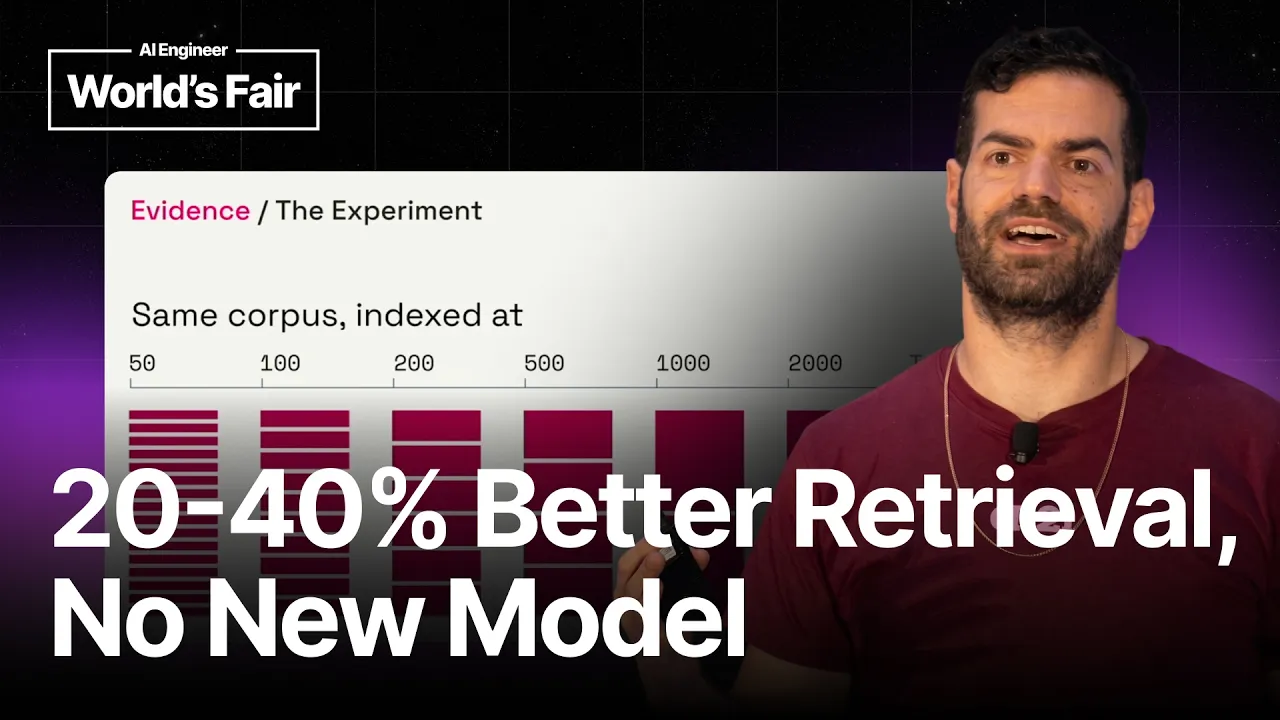
Let's Let's actually take a data set and duplicate this data set several times. In this case, six times. In every duplication, in every instance, the chunk size is different. So we have a database with a chunk size of 2,000, a database with a chunk size of 1,000 and so on and so on. And we did it with several data sets. So QMSum, which is a meeting transcript data set, NarrativeQA, which is question answering on novels, and Seinfeld data set, which is trivia about nothing.
Not really. It's a trivia trivia questions about the transcripts of the Seinfeld. It's a kind of a trolling data set that we built in-house. We also published it if anybody wants the the link at the end. And we tested on all of them to see what happens. And first of all, we just wanted to see for every data set which chunk size is the best. And what we're seeing here is an example from the Seinfeld data set where essentially two queries, which are different by nature, get different results based on the chunk size.
So the first question, what is the name for Jerry's favorite shirt? You can say this is a very focused question, very specific question. The answer to it is probably very contained and this is something that a smaller chunk size will do best in. And you can see rank one versus rank below 50. Between 100 tokens fixed uh uh size chunk size to 100. Whereas a question like where who does Jerry describe as his nemesis and pure evil, which I'm not even that big of a Seinfeld fan and I know it's Newman.
Uh but if you look at the transcript, it's not something you can find that easily. And you can see that it really changes, right? If you use small chunk size, you will not get the answer. And what we did to really after we ran all of these things and we noticed that, we said, "What if we had an oracle or a genie, if you want, that can tell us for every query what is the best chunk size to do retrieval for?" This essentially is the oracle experiment.
This is what we wanted to know to see the potential. This is not right, we already have the answers. So, we're not actually building a system here. We just want to see what is the potential that we have here. And what you can see here, okay, in this graph, all the blue First of all, the Y axis is the recall. Higher is better. Uh the X axis is the number of retrieved chunks. So, it's recall at K versus K. You can see all the blue lines, probably indistinguishable, but each of them is the performance for a fixed chunk size.
Whereas the orange one is the oracle line. This is for every query, we took the best one out of these. And you can see it happens across several data sets. In a lot of them, you can actually see that the blue lines inter intersect with each other, meaning that indeed for a lot of the data sets, no chunk size actually dominates. And what's more interesting is that there's a lot of potential. The gap, which you can see between the orange line and all the blue lines, is big.
And when I say big, it's something like 20 to 40%. Just from doing strategy on chunking and very simple strategy, may I add. And this is like that this gap, this is what the choice of 512 or 1,000 or whatever, right? This number is just arbitrary. This is what it costs you. And I think that the the problem here is like it's a bit tricky because it's kind of like a an information problem that we don't have the information that we need at every stage.
And what do I mean by that? If I'm looking at the indexing part where I do have control over the chunk size, I don't know what the queries will be. I can guess. I can maybe estimate. I I can try, but I don't know what the queries will be, so I cannot adjust my chunk size accordingly. And the retrieval part where I do have my queries, I cannot control the chunk size, right? It's already fixed. And I obviously will not do the entire process per query from the beginning.
So, we looked at prior works such as notably Entropic, contextual retrieval, where they enrich every chunk, and others that fancy try to improve the latent space of every chunk. But this is not the direction that we went. All of them just stayed in the model of let's work with a fixed chunk size, whereas we took a different approach. And we said, "Why commit to one where we can commit to several?" And we call it the multi-scale indexing.
Essentially, we're just doing what we've seen before. So, we're checking the database, we duplicate it, and chunk it with several chunk chunk sizes or window sizes. And then, sorry, um, and then this is happens at the indexing. And then at retrieval time, we are querying all of them. So, if we had n uh duplicates of database n window sizes, we now have to run six different retrieval calls per query. Uh sorry, uh six is n.
And how do we combine them? We obviously cannot use the oracle, right? The oracle is something that we have just for potential. In real life, we don't know the answer. Uh but what we can do is to find some sort of merging algorithm. Now, you would say, when we look at it like this, what can be the issue? The fact that we have n ranking, but the rankings are for chunks. And chunks with different sizes are not really comparable, right?
So, instead, we opted to do something which is pretty popular these days, and a lot of the rag systems actually work like this, that instead of just retrieving the chunk, when we're getting a chunk, we're retrieving the entire document, right? When context window grows, we want to give more and more context. And now, in this case, we have n right? And uh rankings of the same documents, because they're not chunks anymore.
And this we can compare. And in this case, you can think of retrieval as essentially just voting, right? So, it's not purely ranking. We don't have run ranking, and then we're doing a re-rank. We're having n different ranks of the relevant documents, and we want to aggregate them all into one. That's why we're using something called RRF, reciprocal rank fusion, okay, which is pretty much a simple uh formula. We tried several things.
This worked the best. And as you can see, it's not a model. It's not something that you have to do specifically, like especially. This is just a simple script that takes really no time. And this is how the full uh uh how the full system looks like. So, we have the indexing n times, then uh we query each query from every database, and we're using RRF to combine them all. And the results you can guess that they're good, otherwise I would not uh standing here in uh being way too much uh uh confident.
All right, but you can see we tested across several data sets, a QM sum, narrative QA, SciFeL, and also a finance bench. Uh we took all of them, and it matches the best uh bits that best fixed uh size. Let's see it in a graph. Uh it's a bit hard to see here, so I'll walk it slowly. Every row here is a chunk size, so you can see 50, 100, and so on. The bottom row is our method, this one, the one that you do from all of them and then combine, and the every column is uh recall at something.
So, recall at 1, 2, 3, up until 10. What you can see here is that two things, right? First of all, that across like recall at whatever, uh our method still wins, which you can think is very easy, but the fact that you have to combine all of them is not very it's not something which is very trivial. And also you can see that the quality actually increases. The heat map where you can see it's become much greener. And again, this was just something that I wanted to show in large.
Here you can see uh all four of the data sets, where we do achieve better results uh really quite like 20, 30, 40% even in a lot of the things. Uh also, there are results that I did not show you here, uh which uh are on MTAB. Uh you can see in our blog, I will put the link later. We're getting there also a lot of improvements, somewhere between 10 to 40% depending on the data set. Now, I'm I'm I'm not naive. I'm not going to claim here that this costs nothing.
Obviously, there is a cost, right? No free lunches. Everything has to come with something. And yes, this costs with extra memory. It costs something between two to five to O of one, right? A constant of additional memory where you have to keep all of those uh all those uh copies of the database. However, if you think about it, latency-wise, it doesn't really affect that because you can do all the retrieval part parallelly.
And also, the RRF part doesn't really take a lot of time. Uh I will say that this was a very nice research project that we did and we got really really cool results. There are things to do, right? There are places to improve. There are future work uh to do. More precisely, we want to understand how many chunk sizes do we want and and which. All right, that the fact that we worked with 50, 100, 200, and so on was pretty arbitrary uh to be honest.
So, we do need to figure out how to compute this and how to know how many copies exactly do you need. Uh also, go beyond RRF, right? The fact that we're using RRF is because it worked the best from the methods that we used, but it doesn't mean that there is no better method. And if I need to leave you with something, I would say that agents didn't kill retrieval. Nothing died. Come on. Uh it's just infrastructure. And the part the bad bad part is that it's infrastructure from 2022.
And with really simple simple methods, you can take your RAG system or anything that has to do with storing data and then retrieve it with 20 to 40% again, without any something too sophisticated. So, if you want to hear more about or read more about it, you can read the blog. There is also an example code there and the sign for data set. And that's it. I'm Yuval. Thank you so much being here. >> Woo! >> [applause] [music]
The words are the caption track's own and nothing is reworded or re-transcribed. Paragraph breaks are placed between sentences so the text reads as prose.
Free tools for your own script. No signup, no login.
Paste your draft and see where viewers are likely to drop off, with a rewrite for each weak line.
Paste the first 30 seconds of your own draft for a hook score and rewrites.
Check your draft against YouTube's advertiser-friendly guidelines before you record it.
Read this channel's public videos and transcripts, and download a writing brief for it.