Getting the transcript
Reading the captions from YouTube. A video nobody has opened here before takes 10 to 30 seconds; this page fills in on its own.
Getting the transcript
Reading the captions from YouTube. A video nobody has opened here before takes 10 to 30 seconds; this page fills in on its own.
Digital Foundry · @DigitalFoundry
Words
2,495
Runtime
15:31
Speaking pace
161wpm
Reading time
10min
161 words per minute, between the 160 25th percentile and the 181 median of 349 measured videos. That distribution comes from the 349-video hook study.
Opening (first 30 seconds)
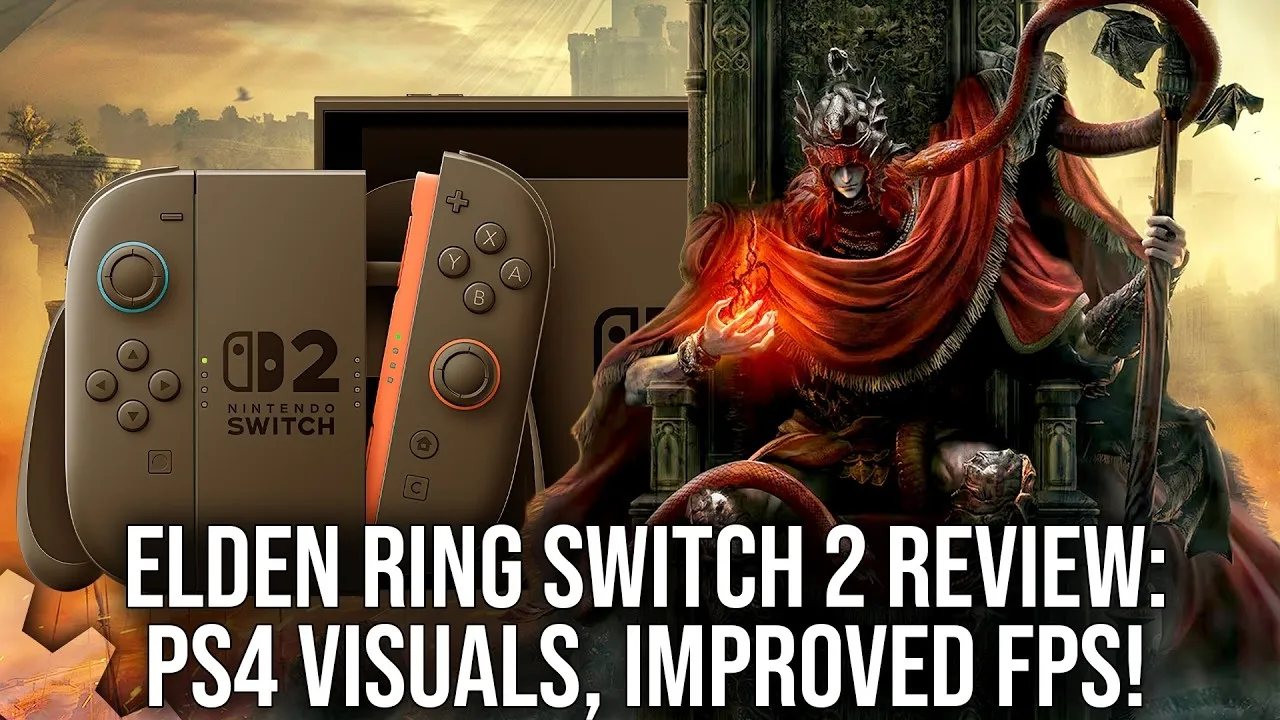
A Nintendo Switch 2 port of Elden Ring is now a reality. After a delay from its original late 2025 release due to performance issues, developer FromSoftware pulls through with what transpires to be a robust handheld release of the game. Dubbed the Tarnish Edition, it makes up for the wait with a raft of content, too. You get the 2024 Shadow of the Erdtree expansion included, two new starting classes, plus extra armor, weapons, and skins for your mount. In
81 words, the words spoken in the first 30 seconds at 161 words per minute.
Free, no signup. See how the first 30 seconds hold attention, with rewrites.
Sentence shape
| Measure | This transcript |
|---|---|
| Sentences | 118 |
| Average words per sentence | 21.1 |
| Longest sentence | 43 words |
| Questions asked | 4 |
| Sentences containing a number |
What this transcript is
Every word below is the caption track YouTube publishes for this video, pulled from the video itself and reproduced unchanged. It is not Prepublish's writing, not a summary, and not a re-transcription: it is the video's own published captions. English captions, generated automatically by YouTube, in the video’s original language. Source: the video on YouTube. A channel that would rather this page did not exist can ask for its removal through the contact page, and it is removed.
No Script X-ray for this video: YouTube shows a Most replayed graph only once a video has enough views.
A Nintendo Switch 2 port of Elden Ring is now a reality. After a delay from its original late 2025 release due to performance issues, developer FromSoftware pulls through with what transpires to be a robust handheld release of the game. Dubbed the Tarnish Edition, it makes up for the wait with a raft of content, too. You get the 2024 Shadow of the Erdtree expansion included, two new starting classes, plus extra armor, weapons, and skins for your mount.
In terms of content, it's all right here in the palm of your hand, which is great stuff. As for Switch 2's technical delivery of the game, though, a few questions are outstanding. So, visually speaking, where does it land between the last-gen PS4 release and the current-gen PS5 version? Will features like ray-traced shadows and ambient occlusion are possible? Secondly, what's the state of performance? Can Switch 2 better the PS4 performance level or, more ambitiously, top the Series S experience?
Let's find out. Let's get right into it. There's no graphics mode toggle on Switch 2, meaning all visuals are essentially set in stone from boot up. Speaking on resolution first, then, while docked, you're getting a dynamic 1080p rendition of Elden Ring with the same max upper bounds there as the base PS4 version. This dynamic scaling is less aggressive than PS4's, however, which is a plus, and on average, Switch 2 runs at a higher pixel count, typically at the peak 1080p around Limgrave.
In the worst case, migrating south to places like the Weeping Peninsula will trigger DRS to keep frame rates at 30 frames per second and above. And it's here that you'll see it drop to 720p. Aliasing is, of course, much easier to catch on the glint of a weapon's edge here with the heavy foliage, mist, and rain likely pushing Switch 2's GPU harder. The Lands Between will have other such areas causing res drops on Switch 2, but in GPU load matched scenes like the first steps, it's a clean 1080p at least.
It's also clear, using this area, that Switch 2 doesn't lean into that scaling as heavily as PS4. The result, more pixels pushed on average with a clearer image. It's also curious to note that FromSoftware has not opted to use Nvidia's DLSS at all in this case, and rather the team's own in-house upscaler and anti-aliasing method is used once again. Viewed on a 4K display then, there's a similarly crunchy look to the trees across the Lands Between, and it begs the question of how DLSS might have improved the image here.
A key to the success of other recent Switch 2 ports like FF7 Rebirth and Indiana Jones is making the most of bespoke features like DLSS. In other words, it's about getting Switch 2 to work smarter in the face of the lower TDP of its Tegra T239 chipset compared to rivaling platforms. Alas, that's not in this port's ambitions, but it still looks the part on Switch 2, and the upscaling is at least consistent with every other release.
Speaking on visual settings more broadly, Switch 2 runs at often identical settings to the base PS4 version. Most visual presets match the last gen release to a T with general world detail, geometry, tree layouts being a one-to-one match as we take our first steps into Limgrave. The only discrepancy you might spot is in grass density, which favors PS4 while looking to the mid to far range. It's ever so slightly higher than Switch 2's intensity by comparison, but it takes a really close zoom to pick out.
There's some randomization of its spread across the ground to factor in, of course, but otherwise the two machines are identical. Now, there's one other difference that actually works in Switch 2's favor here. You'll notice in some shots Switch 2 draws in larger elements sooner, like trees and bushes. This happens primarily during high-speed travel on horseback, so the theory is PS4's HDD access speeds are a limiting factor in drawing these assets quickly enough.
It's a hardware limit rather than a setting, and indeed once you stand still, those elements match one-to-one again. Okay, with that established, next let's add the PS5 version into the mix, complete with its ray traced shadows and ambient occlusion. Clearly, neither PS4 or Switch 2 can possibly compete with the flourishing look of the PS5, Series X, and S grass density setting. This is easily the most noticeable difference compared to the current-gen consoles, and once again, it shows Switch 2 is aligned more so with the last-gen standard.
Equally, screen space reflection quality matches that of PS4's, and misses the fuller coverage of current-gen consoles like PS5. Note that PS5 still uses SSR in its ray tracing mode, and the results here will be similar to its other modes. As for lighting and shadows, Switch 2 gets an identical setup to base PS4 as well. The time of day system translates beautifully here, with world shadows updating in real time as the sun completes its arc across the sky.
Here, shadow detail matches PS4's, but for a more realistic diffuse shadow, the ray tracing mode on PS5 inevitably offers another step up. The good news for Switch 2 owners is that Elden Ring is totally intact on the system, right down to the idiosyncrasies of its object physics, its NPC logic, and the controls as well. Minor grass density differences aside, there are no unique cutbacks to make it work, and it presents as a 100% faithful adaptation.
Accepting that it broadly has parity with PS4 visuals, then it translates very well indeed. Texture quality is retained from the other versions impressively, and we even get full screen and object motion blur into the bargain. The only snag I found is one that already exists on other platforms, most obviously on CPU limited machines like PS4, Xbox One, and even Series S. Just as with those versions, once you gather too many enemies into one space on Switch 2, the game resorts to lowering their animation refresh.
It results in enemies moving like a Ray Harryhausen stop motion scene, which can be distracting. On the plus side, it's not a frequent occurrence on Switch 2, and when it happens, it's more so in line with Series S in terms of how aggressively uses those decimated animations. On which note, comparisons with Xbox Series S bear mention. As a quick refresher, Series S in its quality mode runs at a fixed 1440p resolution, while the performance mode runs at a dynamic 1440p, dropping to 900p lowest.
The performance mode also lowers shadow quality, reduces shadow LODs, and cuts motion blur, though the two modes are otherwise identical. In terms of raw pixels pushed then, right away Switch 2 is usually behind the quality mode in clarity, while enjoying a crisper image than Series S's performance mode at its lowest scaling point. Despite having the wider DRS range, Switch 2 is still pushing a 1080p frame in this case, while the S performance mode settles at 900p, resulting in much more aliasing and noise.
In select circumstances like this then, it gives Nintendo's machine the upper hand. But, there is a curious win for Nintendo's handheld in shadow detail. It turns out this and PS4 match the Series S quality mode setting, while both being a cut above the blurrier performance mode preset on Series S. Portable play on Switch 2 is, of course, a huge selling point for the release, and it's worth touching on a few cutbacks needed to make this work.
In total, by my count, running in a handheld state triggers four main visual changes. First, the dynamic 1080p res while docked slips to 864p, with a lower bounds of 432p spotted in the Weeping Peninsula. Image quality takes a hit if we zoom in very close using stills plucked from the Switch 2's built-in capture, but on its smaller display, it does hold up well. Secondly, foliage density is pruned back one further setting in portable mode.
This means we're running at below the PS4 preset, resulting in slightly sparser terrain, though actual draw distances for foliage are identical to docked. Thirdly, we have the shadows. Funnily enough, shadows drop a preset to match the Series S's performance mode. They're blurrier, less defined, and also shadow draw distances are marginally impacted here. Finally, SSR quality takes a step down in clarity across the game's water bodies.
Potentially, this is a byproduct of Switch 2 running at a lower overall resolution while handheld, but the upside is SSR does remain engaged. Overall, a great many settings stay put from docked, and the portable experience works well despite the stricter GPU and memory resources on tap. To the frame rate testing next, and the bottom line is that Switch 2 runs with a 40 frames per second cap. As a design choice, this 40 FPS cap makes perfect sense for a 120 Hz handheld panel, or even a living room display running at the same refresh rate, but only if it can sustain the frame rate target with even frame pacing.
Historically, not FromSoftware's strongest suit. As an aside, gunning for 40 FPS is entirely unique to this platform, given that PS4 and Xbox One ran with a 30 FPS cap, and the current-gen systems run entirely unlocked at 60. For Switch 2 though, the reality is that 40 FPS play is only truly possible while looking directly up at the sky or during parts of less taxing dungeons. And even then, it's not evenly frame paced. 40 FPS is also simply not sustainable for any length of play in the open world.
Hence, typical play rests much more often at 30 to 35 FPS while running docked. I've even spotted some lurches into the high 20s around the Caelid area, occasional as they are, which may hint at a challenge for Switch 2's handling of late-game areas and bosses. Meanwhile, handheld performance is in a similar 30 to 35 FPS ballpark going by eye. And based on the first 5 hours of play, I've noticed the frequency of dips to 25 FPS is slightly higher.
It's not ideal by any means, but in the wider context of Elden Ring's frame rate on other platforms, like PS4 and especially Xbox One, Switch 2 is at least a more performant release by comparison. To prove the point, here's Switch 2 pitted against PS4 in a one-to-one frame rate test. Many of these scenes are also typically running under that FPS cap on PS4, which makes the performance delta much easier to pick out on the graph.
As a comparison, this paints Switch 2 in a much more positive light overall. Again, we're effectively looking at matching settings either side, and yet the initial run from Limgrave's first steps puts Switch 2 at 33 FPS next to the 27 FPS also reading on PS4. Next along, galloping on horseback puts a further strain on PS4's Jaguar cores as it streams the world in, and here Switch 2's lead becomes even more apparent with an up to 10 frames per second lead.
Needless to say, we're a long way off 40, and a 30 FPS cap would have been much better suited if it could be properly frame-paced. The silver lining to Switch 2's result isn't that it feels smooth, per se, and rather that it feels smoother, often evading the sub-30 drops that blight the last-gen releases. In fact, in like-for-like battles with multiple enemies on screen, it's often cruising ahead with its 30 to 35 FPS range.
Out of pure curiosity, let's see how Switch 2 fares against both Series S modes. Usually, Series S is the most sensible comparison point, and in games where DLSS is involved, like Street Fighter 6, for example, the Switch 2 version has its own pros and cons by comparison. But, in Elden Ring's case, it's a less flattering turnout all round. Right away, in the opening chapel area, Switch 2 falls shy of Series S's quality mode by around 3 to 6 FPS.
Even factoring in Series S's 1440p resolution and higher settings on its quality mode, it's consistently a cut above Nintendo's platform with that high 30s reading. While the performance mode is in a league of its own at 50 to 60 FPS. There's just no chance for Switch 2 to compete here. There is, however, just one instance, walking directly forward from the First Steps bonfire, where Switch 2 edges ahead of the quality mode with a 33 FPS reading versus 31, but it's the exception to the rule.
Ultimately, if you're chasing a high frame rate and higher resolution experience on a machine with VRR support to a TV, Series S is able to tick those boxes much more convincingly. Elden Ring on Switch 2 is a success overall, though the terms of that success will depend on your expectations going in. As a PS4 level experience on the go with at times a higher resolution, this absolutely hits the mark. Less so though if you had designs on seeing it go toe-to-toe with Series S's quality mode.
The bottom line is you get matching visual settings to PS4 with an often higher frame rate at 30 to 35 FPS, albeit with some lingering dips into the high 20s. Performance isn't a strength in modern FromSoftware titles, and so it goes here. Switch 2 doesn't buck the trend, but in terms of raw frames pushed per second, it at least outclasses the last gen consoles. All of which gives us a faithful, fully intact rendition of the game, complete with the Eldtree expansion no less, and that alone makes it worth recommending.
There's an extra benefit to squeeze in here, too. Loading speeds are crucial given the frequency of respawning or fast traveling around the map. So, to test this, I loaded to the first steps from the Roundtable Hold, which takes PS5 the shortest time at 7.1 seconds. Then Switch 2 comes in second place with a very respectable 12.4 seconds, while Series S trails behind that by an equivalent gap at 18.6 seconds. Last of all, the base PS4 version is beholden to its mechanical HDD's limits, which eventually loads in at 35.6 seconds.
So, another point in the positives column for Switch 2, and this is a huge advantage if you're regularly zipping around the map. That's all for me today though. If you did enjoy this review of Elden Ring on Switch 2, do feel free to like or subscribe, and don't forget to hit that bell for instant notifications as any new video lands. Check out our website at digitalfoundry.net to support what we do, and to get in touch directly.
You know where to find me. But for now, thanks for watching.
The words are the caption track's own and nothing is reworded or re-transcribed. Paragraph breaks are placed between sentences so the text reads as prose.
Free tools for your own script. No signup, no login.
Paste your draft and see where viewers are likely to drop off, with a rewrite for each weak line.
Paste the first 30 seconds of your own draft for a hook score and rewrites.
Check your draft against YouTube's advertiser-friendly guidelines before you record it.
Read this channel's public videos and transcripts, and download a writing brief for it.
| 80 |
Most used terms
Filler phrases
17 in total: like 15 · actually 1 · you know 1.
A literal whole-word count of the same phrase list the Prepublish browser extension uses, so a phrase inside another word is not counted and a phrase used in its ordinary sense still is. It is a count and not a judgement.