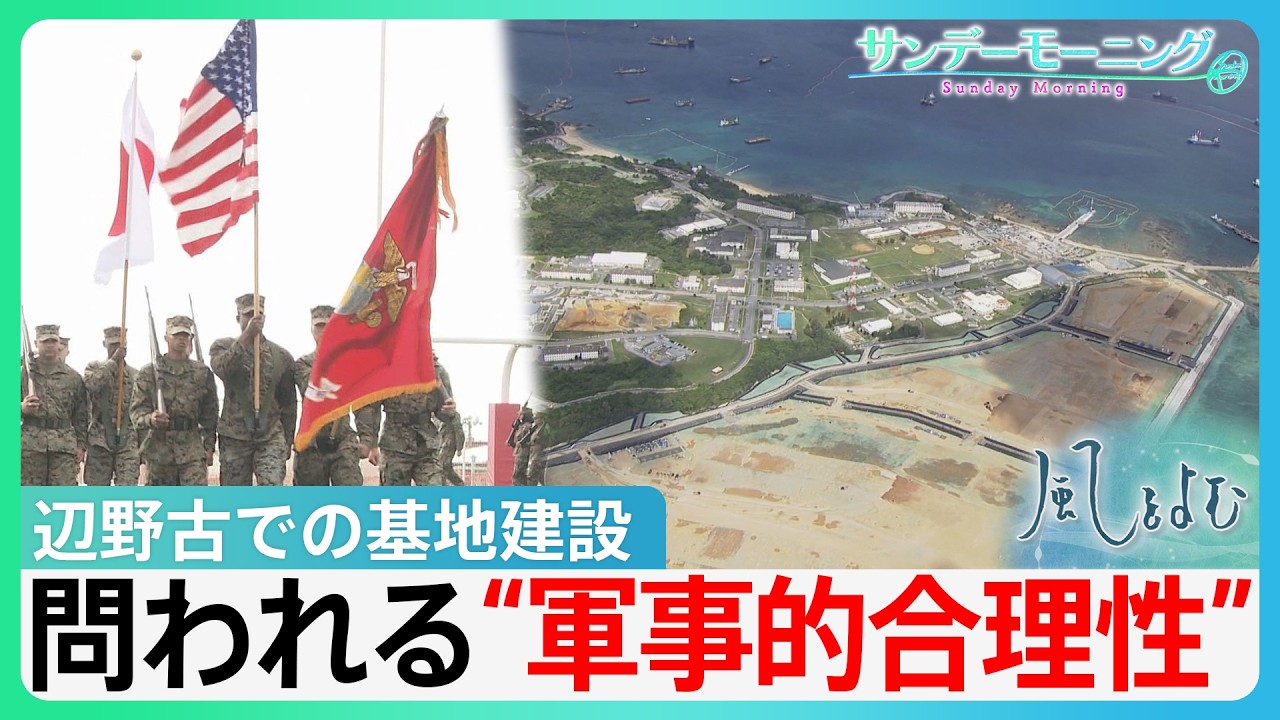
沖縄県知事選 辺野古での基地建設容認の古謝新知事誕生 問われる辺野古の”軍事的合理性” 返還決定から30年 大きく変わった「海兵隊」を巡る状況…【サンデーモーニング】 transcript
TBS NEWS DIG Powered by JNN · @tbsnewsdig
Words
1,543
Runtime
11:23
Speaking pace
136wpm
Reading time
6min
136 words per minute, below the 160 25th percentile of 349 measured videos. That distribution comes from the 349-video hook study.
Opening (first 30 seconds)
The Okinawa gubernatorial election was held on Sunday. " I am truly filled with feelings of gratitude.""Thank you very much indeed. " The result was a landslide defeat for the incumbent, Mr. Tamaki, by nearly 150,000 votes. Mr. Shimoji, supported by the LDP and others, won a landslide victory with a record-high number of votes. "Well, the issues people are struggling with most right now are daily life,
68 words, the words spoken in the first 30 seconds at 136 words per minute.
Sentence shape
| Measure | This transcript |
|---|---|
| Sentences | 99 |
| Average words per sentence | 15.6 |
| Longest sentence | 47 words |
| Questions asked | 5 |
| Sentences containing a number | 16 |
Most used terms
- base15
- henoko15
- okinawa14
- bases10
- years10
- military9
- futenma8
- mr8
- china7
- construction7
- issue7
- japan7
Filler phrases
8 in total: like 4 · kind of 2 · actually 1 · you know 1.
A literal whole-word count of the same phrase list the Prepublish browser extension uses, so a phrase inside another word is not counted and a phrase used in its ordinary sense still is. It is a count and not a judgement.
What this transcript is
Every word below is the caption track YouTube publishes for this video, pulled from the video itself and reproduced unchanged. It is not Prepublish's writing, not a summary, and not a re-transcription: it is the video's own published captions. English captions, generated automatically by YouTube, in the video’s original language. Source: the video on YouTube. A channel that would rather this page did not exist can ask for its removal through the contact page, and it is removed.
Transcript
The Okinawa gubernatorial election was held on Sunday. " I am truly filled with feelings of gratitude.""Thank you very much indeed. " The result was a landslide defeat for the incumbent, Mr. Tamaki, by nearly 150,000 votes. Mr. Shimoji, supported by the LDP and others, won a landslide victory with a record-high number of votes. "Well, the issues people are struggling with most right now are daily life, prices, and fostering new industries." Mr.
Shimoji strongly emphasized economic policies. In fact, in the JNN exit poll for this election, about half of the voters prioritized economic revitalization. The issue of US military bases remained at only 21%. The new governor has indicated a stance of accepting base construction in Henoko, and with this, the base issue, which has seen many twists and turns, is about to face a new turning point. Thirty years ago, in 1996, The Japanese and US governments agreed to return Futenma Air Base, which is located in a densely populated area and said to be the most dangerous base in the world.
" Futenma Air Station will be returned in its entirety within the next five to seven years." At the time, the return of Futenma Air Base was expected to be realized in about five to seven years. However, this began a 30-year period of confusion. Returning the base required the construction of a replacement facility, and the candidate site that emerged was " The relocation site for Futenma Air Station has been decided as the coast of Henoko.""I have done so." It was Henoko in Nago City.
In 1999, then-Governor Inamine selected it as a candidate site, and the government also made a cabinet decision for Henoko. Since then, the issue of base construction in Henoko has always been a major point of contention in Okinawa gubernatorial elections. And from Mr. Onaga in 2014 to his successor, Governor Denny, opposition continued. But even during that time, the government's stance did not change, and they began land reclamation in 2018.
And now, with a pro-base governor elected for the first time in 12 years and construction set to proceed, experts point out that the situation surrounding the Marine Corps has changed significantly from 30 years ago . Thirty years ago, when the relocation to Henoko was first proposed, the Marine Corps 'expected mission was to land from the sea and seize enemy territory. Now, the focus has shifted to launching long-range missiles from coastal areas.
The transport planes needed to carry these missile launchers require a runway, but the one at Henoko is too short. In terms of military rationale, it's hard to find much justification for it. In fact, there have been concerns raised in the U.S. that the Henoko runway is too short, and a report last September concluded that Futenma Air Base will not be returned until an alternative runway is selected. Furthermore, construction has been delayed due to the need to improve the soft seabed discovered later, with completion now expected by the mid- 2030s at the earliest.
Construction costs have also ballooned to 2.7 times the initial estimate. Even so, the Japanese government’s stance remains unchanged, viewing the construction of the Henoko base as the only solution for the return of Futenma. Regarding this, experts say: From the U.S. military's perspective, Henoko isn't necessarily easy to use; this should have been debated, but because it wasn't, reconsidering the Henoko issue could affect the realignment of U.S. forces.
In that sense, it is politically far too sensitive. I think that's why no one wants to touch it. Mr. Kotani argues that discussions between Japan and the U.S. are needed to adapt to the current military situation. While the relocation to Henoko has stalled, we have seen the expansion of North Korea's and China's military capabilities. The threat of missiles from North Korea and China was unthinkable 30 years ago. As this threat grows, Okinawa's strategic importance remains vital, and it would be ideal for Japan and the U.S. to discuss how to make things more efficient.
That is what I believe would be the ideal approach. Debate is needed that takes into account the changes of these past 30 years. Compared to 30 years ago, that military rationale has been largely lost. Yet, it hasn't been discussed simply because it's too politically sensitive. In theory, this should be discussed more between Japan and the U.S., but Mr. Terashima, where do you think we should start? Well, you see. Okinawa has chosen the economy over bases, hasn't it?
So, the base issue cannot be resolved by Okinawa alone; the Japanese government must face the U.S. And based on that premise, let me point out one thing I find important. I spent a long time in Washington dealing with the Pentagon and have many memories of various discussions, but it is very important that we recognize, as was just mentioned, that the U.S. bases in Okinawa are Marine Corps bases. Yes. The military has the Army, the Air Force, and the Navy, you see.
And among them, these are Marine Corps bases. Yes . Therefore, we shouldn't make this a game of just debating what to do with this base or that base, like Futenma. Yes. From the northern bases to those in Okinawa, I have been saying that we must put all U.S. bases in Japan on the table, and after putting all of them on the table, we won't actually solve this issue unless we face the Pentagon and discuss what kind of U.S. base presence is optimal for security in East Asia.
Yes. We keep saying that Japan needs U.S. bases because the Chinese threat is growing, but to avoid giving the wrong image to China and to face China head-on, we need to—as strange as it may sound—face America head-on. Because from China's perspective, Japan is seen as a country that only needs to negotiate with the U.S.;that is, for China. Because neighboring countries end up becoming allies of the U.S. or followers of U.S. policy.
I believe the most important point is for Japan to proactively engage both the US and China head-on to establish security in East Asia, and to clearly define what kind of country we are and what we stand for. Yeah. Mr. Hatayama, how do you see the current situation, including the recent gubernatorial election in Okinawa? Well, let's see. You know, there’s a lot of talk about how the economy was chosen over the bases in this election, but when people are forced to choose just one, I’m not surprised that more than half chose the economy under these circumstances.
However, I don't necessarily think that's the same thing as saying only the economy was chosen. For one, the fact that 21%still insisted that the base issue be addressed is not insignificant. Taking all that into account, this election was incredibly agonizing and tore people apart, forcing them to face the ugliest side of human nature regardless of who they supported, creating a situation where they were even hesitant to express what they truly thought or experienced daily .
I suppose. I think we need to confront that reality and the responsibility of the mainland that has fostered this situation for so long, even before considering military rationality. Yeah. What do you think, Mr. Saito? Well, as just mentioned, the people of Okinawa have seen their opposition to the bases trampled on time and again, so I think the hope that changing the governor and pursuing income doubling might change something economically is what led to the governor's election.
In contrast, the liberal-left side hasn't been able to engage in any discussion that reflects the changes of the last 30 years. Honestly, if we just keep repeating the same principles over and over—like "protect Article 9,""defend peace," or "oppose Henoko"—it’s just not going to resonate with young people. Even though they were once called progressives, they’ve somehow ended up feeling like conservatives now , and for those seeking change who are tired of seeing that nothing changes despite using the same words and methods, it just doesn’t connect.
That’s why I have this sense of crisis that, if things continue this way, the movement will just get older and eventually fall apart. Conversely, just because the candidate won doesn't make Henoko right; it’s about the new generation born after the reversion, including the young, taking charge of shaping Okinawa's future. I think we've entered a stage where it's about how we on the mainland can support that, and in that sense, I have high expectations .
Mura-san, how do you see the situation in Okinawa? Well, watching the video, it means that even though the goal was to eliminate danger, Futenma will remain, and we’ll end up with Henoko as well. That is the outcome the people of Okinawa want the least. When you look back at how the government has treated Okinawa with a mix of carrots and sticks, I really believe their methods need to be called into question. As long as they keep weighing public welfare against military defense, I feel like Okinawa will never return to the hands of its people, and I really want to urge a change in atmosphere here.
The words are the caption track's own and nothing is reworded or re-transcribed. Paragraph breaks are placed between sentences so the text reads as prose.
Use this transcript
Three free tools that work on the material around a video like this one. No signup, no login.
Hook Analyzer
Paste the first 30 seconds of your own draft for a hook score and rewrites.
Policy Pre-Flight
Check your draft against YouTube's advertiser-friendly guidelines before you record it.
Channel Skill Generator
Read this channel's public videos and transcripts, and download a writing brief for it.