The Rigged Economics of Airlines transcript
Modern MBA · @ModernMBA
Words
4,744
Runtime
27:01
Speaking pace
176wpm
Reading time
20min
176 words per minute, between the 160 25th percentile and the 181 median of 349 measured videos. That distribution comes from the 349-video hook study.
Opening (first 30 seconds)
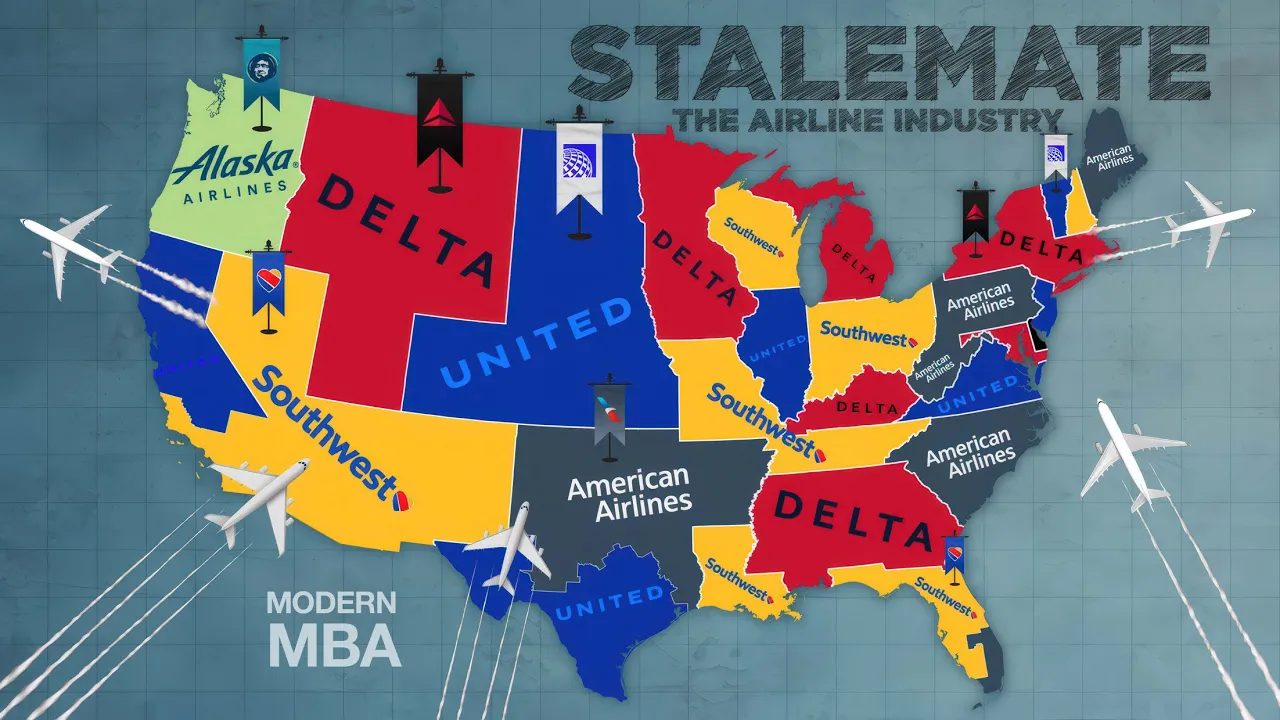
The American airline industry is a highly competitive yet heavily regulated battlefield where no company by design can ever capture majority market share. No airline has greater than a 18% market share in the U.S and any M&A deal that would bring that number to 20% or higher is automatically blocked by the Justice Department. Yet while the customer experience has not changed, American airlines have gone through an often-overlooked evolution in the past decade. It was only 10 years ago when newer low-cost airlines like Southwest and
88 words, the words spoken in the first 30 seconds at 176 words per minute.
Sentence shape
| Measure | This transcript |
|---|---|
| Sentences | 217 |
| Average words per sentence | 21.9 |
| Longest sentence | 62 words |
| Questions asked | 3 |
| Sentences containing a number | 38 |
Most used terms
- carriers49
- cost47
- low42
- low cost40
- airlines33
- airline29
- legacy29
- legacy carriers28
- american21
- passengers21
- spirit21
- southwest20
Filler phrases
14 in total: like 13 · kind of 1.
A literal whole-word count of the same phrase list the Prepublish browser extension uses, so a phrase inside another word is not counted and a phrase used in its ordinary sense still is. It is a count and not a judgement.
What this transcript is
Every word below is the caption track YouTube publishes for this video, pulled from the video itself and reproduced unchanged. It is not Prepublish's writing, not a summary, and not a re-transcription: it is the video's own published captions. English captions, published by the channel, in the video’s original language. Source: the video on YouTube. A channel that would rather this page did not exist can ask for its removal through the contact page, and it is removed.
Transcript
The American airline industry is a highly competitive yet heavily regulated battlefield where no company by design can ever capture majority market share. No airline has greater than a 18% market share in the U.S and any M&A deal that would bring that number to 20% or higher is automatically blocked by the Justice Department. Yet while the customer experience has not changed, American airlines have gone through an often-overlooked evolution in the past decade.
It was only 10 years ago when newer low-cost airlines like Southwest and JetBlue were celebrated as innovators disrupting dominant legacy carriers like Delta and United. They had elevated product and value with extraordinarily cheap fares and unprecedented free amenities like free checked baggage, extra legroom, and self-assigned seating. Americans voted with their wallets and flocked to these no-frills low-cost carriers where the experience was comparable and the price consistently lower.
The airline industry is a straightforward, capital-intensive business where volume and scale is everything. The more planes, the more seats, the more passengers, the more trips, and the more money you can make. When we were to rank all American airlines based on gross earnings, the carriers that make the most money are the ones with the largest fleets - and those with the least amount of revenue have the smallest fleets.
Like cruise ships, passenger aircraft are expensive assets that cost hundreds of millions of dollars and built only by a few suppliers in the world, and must be ordered years in advance. Each plane costs millions more in annual maintenance and must be replaced after 20-30 years. Yet the airline business is not as simple as buying the largest planes possible. For domestic flights between 1-6 hours, frequency and flexibility reign supreme.
Single-aisle narrow body aircraft work best as despite the fewer seats and minimal service, they can be filled and emptied quickly. For long-haul flights, wide-body 2-aisle aircraft are ideal as they possess the range, have space for cargo and meal service, and can seat twice as many passengers. But on the flip side, they hog more fuel, require more crew, and take longer to turn around. There’s no right way - you can get lots of people from A to B in a single shot in one big plane or spread passengers out in many small planes over time.
The path to profitability is to fill every plane you have with as many passengers as possible. Yet no airline can sell out every single flight. Load factor is the measure of seats filled with passengers and 100% is impossible - across all American airlines, the average load factor has hovered between 70-80% for the past decade, meaning roughly 20% of seats are unsold. But beyond supply constraints and high fixed costs of aircraft, variable costs are just as expensive.
Fuel is the most expensive operating expense and chews up roughly 30% of revenue for all airlines. Every carrier spends billions of dollars every year for billions of gallons of fuel and the cost savings are negligible for the biggest airlines who operate with economies of scale. After fuel, the second highest expense is labor as critical staff like pilots, attendants, and mechanics are unionized. They secure higher pay and better benefits every few years - all of which mean ever-rising labor costs.
Even though more people fly than ever before, there is little margin left once bills are paid. Add in labor shortages, supply chain delays, regulation, weather, and the reality that the most lucrative airports and routes have been dominated for decades by the legacy carriers as first movers - it’s why airlines remain an essential service but unpopular business. No matter how you slice it, it’s a tough market and carriers all around the world have to constantly prove they’re worth the investment - handing out generous dividends year-after-year to show return on capital.
All this made the emergence and performance of low-cost airlines in the 2010s all the more impressive - as they consistently outperformed the old-school legacy carriers in profitability and loyalty with fewer planes and marketing spend. Across universities and the private sector, these low-cost carriers were celebrated as leaders in strategy, innovation, and culture. The popularity of Southwest, JetBlue, Spirit, Frontier, and Alaska all pointed to a low-cost future where the airline with the best price would win.
This theory made sense as online aggregators like Expedia, Trivago, and Kayak were taking off and it was easy for anyone to find the cheapest option for any trip. There was a feeling that this was a changing of the guard with low-cost carriers being the successors for domestic travel. Investors poured their optimism into low-cost carriers and for years, these airlines traded at higher multiples than legacy carriers. But fast forward to the present day 2020s and this low-cost future has not materialized.
The low-cost carriers are all struggling, some on the doorstep of bankruptcy, and the legacy carriers are back on top both in earnings and valuations. With their backs against the wall, low cost carriers are in panic mode - asserting that the industry is rigged and there is no way for anyone to beat United or Delta. Is the American airline industry really a rigged game? How exactly did the legacy carriers reclaim market share?
In this episode, we’ll dive into the American airline industry and the territorial battlegrounds through the lens of 7 different carriers - United, Delta, American, and Americans all operate off the hub-and-spoke model. We’ve covered the inherent scalability of hub-and-spoke networks on Modern MBA before - it’s how Dunkin’ and Krispy Kreme have scaled to thousands of stores and millions of donuts worldwide and in finance, that’s how Western Union and MoneyGram can enable so many people to send and receive cash at so many places around the world.
Airlines pick a handful of airports across the country and convert them into strategic bases to centralize planes, passengers, and resources. Passengers are funneled to hubs and those who are too far must layover and catch a connecting flight at the hub to reach their final destination. Airlines can ensure better load factor and profitability by consolidating passengers in one location with big aircraft before packing each cohort onto smaller, fuel-efficient, narrow body aircraft based on their final destination.
Airlines can also use hubs as a home base to consolidate repairs and maintenance - rather than keeping mechanics and parts at every single airport in their network. They can also flexibly swap planes in and out at hubs to keep flights moving whenever unforeseen problems arise. While centralization always equals greater cost-efficiency, the entire network becomes dependent on the hub. If the hub has any downtime through weather, labor issues, or local projects, those delays will ripple through and the entire network suffers.
The complexity in aviation is that airlines don’t own airports as airports are public properties managed by city or state authorities. This means that airlines have to work within the constraints of airports as they’re been built or spend hundreds of millions of dollars to renovate the areas they lease. Carriers ultimately must be strategic about which airports to convert into hubs. Airports too remote or too small won’t be as effective.
On the West Coast, SFO and LAX connect California - the world’s 5th largest economy - to the rest of the country and double as gateways to Asia and Latin America. In Middle America, there’s DEN, ORD, and DFW as midway points between the West and the East along with the North and the South. On the East Coast, JFK and ATL as gateways to Europe, South America, and the broader Eastern seaboard. The locations of these airports and their proximity to wealthy metropolitans and large populations make them strategically more valuable than anywhere else in the country.
While the DOJ ensures that no American airline gains over 20% of overall market share, it doesn’t enforce it on a per airport basis. Legacy carriers like United, Delta, and American have all turned some of their hubs into fortresses through first-mover advantage. In a fortress, one carrier dominates most of the routes and in turn can raise prices as passengers have no alternatives and must go through this one hub and airline to get to where they’re trying to go.
United’s hubs are San Francisco, Chicago O’Hare, Newark, Houston, Washington Dulles, Denver, and Los Angeles. Delta’s fortresses are Atlanta, Minneapolis, Detroit, Salt Lake City, Boston, JFK, and Seattle. American’s hubs are Charlotte, Dallas Fort-Worth, Miami, Philadelphia, and Phoenix. These airlines were first movers at these hubs and benefited as the industry consolidated through the 2010s. It would be impossible to compete with any of these legacy carriers at their fortresses.
If you wanted to go head-to-head against United in SFO, you would have to spend billions undercutting United on prices, spinning up operations, burning fuel and wages, somehow getting the same gates, and flying identical routes and frequencies even if your planes are mostly empty. It would be the same losing battle if you tried to challenge Delta at Atlanta or American at Dallas Fort-Worth. Still, not every hub is a fortress and certain hubs to this day are still contested.
For instance, Delta and America have squeezed United out of New York entirely, leaving United no choice but to bet the farm on building a fortress in neighboring New Jersey. Ultimately, because these legacy carriers have established fortresses around the country, they all have the capital to contest certain hubs and concede others in ways that no smaller airline can. Through the late 2000s into the early 2010s, the legacy carriers all focused on expanding international routes to strengthen their fortresses.
While the majority of revenue came from domestic travel, United, Delta, and American were eager to woo premium travelers as working Americans had been hit hardest in the Great Recession. The three airlines collectively invested billions into trans-Atlantic and trans-Pacific products, renovating existing planes with lie-flat seats for business class, forging alliances with overseas carriers, opening up direct service to major destinations overseas, and building high-class lounges at hubs.
Aviation is a game of butts in seats yet no airline in the world has the same fleet, planes, routes, workforce, and hubs. Every carrier has their own pricing, costs, markets, and break-even. Hence, it’s impossible to evaluate airlines based on conventional revenue and profit. Instead, the airline industry revolves around two metrics, RASM and CASM. They’re measures of earnings efficiency which account for volume, capacity, and distance.
This enables comparison between airlines, regardless of if someone has 10 planes versus 500 planes or flies to Tahiti vs Idaho. RASM is revenue per available seat mile. It adds up all revenue streams - tickets, bag fees, WiFi, onboard sales, change fees, etc. and then divides that by the number of seats per mile flown. RASM asks how much income did you squeeze out per seat per mile flown - inclusive of unsold seats and everything charged to that passenger?
The higher the RASM, the better. And one sure-fire way to increase RASM is through business or first class where a single seat is sold for 3-5 times more the economy - even higher on international long-haul flights. RASM for all the legacy carriers grew year-over-year into the 2010s on the heel of such investments. CASM is cost per available square mile. The higher the RASM and lower the CASM, the greater the profits.
When CASM exceeds RASM, that means trouble. Any airline can boast fast-growing RASM but won’t be able to hide from a greater CASM if they’re flying half-empty planes on routes that could be generating more money elsewhere and not managing costs. This was why all the legacy carriers aggressively cut back domestic capacity. Americans could still get around, but there were increasingly fewer options, more transfers, and longer travel times.
United, Delta, and America were at peace; from their perspective, the average American was now loyal only to Expedia, Kayak, or Google Flights. The vacuum and price transparency of online travel aggregators widened the opportunity for low-cost carriers to thrive. Southwest, Frontier, JetBlue, and Spirit exploded as suddenly now had the platform, product, and visibility to win mainstream consumers - showing up at the top of organic searches as the cheapest and fastest options.
This was the golden age for low-cost airlines. There’s only so many ways to cut costs while still leaving enough meat on the bone - use cheaper narrow, single-aisle planes, install only essentials to keep maintenance low, focus primarily on domestic travel, pack as many seats onto each plane as possible, put all passengers into one class, use minimal staff, and get from A to B as quickly as possible. Low-cost carriers all operate on a point-to-point system.
Every flight is an independent connection with no hubs. As long as there’s a gate at origin and destination, a low-cost carrier can squeeze in. Even at fortresses, there are still gates available - just generally not at the times that most people want to travel. This works for low-cost carriers because their customers are willing to fly at inconvenient hours in exchange for cheaper fare. But without intermediary consolidation, point-to-point networks are constrained at scale.
There needs to be enough demand from A to B yet there are only so many city pairs with such volume and adding a new connection requires far more routes than hub and spoke. The cheapest airlines are Spirit and Frontier, whose fares are on average 2-3 times less than the next airline. These two carriers combined today hold less than 10% of the domestic travel market and have plateaued in market share since. Both carriers have been building up their fleets since the 2000s but still remain to this day amongst the smallest airlines in the country.
With fewer planes, their approach is identical in fewer trips a day but every flight flown is high-density and high-efficiency. This can be seen in load factor, where Spirit and Frontier each feature industry-leading load factor simply out of business necessity. Because there are so few flights and planes, these carriers would delay flights rather than cancel and prioritize completion over being on-time. Spirit’s go-to-market strategy is simple - look at any city pairs with over 200 passengers a day and then sell tickets for 25% cheaper than the current rates.
Through the 2010s, Spirit established itself as the cheapest game in town despite rising fuel and labor costs. By design, the company made up lost fare revenue by pushing ancillary purchases or unorthodox customer behavior. There’s fees for just about everything on Spirit - booking online or printing out your boarding pass at the airport. Customers could pay tens of dollars for a carry-on or not bring any bags at all, which meant fewer staff, faster departures, lighter planes, and less fuel consumption.
As long as the total cost to customers was cheaper than that of the closest competitor, the company could aggressively push ancillary fees and maintain growth. Spirit did just that and overall non-ticket revenue surpassed that of airfare itself year-over-year. Passengers spent on average more on non-fare fees than they do on airfare itself. Yet the spread between RASM and CASM reveals the thin margins of the low-cost model compared to conventional airlines.
Even without hubs, Spirit still needed airports to base its crews out of and it could only play the cards it was given. They chose the emerging airports of Fort Lauderdale and Orland to support its operations in the South, staying clear of American’s Miami fortress. In Central, Spirit gained a foothold into Chicago and Dallas but plateaued quickly as these were United and American fortresses. It had the most success in occupying mid-sized airports that most airlines did not service like Las Vegas, Detroit, New Orleans, and Atlantic City.
Based on these destinations, leisure was the only primary play with this kind of network. Marketing followed suit as Spirit pushed cheap getaways to Sin City and or the Sunshine State. Their path to growth was not west, but instead to go further south building on its core Florida customer base. As Spirit progressed into the 2010s, the airline expanded with flights to the Caribbean and Latin America. Frontier - the other ultra-low cost carrier, followed an identical strategy, taking up market share in Orlando and Las Vegas and making up for its low airfare through aggressive ancillary purchases.
Yet timing still mattered most. If Frontier entered in an airport where Spirit, Southwest, or JetBlue had already established market share, it would be bad business as everyone would be pulled into an unprofitable race to zero. The highest profit was in finding the most underserved markets where the only competition was from legacy carriers. This is why Frontier focused its network in airports like Cleveland, Tampa, Phoenix, Cincinnati, and Philadelphia where they would be the cheapest and only low-cost game in town - no different from how the legacy carriers built their empires generations ago as the only airline in town.
Ultimately, passenger spend between Frontier and Spirit are near-identical with the delta of just a few cents. The only distinction between the two are in their networks and fleet sizes rather than branding or messaging as even their operating margins are similar. While Spirit and Frontier cut everything down to the bone, it was Southwest who was the biggest beneficiary of the low-cost wave. They grew from half-a-billion-dollar business to the busiest airline in the country in just 5 years.
What put Southwest on the map was its revolutionary policy where passengers could check two bags for free - an amenity that no carrier would ever dare match. It made no sense to openly throw away high-margin ancillary revenue, compel passengers to bring more than needed, increase labor costs by accommodating all these bags before and after every flight, and burn more fuel weighing down planes with luggage - all while pushing low-cost airfare.
To offer such amenities when fuel prices had reached record highs at the onset of the Great Recession was seen as radical and unsustainable. Yet their bet was that this would generate loyalty beyond price, elevate the carrier above its low-cost rivals, and encourage regular air travel among middle class Americans. As the grandfather of low-cost airlines, Southwest understood that full planes mattered most. They would rather have the passenger than not at all and subsidizing luggage was the price for more butts in seats.
Southwest snowballed free luggage into a greater message on not just value, but also customer service and affordability. They were the one low-cost carrier that didn’t nickel-and-dime passengers, was proactively transparent, and didn’t package essentials as ancillary purchases. Average airfare on Southwest was cheaper than legacy carriers but marginally more vs Spirit and Frontier. Americans fell in love and the carrier surged to valuations higher than that of the legacy carriers through the 2010s.
Even from the lens of a traditionalist, they netted higher RASM and lower CASM than even the legacy carriers with their fortresses. But contrary to business case studies and LinkedIn fortune cookie slop, the baggage policy was not why Southwest succeeded. It was a winning contrarian bet which deserves its praise, but it was merely a growth accelerant. Southwest was the first ever low cost carrier. They had rightfully pioneered things that would later become standard practice like open seating and single cabin.
But by the time Spirit and Frontier got in, Southwest already had the dominant or second-most market share in airports like Las Vegas, Phoenix, Baltimore, Denver, Dallas, and Chicago. Even at fortresses like Atlanta, Southwest boasted the second most market share. Compared to other low-cost airlines, their point-to-point network was simply that much more mature and its fleet that much bigger. Free baggage amplified growth but none would not have been possible in the first place without these building blocks.
Southwest’s mainstream success and lofty valuations through the 2010s eclipsed that of legacy carriers. But before Southwest, there had been another airline who had attempted this playbook of combining value and elevated in-flight experience. That was JetBlue, who was the youngest low-cost carrier to emerge on the scene. They focused on differentiation through not just affordability, but also experience - all new airplanes, leather seats, free satellite television, complimentary drinks and snacks, extra legroom all in coach.
But while its rivals fought over proven mid-sized airports, JetBlue went all-in on NYC in the early 2000s and bet everything on an emerging airport in New York by the name of JFK. Compared to LaGuardia, JFK was cursed - it's twice as far from Manhattan and commutes can take hours. Thus, legacy carriers ignored JFK and continued to fight for slots at the already-congested LaGuardia. JFK continued to anguish through the 90s despite New York's best efforts.
When JetBlue finally showed up, the state was overjoyed. They finally had a carrier willing to not only embrace JFK for domestic travel, but also make it its base. The state gladly bent the rules and awarded JetBlue's a lion's share of JFK slots. For JetBlue, it was a logical bet. They were aiming to be the cheapest airline in NYC and asking passengers to commute longer to achieve those savings was a small tax to pay - and having the slots meant reducing the risk of direct competition.
On the West Coast, JetBlue did the same deal with Long Beach as another historically under-utilized, high-potential airport and where the local government was more than willing to cut a deal to popularize the venue. As New York City rebuilt itself after 9/11 and fears around air travel disappeared into the 2000s, JetBlue quickly thrived as New York City’s cheapest airline. But to maintain growth, JetBlue needed to diversify beyond Manhattan.
They believed they had the hard product and low cost draw to go toe-to-toe with any carrier in any market. JetBlue pursued the usual suspects - suits in Boston and DC, vacationers in southern Florida, locals in Los Angeles, all of which helped maintain earnings as direct competition grew at JFK. But JetBlue was looking for more than top-line growth; they desired stronger RASMs and higher profit margins. The only way to achieve that was to go up-market where the airline would no longer be constrained by low-cost coach pricing.
By the mid-2010s, JetBlue had rolled out Mint - its luxury, lie-flat, front-cabin experience for transcontinental flights. Mint was for the underserved small business owner and leisure traveler who didn’t fly frequently enough to have status with legacy carriers. Profit margins grew into the 2010s as JetBlue repositioned itself as a premium airline. United, Delta, and American had long appeased Wall Street with cost-cutting, share buybacks, dividends - but everyone knew they were maintaining moats at best.
In 2016, United and Delta replaced their leadership with new blood eager to usher in new regimes. They bucked the old-school penny-pinching mindset and were willing to maximize profits rather than minimize losses. Historically, their predecessors had only ever optimized for the short-term - whenever a domestic route declined in profits, they would reduce schedule and outsource flights to small regional contractors. Customers would get turned off by the inferior experience and limited options and switch to a different airline entirely.
This would further reduce profits to the point where the route became unsustainable and had to be eliminated from the network - thereby conceding domestic market share all in the futile pursuit of saving a buck. The only advantage that the low-cost upstarts had over United, Delta, and American was pricing. People wanted cheaper fares - that much was obvious. The legacy carriers had already conquered the top-of-the-market with loyalty programs, corporate accounts, networks - what they needed now was to lean into the bottom-of-the-market.
The answer was tiered pricing. The airlines took inspiration from Apple, who by 2016 had split the iPhone into three separate tiers for the first time ever. Smartphones had become a commodity and like the legacy carriers, Apple had the top of the market in their back pocket - but needed broader adoption to keep sales up. There was the bare-bones SE at $399, the standard 6s with some bells and whistles at $649, then the top-of-the-line 6s Plus with the latest and greatest at $749.
The legacy carriers lifted and shifted this good-better-best structure to the economy cabin. Historically, economy had been a one all-encompassing cabin where everyone sits in after business class - but with tiered pricing, economy was reinvented into 3 distinct products. By 2018, United, Delta, and American had rolled out Basic Economy, regular Economy, and Premium Economy to all domestic flights. Budget-first passengers could now find comparable fares through Basic Economy where carry-ons are only allowed for an extra charge - which unlocked the same operational efficiencies that Spirit and Frontier had built their businesses on.
Yet Basic Economy was not a price match. Rather, the legacy carriers competed on their age-old strengths - fortresses, hubs, loyalty programs, frequency, and schedules that the low-cost airlines could never match with their smaller fleets. As long as there was a cheaper offering, passengers would have ample incentives and savings buying a slightly more expensive Basic Economy ticket with a legacy carrier over a one-off with a low-cost carrier.
This rapid 2-year rollout generated greater domestic optionality for passengers but more importantly, cut into the moats of low-cost airlines. These new pressures pushed the low-cost airlines to bring their fares down to maintain their edge. While Americans continue to fly whatever airlines that fit their schedule and needs, the profit margins of nearly all the low-cost carriers began to collectively spiral downwards year after year after the introduction of Basic Economy.
Their RASMs also started to decline from record highs while the RASMs for legacy carriers began to inch upwards. The low-cost carriers were looking less convincing by the quarter entering the late 2010s. Before COVID, United, Delta, and American were laggards while the low-cost carriers led the way - with the ultra-low-cost carriers in Spirit and Frontier having the best margins. But post-COVID, the pendulum has now reversed as the legacy carriers have shown resilience while low-cost airlines have struggled to return to profitability - despite record highs in revenue.
United and Delta built on their momentum through the pandemic by strategically and selectively giving up billions of ancillary revenue in the short-term. Southwest was once the only American airline to allow passengers to change flights without penalty - but with the legacy carriers now waiving the same fees, flexibility has become an industry standard. Throw in continued investment for international alliances, credit card programs, frequent flier benefits, exclusive high-end lounges, and there’s progressively less incentive for passengers to consider one-off travel with the lowest bidder and greater upside for loyalty.
These are all critically speaking, easy bets for legacy carriers who uniquely benefit from having a near-monopoly over travel to Europe and Asia. The high-margin international business is why United and Delta consistently outperform American Airlines as AA’s fortresses are largely limited to Latin America. With their competitive advantage eroded, the situation has turned dire for Southwest, JetBlue, Spirit, and Frontier - all of whom are now lashing out that the industry is nothing more than a turf war where first movers with coastal fortresses will always win big.
JetBlue is currently in an identity crisis, stuck between being a low-cost carrier that is no longer meaningfully cheap relative to the competition and a premium airline that is not reliable and expansive enough for business travelers. Southwest, despite a string of operational incidents, has weathered the storm with its first-mover advantage but its future is hazy. There’s two schools of thought - one is that Southwest’s generous baggage policy and absence of ancillary fees is why the airline has remained so popular and profitable year over year.
Yet there’s a growing counter-argument that the billions lost from not charging ancillary fees has not and will not help Southwest combat increasing labor and fuel costs - which ultimately constrain cash flow and reduce the airline’s ability to grow. Spirit and Frontier that have been hit the hardest. The ultra-low-cost model is no longer viable when every other airline is doing some form of it. The savings are just no longer big enough to justify the inconvenience or experience - especially as the delta of total passenger cost between airlines has shrunk over time.
The words are the caption track's own and nothing is reworded or re-transcribed. Paragraph breaks are placed between sentences so the text reads as prose.
Use this transcript
Three free tools that work on the material around a video like this one. No signup, no login.
Hook Analyzer
Paste the first 30 seconds of your own draft for a hook score and rewrites.
Policy Pre-Flight
Check your draft against YouTube's advertiser-friendly guidelines before you record it.
Channel Skill Generator
Read this channel's public videos and transcripts, and download a writing brief for it.