Getting the transcript
Reading the captions from YouTube. A video nobody has opened here before takes 10 to 30 seconds; this page fills in on its own.
Getting the transcript
Reading the captions from YouTube. A video nobody has opened here before takes 10 to 30 seconds; this page fills in on its own.
Trading Courses Resellers · @TradingCourseResellers
Words
1,240
Runtime
6:41
Speaking pace
186wpm
Reading time
5min
186 words per minute, between the 181 median and the 201 75th percentile of 349 measured videos. That distribution comes from the 349-video hook study.
Opening (first 30 seconds)
All right, welcome everyone to a video on specifics for the continuation strategy. All right, so no face cam this video for the next video because I really want to focus a lot on the charts and I want you to focus there as well. No distractions. So, here is basically going to be like pretty much everything that I don't mention on the previous strategy video and the YouTube videos and stuff. So, pretty much a lot more personal. So, I'll go over the specifics of the continuation strategy and then obviously
93 words, the words spoken in the first 30 seconds at 186 words per minute.
Free, no signup. See how the first 30 seconds hold attention, with rewrites.
Sentence shape
| Measure | This transcript |
|---|---|
| Sentences | 79 |
| Average words per sentence | 15.7 |
| Longest sentence | 41 words |
| Questions asked | 0 |
| Sentences containing a number | 26 |
Most used terms
Filler phrases
65 in total: uh 28 · like 20 · um 7 · sort of 6 · actually 2 · basically 1 · literally 1.
A literal whole-word count of the same phrase list the Prepublish browser extension uses, so a phrase inside another word is not counted and a phrase used in its ordinary sense still is. It is a count and not a judgement.
What this transcript is
Every word below is the caption track YouTube publishes for this video, pulled from the video itself and reproduced unchanged. It is not Prepublish's writing, not a summary, and not a re-transcription: it is the video's own published captions. English captions, generated automatically by YouTube, in the video’s original language. Source: the video on YouTube. A channel that would rather this page did not exist can ask for its removal through the contact page, and it is removed.
No Script X-ray for this video: YouTube shows a Most replayed graph only once a video has enough views.
All right, welcome everyone to a video on specifics for the continuation strategy. All right, so no face cam this video for the next video because I really want to focus a lot on the charts and I want you to focus there as well. No distractions. So, here is basically going to be like pretty much everything that I don't mention on the previous strategy video and the YouTube videos and stuff. So, pretty much a lot more personal.
So, I'll go over the specifics of the continuation strategy and then obviously the trade recaps that I post. If you give those a watch, uh obviously whenever you you have time, then that's going to help as well just because there's so many examples like I probably do 90 trades. Okay, maybe not 90 yet. Maybe I'm at 60, but I do one a day. So, probably 60 or so depending on the time you're seeing this and then each one is going to have five continuation trades.
So, there's probably 300 or more specific trades in different sessions that you can watch me take continuation trades. So, uh pretty much by the time you finish all of those, you'll understand the strategy exactly, but I'll just try and give a brief or not a brief like a a semi-brief introduction to it specifically. So, uh what we're looking for mainly is the session to open and then to trade a continuation of the first move that it creates.
And our high time frame bias for this is Actually, I'm going to go a little bit into like continuation. There can be A+ setups, there can be A setups, A minus, B plus. Uh so, there's these sort of like rank setups where like you have all of your confluences lining up 100% and then maybe you have like 90% of them, 80% of them. And honestly, I just wouldn't take anything below A minus honestly like until you have maybe like mm 10 evaluations active at once.
Like if you have 90 evals or less, only take these three setups. You can still take like a 70% setup. Like assuming assume like a 50% setup is totally random. There's no no real point in taking that. Um you can take anything above 50% if you have uh more than 10 accounts. Just because speed is more of a priority for you at that point. But if you have less accounts, then you are just going to look for what the best setups of all time.
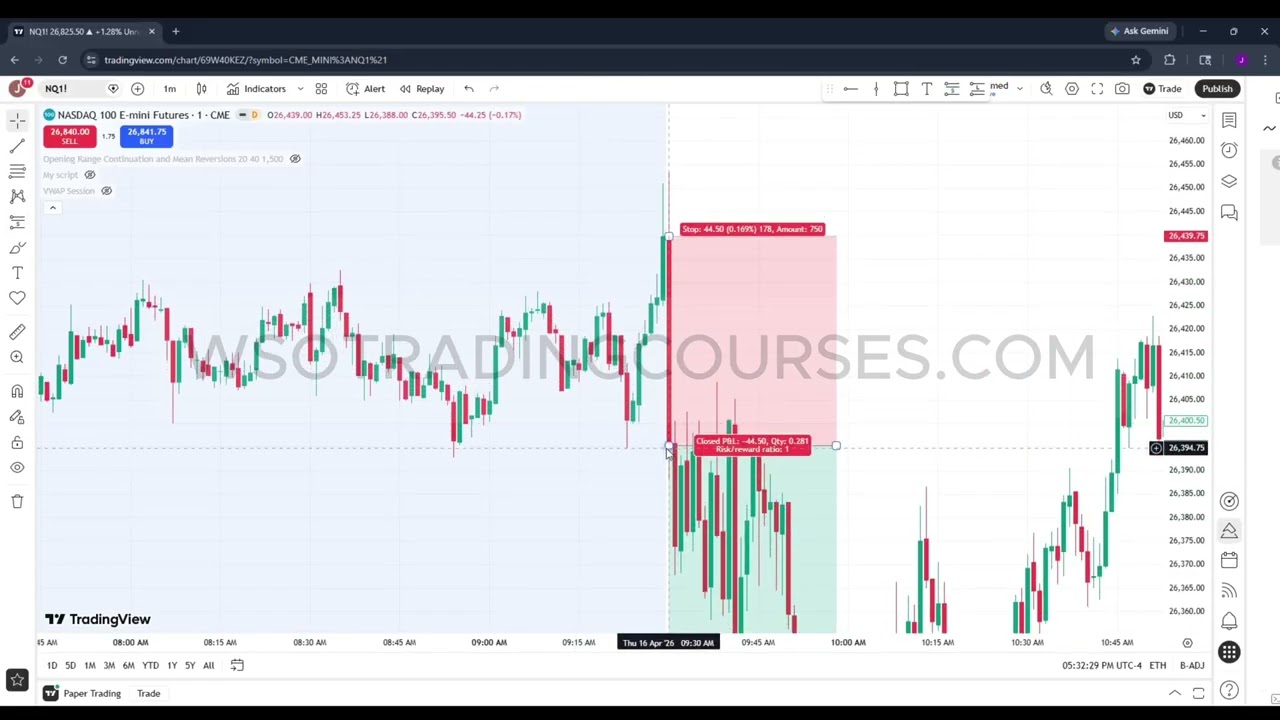
So, continuation specifics. The first thing that I will note, just write these things down um if you have uh a document or something you're taking notes on. Uh just write them down. I'll try and put it in the the comments of this video as well. If the opening candle is 25 or more points, the body of it is 25 or more points, then divide contracts by two. Contracts divided by two. So, in this example, this opening candle right here, 9:30, uh look right here.
This number right here, 0.25, it's going to change as I switch my mouse over arrowing over different uh candles. So, this number right here tells you the size of the body of the candle, the amount of points. So, this opening candle only had a four-point body. This candle right here, very large candle, 38 points. So, if this was the opening candle, then you would use one contract on an eval and do a 50-point stop, 76-point take profit.
So, the dashboard is really good just in general, and mainly for mean reversion since that's sort of what I um I'm trading majority of the time just because you're this is like a limit to one continuation per day, usually. Sometimes two. Uh but mean reversion is sort of the the bread and butter of my strategy, and it pairs a lot better with the funded accounts. But anyways, uh do one contract, and then you'll have a 50-point stop.
The reason for that is if this candle is bigger than 25 points, you don't want to get stopped out due to a 25-point wick. Uh there's a you also like what you wouldn't take a trade on this candle, but I'm just going to show you. This red thing right here is 25 points. It says that there. Uh I'm just dragging it around really. It's literally the size of the wicks of these candles. Um in this case, I wouldn't do 25 just because the body is not that large.
Uh this body is obviously four points. So this one would probably seem fine to just do uh 25 points. But uh let me just go back to the previous day. I remember this one is very large. Yeah, so this one right here 44 points. So continuation shorts would be amazing here because um it's uh it almost closed below. So not amazing. This is like an example of an A setup. It would be A+ if it closed below because uh it just closed like a little bit above this previous structure.
So like an A setup, 90% of the confluences have lined up. So not the best, but if you were to take this, I would definitely cut size in half because the opening candle is 44 points. And when it's more than 25, then you usually want to cut in half. And then just do something like that. So that way you don't get wicked out. Um you wouldn't you would not have been wicked out anyways if you just entered here. Uh if you enter here as well, this is a sort of an A setup as well.
Not A+ cuz this is A+ if this opening candle closes below and then you instantly short. This one is like an A setup because even though cuz this one did close below this this this this almost that. Um this is sort of an A setup just because uh we're shorting at the very bottom of the open. It usually has some reversion in it before it dumps fully. If you were to short here, then I would definitely definitely definitely say use 50 points uh just because you're likely to have some reversion before it runs to take profit.
So that's the first little technical thing is you can uh reduce your chance of getting wicked out. Obviously majority of these things in this video that I'm going to mention are things that you will see through your back testing and you can just sort of find out what works best for you. Uh this is just what has been working best for me is to cut contracts in half when the market open is doing uh large wicks and large candles.
Okay. Uh I'll also just go through some examples of this previous week. Uh so next thing for the specifics of the continuation strategy would be lining it up with a high time frame bias. So, you can move from an A+ setup is when you have high time frame plus low time frame. A setup is just low time frame continuation. Uh so, I guess let me just list out all the confluences. Uh text is going to be easier actually. So, our confluences for continuation strategy would be high time frame bias.
The words are the caption track's own and nothing is reworded or re-transcribed. Paragraph breaks are placed between sentences so the text reads as prose.
Free tools for your own script. No signup, no login.
Paste your draft and see where viewers are likely to drop off, with a rewrite for each weak line.
Paste the first 30 seconds of your own draft for a hook score and rewrites.
Check your draft against YouTube's advertiser-friendly guidelines before you record it.
Read this channel's public videos and transcripts, and download a writing brief for it.