Getting the transcript
Reading the captions from YouTube. A video nobody has opened here before takes 10 to 30 seconds; this page fills in on its own.
Getting the transcript
Reading the captions from YouTube. A video nobody has opened here before takes 10 to 30 seconds; this page fills in on its own.
Wso Trading Courses · @OfficialWSOTradingCourses
Words
1,525
Runtime
8:07
Speaking pace
188wpm
Reading time
6min
188 words per minute, between the 181 median and the 201 75th percentile of 349 measured videos. That distribution comes from the 349-video hook study.
Opening (first 30 seconds)
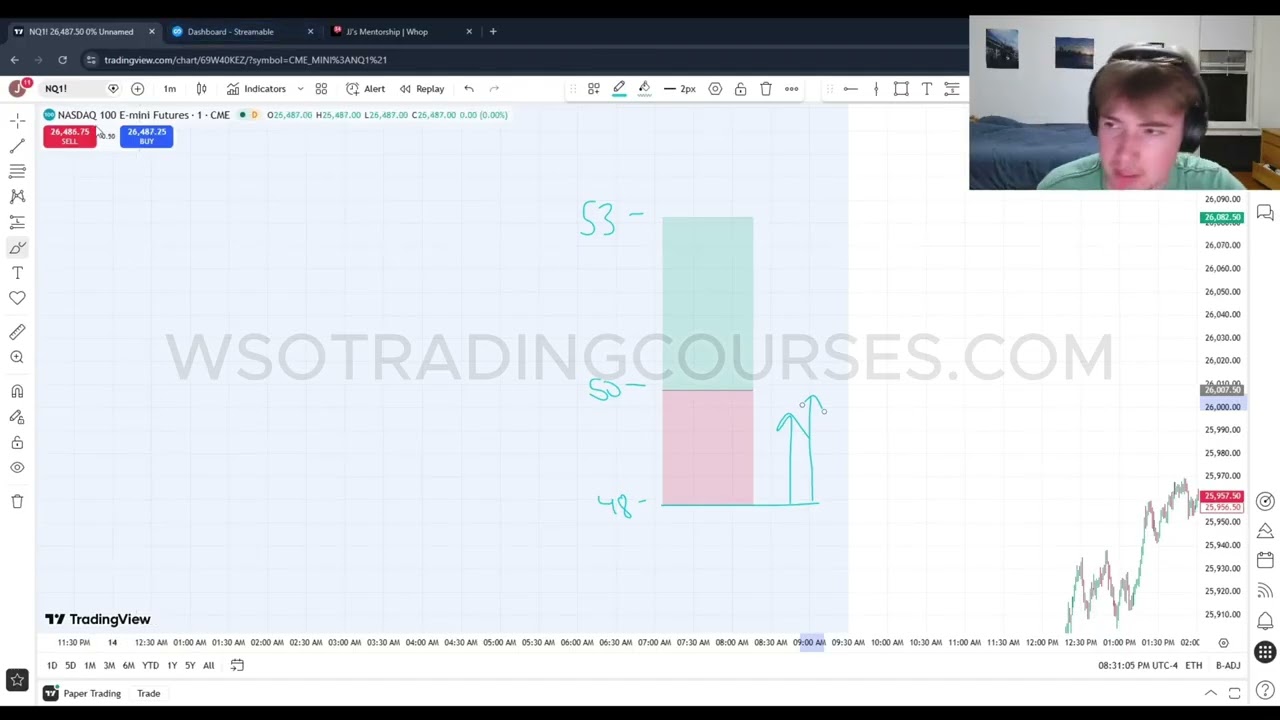
All right, here's a video on prop firm specific risk management. So I am just going to talk about top step for now. It is just the basic and the first thing I'm going to explain is the evaluation. Now we can pretty much imagine the evaluation as minus 50 hold on minus 50 points plus points. The reason why I'm sort of showing you this in this manner is to demonstrate an account's equity and how that changes over time. So this in the middle right here would be $50,000. Obviously you're starting
94 words, the words spoken in the first 30 seconds at 188 words per minute.
Free, no signup. See how the first 30 seconds hold attention, with rewrites.
Sentence shape
| Measure | This transcript |
|---|---|
| Sentences | 93 |
| Average words per sentence | 16.4 |
| Longest sentence | 62 words |
| Questions asked | 6 |
| Sentences containing a number | 35 |
Most used terms
Filler phrases
58 in total: like 28 · uh 14 · literally 5 · right? 4 · sort of 2 · um 2 · I mean 1 · actually 1 · kind of 1.
A literal whole-word count of the same phrase list the Prepublish browser extension uses, so a phrase inside another word is not counted and a phrase used in its ordinary sense still is. It is a count and not a judgement.
What this transcript is
Every word below is the caption track YouTube publishes for this video, pulled from the video itself and reproduced unchanged. It is not Prepublish's writing, not a summary, and not a re-transcription: it is the video's own published captions. English captions, generated automatically by YouTube, in the video’s original language. Source: the video on YouTube. A channel that would rather this page did not exist can ask for its removal through the contact page, and it is removed.
No Script X-ray for this video: YouTube shows a Most replayed graph only once a video has enough views.
All right, here's a video on prop firm specific risk management. So I am just going to talk about top step for now. It is just the basic and the first thing I'm going to explain is the evaluation. Now we can pretty much imagine the evaluation as minus 50 hold on minus 50 points plus points. The reason why I'm sort of showing you this in this manner is to demonstrate an account's equity and how that changes over time.
So this in the middle right here would be $50,000. Obviously you're starting on a 50k eval. So this would be 50k. This down here 48k. And this is for the eval. I'll get to the fund in a second. So obviously to pass you have to achieve this before you achieve this. And they have rules like 50% consistency. Some firms have winning day rules, lower consistency, all that stuff. But top step is just 50%. So uh the way we do profer specific risk is we have to maximize our chance of hitting this before hitting this which obviously seems quite simple right uh kind of first of all we optimize around the rules and then second of all we have to uh optimize around the strategy that I trade and the one that I'm teaching you.
So this is how we pass the eval. Now, just looking at the chart, just look at the chart for a second. Just look at the way the candles are forming. And the pattern seems like it's quite random, right? Like when I'm zoomed this far out. Obviously, this is like an uptrend, but this is like quite random. Now, what if I drag this proper challenge to a random spot like that? Okay, I missed it, but but random spot like that, right?
And then we'll see. We'll zoom in. It entered your prof challenge here and it passed, which is great. And then I'll do it again. Do it again. Obviously, we're in a a bullish market. So, you probably pass where you fail. But say, say it started here, it would come all the way down almost lose, but then you get up eventually get up and win. Uh if you did it, if you bought here, then you would lose. So, this is how we are sort of looking at the prof challenge.
You need to look at it in terms of account equity like that if that makes sense. uh not in terms of like trades because you have so many different independent paths that you could take to pass your eval, right? Like you can have this path, you can have this path, you could even have this path where you win like two trades in a row, something like that. You go all the way down here and it come all the way back up. Like there's so many different paths, like literally infinite different paths that you could take to pass an eval or fail an eval.
So obviously profiter specific risk, we are going to maximize the expected chance of passing. Now, the first way to by doing that is to avoid the trailing draw down as much as possible. So, if you make a trade for like 200 bucks, the trailing draw down will trail and now you have $2,000 of max loss from here to here instead of 2,200. If you had that 2,200 and you kept trading, kept trading and you lost all of what you kept and you lost all of that in the same day or in the same trade, then you would still have $2,000 worth of draw.
Nothing happened. If you did this, went to the next day, did another trade, the draw down would keep on trailing. And so after three wins, you might still only have $2,000 worth of draw down. So what we have to do is pass the evaluation as quickly as possible. So the less amount of times the draw down trails up, the better that is for you because you have less total overall draw down. If that makes sense. Like if you do it in two trades, you have like one there's only one time that the that the draw down moves up if you're passing in two trades every time, which is what I try to do because there's 50% consistency.
So with our prop firm risk, we are passing evaluation as quickly as possible. So the trailing draw down has the smallest effect possible on our pass rate. So I hope that makes sense. And then same thing for the funded account. Literally uh we are trying to win usually 3 to $4,000 on the first day on our 50k in just one trade. That way this thing will only trail once. If you make $2,000 you make 50 If you make $2,000 that's good, but the draw down's going to trail up here and you essentially risk $2,000 in draw down to have the draw down trail up and now you still only have $2,000 in draw down.
So you risk an entire funded account to get pretty much no new draw down. but you are $2,000 in profit. If you were to compare that and say you go for $3,000, now you're $3,000 in profit and you have $3,000 worth of draw down if you win $3,000 on your first day. So, uh if it would be if it's like the risk-to-reward of going for 2K and the riskreward of going for 3K, it's the exact same expected value assuming your strategy is like a normal strategy, right? um like a break even win rate.
Assuming a break even win rate, 50% win rate to win 2K. That's a break even chance to hit 2K. It's the same expected value as uh a 40% chance to win $3,000 if you're risking 2K. That's just like the break even win rate. We can do way better than that, but at worst, it's the same expected value to go for 2K as to go for 3K. So why would we go for 3K? Well, because then you have $3,000 worth of draw down to work with. And with $3,000 worth of draw down to work with, you can first of all, you can take more payouts.
And second of all, if you ever have an accident where you're going for a bunch of winning days, uh well, actually, you you wouldn't have that. I mean, if you're following the risk, we're just going for plus or minus $200 winning days uh to guarantee the payout. So, essentially, uh it'll look like a step a staircase. like you can never lose more than $200 in a day if you're following the risk dashboard. So it could literally be up or down, but like plus or minus 200 every day.
And on average, you're going to stay at 53K. But if you have the same expected value to go for 53 as 52, but you can literally have $1,000 extra in draw down. That's way more profitable. So that's why we go for a large winning day on our first day on the funded account. And then the reason why we do the the small winning days plus or minus 200, 150, 250, whatever the site is asking for is we're guaranteed a payout. So if you're at a 53k balance, your trailing draw comes up and locks at 50k.
If you're doing plus or minus 200 just to go for winning days, your chance of coming all the way down to 50 is literally zero. Like I don't even know what the math for that would be. Um, you can ask Chad GBT, but just because you're doing plus or - 200, you would have to lose 15 times more than you win. So, you'd have to lose 15 times more than you win. Uh, before you get four wins because you already have a big win to get here.
So, you'd have to go 19 losses to four wins of a 50/50 trade. This is a break even win rate by the way for plus or minus 200 and I don't think it's I don't know what even would the odds of this have to be so incredibly small maybe like 01. So that's why we do the winning day is just to guarantee ourselves a payout then take out half of the balance and then do the same thing. Once you take the first payout all of the payout gets reinvested into more evals and then you just repeat the whole cycle.
So, it's a a very cyclical effect and I hope all of that made sense as to why or how we do profit specific risk. If you have any questions, uh you should bring it up in the group in our group coaching calls in the discord just because uh it's easier for me to explain it like your personal situation like your current situation rather than obviously on the chart here. Just give me a shout
The words are the caption track's own and nothing is reworded or re-transcribed. Paragraph breaks are placed between sentences so the text reads as prose.
Free tools for your own script. No signup, no login.
Paste your draft and see where viewers are likely to drop off, with a rewrite for each weak line.
Paste the first 30 seconds of your own draft for a hook score and rewrites.
Check your draft against YouTube's advertiser-friendly guidelines before you record it.
Read this channel's public videos and transcripts, and download a writing brief for it.