Getting the transcript
Reading the captions from YouTube. A video nobody has opened here before takes 10 to 30 seconds; this page fills in on its own.
Getting the transcript
Reading the captions from YouTube. A video nobody has opened here before takes 10 to 30 seconds; this page fills in on its own.
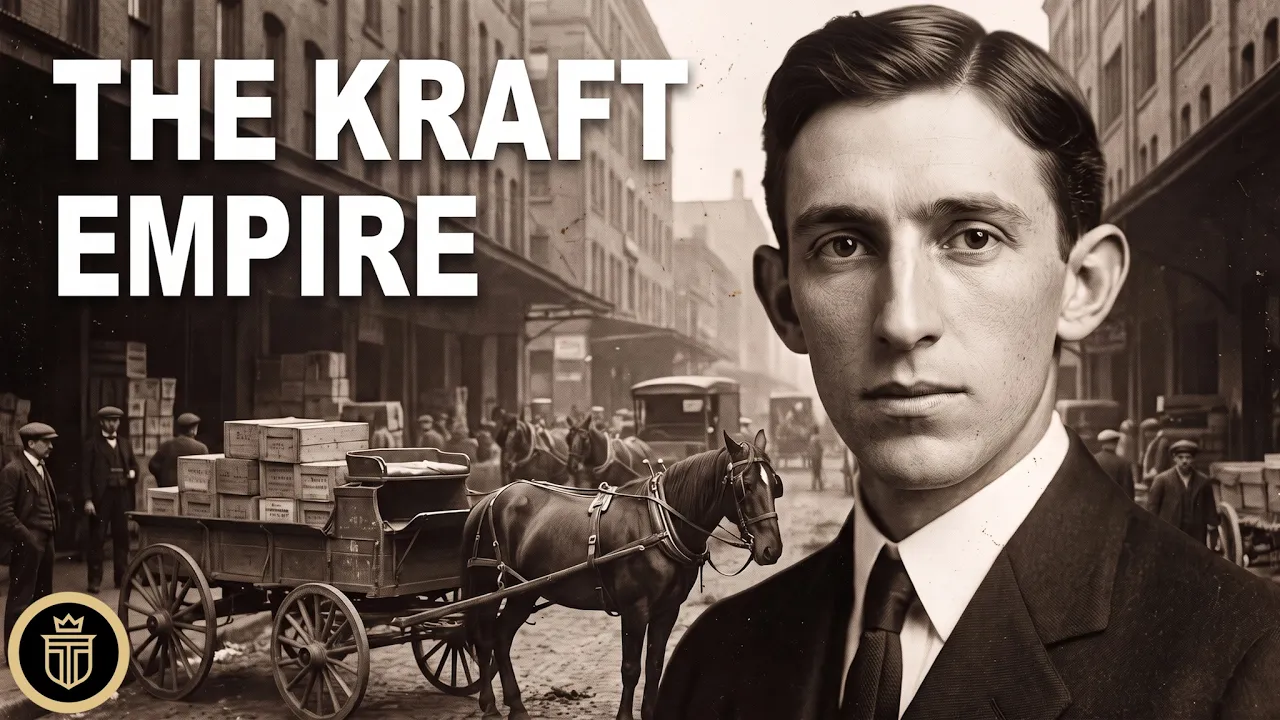
Old Money Documentaries · @OldMoneyDocumentaries
Words
9,752
Runtime
57:44
Speaking pace
169wpm
Reading time
41min
169 words per minute, between the 160 25th percentile and the 181 median of 349 measured videos. That distribution comes from the 349-video hook study.
Opening (first 30 seconds)
The farm stood southeast of Stevensville, >> [music] >> in the flat Ontario country just north of Fort Erie, where the Niagara River runs cold toward Lake Erie, and the wind comes off the water with nothing to stop it. This was a dairy farm, small and ordinary in the way that most Welland County holdings were ordinary in the 1870s, worked by a German-descended farmer named George Franklin Kraft and his wife Minerva Alice Tripp. Their second child was born on the 11th of
85 words, the words spoken in the first 30 seconds at 169 words per minute.
Free, no signup. See how the first 30 seconds hold attention, with rewrites.
Sentence shape
| Measure | This transcript |
|---|---|
| Sentences | 435 |
| Average words per sentence | 22.4 |
| Longest sentence | 66 words |
| Questions asked | 0 |
| Sentences containing a number | 117 |
Most used terms
Filler phrases
9 in total: like 6 · kind of 3.
A literal whole-word count of the same phrase list the Prepublish browser extension uses, so a phrase inside another word is not counted and a phrase used in its ordinary sense still is. It is a count and not a judgement.
What this transcript is
Every word below is the caption track YouTube publishes for this video, pulled from the video itself and reproduced unchanged. It is not Prepublish's writing, not a summary, and not a re-transcription: it is the video's own published captions. English captions, generated automatically by YouTube, in the video’s original language. Source: the video on YouTube. A channel that would rather this page did not exist can ask for its removal through the contact page, and it is removed.
No Script X-ray for this video: YouTube shows a Most replayed graph only once a video has enough views.
The farm stood southeast of Stevensville, >> [music] >> in the flat Ontario country just north of Fort Erie, where the Niagara River runs cold toward Lake Erie, and the wind comes off the water with nothing to stop it. This was a dairy farm, small and ordinary in the way that most Welland County holdings were ordinary in the 1870s, worked by a German-descended farmer named George Franklin Kraft and his wife Minerva Alice Tripp.
Their second child was born on the 11th of December, 1874, in a house on Bowen Road, and they named him James Lewis. He was the second of 11 children, which meant that from the beginning, he was neither the heir nor the baby, but one of the middle bodies in a household where labor was distributed the way food was distributed by necessity and without ceremony. The family kept the Mennonite faith, the plain tradition that had carried the Krafts out of Germany into Pennsylvania, and then north into Upper Canada across three generations, and it left on the boy a specific residue that would outlast the farm itself.
The tombstone over his parents still reads Kraft with two letters F, because his parents never changed the spelling. Their son would drop one of those letters when he founded a company, and in that small subtraction, there is already the whole story of a name detaching itself from a family. His schooling was local, at the plain building the county called school section number nine on Airline Street, and there is nothing in the record to suggest he was marked out as exceptional.
What the record does show is that by the final years of the old century, >> [music] >> he was working as a clerk in Richard Ferguson's general store in Fort Erie at $500 a year, weighing goods for neighbors, and learning the one thing that no school in Welland County taught. The lesson was [music] this, that a grocer's problem is never the customer and never the product, but the gap between the two, the spoilage and the waste, and the hours that turn good stock into garbage.
Cheese in particular was a disaster of a commodity. It arrived in great cloth bound wheels, the cheddar of the Ontario and Wisconsin dairy belts, and a grocer who cut into a wheel was starting a clock he could not stop. The exposed face dried and cracked, mold took the rind, the flavor drifted, and in July the whole thing could turn in a matter of days in a shop that had no refrigeration because almost no shop had refrigeration.
His father had seen a piece of the same problem from the other end, having opened a dairy in Fort Erie by 1900 to sell milk and cream off the family land and off his neighbor's land. The son looked at the gap and concluded correctly that the money was not in making cheese and not in selling cheese, but in solving the middle. During 1902, he crossed the river to Buffalo, which sat directly opposite Fort Erie, and which was by the standards of a farm boy, a metropolis.
He took a position as secretary and treasurer of the Sheppard Cheese Company, a small concern with ambitions, and within a year he had put his savings into the business and become a partner in it. This is the point at which the conventional immigrant narrative would accelerate, and instead it collapses. The partnership sent him west to Chicago in 1903 to look after the company's branch in that city. And while he was there, occupied with the branch and the market and the freight, his partners in Buffalo dissolved the partnership without him.
They did it cleanly and they did it at a distance, and the effect was that a young man arrived in the largest food market in North America as a partner and became in the space of a letter a stranger with luggage. $65 was what remained to him. That figure comes down to us from the company's own official history, and it has been repeated so often in Kraft advertising and Kraft annual reports and craft obituaries, that it has acquired the smoothness of scripture.
But the underlying fact is well attested, and the sum is real. $65 in 1903 was roughly 2 months [music] of what he had been earning at Ferguson's store. And in the money of the present day, it comes to somewhere near $1,900. It was, in other words, not capital. $65 is the amount of money a man has in his pocket when he is deciding whether to go home. Chicago in that year was the hinge of the American food system. A city where the killing floors of the stockyards, and the grain elevators, and the refrigerated cars had already made perishability into an industry.
He went down to South Water Street, the wholesale market on the river, where produce and meat and dairy changed hands before dawn, with his $65 in his pocket. And what he bought was not a business, and not a building, and not a brand. He bought access to a horse. The choice of the word matters, >> [music] >> because he did not buy the horse. And the difference between owning and renting is the difference between a man with assets and a man with a plan.
The family he had left behind in Ontario would never own a share of what followed. And the man who had dissolved his partnership in Buffalo would vanish from the record entirely. And the $500 a year he had earned in a Fort Erie store would come to look in retrospect like the last honest wage of his life. Everything that the 20th century would eventually put into a rectangular box with his name printed on it began with a rented animal and a stranger's cheese.
The horse was called Paddy. That detail survives because the company kept it, printing it in corporate histories, and repeating it through decades of anniversary literature. And it survives for the reason that all such details survive, which is that it was useful. A horse with a name is a story, and the man who sold processed cheese to the armies of the United States understood what a story was worth. The arrangement was elementary and punishing.
Before the market opened, he would go to South Water Street, buy cheese at wholesale in whatever quantity his money allowed, load it onto a rented wagon, hitch Paddy, and drive out into the neighborhoods of a city that was then absorbing immigrants at a rate no municipal system could follow. He sold to the small grocers, the corner men, the Germans and Poles and Bohemians and Swedes who ran shops the size of a parlor and did their accounting in a notebook in quantities those men could move before the goods spoiled.
That was the entire proposition. Not cheaper cheese, but smaller cheese delivered often enough that the grocer's clock never ran out. The whole thing was a service business dressed as a product business, and it required him to be on the wagon in the dark and on the streets all day and over the books at night. The first years were bad. His own words survive from that period in a letter written on the 2nd of August 1904 to a friend named Wilfred.
And the letter is the most revealing document of his early life because it is neither modest nor triumphant. He wrote that he did not have a comparatively large business at present, and then he wrote that he knew what he could do, and that in less than 5 years he honestly expected to have one of the best wholesale cheese businesses in the city. A man does not write that sentence unless the present is humiliating. The humiliation was arithmetical.
Established wholesalers with warehouses, standing credit lines, and long relationships were competing against him. And he with warehouses and credit and relationships, he was buying at the same prices they bought at without their volume, and his product was still perishable because nothing he had done had altered the fundamental chemistry of a cut wheel of cheddar. He sold it faster, which helped, and he sold it in better shape, which helped more.
But every day he was still racing decay with a horse. Losses accumulated. The venture came close enough to collapse that Kraft's own corporate tradition, which had every incentive to skip over the episode, instead built a small monument to it. The tradition holds that in 1907, with the business faltering, he sat down [music] and decided to make God a partner in the enterprise. That phrase, "Make God a partner," would be repeated by Baptist publications for the next half century.
And by Kraft executives for longer. And it is easy to hear it as public relations. But the practice behind it was real. And the man behind it was, by every surviving account, entirely sincere. He tithed, he taught, he took the Mennonite frame of his childhood and refitted it into Chicago Baptist practice, and he ran his business as though the books would be audited by someone other than an accountant. What is worth noticing is the timing, because 1907 was the year of a severe financial panic in the United States, when banks in New York suspended payments and [music] credit dried up across the country, and small concerns everywhere went under for no reason except that they were small.
He did not go under. By 1909, the wholesale business had grown to the point where one man and one wagon could no longer contain it. And he began to do what men from large families do when they need labor they can trust. He sent for his brothers. Charles Herbert came, and Frederick came, and Norman came, and John Henry came out of Ontario and into a rented Chicago operation that had almost died twice. And in 1909, the five of them incorporated as J.L.
Kraft and Brothers Company. Kraft was 34 years old. He was president, and he would hold that office and then its successor without interruption until the day he died. The brothers became executives and stayed executives, and this is a point that will matter a great deal later because none of them ever became owners in the sense [music] that the founding families of Ford or DuPont or Hershey became owners. They were employees with a surname.
Taking American citizenship in 1911 closed the Canadian chapter of his own life in the legal sense. While he kept, for the rest of it, the accent and the habits and the plain manners of a well-run county farm. The following year, in 1912, the company began to advertise cheese in national magazines, which was close to unthinkable in a trade that had never regarded cheese as a branded good at all. He also began, quietly, to spend money he could barely spare on a problem nobody had asked him to solve.
The problem was the wheel itself. Nearly a decade had gone into managing decay, driving faster, selling smaller, cutting the interval between the cheesemaker and the grocer's counter. And every one of those measures was a workaround. In a room behind the Chicago operation, he began heating cheese and watching it fail. Heat it and the fat separated out, the solids gathered, the emulsion broke, and what remained was an oily ruin that no grocer would touch and no customer would eat.
The men who eventually wrote his obituaries would describe this period as >> [music] >> experimentation, which is the word that gets used when an outcome is known. At the time, it was a man in his 30s with four brothers on the payroll and a national advertising bill and no technical training whatsoever standing over a kettle of spoiled dairy. The insight, when it came, was borrowed from milk. Milk had been pasteurized for years by then, heated to kill the organisms that spoiled it, and the dairy industry had been reorganized around that single intervention.
But cheese had resisted the treatment for a mechanical reason, rather than a biological one. Cheese under heat came apart. What Kraft worked out through a process that the surviving record describes only in its results, was that the separation could be prevented by violence. If the cheese was stirred at high speed while it was heated, agitated hard enough to keep the fat suspended in the solids rather than allowing it to pool, the emulsion held.
The heat killed the organisms that caused ripening and spoilage, the stirring kept the body of the cheese intact, and what came out of the kettle was a substance that was no longer quite cheese in the traditional sense and no longer perishable in the traditional sense, either. It was uniform. A grocer could promise something and a customer could form a habit, and habit is the only durable asset in the grocery trade. That word carries more commercial weight than any other word in this story, because the great defect of cheddar as a national product was not that it spoiled, but that it varied.
One wheel sharp and one wheel mild and one wheel off, so that a grocer could not promise a customer anything and a customer could not form a habit. Kraft's product tasted mild, tasted the same in Sacramento as in Savannah, and kept. Kraft was not the first person on Earth to make something of the kind, and the honest version of this history says so. Two Swiss food chemists named Walter Gerber and Fritz Stettler had treated Emmentaler with sodium citrate in pursuit of longer shelf life and better melting, work that predates the American effort.
What Kraft obtained was the first United States patent, and in the American market a patent is not a discovery, it is a moat. The year the European war began, the company opened its first cheese manufacturing plant in Stockton, Illinois, moving from trading other people's product to making its own. And it was by then distributing some 30 varieties under the Kraft and Elkhorn labels. During the following year, he produced the new pasteurized cheese commercially for the first time, about $5,000 worth of it, >> [music] >> and he packed it in small tins with keys that rolled the lids back in a strip.
The tin was not incidental packaging. The tin was the product because a sealed metal container filled with a cheese that did not require refrigeration was, for the first time ever in this commodity, a unit of cheese that could be put on a ship. Most of that first production went to India and to East Asia, which tells you exactly what he understood about what he had built. He had not invented a better cheese for Chicago.
The invention was cheese that could cross an ocean. The United States Patent Office on the 6th of June, 1916, issued patent number 1,186,524, titled A Process of Sterilizing Cheese and an Improved Product Produced by Such Process to James L. Kraft of Chicago. He would obtain the Canadian equivalent 4 years later. The legal language of the document is worth noting because it claims sterilization rather than invention, a process rather than a recipe, and a process is the kind of thing a court will defend.
Competitors could make a soft mild cheese if they wished, and several tried, but they could not make it his way without buying a license from the man who had failed at it for 10 years in a back room. A 30-fold increase in 12 months, and the company that had been a wagon route with a religious streak became a manufacturer with a legal monopoly on the only cheese in America that could be stacked in a warehouse without a thought.
The brothers moved into the positions the new business required. Charles Herbert would rise highest of the four, eventually running the company in his brother's later years, and Frederick and Norman and John Henry took their places among the executives, and the family's collective grip on the enterprise reached its lifetime maximum somewhere in this decade. That grip was operational rather than proprietary, which is a distinction invisible at the time and decisive in hindsight.
The capital to build plants had to come from somewhere, and it came the way industrial capital came in that period, from banks and from investors and from the issuance of shares, each round of which converted a little more of a family business into a public instrument. Meanwhile, the product itself was doing something to the American palate that no advertising campaign could have accomplished on its own. It was teaching a generation of consumers that cheese was supposed to be mild, consistent, soft, and packaged.
And that expectation would eventually be strong enough to make the traditional cheddar wheel into a specialty item in its own country. Every aged cheese sold in the United States today sits on a shelf in a market whose default was set in a Chicago back room by a man trying to keep his emulsion from breaking. In the spring of 1917, the United States declared war on Germany and began the work of assembling, feeding, and shipping an army of millions across the Atlantic.
Somewhere in the procurement offices of the War Department, a quartermaster began to ask whether there existed any form of cheese that could be transported in bulk, stored without ice, carried in a pack, and opened in a trench. There was exactly one, and it was patented. An army is a logistics problem wearing a uniform. The American Expeditionary Forces that went to France in 1917 and 1918 had to be fed across 3,000 mi of ocean and then across a rail and road network already shattered by 3 years of European fighting.
And the constraint that governed everything was weight against calories against spoilage. Cheese is one of the most efficient foods ever devised by human beings for exactly that calculation. Dense in fat and protein, [music] compact, and requiring no preparation. Its historical disqualification had been that it rotted. Kraft's tinned pasteurized cheese did not, and so the United States government bought it by the train load, taking somewhere in the region of 6 million pounds of cheese in tins for the armed forces over the course of the American involvement. 6 million pounds is a figure worth pausing on because it converts a Chicago company into a national supplier in the space of about 18 months.
And because government procurement of that scale does something to a business that no retail success can replicate. It guaranteed the demand, which meant the company could build capacity without fear. It guaranteed payment, which [music] meant the company could borrow against it. And it guaranteed distribution to an audience of young American men who would come home in 1919 having eaten the product for a year and having formed the only opinion about it that mattered, which was that it was familiar.
The soldiers who ate Kraft cheese in the trenches became the householders who bought Kraft cheese in the '20s, and the government had paid for the sampling campaign. The war contracts are often treated as a lucky break, and that reading is mistaken in one specific respect. The patent was issued in 1916, and the American declaration of war came in April of the following year. So the interval between the legal protection of the invention and the arrival of the largest customer in the world was a matter of months.
But the invention was not aimed at the army. The target had been India and East Asia, at the long sea routes, at the colonial trade, at any market whose defining feature was distance. [music] And the army proved to be the most extreme problem of distance the age could produce. He had built a solution to transport, and then history produced the transport [music] problem of the century. A further consequence follows, one the company's own literature never mentioned, which is that the war removed the retailer from the transaction entirely.
For the duration of the contracts, the customer was a government department that wanted volume, uniformity, and shipping tolerance. And every one of those preferences pushed the business [music] further away from the craft it had started in and further toward the factory. Once the soldiers came home, the company had learned to think of cheese as a manufactured commodity with a specification, and it would never think of it as anything else again.
Though there was money, and a manufacturing base, and a reputation, [music] and a habit of thinking in national terms. After the armistice, the company began marketing the product in 5-lb foil-wrapped loaves packed in wooden boxes, a format designed for the American grocer rather than the quartermaster. And the loaf did to the delicatessen counter what the tin had done to the ship's hold. The advertising pushed outward in every direction into magazines and then onto the radio, and it carried a message that was less about flavor than about certainty.
A woman buying a Kraft loaf in 1924 was buying the promise that the cheese in her kitchen would behave the way the last one had behaved. Standardization is a commercial argument dressed as a convenience, and the American food industry of the 20th century would be built on it by Heinz and Campbell and Borden and Kellogg. Each of them selling reliability into a market that had lived with variability for its whole history.
Kraft sold it in cheese, and cheese, unlike soup or cereal, had been the very definition of a local product. By the early '20s, >> [music] >> the company was operating plants, employing thousands, advertising nationally, and exporting internationally. And its founder was a wealthy man for the first time in his life at around the age of 50. He responded to wealth in the manner of a person who had spent his childhood in a plain farmhouse with 10 siblings.
He bought land in the northern Wisconsin woods near the company's new plant at Antigo because the country reminded him of Ontario and he built a summer estate on the edge of a lake and called it Kraftwood and filled it with his wife and daughter and friends every summer. He put money into a golf and tennis resort scheme in Lake Wales, Florida in partnership with a couple named Carl and Bertha Hinshaw and the Florida land bust and then the crash of October 1929 took his interest in it away entirely leaving behind only a Spanish revival house that the locals still call the Kraft house.
He gave a great deal of it to his church. What he conspicuously did not do was build the apparatus that converts new money into standing, the Fifth Avenue house, the marriages into older families, the endowed institutions carrying the surname in stone. That apparatus was being built all around him in those same years by men of comparable means and the difference between their descendants and his is largely the difference between money placed in trusts and money placed in collection plates.
And in the boardroom at the exact moment when his personal fortune had become substantial enough to found a dynasty he began instead the series of transactions that would end with his family holding nothing at all. The 1920s were the decade in which American food stopped being a trade and became an industry and the mechanism was consolidation. Regional dairies, ice cream makers, bakeries and packers were being bought up and welded together at a pace that had no precedent.
Partly because refrigerated transport had made national distribution physically possible and partly because the stock market of that decade would finance almost anything that promised scale. Kraft was both a buyer and though its founder may not have framed it that way, a target. brought control of the maker of Velveeta, a soft processed cheese product that would become one of the most durable and most argued about items in the American pantry.
In 1928 came the merger that changed the shape of the company with the Phoenix Cheese Corporation of New York. Phoenix brought with it a cream cheese brand named for a city it had never been made in, called Philadelphia, which had been created in the 1870s and which carried a reputation for quality that the Kraft name associated with tins and loaves and mild uniformity could not buy for itself. The combined concern, Kraft Phoenix Cheese Company, had potential sales in the neighborhood of $60 a year, making it the biggest cheese business anywhere in the world.
Philadelphia cream cheese would still be a billion-dollar brand a century later, sold in more countries than most governments have embassies in, making it among the shrewdest purchases any American food company ever completed. It also began a habit that would eventually define the enterprise, in which growth arrived by acquisition rather than by invention. And each acquired name was fed into a distribution machine that could reach every grocer in the country within a week.
And began the pattern that would define the next quarter century, >> [music] >> in which an acquired product or an invented product was pushed through a national distribution system that no competitor could match. Two years later, the acquirer was acquired. National Dairy Products Corporation was assembled in 1923 by a former ice cream executive named Thomas McInerney, who had understood earlier than most that the fragmented American dairy business could be rolled up.
And before the decade was out, it had swallowed dozens of regional operations across the country. Through a stock transaction in 1930, National Dairy acquired Kraft Phoenix and became the largest dairy company in the United States. The transaction is the pivot of this entire history and it is almost never told as such. James Lewis Kraft was 55 years old, the company bore his name and from that year forward he was an executive of a corporation controlled by other people.
He kept the presidency of the Kraft division and later the chairmanship. And he kept his office and his authority over the cheese business and his standing as the company's public face and moral center. And his brothers kept their positions alongside him. What he did not keep was control. There was no dispossession in it, no defeat, no boardroom ambush because he had sold willingly into a stronger balance sheet in the middle of a consolidation wave.
And in 1930, that looked like prudence rather than surrender. The result, nevertheless, was that the family lost the thing that families in this position are supposed to hold above all others, which is the ability to say no. 23 years of his working life remained and they were productive years. It is a peculiar arrangement to hold in the mind, a founder spending his final two decades as the most respected employee of the firm that had absorbed his own, drawing a salary against a name he had already sold.
Under his direction, the company put out Miracle Whip in 1933, introduced at the Century of Progress in Chicago as a cheaper alternative to mayonnaise in the depth of the depression and it became one of the great sellers of the century. Then came the Kraft Macaroni and Cheese Dinner, a box containing dried pasta and a packet of powdered cheese, priced at 19 cents and marketed with the claim that it fed a family of four.
Rationing and rail shortages and a national shortage of everything made that box into a staple. And the company sold it by the tens of millions of units. And it remains the item most Americans think of first when they hear the name. Parkay margarine arrived the same year. Kraft Deluxe processed cheese slices in and Cheez Whiz in 1952. The last new product introduced in the founder's lifetime. The Kraft Music Hall went on the radio and became one of the most listened to programs in the country.
And the company's advertising budget bought it a place in American domestic life that no cheese merchant had previously imagined. Advertising of that scale also did something subtler, which was to shift the relationship of trust away from the shopkeeper who had always vouched for his own stock and toward a printed label produced hundreds of miles away. The brands were becoming the asset, not the plants, not the patents, which expire, not the distribution contracts, which renew, and certainly not the family, but the names on the packages and the willingness of a woman in a grocery aisle to reach for the familiar box.
A brand is the only asset in a consumer business that appreciates while sitting still. And it is also, as the 21st century would demonstrate with brutality, the only asset that can be written down to nothing without anything physical having changed at all. Every acquisition in those decades deposited another name into a portfolio that would one day be valued, revalued, and finally marked impaired by men who had never met anyone in this story.
He married Pauline Elizabeth Platt of Chicago in 1910, the year after the company was incorporated, and it held until the day he died. They had one child, a daughter named Edith, born around 1916, the year of the patent. One daughter >> [music] >> in a family of 11 children born to a man whose company would eventually be valued in the billions. The demographic arithmetic of dynasty is unforgiving, and it is worth stating plainly at this point that the Kraft family never had the numbers, the trusts, or the shareholdings to become what the word dynasty implies.
His life outside the business organized itself around two things, and the first was the North Shore Baptist Church on the north side of Chicago. He had come out of a Mennonite household, and he refitted that inheritance into Chicago Baptist practice. And the form his faith took was administrative rather than mystical. He founded a men's Sunday school class at the church, and he served as the Sunday school superintendent for roughly four decades.
A tenure the sources place variously at 37, 40, and 45 years, depending on when the count was made. The image is worth holding. The head of the largest cheese business in the world on Sunday mornings in a church basement teaching lessons to men who worked in offices and shops and factories. He served as president pro tem and as treasurer of the International Council of Religious Education, as a vice president of the American Bible Society from 1926, and as a trustee of a Baptist Theological Seminary.
With a fellow parishioner named C. J. Howell, who had founded the Orange Crush soft drink company, he put up $50,000 of his own money, matched by Howell, to fund the construction of Baptist churches in poor neighborhoods. During the 1940s, he backed the council's crusade for Christian education, an effort to push religious instruction to young people across the country. And in 1951, he accepted the Horatio Alger Award, and the following year, the Gutenberg Award of the Chicago Bible Society.
The second organizing passion was stranger, and it has outlasted the first in the public memory. He collected jade, and he did it with the seriousness of a second career. It began with carved Chinese pieces, the conventional collecting of a wealthy man in that era. And then it turned into something closer to prospecting >> [music] >> because he became convinced that American jade existed and was being walked over unrecognized.
While traveling for the company, he had his chauffeur stop the car so that he could examine roadside gravel. And the interesting pieces went into the trunk. And over the years he acquired jade mines in Alaska and in California. He learned to cut and polish it himself in a workshop. An industrialist in his 60s bent over a lapidary wheel. What he made were rings. He set the polished American jade into rings and gave them to employees who had gone beyond what their jobs required.
And those rings passed into the families of Kraft workers and were kept by their children and grandchildren as heirlooms, which is a form of estate planning that no lawyer would recognize and no probate court would ever record. He wrote a book about it called Adventure in Jade and he became regarded as an authority on the American stone. The two passions met in a window. In the Kraft Chapel of the North Shore Baptist Church, there is a leaded window made entirely of American jade, about 6 and 1/2 ft by 3 and 1/2 ft, assembled from 446 individual pieces in the colors the old Chinese carvers had named rose madder and date skin [music] and sky after the rain with a rare white jade centerpiece.
It faces east to take the morning light. And it is lit by the sun rather than by any endowment. That window is the closest thing to a monument that James Lewis Kraft built for himself. And it is not in a museum or a mansion or a university that bears his name. He died on the 16th of February, 1953 at Wesley Memorial Hospital in Chicago after a short illness of pneumonia complicated by a heart condition he had carried for years.
He was 78. He was chairman emeritus of the company and the New York Times obituary the following morning described him [music] as the man who had sold the public on cheese. He is buried at Memorial Park Cemetery in Skokie, Illinois under a modest stone. Now, the question that this entire chapter exists to answer, which is where the money went, and the honest answer [music] requires admitting what the record does not contain.
There is no famous Kraft will, no reported estate valuation, no Kraft family office, no dynastic trust, no Kraft foundation of the kind the Rockefellers and the Fords and the Mellons erected, and no Kraft heir who appeared on any list of the American rich in the decades that followed. What the record contains instead is a long series of gifts to [music] churches and seminaries and Bible societies, 40 years of unpaid Sunday mornings, a chapel window, and a scattering of jade rings in the homes of former employees.
The fortune that his patent created was real and almost none of it stayed in his family because the company had ceased to be his family's property in 1930. And the man himself had spent his life giving away the rest of it to institutions that do not pay dividends. The name on the box would go on to generate tens of billions of dollars for people entirely unconnected to the household on Bowen Road and the first of them were already buying.
Charles Herbert Kraft, the brother who had risen highest, was running the company's operations in the founder's last years and when the last of the brothers left the executive ranks, the family's presence in the business it had created simply ended. No Kraft ever led the company again and no Kraft was ever asked to. The brothers had come down from Ontario as farm boys and they retired as salaried officers of a large corporation, comfortable and obscure, and the trade press of the period recorded their promotions without ever suggesting that they represented a house.
Compare that with what was happening in the same decades at Hershey, where a trust held the company in the founder's intended shape, or at Ford, where a family kept a separate class of voting shares for the specific purpose of never being outvoted. Those arrangements were available in law and in practice to anyone who wanted them badly enough to accept slower growth. And the Krafts did not make them. There was no succession crisis to mark the moment because succession requires a claim, and the family had traded its claim away in the National Dairy transaction while the founder was still in early middle age.
What vanished with the claim was something harder to see than money, namely the capacity of a family to impose a preference on a business against the preference of the market. A controlling family can refuse to close a plant in the town it came from, can decline to sell the division that carries the founder's face, can accept an inferior return in exchange for continuity, and can be as sentimental as it can afford to be.
Professional managers, answerable to dispersed shareholders, have no standing to do any of those things. And the record of the following 70 years is in essence the record of decisions no descendant was in the room to argue against. The corporation, meanwhile, had entered the era in which American management theory held that a company should be a portfolio rather than a business. National Dairy Products Corporation had been an aggregation of regional milk and ice cream operations with a cheese division attached.
And by the middle of the century, the cheese division was the part of it that anyone outside the industry could name. The parent acknowledged reality in 1969 and renamed itself Kraftco Corporation. And in 1976, it went further and simply became Kraft Incorporated. Consider what that means in the arc of this story. The founder had been dead for 16 years when the corporation that had bought his company decided to adopt his surname as its own legal identity.
And there was no member of his family in a position to be consulted, honored, or compensated for it. The name had become detachable, transferable, an asset like a trademark portfolio or a fleet of trucks. And the 1970s and '80s would demonstrate exactly how far it could travel. In 1980, Kraft merged with Dart Industries. [music] Dart was a conglomerate in the pure style of the period. A holding company whose businesses had nothing in common except that they were owned by the same shareholders.
And its portfolio included Tupperware plastic containers, Duracell batteries, West [music] Bend home appliances, Wilson Art plastic laminates, and Thatcher Glass. The merged entity was called Dart and Kraft. And for a few years, the name of the Ontario farm boy sat in a corporate title alongside [music] battery manufacturing and kitchen storage. The logic was diversification. The belief that earnings from unrelated businesses [music] would smooth each other out.
And the logic did not survive contact with the 1980s capital markets. Investors and the takeover artists who followed them worked out that conglomerates traded [music] at a discount to the sum of their parts. And that the way to extract that discount was to take them apart. Midway through the decade, Dart and Kraft had done to itself what a hostile raider would otherwise have done to it, spinning the non-food businesses, except [music] Duracell, into a separate company called Premark International, and changing its own name back to Kraft Incorporated.
It is worth stating what that spin-off did to the founder's name in practical terms, because a name attached to a conglomerate is a label, while a name attached to a portfolio of leading grocery brands is collateral, the separation was presented as strategic clarity, which it partly was. And it was also an admission that the previous decade's theory of management had been mistaken at enormous cost. Cheese and mayonnaise and macaroni were left in one box and the batteries and the plastic in another.
And the survivors of the experiment learned a lesson that would be forgotten and relearned at roughly 20-year intervals ever afterward. The food business that emerged from that separation in the middle of the 1980s was one of the most attractive assets in the American economy. And its appeal had nothing whatever to do with growth. And it generated enormous predictable cash. Very few businesses on Earth possess that quality.
And the financial industry has spent a century devising ways to buy them with borrowed money. People buy cheese and salad dressing and coffee in recessions and in booms in the same quantities week after week. And a company with a portfolio of category-leading brands in those aisles produces something that looks less like a business and more like a bond. For a buyer with a large debt appetite or a large tax problem or a shrinking core business, that quality of cash flow was worth paying an extraordinary premium for.
And in the autumn of 1988, the largest and most profitable shrinking core business in the United States went looking for exactly that. The Philip Morris companies of that year were an institution in a peculiar kind of trouble. The Marlboro brand was the most valuable consumer trademark in the world. And the American cigarette market was in structural decline with consumption falling, litigation gathering, and advertising restrictions tightening.
And the company was generating cash faster than it could find anywhere respectable to put it. Its purchase of General Foods 3 years earlier had brought in Maxwell House and Jell-O and Post cereals and Oscar Mayer meats. And the strategy was explicit. Convert tobacco earnings into food assets before the tobacco earnings became politically and legally untenable. In the middle of that October, Philip Morris made an unsolicited cash offer for Kraft of nearly 12 billion dollars.
The Kraft board resisted, the courtship turned hostile, and within a fortnight, the price had been raised to $106 a share, valuing the company at nearly 13 billion dollars, and the board accepted. It was the largest non-oil acquisition in American history to that date, and it created the largest consumer products company in the world. The transaction deserves a moment of attention for what it reveals about the nature of the thing being bought.
Kraft's factories and inventories and receivables accounted for a modest fraction of that price, and the overwhelming balance was paid for intangibles, which is to say for the words printed on the packages and the habits those words had formed in 100 million households. Accountants have a name for the difference between the price paid and the identifiable assets received, and the name is goodwill. And it goes onto the acquirer's balance sheet as an asset like any other.
So, a Virginia cigarette company, in order to explain to its auditors why it had handed over that much cash for cheese plants of modest value, was obliged to write down on a legal document the precise worth of the public's affection for a dead Canadian's name. A farm boy's surname capitalized, audited, and carried at evaluation. Goodwill has one property that distinguishes it from every other entry on a balance sheet, which is that it cannot be sold separately, cannot be insured, and cannot be repaired, and can only be tested each year against the earnings it is supposed to be producing.
If those earnings fall short, the auditors require the number to come down, and the difference is charged against profit in a single stroke as though something had been destroyed. Because in the only sense that accounting recognizes, something has. The tobacco company then merged its two food subsidiaries into Kraft General Foods, an enterprise with sales of some 30 billion dollars, whose integration consumed years and whose portfolio now spanned cheese, coffee, cereal, cold cuts, gelatin, and powdered drinks.
For the following decade, the cheese business built by a Baptist Sunday school superintendent existed as a division of a cigarette manufacturer. Its profits used in part to fund the legal defense of an industry facing the largest civil litigation in American history. The arrangement was never mentioned in the advertising for reasons that require no explanation. The founder's church work and the Marlboro Man were now line items in the same consolidated accounts.
By the end of the '90s, the tobacco litigation had made that arrangement intolerable for everyone involved because the food business was being valued by the market at a discount to reflect the liabilities of its parent. And the parent could not monetize the food business while it owned it outright. The separation came in stages, patiently over 6 years. First, Philip Morris sold 280 million Kraft shares in what was then the third largest public offering in history while keeping a stake of roughly 88%.
Then early in 2007, the parent, by then renamed Altria, announced that it would distribute that entire remaining stake to its own shareholders, and within weeks the distribution was complete and Kraft Foods stood as an independent public company for the first time in 77 years. Independence lasted almost no time at all before the company began doing to others what had been done to it. The pattern in these years has a rhythm to it that repays attention since each transaction was justified to shareholders as a route to focus and each one left the surviving company larger, more complex, and more dependent on the next transaction.
In 2009, Kraft went after Cadbury, the British chocolate maker, and the campaign was hostile, protracted, and politically inflammatory in a country that regarded Cadbury as a national institution with a Quaker conscience. An initial approach was rejected as derisory. A second bid was turned down that autumn, and in the middle of the following January, the Cadbury board accepted a revised offer valuing the company at about 19 and 1/2 billion dollars.
Promises made during that fight about British factories were broken within months, questions were asked in Parliament, and the takeover rules of the United Kingdom were subsequently rewritten in response. The enlarged company decided, 2 years after that, that it contained two incompatible businesses, a fast-growing global snacks operation, and a slow, steady North American grocery operation, and split itself in two. The parent company holding the snacks and the international brands renamed itself Mondelez International, an invented word intended to suggest a delicious world, and spun off the grocery business as Kraft Foods Group.
So, the corporate entity that James Lewis Kraft had founded now legally existed under a name generated by a branding exercise, and the surname itself had been assigned to the slower half of the estate. What remained under his name was a portfolio of mature American staples with flat sales, thin growth, and cash flow so dependable that it functioned as a magnet for a particular kind of investor. Two of them were already in conversation, one in Omaha and one in Rio de Janeiro.
The partnership that assembled itself around the American food industry in that decade was one of the strangest pairings in the history of finance. On one side stood Berkshire Hathaway and Warren Buffett, whose entire public philosophy was built on buying good businesses [music] and leaving them alone for decades. On the other stood 3G Capital, a Brazilian investment firm led by Jorge Paulo Lemann and Alex Behring, whose method was the opposite in every particular.
And whose reputation had been made by acquiring consumer companies and reducing their costs with a severity the American market had rarely witnessed. Their instrument was called zero-based budgeting. Under conventional corporate practice, each year's budget begins with the previous year's budget and adjusts at the margins, which tends to preserve every expense that has ever been approved. Under zero-based budgeting, every line item starts at nothing and must be justified from the beginning every year.
And the effect in practice at a company with decades of accumulated habit is a sequence of deep reductions in head count, factories, travel, research, and advertising. The two firms together took H.J. Heinz private [music] in a transaction valued in the low tens of billions of dollars. Two years later, Behring approached the chief executive of Kraft Foods Group, John Cahill, with a proposal to merge the two companies.
The boards agreed within weeks, and in the summer of 2015, the Kraft Heinz company began trading as the fifth largest food and beverage business on Earth. Berkshire's shares in the combined company had cost it just under $10 billion. dollars. The thesis was simple, and for a season it appeared to be working. As costs came out of the business, margins expanded and the share price rose. Analysts wrote admiring notes about discipline.
Rival boards were asked by their own investors why they could not manage the same. And the method acquired the prestige that always attaches to whatever [music] is currently succeeding. The thesis had one requirement, which was that the process could continue, and that requirement produced the most revealing episode of the entire affair. Early in 2017, Kraft Heinz made an approach to Unilever, the Anglo-Dutch consumer goods giant, at a valuation of about $143 billion.
Unilever refused decisively and publicly, and within 2 days Kraft Heinz withdrew. And [music] the withdrawal amounted to an admission that no target of sufficient size remained available. Cost-cutting is a finite resource. A merger of that magnitude would have supplied years of fresh expenses to eliminate. And its refusal left the partners holding two mature portfolios and a method with nothing left to work on. A company can remove expenses only until it reaches the expenses that were producing the revenue.
And in a branded consumer business, those expenses are the ad- vertising, the product development, the sales coverage, and the innovation that keep a 50-year-old product relevant to a shopper who has never in her life been obliged to buy it. What happened next in American grocery aisles happened for reasons far larger than one company as consumers moved toward fresh food, toward store brands, >> [music] >> toward smaller and newer labels, and toward anything that read as less processed.
Processed was the founding proposition of the enterprise. The quality that had made the company, its promise that the contents of the package would never surprise anyone, had become in the space of two generations, the quality a younger shopper was paying extra to avoid. The reckoning arrived in late February of 2019 with the release of the previous quarter's results. Kraft Heinz announced a goodwill and intangible impairment charge of $15.4 billion concentrated on two assets in particular.
And those two assets were the Kraft brand and the Oscar Mayer brand. It cut its dividend sharply by well over a third, and it disclosed that the Securities and Exchange Commission had issued a subpoena the previous October concerning its accounting policies, >> [music] >> its procurement practices, and its internal controls. Understand precisely what an impairment of that kind is because it is the hinge of this story.
No factory burned down, no product was recalled, no patent [music] expired, and no competitor introduced anything ruinous. The company simply announced, in the language of accounting, that the name James Lewis Kraft had put on a tin of cheese in 1916 >> [music] >> was worth many billions of dollars less than the company's own books had been claiming. The market's response was immediate, with the shares falling more than a fifth in after-hours trading, dropping to a record low, and shedding something close to 16 billion dollars of value by the following morning.
Berkshire Hathaway, holding more than a quarter of the company, took a write-down of its own running into the billions. Days later, Buffett sat for a televised interview and said, in the plainest terms available to him, that he had been wrong about Kraft Heinz in a couple of ways, and that Berkshire had overpaid for Kraft. The investigation that followed found that years of accounting errors had understated the cost of goods sold [music] by more than 200 million dollars.
That cost savings had been improperly claimed, and and that 4 years of results had to be restated. The company eventually paid 62 million dollars to settle with the regulator without admitting or denying the findings. A former chief procurement officer accepted a bar from serving as an officer or director of a public company, and another former executive paid a personal sanction. The shareholder class action was later settled for $450 million.
A little over a century after a man with a rented horse worked out how to keep an emulsion from breaking, the institution bearing his name was writing [music] checks to the federal government for describing its own savings inaccurately. What followed the write-down was the slow part, and the slow part is always less interesting to tell and more expensive to live through. The company cut debt, sold peripheral businesses, changed chief executives, and attempted to reposition itself for a consumer who had moved on.
And the share price stayed down through all of it. On some measures, roughly half of what the merged company had commanded at its debut, and on others, closer to a quarter of its peak. The great consolidation thesis of the previous decade had run in reverse across the entire industry, with one packaged food giant after another concluding that its portfolio was too broad to manage and too dull to own. Cereal makers separated their snacks from their breakfast, soup makers hived off their sauces, and the bankers who had been paid to assemble these companies were paid again to take them apart, which may be the most dependable business model Wall Street has ever devised.
The board of Kraft Heinz on the 2nd of September 2025 unanimously approved a plan to undo the merger. The proposal was to separate the company into two independent public entities through a spin-off intended to be free of tax, and the working names given to them in the announcement were about as revealing as corporate placeholders ever get. One was to be called Global Taste Elevation Company, holding Heinz and Philadelphia and the macaroni and cheese business, with roughly $15 billion of annual sales.
The other was to be called North American Grocery Company, holding Oscar Mayer and Kraft Singles and Lunchables, with roughly 10 billion. The founder's surname, which the National Dairy Products Corporation had adopted as its own legal identity in was now being sorted between two unnamed entities according to which products were said to elevate taste and which were left to simply feed people. Then even that came apart.
In December of 2025, the company announced a new chief executive, Steve Cahillane, arriving from the cereal industry where he had presided over a separation of exactly this type. And he took office in the first days of 2026. In January, Berkshire Hathaway, now led by Greg Abel, filed to register its entire stake of roughly 27% for sale, clearing the way to exit an investment it had already written down by nearly $4 billion, and Buffett, by then in his 96th year, had offered his verdict on the proposed breakup in a single sentence.
Putting them together had not turned out to be a brilliant idea. And taking them apart would not fix it. The new chief executive paused the split on the 11th of February, 2026. He told reporters that conditions across the food industry had deteriorated, that he could not simultaneously separate the company and repair it, that the problems were fixable and within his control, and that there was no end date for the pause.
By the spring, the company was telling shareholders that the timing and completion of the whole proposal remained uncertain. And in the summer, it took a further impairment charge of more than $7 billion against the value of its brands. So the position, as of the writing of this account, is that a plan to dismantle the merger has itself been suspended. The largest shareholder is leaving, and the name is being marked down again.
A name One detail should be cleared away here since the surname invites it. The family that owns the New England Patriots has no relation to this story, no descent from the Ontario farmhouse, and no connection to the cheese business whatsoever. This is the place where an honest account has to say what it has found rather than what the shape of the story wants. There is no tragedy in the Kraft family in the sense that the word usually carries in these histories.
No suicide, no feud, no squandered inheritance, no heir dying in a wrecked car, no great house sold at auction to pay the estate tax. James Lewis Kraft died old, honored, devout, and married, having built something enormous and given a great deal of it away. And his one daughter lived a long private life. And his brothers drew executive salaries and retired. And none of them and none of their children ever controlled a dollar of the fortune the name produced after 1930.
The tragedy in this story is structural, and it is the more modern kind. It belongs to a century in which the great fortunes stopped being held by households and started being held by institutions, so that the losses, when they arrived, fell on pension funds and index holders, and the 60,000 employees of a company none of them could name the founder of. It is a family whose surname escaped it and went on to earn and lose sums of money the family itself never saw, passing from a dairy consolidator to a conglomerate of batteries and plastics to a cigarette manufacturer to a Brazilian cost-cutting firm to an Omaha insurance company, each owner extracting what it could from the accumulated trust of a hundred years of grocery shoppers.
The people of Stevensville, Ontario, kept the farmhouse on Bowen Road. And the North Shore Baptist Church kept its jade window facing east. And the families of long-dead Kraft employees kept their polished green rings. Those are the only pieces of this fortune still in the hands of anyone who would recognize the man. A farmhouse, a window, and some rings against an arithmetic of impairments that no household could survive and no household was ever asked to.
Everything else became a number in a footnote, adjusted downward. He spent his life making cheese that would never spoil, and in the end it was the name that turned.
The words are the caption track's own and nothing is reworded or re-transcribed. Paragraph breaks are placed between sentences so the text reads as prose.
Free tools for your own script. No signup, no login.
Paste your draft and see where viewers are likely to drop off, with a rewrite for each weak line.
Paste the first 30 seconds of your own draft for a hook score and rewrites.
Check your draft against YouTube's advertiser-friendly guidelines before you record it.
Read this channel's public videos and transcripts, and download a writing brief for it.