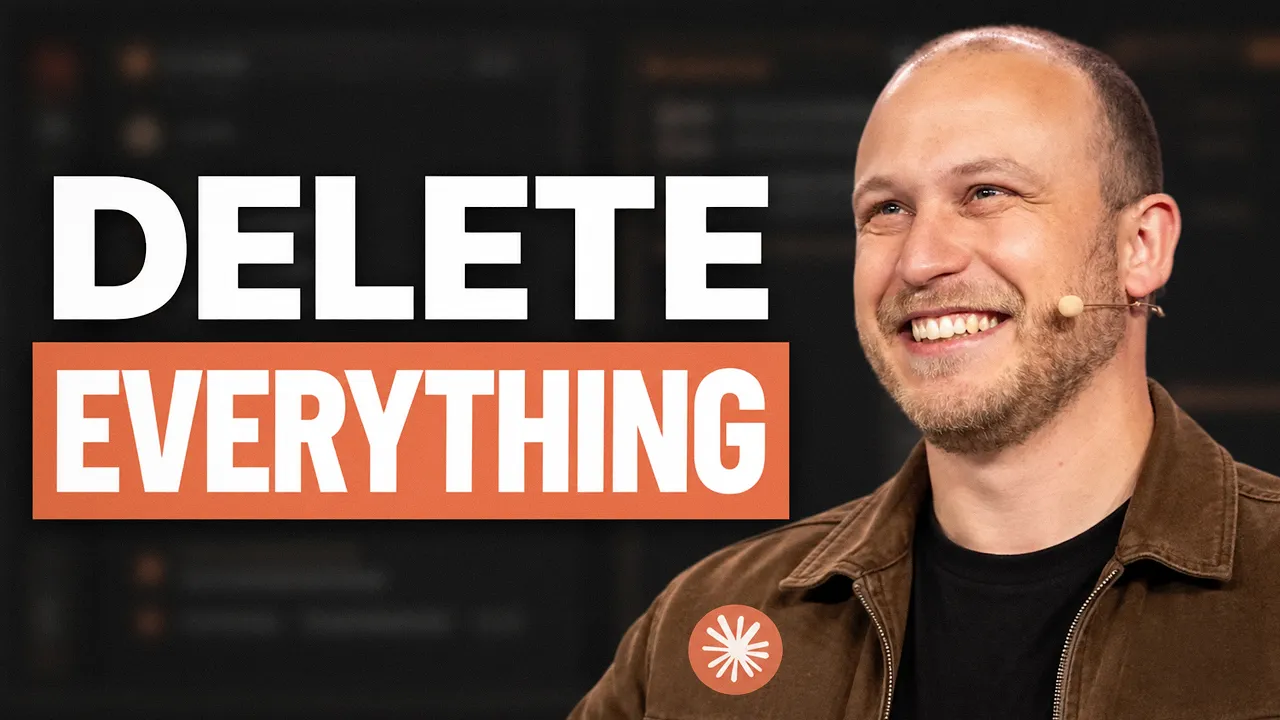
Claude's Creator Just Told Us How to Actually Use Claude in 2026 transcript
AI Edge · @AIEdgeHQ
Words
4,430
Runtime
20:56
Speaking pace
212wpm
Reading time
18min
212 words per minute, above the 201 75th percentile of 349 measured videos. That distribution comes from the 349-video hook study.
Opening (first 30 seconds)
So, I've been ramping up the implementation of AI across my business. But before I spent tens of thousands of dollars on claude credits and developers, I wanted to work out what the new best system would be in 2026. So, instead of watching content creators, I went through over a 100 hours of official material from Anthropic, the creators of Claude and Claude Code, including the head of Claude Code, Boris Churnney, who honestly completely changed my perspective of how we need to be using AI. He actually suggested that you should delete your Claude MD, your custom skills, and your custom instructions because the
106 words, the words spoken in the first 30 seconds at 212 words per minute.
Sentence shape
| Measure | This transcript |
|---|---|
| Sentences | 230 |
| Average words per sentence | 19.3 |
| Longest sentence | 117 words |
| Questions asked | 10 |
| Sentences containing a number | 19 |
Most used terms
- claude52
- actually34
- ai21
- code21
- work18
- business16
- claude code16
- prompt15
- model14
- task13
- process12
- video12
Filler phrases
67 in total: actually 34 · like 21 · you know 5 · literally 4 · kind of 2 · sort of 1.
A literal whole-word count of the same phrase list the Prepublish browser extension uses, so a phrase inside another word is not counted and a phrase used in its ordinary sense still is. It is a count and not a judgement.
What this transcript is
Every word below is the caption track YouTube publishes for this video, pulled from the video itself and reproduced unchanged. It is not Prepublish's writing, not a summary, and not a re-transcription: it is the video's own published captions. English captions, generated automatically by YouTube, in the video’s original language. Source: the video on YouTube. A channel that would rather this page did not exist can ask for its removal through the contact page, and it is removed.
Transcript
So, I've been ramping up the implementation of AI across my business. But before I spent tens of thousands of dollars on claude credits and developers, I wanted to work out what the new best system would be in 2026. So, instead of watching content creators, I went through over a 100 hours of official material from Anthropic, the creators of Claude and Claude Code, including the head of Claude Code, Boris Churnney, who honestly completely changed my perspective of how we need to be using AI.
He actually suggested that you should delete your Claude MD, your custom skills, and your custom instructions because the model is now smarter without them. Which at face value sounded crazy. But the more I started to dig in, the more I realized he had a point. And the way we have to use Claude now is completely different from even 6 months ago because these new models operate in a completely different manner. So, in today's video, I'm going to break down each learning, and then I'm going to break down exactly how that learning is now materially changing how I'm using AI.
I tried out all of these techniques on my real business setup, and honestly, I was mind-blown. If you want to make sure you stay on the cutting edge of AI, make sure you subscribe to the channel and click the notification bell because I'm obsessed with this stuff. And whenever I learn something new, I'm going to give it to you. There are specifically two things right now which I think you need to be doing if you're half serious about AI.
All right, so lesson number one, and this is coming from Boris himself, who created Claude Code inside a fourperson team at Anthropic, controversially said that you should delete everything. He's done a few talks recently, and I noticed his loudest theme is actually subtraction and not addition. In fact, this is actually how they build Claude code. Every time a new model ships, Anthropic deletes most of Claude Code's system prompt and slowly builds up the lines back at a time.
They call this ablation because they found that the new models actually run better and more efficiently with less instruction because most of what was in the system prompt was actually correcting an issue that the model didn't have before. So, if you've been using your old skills that were optimized for Opus, you'll probably notice if you try them on Fable, they probably won't work the same because the huge amount of context and instructions that you needed to give the old models simply isn't necessary now because the old models are smarter and they think differently.
So, he actually advised users to undertake the same ablation process. He said every 6 months you should delete your Claude MD file and just see what the model does bare and the output will probably actually be better than with the skills and the memory. Now, personally, I'm still using skills. Personally, I still have a memory system. I'm not saying disregard your memory system, but I think the concept of ablation and the concept of testing the new models without all of your old bloat and then building it back up slowly again based on what the new model needs is super relevant.
You've probably also experienced when you give a model too much context, it actually starts working worse. But I think if you're going to delete anything, delete the lines that are telling the model how to behave. I think context on who you are in your business is still going to be relevant, but all of those old instructions we needed to add like think in this way, respond in this way, act in this way. That kind of stuff probably isn't as necessary now.
So, you can really keep three things. your context, your goals, and your definition of what completion looks like for a specific task. Work that normally for a day. And if the model keeps tripping on a particular thing, then add a line back for it and slowly build it back up. That's the entire ablation process that Anthropic also runs internally. And if the creators of Claude Code are literally recommending that you do these things and are doing them internally, it's a pretty good indication that this is the best practice when it comes to using Claude in 2026.
Now, in the description below, I'm going to give you access to a free ablation prompt that you can copy and paste and put it into your own Claude. What it's going to do is read your current setup, ask you a few questions about what and how you actually use Claude, and then hand you back a lean version of instructions that are actually applicable to you. It's available for free alongside all the other resources from these videos in my school community below.
And that community is amazing because it's where I'm keeping you guys up to date in between these videos of the way I'm changing how I'm using AI. In the future, I'm going to be adding a skill library, including the skills on how I'm creating my own content and my marketing funnels and pipelines. So, lesson one focused on deletion or subtraction. Lesson two is all about verification, aka how you actually prompt Claude.
So, Boris says that the most common mistake that he sees when it comes to users using Claude is oversp specification, which if you're doing this, I don't blame you cuz a year ago, this is literally what you had to do to get the output that you wanted. So users would have to go, you know, step one, do this, step two, do this, step three, then do this. The issue is you're telling the AI how to think. And by telling it how to think, it might actually arrive at a worse destination because you are limiting how smart and capable these models actually are.
So instead, what you should be focusing on is optimizing for a clear specification of the output, verifying what creates a successful output in your mind instead of giving Claude all of the instructions as to how to arrive at that output. You don't need to micromanage the new models, especially the mythos class models like Fable. They actually do worse when you micromanage them. Like a lot of the time now, I'll just dump something into Claude code.
I have no idea how to do it, and I'll just ask it to get it done. For example, I was researching for this video. I was scraping X to find real clips from Boris and other members of Anthropic speaking about best practices and I just dumped all of the links into claude code and I said hey transcribe all of these and it just did it on my behalf. I didn't need to tell it how to do it. These models are now smart enough to be able to do the work on your behalf.
The real example which really hit home as to how powerful this verification mindset is was a company called Bun. If you haven't heard of it, it's a massively popular JavaScript runtime. So essentially the engine that executes JavaScript code. It gets over 20 million downloads a month and it's actually the thing that Claude Code itself runs on, but it was written in a low-level language called Zigg. So it started to experience lots of issues like memory issues, crashes, bugs, leaks.
So its creator decided to test whether claude code could rewrite the entire thing rewritten in a language called Rust, which would solve a lot of these problems. For reference, that's over 530,000 lines of code, which the creator said would take an engineering team around a whole year to complete. And you know how long it took with Claude code? 11 days with just one engineer steering the prompt. That had around 64 coding agents running the rewrite.
And that Rust version is in production right now. So if you use Claude code, you are literally running code that Claude wrote for itself. And Daario, the CEO of Anthropic, has said now that the majority of code for Claude itself is now written by Claude itself and just overseen by software engineers. So the demand for software engineers is shifting from the act of physical coding to more the ability to curate, oversee and verify.
So in that entire coding process, Claude was able to verify the work at every step of the way. So the lesson in this isn't that the rewrite is possible because the prompt was really clever. It's possible because the checking and verification process was automatic. So instead, by becoming end goal orientated, and I'll show you a very good system for this in just a couple of minutes, Claude becomes a lot more effective than trying to involve yourself every step of the way.
So in practice, what I try and do now is actually challenge Claude. I think of my base idea and then I think, how can I actually make this harder? How could I ask Claude to do something I don't think it can do or I think is really hard. And more often than not, it can actually do that thing. So, I think sometimes we actually need to challenge Claude more. You'd be surprised at how capable it actually is. Sometimes I'll just have Claude code on my second monitor while I'm working.
And something I'm about to do on my computer, I'll just voice prompt into the monitor next to me, I'll be like, "Hey, Claude, can you do this?" Just to see if it can do it, and it often can. Whether it's rewriting files on my desktop, whether it's searching for a lost file, whether it's scraping a YouTube page to deliver some data, whether it's going onto my notion and curating my entire content slate, whether it's reviewing a product that I need to do due diligence on, it can do all of these things.
And you know, I almost need to get out of the habit, and I have just been drilling this in over time, you know, of not doing work manually myself and thinking, can Claude do it? you know, instead of trying to look at a company and review all of the specifics, get Claude to do it and I just review the output. And this shift is making me a lot more AI native over time without me needing to be like, oh, I want to become more AI native now.
You just gradually start to introduce it into your life by just having it open and leaning on it. And that leads me on to the third lesson. The model can do way more than you realize. There's a story that happened inside Anthropic that stuck with me when I was watching all of this content. So, someone actually discovered by accident that Claude can actually draw portraits and landscapes using OpenCV, which is a computer vision library.
Nobody even trained it to draw, and nobody knew that it could. Boris thinks that there are dozens, maybe hundreds of abilities sitting in the model right now that nobody knows about because nobody's asked. So, if you come up with something insane, just try. you don't actually know what it's capable of because neither do the creators of Anthropic, which the more that I think about it is like a little scary, but anyway.
So, to make this actionable, make it a goal that once a week you give Claude a task that you don't think is possible, something that you never delegate. Worst case, it fails and you lost 10 minutes. And if you set Claude code to automatic, it can operate on your behalf without the need for constant approvals. And you can even run it on a scheduled session or a loop which we're going to get into so it can verify its behavior on its own behalf.
For example, I don't know, on a Friday evening, you could come up with a business idea, just a crazy idea you've been thinking of, and be like, "Hey, build the landing page. Here's the scope. Build the pipeline. Build the research funnel. This is the output. This is the company I'd like to create. Go about your weekend. And then on Sunday evening or Monday morning, check in. See what it was able to create." Maybe you've created a business in a weekend that you didn't know was possible before, but Claude did it.
Or maybe it fails, but what do you have to lose? You probably spend an hour on a Friday evening watching Netflix anyway, so why not spend a few minutes prompting something that could generate you potentially thousands of dollars or provide you a massive productivity unlock? I've been doing this in my business a lot. Like even this morning, I thought of a new way to prospect potential clients. And I've already actioned a prompt that's going to build an entire scraping system that I don't know if it's actually possible, but if it is, it could potentially land me hundreds of new leads for my agency every single month.
And to make that possible, this brings me into lesson number four, agents managing agents. So, the fourth theme kind of sounds like sci-fi until you actually dive into the details, but Boris says that he actually no longer even speaks to agents directly because his agents are talking to other agents. And on a normal night, he says he has thousands of them running while he sleeps. Inside Anthropic, this is manifested into Claude actually maintaining its very own code base.
They run 20 to 30 daily routines and each one is a single sentence. The result in Boris words is engineer productivity up hundreds of percent every single month and accelerating fast. And he says they're still bottlenecked on engineers, which tells you how much work then becomes available once the ceiling inevitably lifts. So once again, how do you make this actionable? How do you get an agent to manage an agent? Well, simply, and I've done a full video breakdown on this if you want to watch it.
I'll leave a link below. Pick a reoccurring task that you do every single week or every single day. Something that happens on some sort of cadence. It could be running a business development research sweep. It could be automated outreach for prospective clients or managing inbound deal flow. It could even be managing your own monthly accounting. Pick one task to begin with and put it on a schedule. This functionality is available inside Claude and it's automatically going to spawn and run an agent on your behalf.
So don't try and build an agent army on day one of dozens of different flows. Just pick one high leverage thing that you already do and try and automate it. And then the next week automate another thing and another thing and another thing. And that's how in a month you take four workflows that take you hours a week and you fully automate them. And within 6 months you've automated 24 workflows. That's how you build the blocks to becoming a fully autonomous AI individual or AI business.
Now, when I say fully autonomous, I don't mean that you won't be involved. In fact, you're more important than ever. You give the direction, the taste, and creativity to the agents to do the work, but you're no longer the hands in the business. The agents are, at least for anything digital. So, now let's get into lesson number four. And this has already been something that I've been implementing in my daily work, and that is loops.
We just spoke about setting reoccurring tasks, but how do you make sure that the tasks execute autonomously and executed in the correct manner? Well, that's where loops come in. And this is now the best way to be using Claude in 2026. I recently did a video where I said prompting is dead. Loops are the future. And that is 100% my belief and also the belief of those at anthropic because the new model is so good at verification that it's able to correct its own work, thus paving the way for truly autonomous loops.
So a lot of the tasks that I just discussed run on a looping schedule where I give it the goal, so the defined output, and I give it the loop, which is the interval for the time I'm expecting a process to take with mini loops or verifications happening along the way. The reason Claude didn't ship this before is because it simply wasn't safe. A year ago, if an agent read a malicious instruction, aka a prompt injection, like delete everything on the user's computer or install this piece of malware, there was a real chance it would just do it.
Boris says that with the new clawed models and the classifiers that Anthropic now runs on all traffic, they can't demonstrate prompt injection anymore. So the big unlock is that unsupervised agents weren't really viable at the start of this year because you couldn't trust the information they were reading. But now that constraint is mostly gone. So it's created a huge shift in how I and many others are completing work because before you'd used to be the loop yourself.
You'd prompt, check the output, give feedback, prompt again. You'd be sitting in the middle of every task. But now Clawude does the verification of every step. So the AI now runs that cycle internally. It tries. It checks its own work against your definition of done. It fixes what fails and it only comes back when it passes based on your end goal. So they essentially took Boris's verification idea and they turned it into an actionable system that you can now use within Claude.
I've done a full video on this if you want to check it out. It's a loop engineering masterass, but let me break it down really simple quickly. Essentially, you want to start with a goal. So forward/goal determines the final output that you would want. Then alongside that you can use forward/loop to dictate to claude code what interval you would like that task to be completed. For example, I can ask for/goal scan this competitor channel for new uploads.
Log the title views views per day topic to the niche tracker MD file. Flag any video doing 3x the channel's median as an outlier with one line on why the title or thumbnail works. done equals tracker updated outliers flagged stop after eight runs and then I can do forward/loop and state the interval that I would like this task to complete and you don't really need to spell it out more than that because if you give claude a goal and you give it an interval it's going to automatically be running mini loops to verify its own work especially if you're using fable where I think this is most effective but the new opus models still do this as well it really just depends on the complexity of the task and if you're willing to spend the extra money for fable it's honestly too expensive expensive for most people.
I still use it in many cases. But what you can actually say to Claude, which I also put into my loops masterass, is default to the best model for each step of the task. So then you essentially use Fable as an orchestration model. So Fable outlines the strategy and it defers to Opus or it defers to Haiku or Sonnet when it thinks that model is better optimized for that task. That's essentially agent orchestration with Fable as the orchestrator.
So if you want to link that full video, I'll link it down below. And of course in my free school community, we also have a bunch of the top loops that I actually run inside my own business. So loops is part one of what I think creates really strong agentic work in 2026 on chord. By the way, a lot of these principles apply to GPT as well, but I'm a chord power user. That's why I'm focusing on chord in today's video. But the second part, which is lesson number five, is utilizing graph engineering.
This is also something I did a full master class on, which you can check out. But let me give you the quick explanation cuz this really has changed how I create processes in my business and as a result has made all of my processes so much more efficient. So for most businesses and even most individuals that do work, which I'm presuming is you, you essentially keep a lot of processes in your head. I have even been surprised at times when I really try and unpack it how many processes are just in my head that are just intuition built up over years.
But what I realized is that most processes can actually be broken down into a defined set of variables and a defined set of steps that lead to the end goal. Like in the past, I'd be scanning X for content ideas. But what was I actually doing? Well, I was looking for posts that had a statistical outlier. I was looking for posts that matched the subject matter that I was interested in. And I was looking at posts which had a viral hook and viral copy that I could then lean on to create more content.
So even my ex research process was really a process that could be broken down into a set of agentic steps. Even my deal flow process I realized was a process that could be broken down to reaching out to a prospective client, drafting the message in a particular way based on that client. finding the right touch points for the client, reviewing and scanning those touch points, automatically tracking them in our system once we've landed the client, automatically scheduling a call, a follow-up, a proposal, and then going to the final deal procurement stage where it then shifted from an outreach pipeline to an implementation pipeline which then shifts to a separate graph.
So to sum it up simply, what I did is I started breaking down every workflow in my life and my business and I started creating a graph, a very visual workflow with HTML in Claude that clearly stated across each step of the way what task needed to be done, why it needed to be done, and who needed to do it. Whether it was an AI specifying which AI specifying using which skills, and then if it was a human to verify a process.
I clearly outlined where human intervention is needed. And when I started going through this process of breaking down a workflow like land a client into a set of 20 individual SOPs, I realized that like 17 or 18 out of the 20 could actually now be done by AI. And by engineering a graph, that is I think the most effective way for us as humans to pass our work to AI because it's so much more visual. Now the AI doesn't need visuals.
It just needs a markdown file. So this is more of an exercise for you to visualize where the agents can step in so you can better curate what work needs to be done. So that is the taste and knowledge compression aka you giving your knowledge to AI side of the equation because your brain is essentially an algorithm that's trained on years of data. So our goal is to compress that into an AI and into a format that we understand because if you don't understand what the AI is doing then you don't know how it's arriving at an output.
So this completely bypasses that and that's why graph engineering is so impactful in 2026. So in my school community, I've also put a bunch of graphs that I use in my business and you could then take them if you're in a similar niche like the agency niche or the content niche and you can then apply that format to your own work. In my resource library, I also have the full prompt from that video. So you can take that prompt, put it into claude code and start creating graphs for yourself.
And what I recommend is that for each task you actually create it could be a notion library. It could be an Excel spreadsheet. I personally use Google sheets created with claude and I have a library of every single workflow and then I have a HTML and MD file for every single workflow that the AI can read. So I keep my own library and then as I have ideas and as business processes evolve, I simply edit that library. So I have a constant library of graphs which are reflecting the current automated workflows in my business.
Now, before you get overwhelmed, going back to what I said before, just pick one process and start with it. Like, that is all you need to do. That's like my homework after watching this video. Just pick one task and automate it. And if you want a more in-depth summary on graph engineering, I'll also leave the link below because I did a full video guide on it where I actually break down the real processes in my business and how I've graph engineered them into aic workflows.
So, those are the best five ways that you can use Claude right now in 2026. I'll keep you updated as things change because things are evolving so fast. Claude is literally coding itself. So the best practices now might not be the best practices in a few months. So make sure you subscribe to the channel to stay upto date. If you join my free school community, I'll also keep you updated in between videos as well as giving you all of the resources including the prompt from today's video.
I will see you in the next one. Thanks for watching. See you later. Peace.
The words are the caption track's own and nothing is reworded or re-transcribed. Paragraph breaks are placed between sentences so the text reads as prose.
Use this transcript
Three free tools that work on the material around a video like this one. No signup, no login.
Hook Analyzer
Paste the first 30 seconds of your own draft for a hook score and rewrites.
Policy Pre-Flight
Check your draft against YouTube's advertiser-friendly guidelines before you record it.
Channel Skill Generator
Read this channel's public videos and transcripts, and download a writing brief for it.